Best Elementary Education Degree Programs in Nevada
Compare 4 accredited Elementary Education programs in Nevada, with net price after aid, graduation rates, earnings and debt from IPEDS and the U.S. College Scorecard.

Cost and schedule pull in different directions in Nevada. Great Basin College publishes $3,923 a year in in-state tuition and runs much of its coursework at a distance, while UNLV charges $9,748 and builds in a full semester of in-person student teaching. Both end at the same place: a Nevada elementary license.
The credential is usually a Bachelor of Science (B.S.) in Elementary Education, and the programs ranked here split between campus and online delivery. What actually separates them is the field placement calendar: supervised classroom hours and licensure exams set the pace of the final year, not the tuition line.
Key Points
- Yearly in-state tuition ranges from $3,923 (Great Basin) to $9,748 (UNLV).
- UNLV's B.S. in Elementary Education requires a full in-person student teaching semester.
- Median debt equals roughly 43% to 51% of first-year graduate earnings.
Best Elementary Education Degree Programs in Nevada, Ranked
Four Nevada public universities currently award a bachelor's degree in elementary education that leads to state licensure, and they appear below in the order our comparison returns them. Each card carries the approximate average net price after aid, the institution-wide graduation rate, the delivery format, and, where federal data publishes it, program-level earnings and debt. The following section explains how those measures were weighed.
University of Nevada-Reno
#1Reno, NV · $16,000/yr (est. net price)
Best for: Dual-certification classroom teachers
The University of Nevada, Reno awards a Bachelor of Science in Integrated Elementary Teaching that leads to K-8 certification, and students choose a specialization that can add a second license or endorsement after graduation. Coursework is built around dually certified teaching, preparing candidates to serve English-language learners and students with disabilities in the same classroom. Schools offering this program have an institution-wide graduation rate of about 61%, and federal data puts median earnings for graduates of the program at roughly $46,500 one year after completion and $55,500 four years out, with median debt near $22,000. The Reno campus graduated about 93 students in the most recent federal count.
- Leads to Nevada certification for teaching grades K-8
- Students choose a specialization for an added license or endorsement
- Prepares dually certified teachers for a single classroom
- Focus on English-language learners and students with disabilities
- Awarded as a Bachelor of Science by the university
University of Nevada-Las Vegas
#2Las Vegas, NV · ~$10,000/yr (est.)
Best for: Las Vegas residents seeking local pathways
UNLV awards a Bachelor of Science in Elementary Education that carries a Nevada K-8 teaching license, covering English language arts, science, mathematics and social studies. Candidates build instructional plans from child development and learning theory, write a classroom management plan, and design formative and summative assessments; students who already hold a bachelor's degree can take a licensure-only route instead. Schools offering this program have an institution-wide graduation rate of about 51%, while program graduates report median earnings of roughly $49,500 one year after completion and $56,000 four years out, with median debt near $21,000. With about 207 completions in the latest federal count, it is the highest-volume elementary education program in Nevada, and the university runs a Southern Nevada admissions pathway with the College of Southern Nevada and the Clark County School District.
- Earns a bachelor's degree and a Nevada K-8 teaching license
- Content areas: English language arts, science, math, social studies
- Instructional plans grounded in child development and learning theory
- Classroom management plan plus formative and summative assessments
- Licensure-only route available for students who already hold a degree
- Housed in the Department of Teaching and Learning
Great Basin College
#3Elko, NV · ~$8,000/yr (est.)
Best for: Rural Nevadans studying close to home
Great Basin College in Elko offers a Bachelor of Arts in Elementary Education built for rural Nevada, with courses delivered through distance education and campuses in Elko, Winnemucca, Ely and Pahrump. Students choose an emphasis in English, mathematics, social studies or science, and can add Special Education or Teaching English as a Second Language endorsements. The Teacher Education Program front-loads clinical and field experience with rural school districts, and a paid student-teaching internship is available to candidates. Schools offering this program have an institution-wide graduation rate of about 41%, and the program is small, with about 13 completions in the most recent federal count.
- Prepares for Nevada certification to teach kindergarten through eighth grade
- Four concentration options: English, math, social studies, science
- Special Education and ESL endorsement options
- Early and extensive clinical and field experience in rural districts
- Distance education courses for students in rural areas
- Praxis entrance exam; advisers plan which tests are required
Nevada State University
#4Henderson, NV · ~$14,000/yr (est.)
Nevada State University in Henderson teaches a 120-credit Bachelor of Arts in Elementary Education in person through its School of Education, placing candidates in elementary classrooms early in the program. Methods coursework covers guided reading, thinking maps and story theater, and the 2026-27 curriculum and course sequence are published so students can plan a full course map. Graduates prepare for roles such as elementary teacher, reading specialist, curriculum coordinator and instructional aide. Schools offering this program have an institution-wide graduation rate of about 34%, and program graduates report median earnings of roughly $48,600 one year after completion and $54,600 four years out, with median debt near $24,600.
- 120 credit hours, taught in person by the School of Education
- Coursework in pedagogy, child development and subject-specific instruction
- Teaching methods include guided reading, thinking maps and story theater
- Teacher candidates placed in elementary classrooms early in the program
- 2026-27 curriculum and course sequence published for planning
- Prepares for roles such as reading specialist or curriculum coordinator
Cost & outcomes by school
Federal data for the highest-earning Elementary Education programs, independent of the ranking above. Earnings are this field's bachelor's graduates four years after completing where the Scorecard reports them, else the school's undergraduate median.
| School | Net price / yr | Grad rate | Earnings | Debt | Grads/yr | Format |
|---|---|---|---|---|---|---|
| University of Nevada-Las Vegas NV | $10,359 | 51% | $56,095 | $21,226 | 332 | Campus |
| University of Nevada-Reno NV | $15,927 | 61% | $55,532 | $22,000 | 67 | Campus |
| Nevada State University NV | $14,068 | 34% | $54,646 | $24,585 | 90 | Campus |
| Great Basin College NV | $8,471 | 41% | $39,289 | $15,750 | 32 | Online or campus |
Sources: U.S. Department of Education. Net price, graduation rate, earnings and debt: College Scorecard (earnings and debt for this field's bachelor's graduates where reported, else school-wide); graduates: IPEDS. A dash means no figure is reported.
Cost, debt & payoff
Median earnings of this field's bachelor's graduates (4 yrs after completing, else the school's undergraduate median) vs. their median federal loan debt · U.S. College Scorecard
Across these programs the median graduate earns about $55,089 and finishes with roughly $21,613 in debt — a ratio that clears a common rule of thumb (keep debt below first-year salary). Net price and debt vary widely school to school, so check the per-school figures in the table above before you shortlist.
How We Ranked Nevada Elementary Education Schools
What We Looked At
The rankings draw on College Scorecard, the U.S. Department of Education's public source for college outcomes. Four inputs matter most for a future teacher:
- Net price: What students actually pay once grants and scholarships are applied, not the sticker tuition. Teacher pay is modest, so a lower upfront cost makes the degree easier to justify.
- Completions: How many students finish the degree in elementary education. It shows whether a program is established and whether students actually reach the classroom.
- Program earnings: What graduates of the field earn after leaving school. This tells you whether a starting salary can cover rent and groceries.
- Debt: Typical borrowing. Monthly loan payments take a bigger share of a teacher's paycheck than of many other professions.
What the Numbers Can't Tell You
Net price averages all students together, so your own bill depends on your family income, aid, and residency. Graduation rate describes the whole school, not just the education program. Earnings are medians, meaning half of graduates earned more and half earned less, and they describe past graduates, not a promise for you.
Scope
The rankings cover Nevada-based bachelor's programs only, including online options offered by those schools. Treat the figures as a starting point, then confirm current costs and requirements with each school's admissions and financial aid offices.
Online and Hybrid Bachelor's Options at Nevada Schools
At the University of Nevada, Las Vegas, the Bachelor of Science in Elementary Education is not offered as a fully online program, and student teaching is in person, full time, for a full semester. That split, flexible coursework on one side, a real classroom on the other, is the first thing to understand about any program in the state.
What each Nevada school lists
Great Basin College, based in Elko, lists its elementary education bachelor's as campus and online, which fits the distance courses it runs for rural Nevada. That matters if you live outside Las Vegas or Reno and want to keep working while you finish coursework. The University of Nevada, Reno and Nevada State University list their programs as campus based. UNLV's program is campus based as well. Treat "online" as a label for coursework, not for the whole degree.
Student teaching is not online
At UNLV, the final phase requires an on-campus orientation, supervised classroom teaching, evaluations by a cooperating teacher and a university site facilitator, and weekly seminars. It runs full time across a full semester, so outside employment is strongly discouraged, and students may not take other courses beyond the student-teaching sequence without department approval. UNLV publishes no part-time student-teaching option, and its materials do not establish a rural placement path for the elementary bachelor's.
A question worth asking early
The published program pages for rural placement at Great Basin College, and for placement rules at Nevada State and UNR, spell out neither district restrictions nor part-time arrangements. Before you apply, ask the education department in writing who arranges placements, which districts the program uses, and whether part-time or rural student teaching is approved.
Cost of a Bachelor's Degree in Elementary Education in Nevada
Published in-state tuition and fees at the Nevada schools below run from $3,923 a year at Great Basin College to $9,748 at UNLV, and the average net price after grants and scholarships falls between $8,471 and $15,927 a year. Treat net price as an average across all aided students, not a quote; your own figure depends on family income, residency, and the aid you secure. Nevada residents can lower that cost with the Millennium Scholarship, which pays up to $10,000 over a student's lifetime (paid per credit at rates that vary by school type) to Nevada high school graduates with a 3.25 GPA or an SAT of 1070 or ACT of 21 and generally two years of state residency. The Nevada Promise Scholarship works as last-dollar aid at eligible Nevada community colleges for up to three years. Teacher-focused awards such as the Teach Nevada Scholarship (up to tuition and fees) and Incentivizing Pathways to Teaching stipends (up to $9,600 for final-year student teaching) both require five years of teaching in Nevada after you finish.
| School | City | Degree | In-State Tuition and Fees (per year) | Out-of-State Tuition and Fees (per year) | Average Net Price After Aid (per year) |
|---|---|---|---|---|---|
| Great Basin College | Elko | Bachelor of Arts in Elementary Education | $3,923 | $13,883 | $8,471 |
| University of Nevada-Las Vegas | Las Vegas | Bachelor of Science in Elementary Education | $9,748 | $27,411 | $10,359 |
| Nevada State University | Henderson | Elementary Education B.A. | $6,765 | $21,833 | $14,068 |
| University of Nevada-Reno | Reno | B.S. in Integrated Elementary Teaching | $9,578 | $27,720 | $15,927 |
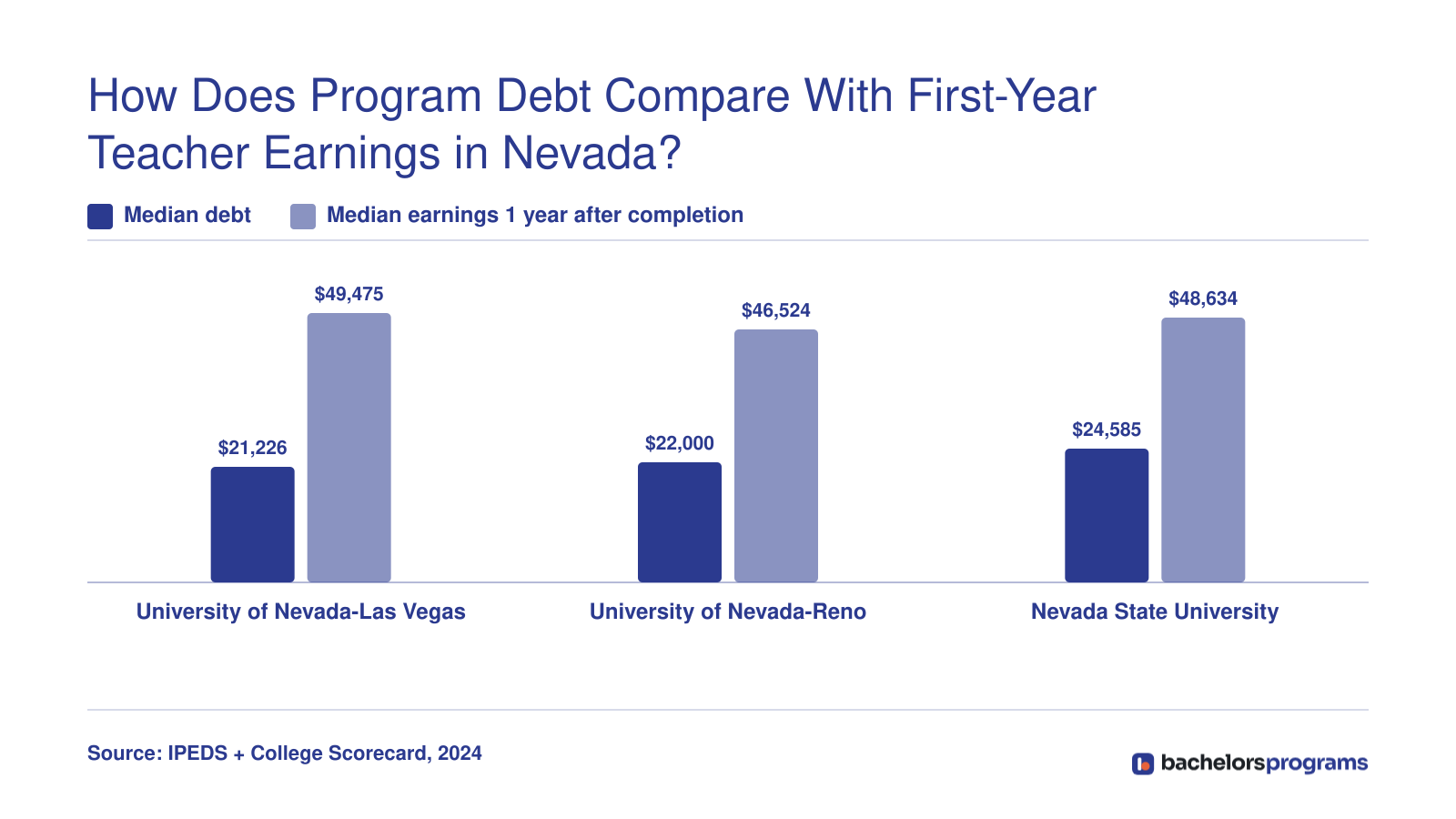
How Does Program Debt Compare With First-Year Teacher Earnings in Nevada?
At the Nevada universities that report both figures, median debt for elementary education bachelor's graduates runs about 43% to 51% of median earnings one year after completion. On a standard 10-year repayment plan, that debt works out to roughly $225 to $261 a month, or about 5.5% to 6.4% of a new teacher's gross monthly pay. That is a manageable load for most first-year teachers, but graduates of the programs with higher debt should budget a little more tightly.
Related Articles
Questions to Ask Yourself
Where do you want to student teach: Clark County, Washoe County, or a rural district?
Do you need part-time or online coursework while working?
Do you want an endorsement such as special education or ESL?
Median Pay for Nevada Elementary Teachers
Nevada employed about 10,300 elementary school teachers when this wage was recorded.
Compare Elementary Education programs on the data that matters
Explore more Education & Teaching majors or browse every field of study.
All Education & Teaching programs Browse every field of study