Best Public Health Schools in Nevada
Compare 3 accredited Public Health programs in Nevada, with net price after aid, graduation rates, earnings and debt from IPEDS and the U.S. College Scorecard.

Which Nevada universities award a bachelor's degree in public health, and what does one cost? The Bachelor of Science (B.S.) in Public Health is the degree to look for, offered at the University of Nevada, Reno and the University of Nevada, Las Vegas. College of Southern Nevada adds dental hygiene. The field is small enough that fit, cost and accreditation matter more than a long comparison list. In-state tuition and fees run from about $4,358 to $11,079 a year, so campus choice alone can more than double the annual bill.
Key Points
- UNLV and University of Nevada-Reno both award a B.S. in Public Health.
- CEPH has accredited UNLV's School of Public Health since June 2013.
- In-state tuition and fees span $4,358 (CSN) to $9,748 (UNLV).
Best Bachelor's in Public Health Schools in Nevada, Ranked
Nevada offers a small but focused set of bachelor's programs in public health, concentrated in Reno and Las Vegas. The three schools below range from a large land-grant research university with a full public health core to a fully online completion degree built for working hygienists. Each entry notes what the school is known for and which students tend to fit best.
University of Nevada-Reno
#1Reno, NV · $16,000/yr (est. net price)
Best for: Students wanting data science health tracks
The University of Nevada, Reno is the state's land-grant research university and the northern anchor for public health study in Nevada. Its public health bachelor's degree builds a 36-credit core in epidemiology, biostatistics, environmental health, and health policy, with suggested tracks in data science, behavioral health sciences, and environmental health. Students benefit from proximity to UNR Med and Renown Health, the region's integrated academic health system, which supports population health research and community service across northern Nevada.
- CEPH-accredited B.S. in Public Health
- 36-credit public health core in epidemiology, biostatistics, and policy
- Suggested tracks include data science and environmental health
- 120 total credits with capstone and practicum options
- 2.0 GPA minimum for the major
University of Nevada-Las Vegas
#2Las Vegas, NV · ~$10,000/yr (est.)
Best for: Las Vegas metro career starters
UNLV is Southern Nevada's largest public research university and the second of the state's two CEPH-accredited public health schools. The B.S. in Public Health splits into three focus areas, social and behavioral health, epidemiology and biostatistics, and environmental and occupational health, and pairs coursework with faculty mentorship and undergraduate research. The School of Public Health stays active in the Las Vegas region, including a community-health innovation partnership announced in 2026, which gives students a metro area full of health systems, nonprofits, and agencies to draw on.
- CEPH-accredited Bachelor of Science in Public Health
- Three focus areas: social/behavioral health, epidemiology, environmental and occupational health
- Faculty mentorship and undergraduate research projects
- Prepares students for health promotion and outreach coordinator roles
- Campus-based program with community engagement opportunities
College of Southern Nevada
#3Las Vegas, NV · $4,400 – $13,000/yr (est.)
Best for: Working dental hygienists finishing online
The College of Southern Nevada is the state's largest community college, with campuses across the Las Vegas valley, and its public health offering is a specialized one rather than a generalist degree. The B.S. in Dental Hygiene with a Public Health concentration is a completion program for registered dental hygienists who want to move into public health, administration, teaching, or research. All coursework is delivered online and can be taken full time or part time, though admission to the dental hygiene program is competitive and limited-entry, so applicants should plan well ahead.
- Completion B.S. for registered dental hygienists
- 100% online, full-time or part-time for working professionals
- Upper-division public health, research, leadership, and teaching courses
- Limited-entry admission with competitive selection
- Accredited by the Northwest Commission on Colleges and Universities
Cost & outcomes by school
Federal data for the highest-earning Public Health programs, independent of the ranking above. Earnings are this field's bachelor's graduates four years after completing where the Scorecard reports them, else the school's undergraduate median.
| School | Net price / yr | Grad rate | Earnings | Debt | Grads/yr | Format |
|---|---|---|---|---|---|---|
| University of Nevada-Reno NV | $15,927 | 61% | $60,614 | $18,922 | 235 | Campus |
| University of Nevada-Las Vegas NV | $10,359 | 51% | $55,037 | $19,450 | — | Campus |
| College of Southern Nevada NV | $6,615 | 19% | $38,087 | $8,000 | — | Campus |
Sources: U.S. Department of Education. Net price, graduation rate, earnings and debt: College Scorecard (earnings and debt for this field's bachelor's graduates where reported, else school-wide); graduates: IPEDS. A dash means no figure is reported.
Cost, debt & payoff
Median earnings of this field's bachelor's graduates (4 yrs after completing, else the school's undergraduate median) vs. their median federal loan debt · U.S. College Scorecard
Across these programs the median graduate earns about $55,037 and finishes with roughly $18,922 in debt — a ratio that clears a common rule of thumb (keep debt below first-year salary). Net price and debt vary widely school to school, so check the per-school figures in the table above before you shortlist.
How We Ranked Nevada's Bachelor's Public Health Schools
University of Nevada, Reno, University of Nevada, Las Vegas and Nevada State University all award public health bachelor's degrees, while College of Southern Nevada covers dental hygiene, so this comparison set is compact and the scores land close together.
The Inputs, in Plain Terms
- Graduation and earnings: federal College Scorecard outcomes showing how many students finish and what they earn a decade after enrolling.
- Net price: average yearly cost after grants and scholarships, not the published sticker price.
- Completions: how many students actually finish the program.
- Accreditation: whether a program holds CEPH standing, or the recognized credential for its own field.
A Caveat Worth Repeating
Graduation rate, net price and 10-year earnings are institution-wide figures. They describe the whole university rather than the public health major, so treat them as a signal about the school, not a promise about your particular degree.
Why the Gaps Stay Narrow
Nevada's market is small, and the distance between one school and the next comes down to modest margins. Format and budget usually decide it: whether you need online or evening classes, and what you can pay after aid. A school sitting a couple of places lower can still be the stronger financial pick once in-state tuition and state grant money are in the picture.
Online and Hybrid Public Health Bachelor's Options at Nevada Schools
What Is Confirmed
The University of Nevada-Las Vegas (B.S. in Public Health) and the University of Nevada-Reno (B.S. in Public Health) are both listed as campus programs.1 The transfer agreements and program pages we reviewed never confirm that either degree can be completed fully online or in a blended format. Treat online or hybrid delivery at either school as unverified until the department confirms it in writing. Some lower-division coursework at Nevada community colleges is offered online4, but that does not make the bachelor's itself an online degree.
Starting at a Community College
College of Southern Nevada students have a mapped route into UNLV. The 2026-2027 pathway pairs an Associate of Arts (60 credits) with upper-division work at UNLV. The earlier 2025-2026 version listed a 2.75 GPA within the public health core. Key details:
- Credit rules: At least 30 upper-division credits must be completed at UNLV, and the old blanket 60-credit transfer cap generally no longer applies.
- Reverse transfer: Students who leave CSN without an associate but with 15 or more CSN credits may use reverse transfer.
- Northern Nevada: A community college associate in Public Health leads into UNLV, and an associate in Community Health Science (Public Health Track) leads into UNR with co-admission available.2 Finish the associate, because changing programs can affect how courses count.
UNR's transfer planning also names other Nevada community colleges3, but we found no public health-specific articulation map for them.
Choosing Online or Campus While Working
Before you commit, ask each department which upper-division public health courses run in the evening or online, and how often. Because at least half your upper-division credits must come from the university, the course schedule, more than the label on the degree, decides whether a full-time job fits.
CEPH Accreditation for a Bachelor's Degree in Public Health in Nevada
Nevada's public health accreditation sits at the school level, not as a separate undergraduate badge. The CEPH Accredited Programs Directory lists the University of Nevada, Las Vegas School of Public Health as accredited from June 8, 2013 through December 31, 2031, and the University of Nevada, Reno School of Public Health as accredited from June 18, 2011 through December 31, 2033.1 Both appear under CEPH's Schools of Public Health category, which covers bachelor's, master's, and doctoral offerings.2 The directory information shown does not separately list either school as a standalone baccalaureate program.1
What CEPH Means for a Bachelor's Student
CEPH accreditation means a school's public health curriculum has been measured against peer standards for faculty, coursework, and student outcomes. Employers recognize it as a quality marker, and it can support later applications to accredited master's and doctoral programs, though each graduate program sets its own admission rules.
CEPH vs. Regional Accreditation
Every degree-granting institution also needs regional accreditation, which is separate from CEPH. If a public health bachelor's program is not CEPH-accredited, confirm the school's regional accreditation, review the required courses, and ask whether the program is in CEPH's applicant or review pipeline before you enroll.
Verify Before You Enroll
Use the CEPH directory to search by institution and state, then check the category, current accreditation dates, and whether the bachelor's degree is included in the accredited unit. Confirm the listing is active for the year you start, not just the year the school last advertised it. The CEPH FAQs on baccalaureate accreditation explain how undergraduate programs fit the review process.2
Admissions Requirements for Nevada Public Health Bachelor's Programs
Getting into a public health bachelor's program in Nevada often happens in two steps: university admission first, then a GPA threshold for the major itself. UNLV spells out both steps most clearly.
Test Scores and GPA
UNLV's 2026 catalog lists an admissible SAT composite of 1120 for tests taken after March 2016 (1040 for earlier tests) or an ACT score of 22. The catalog does not set a single minimum high school GPA. It also does not say whether every applicant must submit scores or whether a separate test-optional rule applies, so confirm that directly with the admissions office.
For University of Nevada-Reno, current SAT/ACT, GPA and transfer figures could not be verified from official pages for this update. Rather than guess, check its admissions site before you plan around any number.
Entering the Public Health Major at UNLV
The B.S. in Public Health has no formal application. Instead, you need to meet these conditions:
- Cumulative GPA: 2.75, which also matches the School of Integrated Health Sciences minimum.
- General education: UNLV's math and science requirements completed.
- Core course GPA: 2.75 across PBH 202, 205, 210, 360 and 365.
The published materials describe no separate public health transfer GPA beyond the university-wide rules.
Transfer and Community College Route
Transfer applicants to UNLV from regionally accredited colleges generally need 24 transferable semester credits and a 2.50 cumulative GPA in them. In-state students who have earned an NSHE associate degree (AA, AS or AB), for example at an institution such as College of Southern Nevada, need only a 2.0 overall GPA for university admission. That makes the associate-then-bachelor's path the lowest GPA bar in the state system. Keep in mind that the major's 2.75 GPA standard still applies once you arrive.
UNLV's revised 50/50 rule no longer generally caps transfer credit from two-year schools at 60, unless a specific college or major sets its own limit. You will still need at least 30 upper-division UNLV credits, and your last 30 credits must be completed in residency.
Policies can change from one admissions cycle to the next, so use each school's admissions page for the current rules before you apply.
How Do Tuition and Net Price Compare at Nevada Public Health Schools?
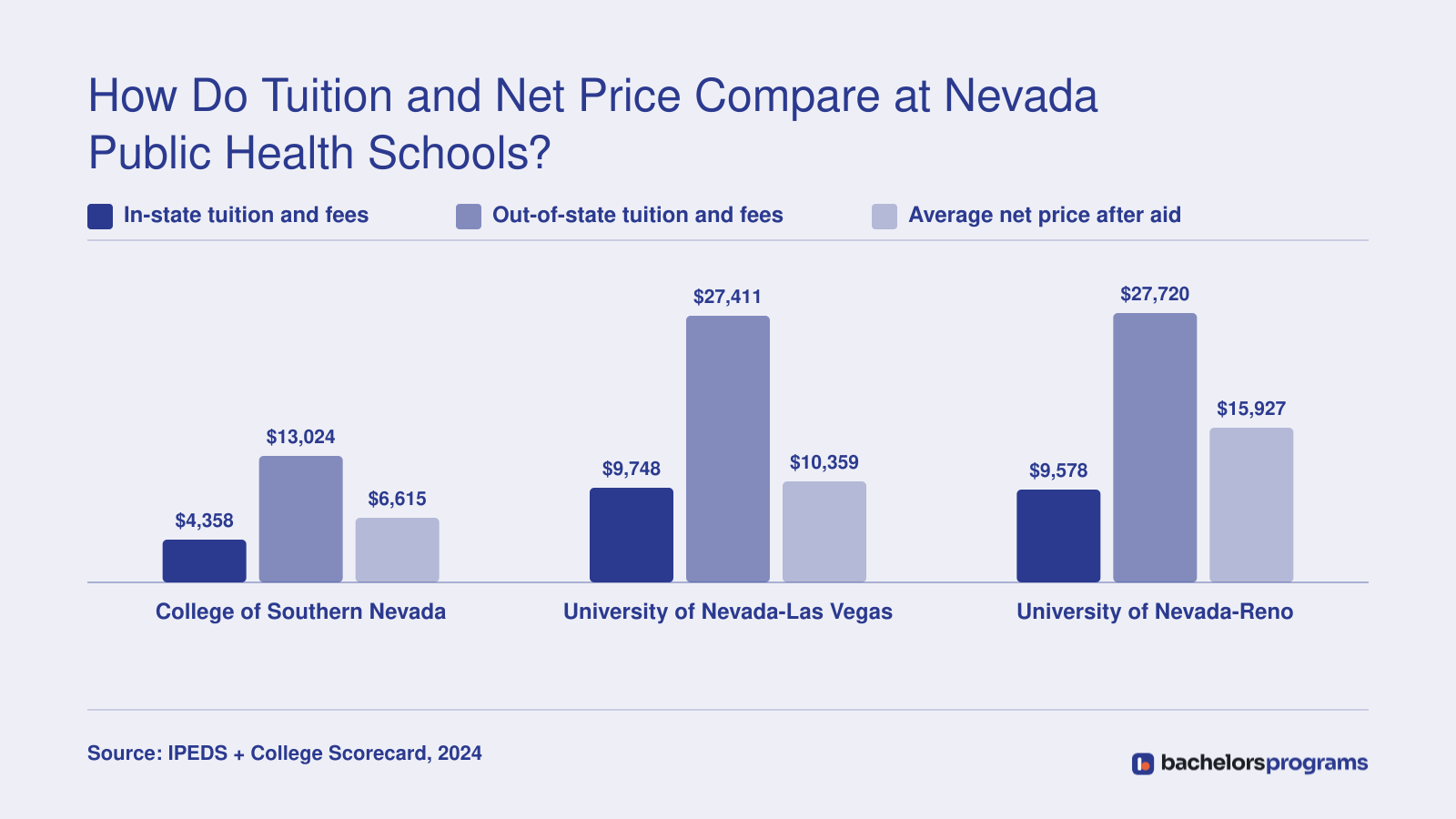
In-state tuition and fees run from $4,358 at College of Southern Nevada to $9,748 at University of Nevada-Las Vegas, and out-of-state students pay roughly three times the in-state rate at each school. Average net price after grants and scholarships ranges from $6,615 at College of Southern Nevada to $15,927 at University of Nevada-Reno. Net price is an institution-wide average for aided undergraduates, not an exact quote for any one student, so run each school's net price calculator for your own estimate.
What a Bachelor's in Public Health Costs in Nevada
College of Southern Nevada carries the lowest net price of the schools ranked here, roughly $6,615 a year once grants and scholarships are applied, even though its published in-state tuition and fees sit near $4,358. UNLV follows at about $10,359 net, and the University of Nevada, Reno sits near $15,927.
Sticker Price: In-State vs. Out-of-State
Nevada's public universities charge nonresidents far more than residents. For 2026-27, UNR lists $11,079 in annual tuition and fees for a resident taking 30 credits ($9,383 base tuition plus $1,696 in mandatory student fees), while a nonresident pays $31,268.1 Students eligible for the Western Undergraduate Exchange land in between at $15,770.1 Published rates at UNLV and CSN show the same pattern: in-state figures run roughly $9,748 and $4,358 respectively, with out-of-state totals near $27,411 and $13,024. If you can establish Nevada residency, or qualify for WUE from a participating Western state, the savings over four years are substantial.
What Students Actually Pay
Pell Grant participation tells you how much of the sticker price gets discounted in practice. At CSN, 88.4 percent of undergraduates receive Pell funding; at UNLV, 69.7 percent; at UNR, 57.5 percent. Median debt at graduation runs about $8,000 for CSN completers, $19,450 at UNLV, and $18,922 at UNR, though those are institution-wide figures covering all majors, not public health graduates alone.
One Practical Way to Cut the Bill
Start at College of Southern Nevada. Complete general education and lower-division coursework at CSN rates, then transfer into the B.S. in Public Health at UNLV or UNR; you finish the same degree and can remove thousands from the total cost.
Nevada Grants and Scholarships That Can Lower the Price
The Silver State Opportunity Grant is Nevada's main need-based award for undergraduates; based on 2025-2026 figures from the Nevada System of Higher Education, it pays up to $5,500 a year toward whatever need remains after other aid.1
Silver State Opportunity Grant
The grant operates through NSHE's community and state colleges, which includes College of Southern Nevada. To qualify, you need a degree or certificate program, at least 12 applicable credits, college readiness in math and English, Nevada residency for tuition purposes, satisfactory academic progress, no prior bachelor's degree, and a FAFSA showing a Student Aid Index of 8,500 or less.1 The award covers remaining need after other aid and resources, capped at $5,500 annually. Money is limited, and students carrying 15 credits with the greatest need are funded first1, so meeting the 12-credit minimum does not guarantee a payment.
Governor Guinn Millennium Scholarship
The Millennium Scholarship provides up to $10,000 in tuition at eligible in-state institutions and can be used for up to six academic years after high school graduation.2 NSHE describes it as up to $10,000 in tuition rather than a fixed annual payment2, so the yearly value can depend on your tuition charges and how much eligibility remains. Confirm the current GPA, coursework, and renewal rules with the Nevada Treasurer's office before you count on it.
Stack aid early
The FAFSA is the gateway to need-based state aid and to many school-specific scholarships at the University of Nevada-Reno, the University of Nevada-Las Vegas, and the College of Southern Nevada. File it as soon as the window opens, then apply for departmental awards in the same cycle so grants, scholarships, and work-study can layer before funds run out.
Related Articles
Questions to Ask Yourself
Do you need an online or hybrid format, or can you attend on campus in Las Vegas or Reno?
Would starting at a Nevada community college and transferring cut your cost enough to matter?
Do you want a program with CEPH accreditation for a later graduate or professional path?
Are you aiming for local government and health district work, or a clinical or other health route?
Compare Public Health programs on the data that matters
Explore more Healthcare majors or browse every field of study.
All Healthcare programs Browse every field of study