Best Business Communications Degree Programs
Compare 30+ accredited Business Communications programs, with net price after aid, graduation rates, earnings and debt from IPEDS and the U.S. College Scorecard.

A business communications bachelor's blends writing, presentation and media work with management and marketing fundamentals. Employers in nearly every sector hire for exactly that: people who can explain complex ideas to clients, regulators and the public.
The pay case is uneven. Federal earnings data for the schools here runs from $46,833 to $75,971 a decade after entry, and average net price after aid stretches from $3,033 to $26,505.
That spread matters more than the diploma's exact title. Hiring managers read the writing samples, the internship record and the presentation reel.
Key Points
- CUNY Baruch College posts the lowest average net price here: $3,033.
- Federal Department of Education outcome data, not brochures, decided each ranking spot.
- Check institutional accreditation first; business-school accreditation is a secondary layer.
Best Business Communications Schools at a Glance: Our Top 10 Picks
This list covers every delivery format, so online, campus and blended programs all appear side by side and first-year students, transfer students and working adults can each find a fit. Net prices are average net price after aid, not a guaranteed quote, and graduation rates are institution-wide figures for the whole school rather than for one major. Each card below gives rank, location, format, average net price after aid and that overall graduation rate.
CUNY Bernard M Baruch College
#1New York, NY · $7,000 – $15,000/yr (est.)
Best for: Corporate communication hopefuls in New York
Baruch College is a public institution in New York City where business and liberal arts coursework meet, and its business communication major draws on both the Weissman School of Arts and Sciences and the Zicklin School of Business. Students choose among three concentrations, including corporate communication and a graphic communication track that adds design production and a senior seminar. A graphic communication internship and independent study options are part of the offering. The college graduates about 72% of students overall.
- 15 credits of program prerequisites in business and marketing
- 12-credit interdisciplinary core in business communication
- 12 credits of required graphic coursework plus a senior seminar
- 6 credits of electives such as typography, branding and UI design
- Graphic Communication Internship available
- Courses span the Weissman and Zicklin schools
- One of three concentration options within the major
- Prepares students for media relations and investor relations
- Career paths include corporate advertising and nonprofit communication
- Built on coursework from both Weissman and Zicklin
Purdue University
#2West Lafayette, IN · ~$15,000/yr (est.)
Best for: Students pairing communication with organizational leadership
Purdue University is a large public research university in West Lafayette, Indiana, and its business communication BA is housed in the Brian Lamb School of Communication. The 120-credit degree covers organizational development, leadership, technology, diversity, team processes and global organizations, with a required experiential component. A Degree in 3 option lets motivated students finish faster, and the university's business partnerships create course-based consulting projects with companies.
- 120 total credit hours
- Degree in 3 option for accelerated completion
- Experiential learning required through internship or project
- 2.67 pre-communication GPA requirement
- Electives include global workplace communication and conflict negotiation
- Core covers leadership, team processes and social network analysis
- Housed in the Brian Lamb School of Communication
University of Wisconsin-Eau Claire
#3Eau Claire, WI · ~$17,000/yr (est.)
Best for: Wisconsin residents seeking local employer connections
The University of Wisconsin-Eau Claire is a public university whose business communication major sits inside its business school and is one of only two such majors in the UW System. Students work through advanced business writing, team-based communication strategies and the Business Writing and Presentations Studio. Internships and connections to Eau Claire-area employers are emphasized, and the subject can also be completed as a certificate.
- 4-year program with no minor required
- Internship experience emphasized
- Business Writing and Presentations Studio for hands-on practice
- Available as a major or a certificate
- Classes primarily in person with some hybrid and online options
Aquinas College
#4Grand Rapids, MI · ~$17,000/yr (est.)
Aquinas College is a private Catholic liberal arts college in Grand Rapids, Michigan, where business communication is built as a dual major in business administration and communication. The 57-hour major pairs accounting, finance, marketing and business law with public speaking, interpersonal, intercultural and organizational communication. A communication lab gives students immediate feedback from upper-level peers, and a case study course applies theory to public relations or business policy problems.
- 57 semester hours in the major
- At least 18 hours must be completed at Aquinas
- Communication courses require a C or better
- Business courses require a C- or better
- Case study course in public relations or business policy
- Communication lab with feedback from upper-level majors
Central Michigan University
#5Mount Pleasant, MI · $18,000/yr (est. net price)
Central Michigan University is a public university in Mount Pleasant offering an applied business communication degree inside general business administration. Coursework covers social media, graphic design and public speaking, with hands-on projects and networking events with business professionals. The program runs on campus and online, admits on a rolling basis for fall or spring starts, and lets students add a Hootsuite social media certification. Students can also live in the Business Residential College.
- 36 credit hours in the major
- On-campus and online formats available
- Rolling admissions with fall or spring starts
- Hootsuite social media management certification available
- Coursework in social media, graphic design and public speaking
- Business Residential College living option
Stephen F. Austin State University
#6Nacogdoches, TX · $14,000/yr (est. net price)
Stephen F. Austin State University is a public university in Nacogdoches, Texas, offering a BBA in business communication and corporate education. The degree combines business communication, business law and general business with training design and presentation skills aimed at corporate training and employee development roles. It is available on campus and online, and transfer partnerships with four Texas community colleges smooth the path for students arriving with credit.
- On-campus and online options
- Combines business communication, business law and general business
- Transfer partnerships with four Texas community colleges
- Focus on training design and employee development
Stevenson University
#7Owings Mills, MD · ~$27,000/yr (est.)
Stevenson University is a private institution in Owings Mills, Maryland, offering a BS or BA in business communication that blends communication, business, writing and design. Students gain client experience through The Mill, a student-run design and communications agency, and required internships have placed students with organizations such as Amazon and the Baltimore Ravens. A capstone and a bachelor's-to-master's option in as little as five years round out the program.
- BS or BA track available
- The Mill, a student-run design and communications agency
- Required internship that satisfies employer expectations
- Capstone project required
- Bachelor's to master's option in as little as five years
- Small classes with hands-on learning
Western Colorado University
#8Gunnison, CO · $16,000/yr (est. net price)
Western Colorado University is a public university in Gunnison offering its business communication BA through the Adult Degree Completion program. The flexible online format is built for returning adults, with no minor required and scholarships aimed at reducing financial barriers. Media literacy, research, editing and writing anchor the curriculum, and students can add study abroad at Harlaxton or business competitions.
- Flexible online delivery for adult learners
- No minor required for Adult Degree Completion majors
- Scholarships tailored to returning adults
- Study abroad at Harlaxton available
- Real-world business competitions
- Skills in media literacy, research, editing and writing
Concordia University-Nebraska
#9Seward, NE · ~$24,000/yr (est.)
Concordia University, Nebraska is a private university in Seward offering a BS in business communication with coursework in marketing, public relations, strategic planning and digital media. Classes are small, averaging about 21.6 students, with a 14:1 student-to-faculty ratio, and the 120-credit degree includes hands-on projects. Graduates move into social media management, content strategy and technical writing.
- 120 total credit hours
- 14:1 student-to-faculty ratio
- Average class size of 21.6
- Coursework in marketing, public relations, strategic planning and digital media
- Career paths include social media manager and content strategist
Millikin University
#10Decatur, IL · ~$22,000/yr (est.)
Millikin University is a private university in Decatur, Illinois, where business communication sits in the Tabor School of Business. The program emphasizes Performance Learning, applying classroom concepts through social media certification, intercultural training seminars and nonprofit projects. Classes average about 20 students, and the school cites more than 180 internship opportunities and 10 or more student-run ventures.
- Performance Learning projects with nonprofits and clients
- Social media certification built into the program
- Intercultural training seminars
- Average class size of 20 students
- 180+ internship opportunities
- 10+ student-run ventures on campus
Cost & outcomes by school
Federal data for the highest-earning Business Communications programs, independent of the ranking above. Earnings are this field's bachelor's graduates four years after completing where the Scorecard reports them, else the school's undergraduate median.
| School | Net price / yr | Grad rate | Earnings | Debt | Grads/yr | Format |
|---|---|---|---|---|---|---|
| University of Southern California CA | $32,740 | 92% | $92,498 | $18,000 | — | Campus |
| Merrimack College MA | $37,927 | 70% | $75,584 | $27,000 | — | Campus |
| University of Scranton PA | $32,568 | 80% | $74,652 | $27,000 | — | Campus |
| University of St Thomas MN | $29,155 | 76% | $73,739 | $23,250 | — | Campus |
| Purdue University IN | $14,600 | 83% | $72,424 | $19,500 | — | Campus |
| CUNY Bernard M Baruch College NY | $3,033 | 72% | $69,215 | $11,640 | 191 | Campus |
| Rockhurst University MO | $25,884 | 75% | $67,102 | $18,250 | — | Campus |
| Washington College MD | $27,898 | 65% | $65,518 | $26,956 | — | Campus |
| Arizona State University AZ | $14,967 | 68% | $62,668 | $19,500 | — | Online or campus |
| Arizona State University AZ | — | — | $62,668 | $19,500 | — | Online or campus |
| Stevenson University MD | $26,505 | 69% | $60,109 | $26,000 | 22 | Campus |
| Oklahoma Wesleyan University OK | $28,358 | 35% | $59,841 | $24,813 | 1 | Campus |
Sources: U.S. Department of Education. Net price, graduation rate, earnings and debt: College Scorecard (earnings and debt for this field's bachelor's graduates where reported, else school-wide); graduates: IPEDS. A dash means no figure is reported.
Cost, debt & payoff
Median earnings of this field's bachelor's graduates (4 yrs after completing, else the school's undergraduate median) vs. their median federal loan debt · U.S. College Scorecard
Across these programs the median graduate earns about $55,874 and finishes with roughly $24,500 in debt — a ratio that clears a common rule of thumb (keep debt below first-year salary). Net price and debt vary widely school to school, so check the per-school figures in the table above before you shortlist.
Behind the List: The Federal Outcome Data That Decided Each Spot
Every college brochure promises strong outcomes, so your choice comes down to whether you trust the pitch or the public record. This list uses the public record. Each spot was decided by federal outcome numbers from the U.S. Department of Education's College Scorecard, not by advertising budgets or admissions marketing.
The Four Signals That Mattered
- Average net price: What students actually pay after grants and scholarships. This figure often lands well below the sticker price.
- Graduation and retention rates: How many students return after their first year and how many finish. Both offer a practical read on how well a school supports students.
- Program-level earnings: What graduates of the communications program earn after completing it, rather than a campus-wide average.
- Median federal debt at completion: The typical federal loan balance a completer carries after graduation, which shapes monthly payments for years.
What the Numbers Can and Cannot Tell You
These figures do not all describe the same group of people. Graduation rates and 10-year earnings cover the entire institution, so they blend engineers, nurses and accountants with communications majors. Program-level earnings and debt describe only students who completed the communications program itself. That makes them more precise, but the Department of Education does not publish them when a program has too few graduates to report reliably. For a smaller program, you may see only institution-wide data. A missing program figure is a good reason to ask the school directly. It is not, by itself, a warning sign.
Why This List Reads Differently
Many "best of" pages are built on affiliate deals or sponsored placements. No school paid to appear here or to move up. Every figure behind a ranking traces back to a public federal dataset, so you can verify it yourself before you apply.
Business Communications Degree Cost, Debt and Monthly Payments
Is a business communications degree worth the money? It depends on what you pay after aid and what that program's graduates earn, so start with net price rather than the published tuition.
Net Price at Public vs. Private Schools
At the public schools here, net price after aid runs from $3,033 at CUNY Baruch College to $16,550 at the University of Wisconsin-Eau Claire. Private schools start higher. Aquinas College averages $16,626, Stevenson University $26,505 and the University of Southern California $32,740. Across the ranked schools, the full range is $3,033 to $32,740.
Program-Level Debt and Monthly Payments
These are program figures, not institution-wide averages. The lowest-debt programs with published numbers are:
- CUNY Baruch College: $11,640 median federal debt at completion, about $123 a month on a 10-year plan.
- Aquinas College: $21,500 median debt, about $228 a month.
- Stevenson University: $26,000 median debt, about $276 a month.
Setting Debt Against Earnings
Median program earnings one year after finishing were $47,880 at Baruch, $49,378 at Aquinas and $41,000 at Stevenson. Annualized, the monthly payments come to roughly 3 percent of first-year earnings at Baruch, 6 percent at Aquinas and 8 percent at Stevenson. For most graduates those payments are manageable, and Baruch pairs a low net price with low debt, the strongest fast-payback case on this list.
Treat the smaller programs with caution. Aquinas and Stevenson report outcomes for small graduating groups, so one year's results can swing. Some schools on the list have no published program-level debt or earnings, and we leave those out rather than borrow a campus-wide figure that describes a different set of graduates.
A Practical Tip
Compare net price, not sticker tuition. A private school with a high published price can land closer to a public option once institutional aid is applied, and the reverse can happen too. Enter your own family income and academic profile in the school's net price calculator, then compare the result with that program's debt and payment figures before you decide.
Lowest Average Net Price Among Ranked Business Communications Schools
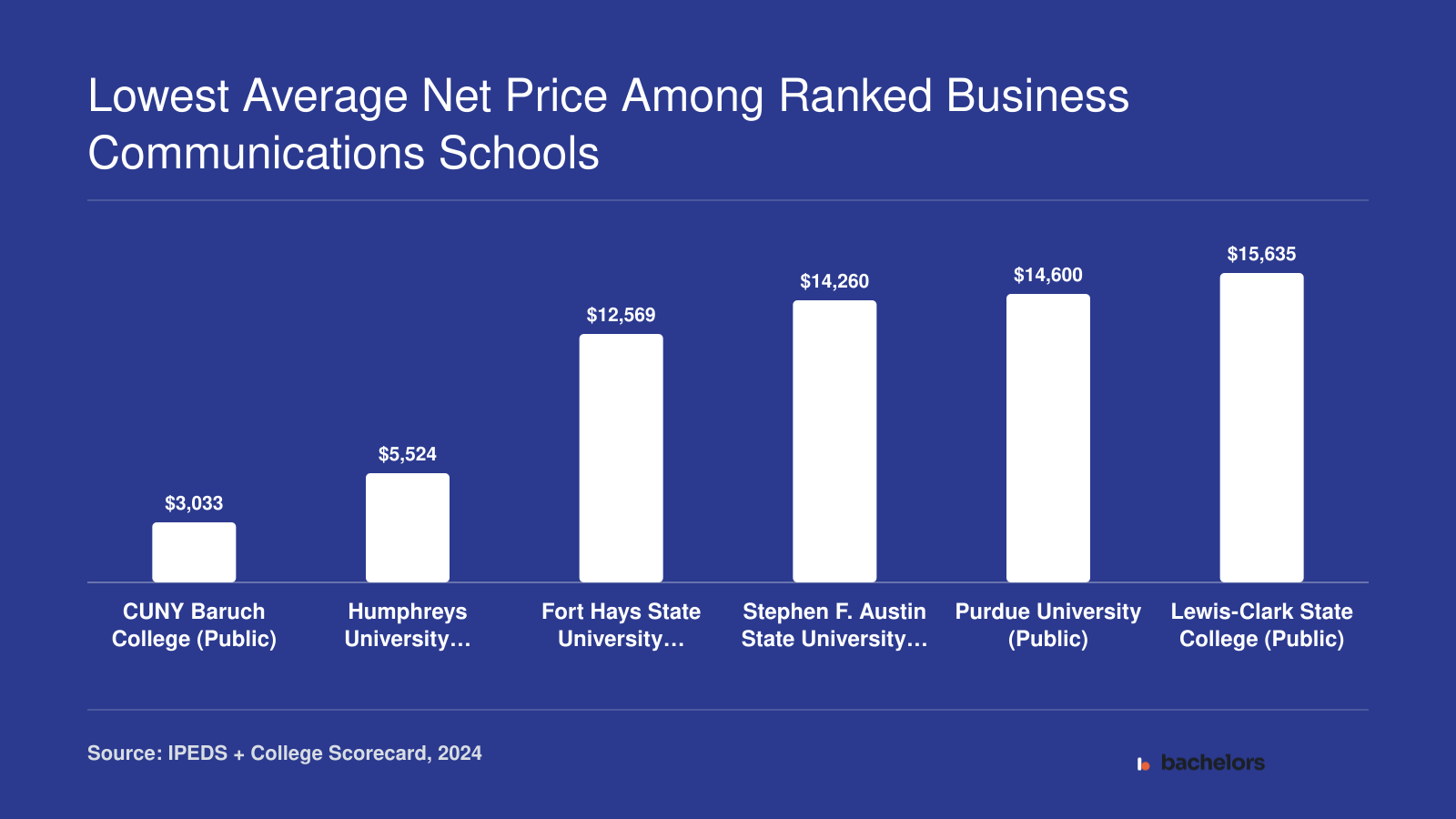
Net price is an institution-wide average of what students paid after grants and scholarships, so your own cost will vary with family income and the aid you receive. Public CUNY Baruch College leads at $3,033, and private nonprofit Humphreys University comes in second at $5,524, ahead of every other public school shown.
Related Articles
Online, Campus or Hybrid: Which Business Communications Format Fits Your Life?
Can you earn a business communications degree entirely online? Yes. Fully online bachelor's programs in the field are well established, and the schools here offer online, campus and dual-format options; the real question is which fits your schedule and your starting credits.
Online: Built Around a Working Schedule
Online suits working adults and transfer students best. Coursework is typically asynchronous or paired with evening live sessions, so a full-time job stays intact. The tradeoff is fewer spontaneous networking moments, so look for virtual internship partnerships, alumni mentoring, and recorded presentation assignments that still build speaking skills. Online programs also tend to be the most transfer-friendly. Old Dominion accepts up to 90 credits toward a 120-credit degree, with 30 that must be earned there. Merrimack takes up to 93 of 124, with 34 in residence. Louisville caps community college credit at 60 and four-year credit at 90 toward 121 credits.
Campus: Practice in the Room
Campus fits first-year students and anyone who learns best in person. You get built-in team presentations, pitch practice, career fairs, and local internship pipelines into marketing and public relations firms. Transfer credit is usually accepted but capped lower, and daytime classes are harder to fit around full-time work.
Hybrid: Flexibility With a Home Base
Dual-format programs let you take general education and electives online and reserve campus time for upper-division seminars, client projects, and presentations.
How Fast You Finish Depends on Your Starting Credits
Students who enter with 30 to 60 credits, often an associate degree, commonly finish in about 18 to 24 months full-time; Merrimack cites that window for qualified transfer students. Accelerated online programs can run from zero credits to a degree in roughly 30 to 36 months, while others take longer: Herzing lists about 36 months and National University about 40 with year-round four-week courses. Part-time study stretches every one of these timelines.
Before applying, working adults should confirm the school offers a true degree-completion pathway rather than an online version of a four-year residential program. Request a written transfer-credit evaluation and the residency minimum in writing, since that minimum caps how much prior coursework actually counts.
Accredited Business Communications Degree Programs: Institutional vs. Business-School Accreditation
A business school's badge can look like the credential that matters, but the accreditation covering the whole college counts for more. Start there, then treat the business-school layer as a secondary check.
Institutional Accreditation Comes First
Institutional accreditation is the non-negotiable layer. It applies to the entire college or university, and it shapes whether you can use federal student aid, how readily other schools consider your credits, and how employers and graduate programs view your degree. To qualify for federal aid, a school generally needs accreditation from an agency the U.S. Department of Education recognizes. CHEA also recognizes accreditors, but that recognition is nongovernmental and does not by itself decide aid eligibility.
You will still see the older word "regional" in some places. The current term is "institutional," and it describes the same type of accreditation. Transfer is never guaranteed, since receiving schools make their own calls, but institutional accreditation is one factor they weigh.
Business-School Accreditation: AACSB, ACBSP and IACBE
These three are programmatic accreditors. They review a business school or its programs, not the whole institution, and they do not replace institutional accreditation. None of them affects federal aid eligibility or guarantees transfer.
- AACSB: Emphasizes faculty qualifications and scholarship, and is often associated with larger research-oriented schools.
- ACBSP: Emphasizes teaching quality and continuous improvement, with a more practitioner-oriented feel.
- IACBE: Emphasizes mission alignment and measured learning outcomes.
This layer applies only when the communications program sits inside a business school. Many strong business communications degrees are housed in communication or liberal arts departments, so the absence of a business-school badge is not a red flag.
Verify It in Two Steps
- Step 1: Confirm the institution in the Department of Education's DAPIP database or in CHEA's directory.
- Step 2: If the degree is offered through a business school, look the school up in the AACSB, ACBSP or IACBE directory.
Business Communications vs. Corporate, Strategic, PR and Marketing Communication Degrees
Colleges give different names to majors that overlap heavily, so a business communication degree at one school can look a lot like a strategic communication or public relations degree at another, and the table below untangles those labels. The clearest split is between business communication, which applies workplace writing, presentations, public speaking and organizational messaging to everyday business settings, and corporate communication, which centers on managing a company's reputation, internal and employee communication, media relations and stakeholder relationships. Rule of thumb: choose business communication for broad workplace skills paired with management and marketing coursework, and choose corporate communication, PR or marketing communication if you want to be the voice of an organization to the public.
| Degree | Typical Home Department | Core Focus | Sample Courses | Common First Jobs |
|---|---|---|---|---|
| Business Communication | Business, communication, or a combined business-and-communication program | Applying communication skills inside business settings: leadership communication, group dynamics, interviewing, conflict management, public speaking, social media and cross-cultural communication | Business and Professional Communication; Organizational Communication; Small Group Communication; Conflict Resolution and Negotiation; Principles of Management; Principles of Marketing | Operations specialist, online merchant, business teacher |
| Corporate Communication | Communication and rhetorical studies or a comparable communication department | Managing a company's reputation and relationships: communication strategy, crisis communication, stakeholder management, branding and identity, media relations, employee and community relations | History of Communication; Strategic Corporate Communication | Entry-level public relations, employee relations, community relations, event planning and corporate communication roles |
| Strategic Communication | Communication studies or a professional-studies communication school | Interdisciplinary, customizable study of persuasion, culture, team leadership, organizational communication, global commerce, corporate branding and crisis communication | Theories of Persuasion; Team Leadership and Decision Making; Global Culture, Commerce, and Communication; Research Seminar; Topics: Crisis Communication | Employee communication, special events, and training and development roles in companies, nonprofits and government agencies |
| Public Relations | A college or department of communication | Theory, research and practice for corporate, nonprofit, public-affairs and media work, emphasizing media relations, digital expression, ethics, crisis communication and campaign strategy | Media Writing; Public Relations Writing; Communication Law; Strategic Crisis Communication; Media Analytics; Senior Portfolio | Public relations, social media, advertising, fundraising, research and lobbying roles |
| Marketing Communication | Communication, marketing, or an interdisciplinary business-and-communication program | Integrating marketing, advertising, public relations, publicity and consumer behavior to support campaigns and organizational messaging | Integrated Marketing Communication; Consumer Behavior; The Advertising Campaign; Event Planning and Publicity; New Media Communication | Marketing communication, advertising, public relations, social media and fundraising roles |
Questions to Ask Yourself
Do you want accounting and management courses built into your degree, or a communication major with business electives?
Are you drawn to internal messaging and leadership communication, or to public-facing PR and brand work?
Could an MBA be in your future, making a business-school-accredited program worth prioritizing?
Will you need a degree-completion pathway that accepts the college credits you already have?
Where the Pay Ceiling Sits for Communications Leaders
A business communications degree can lead to senior leadership, where pay rises well above entry-level roles.
Business Communications programs by state
Compare Business Communications programs on the data that matters
Explore more Communications & Media majors or browse every field of study.
All Communications & Media programs Browse every field of study