Best Online Business Communication Degree Programs
Compare 90+ accredited online Communication programs, with net price after aid, graduation rates, earnings and debt from IPEDS and the U.S. College Scorecard.

Communication work inside companies has moved from the margins of the org chart to the center of change management, and the degrees that train for it have followed. Many programs that call themselves online still schedule campus residencies or hybrid weekends; the ones ranked here do not.
Cost is the harder variable. Average net price after grants and scholarships runs from roughly $9,300 to $36,200 a year across the schools on this list, an average rather than a quote, and it swings with state residency and aid packaging. A program you can finish without a plane ticket can still cost more than a flagship state campus.
Key Points
- Every program ranked here is 100% online, with no campus residencies.
- National University posts the highest first-year median earnings among ranked programs.
- BLS projects 11% growth for training and development specialists, 2025 to 2035.
Top 10 Fully Online Business Communication Degree Programs
Every program in this ranking can be completed 100% online, with no campus visits, hybrid weekends, or residency requirements. The ten schools are ordered by a blended quality composite rather than any single number, and each one enrolls students from across the country. Program details come from institutional records and federal data.
National University
#1San Diego, CA · ~$23,000/yr (est.)
Best for: Working adults wanting four-week terms
National University built its reputation on short, sequential courses for working adults, and that format carries directly into its online communication degree. Students choose between Strategic Communication, aimed at public relations, advertising, and campaign work, and Creative Communication, which leans into writing, storytelling, and digital media. Enrollment runs year-round with rolling admissions and generous transfer credit. The school's graduation rate is 43%.
- Strategic Communication and Creative Communication concentrations
- Finish in as few as 40 months with 4-week course terms
- 180 total credit hours required
- No entrance exam and no application fee
- Capstone e-portfolio required
- Rolling admissions with transfer credits accepted
- Yellow Ribbon tuition discounts for military students
Loyola University New Orleans
#2New Orleans, LA · ~$24,000/yr (est.)
Best for: PR and brand-strategy career changers
Loyola University New Orleans runs its communication degree entirely online while keeping the faculty attention and portfolio expectations of a campus program. Core coursework covers writing, digital media, social media strategy, and media law, paired with 12 credits of electives students use to specialize in areas such as sports promotion, podcasting, or television news producing. The program holds ACEJMC accreditation, a field-specific mark that employers in journalism and public relations recognize. The school's graduation rate is 59%.
- Accredited by ACEJMC
- Transfer up to 90 credits
- 120 total credit hours
- 12 credits of electives to tailor the degree
- Four concentration options
- Build a digital portfolio before graduating
- 100% online coursework
Wilmington University
#3New Castle, DE · ~$16,000/yr (est.)
Best for: Budget-conscious adult learners
Wilmington University is a career-focused institution in New Castle, Delaware, with classes that start every eight weeks and a long history of serving working adults. Its communication degree requires a cooperative learning experience, so students finish with work samples and professional contacts rather than coursework alone. Students can also fold a Technical Communicator certification into the degree. The school's graduation rate is 20%.
- Digital Journalism, Public Relations and Strategic Communication, Visual Communication tracks
- Required cooperative learning experience
- Technical Communicator certification included in the degree
- 120 total credit hours across 40 courses
- Classes start every 8 weeks
- $1,317 per course
- Dual-credit accelerated options available
University of New Hampshire College of Professional Studies Online
#4Manchester, NH · ~$11,000/yr (est.)
The University of New Hampshire's College of Professional Studies Online is built for adults returning to finish a bachelor's degree, and its professional communication option centers on workplace fluency. Coursework covers team collaboration, conflict resolution, diversity and inclusion, and strategic messaging, including a course on using AI in workplace communication. Students can transfer up to 90 credits or earn credit for prior learning, and a capstone ties the degree together. The school's graduation rate is 30%.
- Interpersonal and Organizational Communication option
- 8-week terms, fully online, rolling admissions
- Transfer up to 90 credits plus credit for prior learning
- 120 total credit hours across 26 courses
- Capstone required; no GMAT or GRE required
- Regionally accredited by NECHE
- Coursework includes Leveraging AI in Workplace Communication
Concordia University-Wisconsin
#5Mequon, WI · ~$36,000/yr (est.)
Concordia University Wisconsin frames its online communication degree around servant leadership, pairing communication coursework with ethical decision-making and cultural awareness. The program is designed for working adults, delivered in eight-week online modules, and accepts up to 84 transfer credits. An accelerated MBA Fast-Track option lets strong students continue straight into graduate business study. The school's graduation rate is 68%.
- Faith-centered program with a Christian servant leadership focus
- $500 per credit; 120 total credit hours
- Transfer up to 84 credits
- 8-week online modules with start dates every eight weeks
- MBA Fast-Track option available
- No-cost application
Florida International University
#6Miami, FL · ~$9,000/yr (est.)
Florida International University is a large public research university in Miami, and its communication arts degree draws on more than 70 courses spanning traditional and digital media. The Organizational Communication track is the closest fit for business-facing roles in corporate, government, and nonprofit settings. Students build a professional portfolio and study ethical and global communication throughout. The school's graduation rate is 74%.
- Organizational Communication track available
- Additional tracks in Art + Performance and Media + Design Studies
- More than 70 courses available
- Portfolio of professional work built
- Ethical foundations and global communication emphasized
- Web-based, interactive, digital focus
Thomas Edison State University
#7Trenton, NJ · $5,000 – $10,000/yr (est.)
Thomas Edison State University exists specifically for adults who arrive with credits already in hand, and its online communications degree reflects that mission. Prior learning assessment, military training credit, and transfer policies are built into the path, and multiple start dates keep enrollment flexible. The program also sets up a direct route into a master's degree. Coursework spans communication theory, mass communication, and digital age communication.
- 120 total credit hours
- Credit for prior learning and military experience
- Multiple start dates throughout the year
- B.A. to Master's pathway
- Generous transfer credit options
- Courses in Communication Theory and Digital Age Communication
Waldorf University
#8Forest City, IA · ~$20,000/yr (est.)
Waldorf University blends communication study with business and psychology, which suits students aiming at management rather than media production alone. Professional electives range across graphic design, public relations, web design, and television or film, and students work in Adobe Creative Cloud. The program requires 120 credits, including 36 upper-division hours, and closes with a senior capstone. The school's graduation rate is 21%.
- Curriculum blends communication, business, and psychology
- Electives in graphic design, PR, web design, and television or film
- Adobe Creative Cloud required
- 120 total credit hours, including 36 upper-division credits
- Capstone required
- 2.0 GPA minimum with a minimum C in major courses
University of Oklahoma
#9Norman, OK · $15,000 – $20,000/yr (est.)
The University of Oklahoma offers its communication degree as a 120-credit completion program for transfer students and working professionals, taught in asynchronous eight-week courses. Coursework spans public speaking, strategic message design, research methods, media literacy, organizational communication, and persuasion, ending in a capstone. Employer tuition reimbursement is supported, and graduates join an alumni network of more than 250,000. The school's graduation rate is 75%.
- $550 per credit; 120 total credit hours
- Asynchronous 8-week online courses
- Designed as a transfer-friendly degree completion program
- Capstone required
- 2.5 GPA minimum; $50 application fee
- Global alumni network of 250,000+
- Employer tuition reimbursement supported
American Public University System
#10Charles Town, WV · $5,000 – $10,000/yr (est.)
American Public University System serves a large share of military and public-sector learners, and its online communication degree is structured around that audience. Students pick between Digital Communication and Media Design and Strategic Communication, with core work in ethics, theory, research, and social media. A capstone pulls the coursework together into a portfolio-ready project. The school's graduation rate is 57%.
- Concentrations in Digital Communication and Media Design or Strategic Communication
- 120 total credit hours with a capstone
- Coursework in communication ethics, theory, and social media
- Public speaking, mass communication, and small group and interpersonal courses
- Prepares students for public and private sector communication roles
Cost & outcomes by school
Federal data for the highest-earning Communication programs, independent of the ranking above. Earnings are this field's bachelor's graduates four years after completing where the Scorecard reports them, else the school's undergraduate median.
| School | Net price / yr | Grad rate | Earnings | Debt | Grads/yr | Format |
|---|---|---|---|---|---|---|
| Florida International University FL | $9,288 | 74% | $60,249 | $16,500 | — | Online |
Sources: U.S. Department of Education. Net price, graduation rate, earnings and debt: College Scorecard (earnings and debt for this field's bachelor's graduates where reported, else school-wide); graduates: IPEDS. A dash means no figure is reported.
Cost, debt & payoff
Median earnings of this field's bachelor's graduates (4 yrs after completing, else the school's undergraduate median) vs. their median federal loan debt · U.S. College Scorecard
Across these programs the median graduate earns about $54,947 and finishes with roughly $23,250 in debt — a ratio that clears a common rule of thumb (keep debt below first-year salary). Net price and debt vary widely school to school, so check the per-school figures in the table above before you shortlist.
How We Ranked These 100% Online Programs
Fully online and "online-friendly" are not the same thing. Many programs advertise remote coursework but still require campus residencies, in-person sessions, or hybrid formats. We removed those before any scoring began, so every program on this list can be completed without setting foot on campus.
What Went Into the Score
Each remaining program received a composite score built from four inputs:
- Net price after aid: what students pay on average once grants and scholarships are subtracted, not the sticker tuition.
- Graduation rate: the share of students who finish at the institution.
- Earnings and debt: College Scorecard program-level figures for graduates, used where they are published.
- Retention: how many first-year students return for a second year, a signal of satisfaction and support.
What the Numbers Can't Tell You
The completion and cost figures are institution-wide. They describe the whole school, including its on-campus undergraduates, rather than the business communication program alone. A university with a strong overall completion rate may still have a program that performs differently. Earnings and debt figures are also limited to programs with enough graduates for the federal government to report.
Verify Before You Apply
Our data reflects the latest College Scorecard snapshot, which trails current conditions. Before you apply, confirm accreditation status and current tuition directly with each school's admissions or billing office. Use the ranking as a well-informed starting point for your shortlist, not a final verdict.
What an Online Business Communication Degree Costs: Net Price Compared
Net price is the average yearly cost after grants and scholarships, reported in federal data for students who receive aid. It is an average, not a quote, and your bill will depend on your income, aid package, and enrollment pattern. The debt figure below covers each school's undergraduates as a whole, not only communication majors. Published rates at large online providers show how pricing models change the math. ASU Online lists $580 per credit for 2026-27, plus program fees and a $200 Advanced Technology fee. Penn State World Campus charges $644 per credit below 12 credits for students with 59 or fewer accumulated credits ($692 at 60 or more), or a flat $7,833 per semester for 12 to 19 credits ($8,455 at 60 or more). WGU's B.S. in Communications uses a competency-based model at $3,850 per six-month term plus a $200 e-books and resources fee, with no cap on the courses you finish in a term. Under that model, finishing faster lowers your total. WGU notes that new rates apply to terms starting on or after October 1, 2026, so confirm the current figure. Practical tip: multiply the per-credit rate by the credits you still need after transfer. For example, 60 remaining credits at $580 comes to $34,800 before fees.
| School | Program | Avg. Net Price per Year | Published Tuition (In-State / Out-of-State) | Median Debt (Institution-Wide) |
|---|---|---|---|---|
| Eastern New Mexico University | Communication | $4,904 | $7,074 / $9,054 | $16,500 |
| University of Maine at Presque Isle | English, B.A. (Professional Communication & Journalism) | $7,035 | $9,402 / $14,862 | $16,000 |
| Purdue University Global | Bachelor of Science in Communication (Business Foundations) | $7,770 | $10,101 / $14,412 | $26,078 |
| Florida International University | Communication Arts (Organizational Communication) | $9,288 | $6,565 / $18,964 | $16,500 |
| American Public University System | Bachelor of Arts in Communication | $9,597 | $8,400 / $8,400 | $21,743 |
| University of Illinois Springfield | Communication, BA | $9,833 | $12,557 / $20,139 | $19,128 |
| University of New Hampshire College of Professional Studies Online | Professional Communication: Interpersonal and Organizational Communication | $10,864 | $7,724 / $9,284 | $26,814 |
| Eastern Kentucky University | Communication Studies, B.A. | $11,040 | $10,320 / $21,230 | $22,500 |
| Valley City State University | Communication | $11,890 | $8,580 / $13,544 | $20,369 |
| Western Governors University | Bachelor of Science in Communications | $12,548 | $8,658 / $8,658 | $11,116 |
Business Communication vs. Business Administration vs. Strategic Communication
The real decision is not among three majors but between two centers of gravity: a degree built around writing, speaking, and relationships, or one built around ledgers and operations. The label on the diploma matters less than which side of that line most of your credits fall on.
What a Business Communication Degree Emphasizes
Business communication majors spend the bulk of their coursework on writing, presentations, organizational and interpersonal communication, public relations, and often persuasion or media courses. Business classes such as management principles, marketing, and economics support that core. A business administration degree inverts the ratio: accounting, finance, management, operations, and business law come first, with communication treated as a supporting skill.
Three Labels You Will See
- Business or professional communication major: usually housed in a communication department, with a business minor or a built-in cluster of business courses.
- Business degree with a communication concentration: an administration or management major plus upper-level communication electives.
- General or strategic communication degree with business electives: the most flexible and least business-heavy option; strategic communication leans toward PR, branding, and messaging campaigns.
The Trade-off
Business-heavy programs suit management, sales, and operations tracks, and they read well to recruiters who screen for quantitative coursework. Communication-heavy programs suit public relations, internal communications, content, and client-facing roles, where a writing sample and portfolio do more talking than a transcript.
Check the Credit Split Before You Enroll
Request the degree map or eight-semester plan and count for yourself. If a program markets itself as business communication but most of its credits are general business courses, you are effectively buying a business degree with a communication flavor. If only a handful of credits are business, plan on building financial vocabulary on the job. Match the mix to the job title you actually want.
Related Articles
Accreditation Explained: Regional, AACSB, ACBSP, and IACBE
Institutional (regional) accreditation is the non-negotiable baseline. Without it, a degree may not qualify for federal financial aid, and credits may not transfer to other schools. AACSB, ACBSP, and IACBE are business-school accreditors. They matter mainly when your communication degree is housed in a business school or carries a business concentration, and they add a second layer of quality assurance on top of institutional status.
| Accreditation type | What it accredits | Focus | Recognition | How to verify |
|---|---|---|---|---|
| Institutional (regional) | Whole universities, academies, and institutes offering undergraduate, graduate, and postgraduate degrees | Whether the institution or program meets acceptable levels of educational quality, reviewed through peer review | The U.S. Department of Education recognizes accrediting agencies and publishes a master list of accredited institutions. CHEA treats institutional accreditation separately from programmatic accreditation. | Search the Department of Education's DAPIP database, then cross-check the CHEA directory |
| AACSB | An institution or a single business unit within a larger institution. Institutional accreditation is the default and can cover all business degrees unless some are excluded. | Continuous improvement and impact: mission alignment, adequate resources, and assurance of learning showing students reach stated competencies | Programmatic business accreditor. Confirm current status in CHEA's programmatic accreditor listing. | Use AACSB's member-school directory and check the scope of accreditation listed for the school |
| ACBSP | Business programs, as a programmatic (not institutional) accreditation | Program-level quality in business education. Review its published standards for specifics. | CHEA's programmatic listing did not include a specific ACBSP recognition statement in the excerpt we reviewed. Confirm status directly with CHEA. | Use ACBSP's member search, then confirm the school's institutional accreditation in DAPIP |
| IACBE | Business, accounting, and business-related programs at the associate, bachelor's, master's, and doctoral levels | Mission-driven and outcomes-based: evaluates teaching-learning processes and results against the business unit's mission, not prescriptive resource standards. Includes a self-study and an independent peer-review site visit. | Programmatic business accreditor. Confirm current status in CHEA's programmatic accreditor listing. | Use the IACBE directory of accredited institutions and programs |
What Business Communication Careers Pay
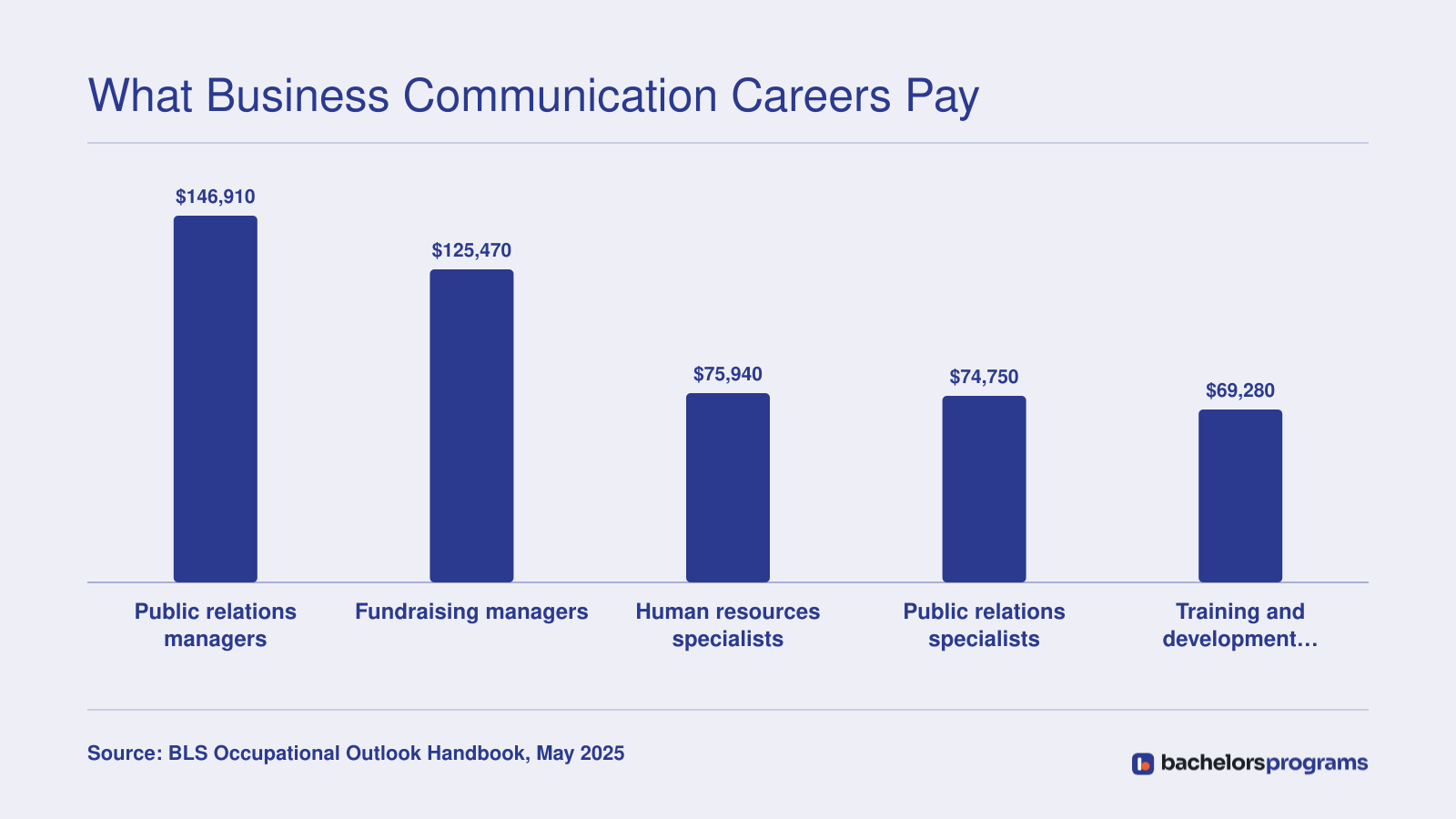
These are May 2025 median annual wages from the BLS Occupational Outlook Handbook for everyone working in each occupation, not earnings reported for graduates of the programs ranked here. Projected growth for 2025-2035 is 11% for training and development specialists (much faster than average), 6% for human resources specialists, 6% for public relations and fundraising managers as one combined category, and 2% for public relations specialists (slower than average). BLS publishes separate wage medians for public relations managers and fundraising managers, so each appears as its own bar rather than as one shared manager figure.
Early-Career Earnings Standout
National University posts the highest first-year median earnings of the online programs ranked here.
How Long It Takes: Completion Time, Transfer Credits, and Online Formats
A bachelor's degree in this field runs 120 credit hours at most schools, which is roughly four years of full-time study. ASU Online's communication degrees, Penn State World Campus's organizational and professional communication programs, and Loyola University New Orleans, Wilmington University, Concordia University Wisconsin, the University of Oklahoma, and American Public University all list 120 credits. National University is the outlier among the programs here, listing 180 total credit hours on a quarter-credit system across a 40-month plan.
Three Formats, Three Different Clocks
- Competency-based, self-paced: Western Governors University's communications degree is built from 38 courses with no set class times, and students finish each course by demonstrating competency. Motivated students who already know the material can move faster than a calendar-based term allows.
- Eight-week accelerated terms: Wilmington University starts classes every eight weeks, and Concordia Wisconsin, the University of New Hampshire's online professional communication major, and the University of Oklahoma all run eight-week terms. Doubling up two courses per term keeps you on a full-time pace while handling one subject at a time. National University uses even shorter four-week courses.
- Traditional 15 to 16 week semesters: Penn State World Campus and ASU Online follow a conventional semester rhythm. Most coursework in these online programs is asynchronous (Oklahoma states this explicitly), though individual courses may schedule live sessions, so confirm with an adviser before you enroll.
Transfer Credit Policies Vary Widely
Caps differ by school. Loyola New Orleans and UNH both accept up to 90 transfer credits; Concordia Wisconsin accepts up to 84. Penn State publishes no flat maximum; the number of credits you need depends on which courses transfer, and an adviser maps the remainder after admission. Penn State's strategic communications degree also allows up to six communication credits by portfolio. ASU treats applicants with 12 or more transferable credits as transfer students. UNH and Thomas Edison State University both evaluate prior learning and military training for credit, and National University accepts military benefits.
A Realistic Two-Year Example
Consider an associate degree holder with 60 credits. At a school accepting 90, those credits apply and the remaining 60 can be finished in about two years full time, or faster in eight-week terms. WGU unofficially estimates an associate degree covers 14 of its 38 courses, leaving 27, though that figure is not guaranteed and depends on your specific coursework. A.A. and A.S. graduates there typically qualify for upper-division standing.
How to Choose the Right Online Business Communication Program
Online business communication degrees now differ less by coursework than by the capstone, portfolio, or internship that sits at the end of them.
Start With the Career You Want
If you are aiming at public relations or corporate communications, favor communication-heavy programs that hand you a portfolio you can show employers. At USC Aiken, the communication capstone requires a portfolio or ePortfolio plus one of four approved paths: an internship, a professional project, a research project, or a media project. Colorado State University Online requires an internship of at least one credit, supervised by communication professionals, alongside a web-based portfolio. If management, HR, or operations is the goal, a business-concentration program such as Lenoir-Rhyne's Professional Studies B.S. puts more weight on the business side.
Check Whether the Capstone Fits Your Job
Ask directly whether the final requirement can be completed remotely or at your current employer. USC Aiken recommends its professional project for online students working full time. It requires employer collaboration and agreement on a substantive project; students log 80 hours during the enrolled term, and enrollment is blocked until the capstone director approves the plan. UW-Extension capstone students consult for a partner organization, and some projects can use a current workplace; work happens onsite or remotely as the host needs. At WGU the applied learning capstone is fully online and builds a professional portfolio, while internships stay optional.
Compare Net Price and Schedule
Weigh budget by net price and the 10-year monthly payment figure, not sticker tuition. Working adults should prioritize fully asynchronous formats with no live sessions and short terms.
Confirm Before You Apply
Request information from two or three shortlisted schools and ask for a transfer credit evaluation before you apply.
Communication programs by state
Compare Communication programs on the data that matters
Explore more Business & Management majors or browse every field of study.
All Business & Management programs Browse every field of study