Best Construction Management Schools in Connecticut
Compare 3 accredited Construction Management programs in Connecticut, with net price after aid, graduation rates, earnings and debt from IPEDS and the U.S. College Scorecard.

Is a bachelor's degree in construction management worth pursuing in Connecticut, where the work spans commercial buildings, infrastructure and residential projects? The state employed 5,719 construction managers in 2026, and the typical route into the field is a Bachelor of Science (B.S.) in Construction Management.
The real tension is cost. Published tuition and fees at University of Hartford and Sacred Heart University run roughly $49,000 to $50,000 a year, while Central Connecticut State University is a public school with a very different price structure.
What families actually pay after aid, not the sticker price, is what separates these programs in practice.
Key Points
- University of Hartford's $30,282 net price sits $18,793 below its sticker.
- Every construction management program on this list is delivered on campus.
- Connecticut's Department of Consumer Protection issues no "construction manager" license.
Best Bachelor's in Construction Management Schools in Connecticut, Ranked
Three Connecticut institutions anchor this list, and what separates the top-ranked school from the rest is straightforward: it runs the longest-established program of the three, it carries the lowest net price after aid, and it graduates the largest cohorts. The other two are newer entries, one already enrolling students and one preparing its first class, both built around industry partnerships and technology coursework.
Central Connecticut State University
#1New Britain, CT · ~$17,000/yr (est.)
Best for: Connecticut residents wanting an established public program
Central Connecticut State University in New Britain runs the state's most established construction management bachelor's degree, a B.S. that pairs estimating, scheduling and project management coursework with lab work, field trips and a required internship, all delivered on campus. It is a public university with the lowest net price after aid on this list, and schools offering this program have graduation rates of 48%. The program describes itself as ACCE-accredited, but that status could not be confirmed from the sources reviewed here, so verify it directly with the department before you apply. Graduates who received federal aid earned a median of $65,470 one year after entry and $93,908 four years after entry, with median debt of about $22,300.
- Program describes itself as ACCE-accredited; confirm current status with the department
- Required internship plus lab experiences, field trips and student clubs
- Coursework spans estimating, scheduling, superintendency and project management
- Entry roles include assistant superintendent, project engineer and junior estimator
- Training in current computer applications applied to real construction processes
- Free on-campus child care available to enrolled students
Sacred Heart University
#2Fairfield, CT · ~$46,000/yr (est.)
Best for: Business-minded students wanting a management minor
Sacred Heart University in Fairfield pairs its on-campus construction management B.S. with a required business minor, so students leave with cost control, contracts and risk management coursework layered onto a management core. The program is new, with its first cohort scheduled for fall 2027, and it has been built with input from regional contractors expected to supply internships, co-ops and job shadowing. Schools offering this program have graduation rates of 73%. The curriculum is described as aligned with ACCE standards, but it is not listed as an accredited program in the sources reviewed here, so treat accreditation as unconfirmed and ask the department directly.
- Requires a business minor alongside the construction management core
- First cohort scheduled to launch in fall 2027
- Covers safety, estimating, cost control, scheduling, contracts, risk and sustainability
- Dual degree option lets students begin an MBA while completing the bachelor's
- Industry partners support internships, co-ops, job shadowing and advisory board input
- Small classes with faculty mentorship
University of Hartford
#3West Hartford, CT · $30,000/yr (est. net price)
Best for: Technology-focused learners drawn to BIM coursework
The University of Hartford houses its construction management degree in the College of Engineering, Technology and Architecture, and the 127-credit B.S. in Construction Management + Technology leans heavily on digital tools, including building information modeling. A required internship and a two-semester senior project give students applied experience before graduation, and coursework in accounting, management and engineering economics rounds out the business side. Schools offering this program have graduation rates of 54%. No ACCE accreditation is on record for this program in the sources reviewed here, and the university does not present it as accredited, so confirm status with the department.
- 127-credit program within the College of Engineering, Technology, and Architecture
- Building information modeling (BIM) coursework built into the curriculum
- Required construction internship plus a two-semester senior project
- Covers soils and foundations, structural analysis and environmental systems
- Includes construction safety, law, planning, scheduling and negotiations
- Accounting, management and engineering economics integrated into the degree
Cost & outcomes by school
Federal data for the highest-earning Construction Management programs, independent of the ranking above. Earnings are this field's bachelor's graduates four years after completing where the Scorecard reports them, else the school's undergraduate median.
| School | Net price / yr | Grad rate | Earnings | Debt | Grads/yr | Format |
|---|---|---|---|---|---|---|
| Central Connecticut State University CT | $16,857 | 48% | $93,908 | $20,239 | 36 | Campus |
| Sacred Heart University CT | $46,174 | 74% | $75,059 | $25,000 | — | Campus |
| University of Hartford CT | $30,282 | 54% | $60,823 | $27,000 | — | Campus |
Sources: U.S. Department of Education. Net price, graduation rate, earnings and debt: College Scorecard (earnings and debt for this field's bachelor's graduates where reported, else school-wide); graduates: IPEDS. A dash means no figure is reported.
Cost, debt & payoff
Median earnings of this field's bachelor's graduates (4 yrs after completing, else the school's undergraduate median) vs. their median federal loan debt · U.S. College Scorecard
Across these programs the median graduate earns about $75,059 and finishes with roughly $25,000 in debt — a ratio that clears a common rule of thumb (keep debt below first-year salary). Net price and debt vary widely school to school, so check the per-school figures in the table above before you shortlist.
How We Ranked Connecticut Construction Management Schools
Most of the numbers behind this ranking come from College Scorecard, the U.S. Department of Education's public data file, in its latest release.
What the Numbers Measure
We weigh the figures a family can actually act on: net price after grants and scholarships, graduation rate, earnings a few years after students enter, typical debt at completion, and the number of bachelor's degrees a school awards in construction management and related building fields. Completions count because a program that graduates students steadily is usually one with stable faculty and steady industry demand.
ACCE Accreditation as the First Check
Construction management has its own programmatic accreditor, the American Council for Construction Education. ACCE reviews curriculum, faculty, facilities, and industry advisory input. Employers hiring for internships and project engineer roles often recognize accredited degrees, and some certifications and graduate pathways point back to it. A program without ACCE accreditation is not automatically out, but it has to clear a higher bar on outcomes.
Where the Averages Stop
Net price and graduation rate are institution-wide averages, not construction-management-only figures; a university's overall rate blends every major on campus. Program-level earnings and debt, where published, cover only some programs, so we read them as a signal rather than a precise forecast for any one graduate.
The ranking covers Connecticut-based bachelor's programs only, campus and online, for students who want to study in the state or earn a Connecticut degree from a distance.
Online and Hybrid Construction Management Bachelor's Options at Connecticut Schools
Campus Delivery Is the Norm
Every program on this list is delivered on campus. Central Connecticut State University's Construction Management, BS in New Britain is a campus-based program built around lab work, field trips, student clubs and a required internship. Sacred Heart University's construction management B.S. in Fairfield and the University of Hartford's Construction Management + Technology program in West Hartford are also campus programs. Neither school's program page spells out a hybrid or fully online track. If you need remote coursework, ask the admissions office directly before you apply.
What Flexibility Looks Like at CCSU
CCSU does not describe its degree as online or formally hybrid, and lists no online degree-completion option. It does offer part-time study, including later-afternoon and evening courses. Its curriculum sheet requires 30 credits in residence, with at least 15 of those in the major, and defines "in residence" as attending classes on campus or under Central's supervision. That wording leaves some room, but plan on regular trips to New Britain.
The hands-on parts of the degree are hard to move online anyway. Labs, field trips and the internship happen in person, which helps explain why these programs lean toward campus delivery.
Who Benefits from a Flexible Schedule
- Working tradespeople: Carpenters, electricians and field crews finishing a degree can use CCSU's evening and part-time options to keep earning while they study.
- Transfer students: If you already hold credits, ask how many will count and how the residency rule applies to you.
- Career changers: If you're new to job sites, the in-person labs and internship are where you'll build the most practical experience.
Admissions: GPA, Test Policy, and Transfer Credit
Admission rules at Connecticut construction management schools center on transfer applicants, with GPA floors and test exemptions tied to prior college credit. The table below summarizes what each school's admissions pages state. For Sacred Heart University, confirm GPA, testing, and transfer rules directly with its admissions office. Practical tip: if you plan to start at a community college, ask for a course-by-course transfer evaluation before you enroll so you know which credits will count toward the B.S. in Construction Management.
| School | GPA Expectations | Test Policy | Transfer and Articulation Pathways |
|---|---|---|---|
| Central Connecticut State University | Transfer applicants typically need a C average or better after completing at least 12 college-level credits from a regionally accredited institution | SAT or ACT not required for applicants who have completed more than 12 college-level credits or have been out of school for more than five years | Students must complete at least 30 credits at Central to earn the bachelor's degree, regardless of how many credits transfer in |
| University of Hartford | Transfer students need a minimum 2.0 GPA for admission | SAT or ACT optional for all undergraduate programs | Not specified on the first-year admissions page |
What a Bachelor's Degree in Construction Management Costs in Connecticut
The price of a bachelor's degree in construction management in Connecticut depends far more on the sector of the school than on the major itself.
Every school publishes two different numbers, and mixing them up is the most common budgeting mistake families make. The sticker price is tuition and fees before any aid. The net price is what students pay on average after grants and scholarships, and it also folds in housing, meals, books and travel, so it can land above tuition alone.
Sticker Price vs. Net Price
- Central Connecticut State University: In-state tuition and fees run $12,380 a year. Average net price after aid is about $16,857. Out-of-state students pay a higher rate, and part-time or online students are charged per credit instead of the full-time schedule.
- University of Hartford: Tuition and fees of $51,9081, with an average net price near $30,282. Housing and meals add roughly $15,500 for students who live on campus.1
- Sacred Heart University: Tuition and fees of about $50,404, with an average net price near $46,174.
The pattern is the point. CCSU's net price is roughly half of Hartford's and about a third of Sacred Heart's. Private schools post much higher sticker prices, and their aid packages close part of that gap. At Sacred Heart, on these figures, the gap stays wide.
Aid for Connecticut Residents
The Roberta B. Willis Scholarship is the state's need-based grant for Connecticut residents who study in state, administered by the Connecticut Office of Higher Education. Award amounts and eligibility rules are set each year and published by that office, so confirm the current terms before you build a budget around them. Each of the three schools also runs its own institutional aid and merit scholarship programs through its financial aid office, and transfer students should ask specifically what credit and aid carry over.
Median debt among graduates who borrowed sits near $22,300 at CCSU, $25,000 at Sacred Heart and $27,000 at Hartford, a rough measure of how much aid offset each sticker price.
The Move That Matters
File the FAFSA as soon as it opens, then compare net price letters side by side instead of sticker prices. A $50,000 tuition line and a $13,000 one can produce very different final bills, and only the net price letter tells you which is which.
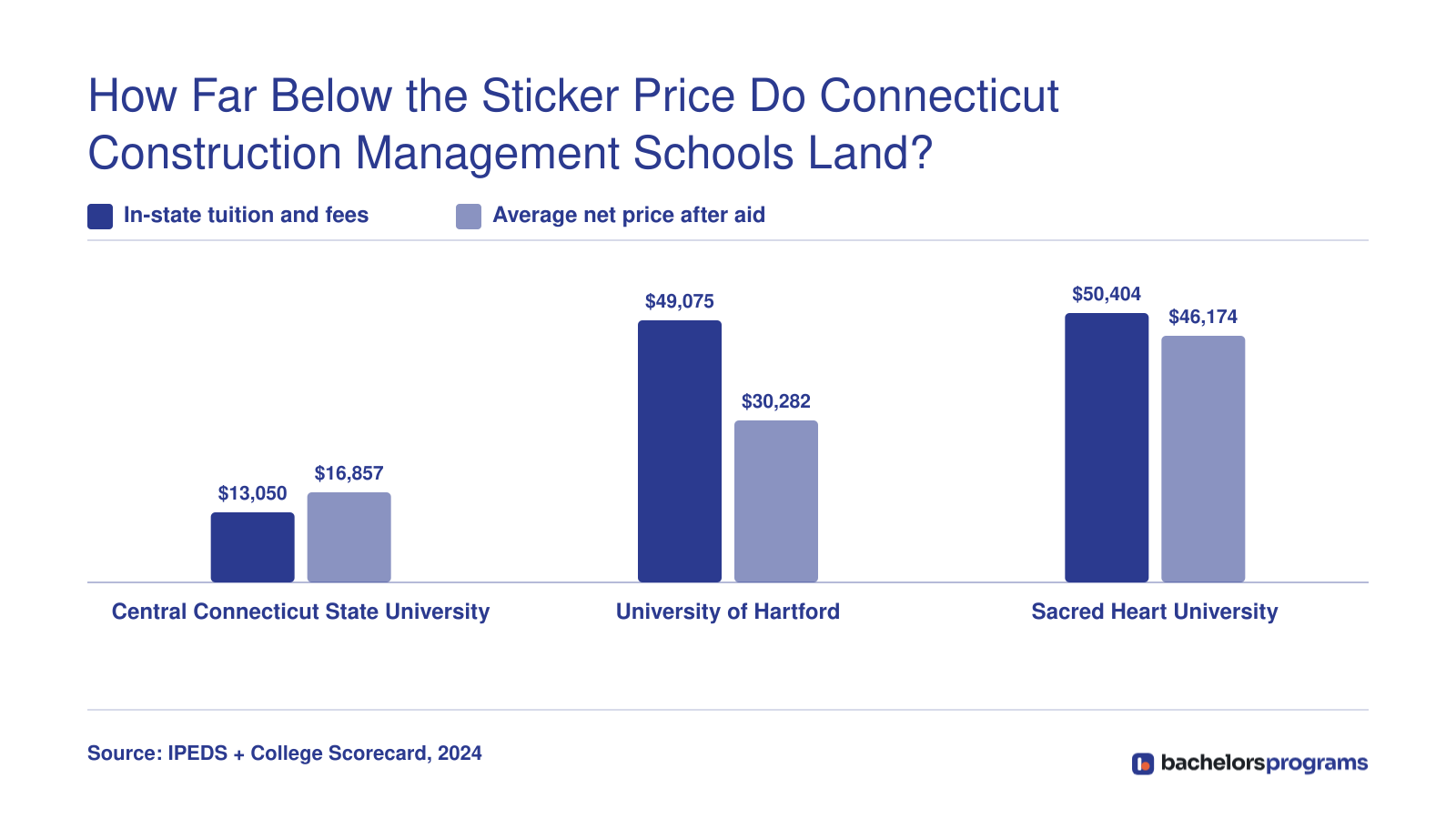
How Far Below the Sticker Price Do Connecticut Construction Management Schools Land?
University of Hartford shows the widest gap: its average net price of $30,282 sits $18,793 below its $49,075 published tuition and fees, while Sacred Heart University's $46,174 net price lands $4,230 under its $50,404 sticker. Central Connecticut State University runs the other way: its $16,857 net price exceeds its $13,050 in-state tuition by $3,807, because net price counts the full cost of attendance, including housing and books, minus grant aid. Net price is a school-wide average for aided undergraduates, not a quote for every student or specific to the construction management major, so your own figure will depend on your aid package.
Related Articles
Construction Management Careers and Pay in Connecticut
Construction managers run the job: they set budgets and schedules, coordinate trades and subcontractors, and answer for safety and quality from groundbreaking to closeout. Connecticut employed 5,719 of them in 2026, and the state projects that figure to reach 6,175 by 2036.1 The occupation is bachelor's-level, and employers typically look for a construction management or construction technology degree paired with internship experience.
What the Work Pays Statewide
Connecticut construction managers earned a median of $102,786 a year in 2026, or $49.42 an hour, according to Connecticut Department of Labor wage data. The mean is $126,984, or $61.05 an hour.2 The middle half of the occupation earns between $46.78 and $76.00 an hour, and entry-level pay starts near $40.56 an hour, roughly where new graduates enter as project engineers or assistant superintendents.
Where Pay Is Highest
Wages track the local market. Mean annual pay runs about $133,007 in the New London/Norwich area, $130,118 in Bridgeport/Stamford, $127,670 in Hartford, $124,505 in New Haven, and $114,887 in Danbury.2
Hiring and the Outlook
State projections show 8.0% growth from 2026 to 2036, or 456 net new jobs, with about 446 openings a year as workers retire or change fields.1 Nationally, the Bureau of Labor Statistics projects 9% growth from 2025 to 2035, with roughly 49,700 openings annually.3 In Connecticut, hiring comes from general contractors, heavy and highway contractors, construction management firms, and owner's representatives who oversee projects on behalf of institutions. Work spans residential, commercial, institutional, and transportation and infrastructure projects.
What Graduates Earn
Program-level earnings are a separate measure from occupational wages, and they carry their own window. Federal Scorecard data for Central Connecticut State University's construction management graduates shows median earnings of $65,470 one year after finishing and $93,908 four years after finishing.
Credentials That Support Advancement
The Certified Construction Manager (CCM) and Associate Constructor (AIC) credentials are voluntary, but they signal project experience and management training when employers weigh promotions into senior project manager or operations roles.
What Connecticut Construction Managers Earn
Construction management pays well in Connecticut, and the state's wage data gives a clear benchmark for what experienced professionals in the field earn.
Do You Need a License to Be a Construction Manager in Connecticut?
Does Connecticut require a license to work as a construction manager? Generally, no. The state's Department of Consumer Protection (DCP) does not issue a license titled "construction manager," so a bachelor's degree from Central Connecticut State University, Sacred Heart University, or the University of Hartford does not lead to a state exam. What you do on the job can still trigger other requirements.
Licenses and registrations that may apply
The rules attach to the work, and to who holds the contract, not to your job title. DCP handles these:
- Home Improvement Contractor: Registration applies to residential work for consumers, generally contracts above $1,000 in 12 months, with at least $20,000 in liability insurance.
- New Home Construction Contractor: Required before a building permit for building or selling a new home. It carries $20,000 in general-liability insurance and a $360 fee, which includes a $240 guaranty fund payment.
- Major Contractor: Covers larger commercial construction work. It requires two credit references, is filed online, and expires each June 30 with a $500 renewal.
- Trade licenses: Electrical, plumbing, and similar trades are licensed separately. Check DCP for the classifications and requirements.
Legal entities such as LLCs must register with the Secretary of State before DCP. If you plan to run your own firm, confirm your registration category directly with DCP.
Voluntary credentials
The Construction Management Association of America offers the Certified Construction Manager (CCM) credential. It is optional, but employers and owners may value it on larger projects. Eligibility combines education and professional experience, so most graduates pursue it after several years in the field rather than right after graduation. Other voluntary constructor credentials exist as well, and they work the same way.
Before relying on any requirement, verify it with the Connecticut Department of Consumer Protection and the credentialing body itself.
Questions to Ask Yourself
Do you want commercial building, heavy civil and highway, or estimating work, and does the program offer that emphasis?
Does ACCE accreditation matter for the employers or credentials you are targeting?
Can you commute or relocate, or do you need an evening, hybrid, or online format?
Will you transfer from a community college and need to protect your credits?
Compare Construction Management programs on the data that matters
Explore more Business & Management majors or browse every field of study.
All Business & Management programs Browse every field of study