Best Construction Management Degree Programs
Compare 250+ accredited Construction Management programs, with net price after aid, graduation rates, earnings and debt from IPEDS and the U.S. College Scorecard.

How much does a construction management bachelor's degree cost after aid, and what do graduates earn in the first year out? At the schools ranked here, average net price runs from $10,440 to $24,953, and graduation rates from 69% to 86%.
That spread matters because construction employers hire on project controls, scheduling, and estimating competence, not on the name of the school alone. Accreditation splits the field too: some programs carry ACCE recognition, others sit under ABET as construction engineering and management. The difference shapes coursework and, in some cases, which firms recruit on campus.
Key Points
- Utah Valley University posts the lowest average net price here: $6,376.
- ACCE accredits construction management bachelor's programs; ABET covers engineering-focused ones.
- LSU, Arkansas State, and Rowan offer online construction management bachelor's degrees.
Best Construction Management Schools Ranked
The programs below earned their places on verified outcomes and price: graduation rates, net price after aid, and, where the federal data publishes it, median earnings for construction management graduates. Reputation alone did not move a school up this list. Each card shows the format the program is offered in, the school's overall graduation rate, net price, and program-level earnings with the time window stated.
California Polytechnic State University-San Luis Obispo
#1San Luis Obispo, CA · ~$17,000/yr (est.)
Best for: Hands-on learners wanting paid co-op experience
California Polytechnic State University in San Luis Obispo pairs a nationally accredited construction management department with a Learn by Doing philosophy that puts students in heavy civil, residential, and commercial labs. Small classes and laboratory coursework are the norm, and the department reports direct recruiting relationships with more than 200 companies each year. Paid cooperative education lets students work full time while earning degree credit. Graduates are recruited heavily before commencement.
- Nationally accredited construction management department
- Learn by Doing labs in heavy civil, residential, and commercial work
- Paid co-op program allows full-time work for degree credit
- Recruiting relationships with more than 200 companies annually
- Coursework covers BIM 3-D modeling, estimating, and project controls
- Graduates recruited by DPR Construction, McCarthy, Sundt, and Hensel Phelps
- Industry advisory council supports alumni and student engagement
- Covers commercial, residential, heavy civil, and specialty sectors
Brigham Young University
#2Provo, UT · $15,000 – $20,000/yr (est.)
Best for: Cost-conscious students wanting a compact credit load
Brigham Young University offers construction management as an emphasis within its Bachelor of Science in Construction and Facilities Management, a compact 85 to 86 credit program with a required 300-hour construction work placement. Coursework spans structural systems, estimating, scheduling, safety, law, and company operations, with electives in virtual design and construction and real estate development. Latter-day Saint affiliation and low tuition make it one of the most affordable routes into the field.
- 85 to 86 total credit hours
- Required 300-hour construction work placement
- Choose from 27 program electives
- Electives in virtual design and construction and real estate development
- Senior seminar and experiential learning required
- Ethics emphasized among stated learning outcomes
- Covers structural systems, estimating, scheduling, safety, and law
Virginia Polytechnic Institute and State University
#3Blacksburg, VA · $25,000/yr (est. net price)
Best for: Students aiming at engineering licensure
Virginia Tech's Myers-Lawson School of Construction houses an ABET-accredited construction engineering and management degree that blends civil engineering and building construction with business management. Students can tailor studies toward engineering or management careers and may pursue Professional Engineering licensure after graduation. An optional construction safety leadership major adds depth in safety, health, and regulation.
- ABET-accredited construction engineering and management degree
- Combines civil engineering and building construction with business
- Focus areas in engineering and business management
- Pathway to Professional Engineering licensure
- Optional Construction Safety Leadership major
- Covers roads, bridges, public works, and commercial structures
- Emphasizes safe, ethical, and sustainable built environment solutions
University of Minnesota-Twin Cities
#4Minneapolis, MN · ~$17,000/yr (est.)
The University of Minnesota Twin Cities offers an ABET-accredited construction management bachelor's degree with three tracks: commercial, highway heavy and civil works, and residential. A capstone and internship supply applied experience, and the program helped launch a regional collegiate construction league with neighboring states. Most students finish in four years, and coursework is delivered in a partially online format with some required on-campus classes.
- ABET-accredited program with three concentration options
- Tracks in commercial, highway heavy and civil works, and residential
- Capstone and internship required
- 120 total credit hours, two start dates per year
- Partially online format with some required on-campus classes
- Transfer credits accepted and financial aid available
San Diego State University
#5San Diego, CA · $15,000/yr (est. net price)
San Diego State University's construction management degree blends engineering and management coursework, covering virtual design and construction, scheduling, project controls, preconstruction, and accounting. Students learn to coordinate architects, engineers, owners, agencies, suppliers, and trades across public and private work. The program emphasizes resilient and sustainable infrastructure, and the university also runs construction-focused professional certificates through its global campus with local industry partners.
- Combines management and engineering coursework
- Covers virtual design and construction, scheduling, and project controls
- Emphasis on resilient and sustainable infrastructure
- Prepares students to coordinate owners, agencies, and trades
- Professional certificates offered through the global campus
- Industry ties include the San Diego chapter of a national contractors association
Louisiana State University and Agricultural & Mechanical College
#6Baton Rouge, LA · $15,000 – $20,000/yr (est.)
Louisiana State University's Bert S. Turner Department of Construction Management is expanding into a School of Construction with added emphasis on industry partnerships, research, safety, sustainability, and project delivery. The curriculum covers estimating, scheduling, safety, and construction law, with internships and industry partnerships supplying field experience. The program incorporates the American Institute of Constructors Level I exam and serves as an AIC testing site.
- Department transitioning into a School of Construction
- Curriculum covers estimating, scheduling, safety, and construction law
- Incorporates the American Institute of Constructors Level I exam
- Serves as an AIC testing site and accepts exam performance for prior-learning credit
- Internships and industry partnerships built into the program
- Prepares students for project manager, estimator, and field engineer roles
Clemson University
#7Clemson, SC · $20,000 – $25,000/yr (est.)
Clemson University's construction science and management program has run since 1962 and is accredited by the American Council for Construction Education. Students complete 800 hours of real construction experience with an approved company, alongside site visits, industry-led seminars, and hands-on work in a dedicated Experiential Learning Yard. The program maintains an average 25-to-1 student-teacher ratio.
- Accredited by the American Council for Construction Education
- 800 hours of construction experience with an approved company required
- Dedicated Experiential Learning Yard for hands-on practice
- Industry expert seminars and site visits
- Curriculum covers structures, materials, estimating, scheduling, and safety
- Average 25-to-1 student-teacher ratio
- Established in 1962
California State University-Long Beach
#8Long Beach, CA · $7,000 – $20,000/yr (est.)
California State University Long Beach delivers an ACCE-accredited construction management bachelor's degree through its college of engineering, built around project-based learning in planning, materials, equipment, job control, and cost management. Students have access to dedicated academic advisors plus an engineering student success center and career development center. The program prepares graduates for field supervision and project leadership roles across construction planning and design.
- Accredited by the American Council for Construction Education
- Project-based learning in planning, materials, equipment, and cost controls
- On-campus program within the college of engineering
- Dedicated academic advisors and an engineering student success center
- Career development center support for construction placements
- Maintain 2.5 GPA before reaching 60 units to progress
University of Oklahoma
#9Norman, OK · $15,000 – $20,000/yr (est.)
The University of Oklahoma offers a fully online Bachelor of Arts in Construction Management through its college of professional and continuing studies, designed for adult learners who already hold at least 60 college credits and are 25 or older. The interdisciplinary curriculum covers preconstruction management, estimating, scheduling, construction efficiency, and personnel leadership, capped by a portfolio course. Prior Learning Assessment credit can shorten the path, and 30 hours must be earned at the university.
- Fully online Bachelor of Arts for adult learners
- Requires 60 prior college credit hours and age 25 or older
- 120 total credit hours with a 2.0 GPA minimum
- Covers preconstruction, estimating, scheduling, and personnel leadership
- Portfolio course caps the program
- Up to 15 Prior Learning Assessment credit hours accepted
- Minimum 30 hours must be earned at the university
Appalachian State University
#10Boone, NC · $8,000 – $25,000/yr (est.)
Appalachian State University's building sciences degree with a construction management concentration takes an interdisciplinary design-construction approach across residential, commercial, military, and industrial projects. Coursework covers building systems, materials and methods, planning and scheduling, cost estimating, surveying, codes, safety, and sustainable design. Students gain experience through internships and the Student Builders Association, and no minor is required.
- Construction management concentration within building sciences
- Interdisciplinary design-construction approach
- Covers estimating, scheduling, surveying, codes, safety, and sustainable design
- Internships available with real-world placements
- Student Builders Association for extracurricular experience
- No minor required
Cost & outcomes by school
Federal data for the highest-earning Construction Management programs, independent of the ranking above. Earnings are this field's bachelor's graduates four years after completing where the Scorecard reports them, else the school's undergraduate median.
| School | Net price / yr | Grad rate | Earnings | Debt | Grads/yr | Format |
|---|---|---|---|---|---|---|
| California State University-East Bay CA | $9,320 | 48% | $119,067 | $16,544 | 33 | Campus |
| California Polytechnic State University-San Luis Obispo CA | $16,665 | 86% | $118,331 | $18,500 | 131 | Campus |
| Wentworth Institute of Technology MA | $34,170 | 68% | $111,195 | $27,000 | 119 | Campus |
| California State University-Chico CA | $14,480 | 63% | $108,021 | $19,341 | — | Campus |
| Washington State University WA | $14,971 | 61% | $107,531 | $19,500 | — | Campus |
| Weber State University UT | $10,258 | 46% | $105,738 | $15,928 | 18 | Campus |
| Arizona State University AZ | $14,967 | 68% | $103,060 | $19,500 | — | Hybrid |
| Georgia Institute of Technology GA | $12,116 | 94% | $102,772 | $21,672 | — | Campus |
| University of Wisconsin-Stout WI | $17,490 | 55% | $101,758 | $20,175 | 65 | Campus |
| Northern Arizona University AZ | $14,158 | 61% | $99,015 | $22,589 | 50 | Campus |
| Middle Tennessee State University TN | $13,359 | 54% | $98,967 | $17,000 | 71 | Campus |
| Clemson University SC | $22,253 | 87% | $98,726 | $19,962 | — | Campus |
Sources: U.S. Department of Education. Net price, graduation rate, earnings and debt: College Scorecard (earnings and debt for this field's bachelor's graduates where reported, else school-wide); graduates: IPEDS. A dash means no figure is reported.
Cost, debt & payoff
Median earnings of this field's bachelor's graduates (4 yrs after completing, else the school's undergraduate median) vs. their median federal loan debt · U.S. College Scorecard
Across these programs the median graduate earns about $59,547 and finishes with roughly $21,500 in debt — a ratio that clears a common rule of thumb (keep debt below first-year salary). Net price and debt vary widely school to school, so check the per-school figures in the table above before you shortlist.
How We Ranked These Construction Management Programs
College Scorecard publishes earnings for graduates of a specific program, not just a whole school, so program-level results carry the most weight here. We built it on program-level earnings and debt, institution net price after aid, the number of students completing the credential, and institution-wide graduation and retention rates.
Why program-level earnings come first
Earnings measured one to five years after completion reflect graduates of this exact construction management credential. An institution-wide figure blends in nursing, art history, and every other major a university offers, which says little about what this degree pays. We read debt alongside earnings, since a strong paycheck matters less if loan payments absorb it.
Limits you should know about
- Graduation rate: It covers the whole institution, not the construction program alone.
- Net price: It is an average after grants and scholarships, so your own cost depends on aid eligibility and residency.
- Earnings gaps: Some programs have unpublished earnings. Where that happens, we say so rather than estimate.
Many competing lists publish no criteria at all, leaving you to trust an order without knowing what drove it. The inputs come from public federal data you can check yourself, and the weak spots are stated up front. Treat the order as a starting point, then confirm accreditation and format fit before you apply.
Most Affordable Construction Management Programs by Net Price
Ranked by average net price after aid, the lowest-cost construction management programs here are Utah Valley University ($6,376), Brigham Young University-Idaho ($8,221), and California State University-East Bay ($9,320), according to 2024 IPEDS and College Scorecard data from the U.S. Department of Education. The usual public-versus-private gap runs in reverse at this end of the list: BYU-Idaho, a private nonprofit, charges every student the same $4,800 in tuition regardless of residency, while the two public universities charge nonresidents about $12,000 to $12,600 more (UVU rises from $6,507 to $18,489 and Cal State East Bay from $7,583 to $20,183). Net price also includes housing, books, and other costs, so it can exceed listed tuition. At BYU-Idaho, construction management graduates leave with a median $15,250 in federal debt, or about $162 a month on a 10-year repayment plan. Treat each net price as an average across aided students, because your own aid package could come in higher or lower.
| School | Location | Sector | Average Net Price After Aid | In-State Tuition | Out-of-State Tuition | Median Federal Debt at Completion | 10-Year Monthly Payment |
|---|---|---|---|---|---|---|---|
| Utah Valley University | Orem, UT | Public | $6,376 | $6,507 | $18,489 | N/A | N/A |
| Brigham Young University-Idaho | Rexburg, ID | Private nonprofit | $8,221 | $4,800 | $4,800 | $15,250 | $162 |
| California State University-East Bay | Hayward, CA | Public | $9,320 | $7,583 | $20,183 | N/A | N/A |
Construction Management Salary and Job Placement
A construction management degree pays off quickly, but graduates start well below the occupational median and close the gap over time. Earnings for the programs ranked here show that climb plainly.
What Graduates Earn
One year after completion, median earnings across the ranked programs run from $66,934 (Louisiana State University) to $99,649 (Cal State East Bay). By year four, the range is $91,017 (Illinois State University) to $119,067 (Cal State East Bay), with Cal Poly San Luis Obispo close behind at $118,331. Five years out, the programs that report that window fall between $93,016 (BYU) and $99,760 (John Brown University).
Employment holds up as well. Among the programs here, roughly 96 to 100 percent of completers are working one year out.
The BLS Benchmark
The national median annual wage for construction managers was $114,990 in May 2025.1 BLS projects 9 percent growth from 2025 to 2035, much faster than average, with about 49,700 openings per year.1 Pay varies by location. Among the reported high-wage areas, Massachusetts ($145,010) and Alaska ($139,190) lead the states cited2, while the New York-Newark-Jersey City metro ($158,000) and Boston-Cambridge-Newton ($156,470) lead the metros cited.3
Why Starting Pay Trails the Median
The occupational median reflects experienced managers who oversee budgets, crews, and contracts. Most new graduates start as assistant project managers, project engineers, estimators, or field engineers. They move into full management roles as they build a record on live projects.
How to Vet Placement Claims
Several programs advertise a "100% job placement rate." Treat that as a starting point and ask:
- Response rate: What share of graduates actually reported an outcome? A high rate from a small, self-selected group means little.
- Timeframe: Is the figure measured at graduation, six months out, or one year out?
- Internships: Are internships or co-ops counted as jobs? Placement should reflect full-time, post-graduation positions.
- Cohort size: Some programs graduate only a dozen or so students a year, so one cohort can swing the numbers.
A school that answers these questions plainly is usually one whose numbers hold up.
ACCE vs. ABET Accreditation: What to Check Before You Apply
Construction degrees split between two accreditors, and the dividing line is the program's orientation, not the school's reputation. The American Council for Construction Education accredits baccalaureate programs in construction, construction science, construction management, and construction technology.2 ABET accredits engineering programs, including construction engineering and the various construction engineering and management titles listed in its program search.3
Which schools hold what
Among the programs ranked here, Clemson lists its Bachelor of Science in Construction Science and Management as ACCE accredited, and Cal State Long Beach does the same for its construction management degree. Virginia Tech's Construction Engineering and Management major and the University of Minnesota's construction management degree are both described as ABET accredited. Elsewhere, Oregon State's Construction Engineering Management degree has carried ACCE accreditation since 1980, renewed most recently in 2021 for ACCE's maximum six-year term4, and Michigan Tech identifies its construction management B.S. as ACCE accredited. Accreditation status changes, so treat any listing, including ours, as a starting point.
Why it matters after graduation
Large general contractors recruit heavily from accredited departments, and campus career fairs at those schools reflect it. Professional credentials are the other consideration: the American Institute of Constructors (AC and CPC) and the Construction Management Association of America (CCM) set education and experience thresholds, and the degree you hold factors into how quickly you qualify. Confirm the current requirements directly with each certifying body before you assume your program counts. Graduate admissions committees in construction and engineering management also tend to recognize accredited undergraduate coursework more readily.
A two-step check before you apply
- Search by program title, not school name. Open the ACCE accredited programs directory and the ABET program search1, then look up the exact degree you plan to enroll in. ACCE's directory filters by institution, degree level, and location.
- Watch for the mismatch. A university can be institutionally accredited while its construction program holds no specialized accreditation at all. Regional accreditation covers the school, not the major. If the program does not appear in either directory, ask the department why.
Related Articles
Online, Hybrid, or On-Campus: Which Construction Management Format Fits You?
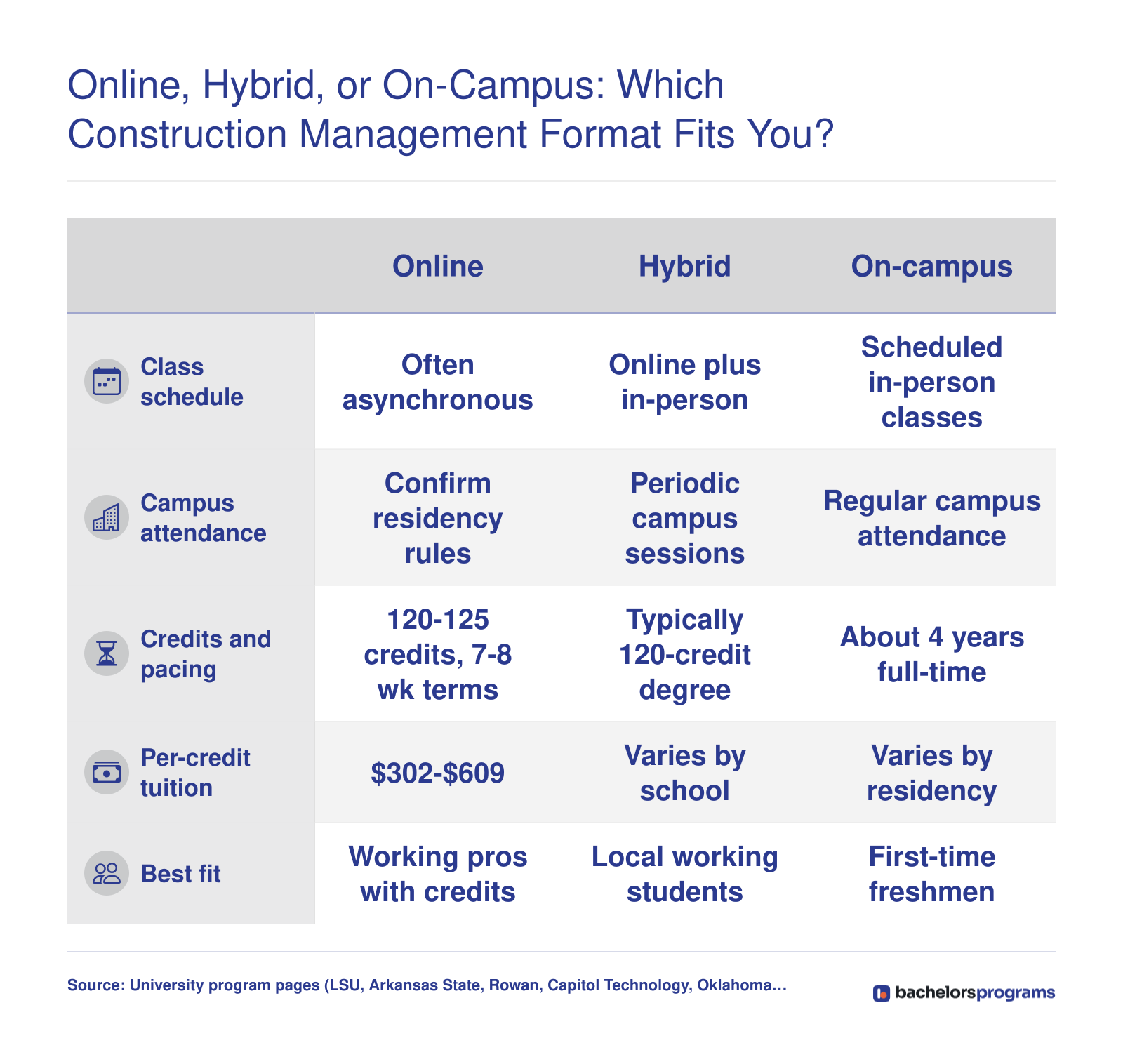
Online construction management bachelor's programs are offered by Louisiana State University, Arkansas State University, Northern Michigan University, Capitol Technology University, the University of Oklahoma, Grand Canyon University, and Rowan University. Online degree-completion programs often suit working professionals with field experience and transfer credits. Oklahoma's online track admits only students with at least 60 prior college credits, and LSU accepts up to 75% of its credits in transfer. Residency rules and completion timelines vary by school, so confirm both before you apply.
Questions to Ask Yourself
Are you already working on job sites, and could transfer credits or field experience shorten an online degree-completion track?
Can your schedule handle synchronous evening classes, or do you need fully asynchronous coursework?
Do you want campus career fairs and student competitions (such as ASC regional competitions) that mostly reward on-campus students?
Does your target employer recruit only from ACCE-accredited programs, and is the online version covered by that accreditation?
Highest Early-Career Program Earnings
Among the programs ranked here, one stands out for what graduates earn right after finishing.
Construction Management programs by state
Construction Management Degree FAQs
These answers cover the questions prospective students ask most about pay, accreditation, requirements, and alternative routes into the field. Details vary by school, so confirm specifics with each program.
How much do construction managers make with a bachelor's degree?
Is ACCE accreditation important for a construction management degree?
What are typical construction management degree requirements?
Can you become a construction manager without a degree, and how long does it typically take?
Compare Construction Management programs on the data that matters
Explore more Business & Management majors or browse every field of study.
All Business & Management programs Browse every field of study