Best Construction Management Schools in Maryland
Compare 6 accredited Construction Management programs in Maryland, with net price after aid, graduation rates, earnings and debt from IPEDS and the U.S. College Scorecard.

Maryland employed 5,770 construction managers in May 2025, and their median pay was $128,330. Most of those jobs are filled by people holding a bachelor's degree in construction management, typically the Bachelor of Science (B.S.) in Construction Management, backed by internship hours on an active jobsite.
The supply of programs is thin. Only a handful of Maryland schools award the degree, and the ones that do differ sharply on price: in-state tuition runs about $8,229 at Morgan State University, while Loyola University Maryland's published rate is $57,150 before aid.
Accreditation varies as well. ACCE or ABET recognition is not automatic here, and some employers ask about it.
Key Points
- Capitol Technology University's 121-credit B.S. runs online or on campus.
- Maryland construction managers earned a $128,330 median wage in May 2025.
- Compare net price after aid; Loyola's grants often cut sticker tuition sharply.
Best Bachelor's Degree in Construction Management Schools in Maryland, Ranked
Fewer than ten Maryland institutions currently award a bachelor's degree in construction management, so this list covers the schools that met our criteria rather than a long slate. Six qualified, ranging from large public universities to a small private technology college, and their institution-wide graduation rates span roughly 35% to 79%. Each card gives you the essentials: where the school sits, how the program is delivered, the credential awarded, one standout feature, and the published cost and admission picture.
Capitol Technology University
#1Laurel, MD · ~$22,000/yr (est.)
Best for: Working adults wanting online or campus flexibility
An independent university in Laurel focused on engineering, computer science, information technology and business, Capitol Technology University gives construction management students a technology-heavy foundation. The four-year Bachelor of Science in Construction Management runs on campus and fully online, with the same curriculum in both formats. Admission is relatively open for a private institution, with about three in four applicants accepted, a net price after aid near $22,100, and an institution-wide graduation rate of roughly 43%. Program materials do not list ACCE accreditation for the construction program, so confirm current status with the department before you apply.
- Four-year degree, on campus or fully online
- Curriculum pairs construction skills with digital and IT tools
- Only independent technology-focused college in Maryland
- On-campus students get direct faculty interaction and hands-on projects
- Online learners follow the same rigorous curriculum as campus students
Morgan State University
#2Baltimore, MD · $10,000 – $15,000/yr (est.)
Best for: Baltimore-area students wanting an urban public campus
Morgan State University, a public institution in Baltimore, houses construction management in its own department and builds the degree on a full 120-credit sequence with a required internship and capstone. The curriculum follows ABET's applied and natural science accreditation standards. Admission is accessible, with roughly four in five applicants accepted, a net price near $15,000 after aid, and an institution-wide graduation rate of about 41%. The program is not listed as ACCE-accredited, so verify status directly with the university.
- 120 credits: 43 general education, 74 in the major, 3 supporting
- Required courses in cost estimating, scheduling and construction law
- Covers building information modeling and sustainable construction
- 3-credit internship (CMGT 498) and 4-credit capstone (CMGT 499)
- Admission requires a 2.0 cumulative GPA
- Final 30 credits must be earned at Morgan State
- Curriculum follows ABET applied and natural science standards
- Business administration minor option available
Loyola University Maryland
#3Baltimore, MD · ~$31,000/yr (est.)
Best for: Business-minded students drawn to real estate development
Loyola University Maryland, a private university in Baltimore, pairs construction with real estate through a Bachelor of Science in Construction Management and Real Estate Development. Students pick a Construction Engineering or Real Estate Development concentration, and coursework blends business strategy, engineering fundamentals and studio work. About three in four applicants are accepted, the net price after aid runs near $30,600, and the institution-wide graduation rate is roughly 79%, the highest on this list. No ACCE accreditation is listed for the program, so confirm with the business school before applying.
- Two concentrations: Construction Engineering or Real Estate Development
- Blends business strategy, engineering principles and applied studio work
- Required capstone studio
- Coursework includes real estate finance and sustainability topics
- Industry partners, mentorship and internship connections
- Prepares students for project manager and developer roles
Frostburg State University
#4Frostburg, MD · $10,000 – $26,000/yr (est.)
Frostburg State University, a public university in western Maryland, frames its construction degree around sustainability rather than traditional delivery. The Bachelor of Science in Sustainable Construction Management requires 12 internship credits and draws faculty from physics, engineering, geography and management. Admission is open, with about nine in ten applicants accepted, a net price near $16,700 after aid, and an institution-wide graduation rate of about 50%. ACCE accreditation is not listed for this program, so confirm with the department.
- Sustainability-focused construction management degree
- 12 required internship credits
- Coursework in life-cycle cost estimating and risk management
- Covers contracting, bidding and negotiation strategies
- Faculty drawn from physics, engineering, geography and management
- Internship partners include contractors and Maryland agencies
- Students can work part time within the department
University of Baltimore
#5Baltimore, MD · $10,000 – $24,000/yr (est.)
University of Baltimore takes a different route: its construction management specialization sits inside the Bachelor of Science in Real Estate and Economic Development and is built for students arriving with construction coursework from a Maryland community college. Up to 15 approved credits transfer in and satisfy the program's real estate electives, leaving general education, business core and real estate courses to finish. About four in five applicants are accepted, the net price after aid is near $13,900, and the institution-wide graduation rate is roughly 38%. No ACCE accreditation is listed for this pathway.
- Transfers up to 15 construction credits from approved Maryland community colleges
- Transferred credits satisfy the program's real estate electives
- Remaining work covers general education, business core and real estate courses
- Designed as a transfer pathway for community college students
- Blends construction knowledge with finance and market analysis
- Leads to roles in property development and commercial property management
University of Maryland Eastern Shore
#6Princess Anne, MD · ~$13,000/yr (est.)
The University of Maryland Eastern Shore, a public historically Black university on the Eastern Shore, offers the state's most established construction program in name and structure. Its Bachelor of Science in Construction Management Technology is described by the university as the only ACCE-accredited construction program in Maryland, and it requires two summer internships plus an industry advisory board that keeps coursework current. The university accepts about 96% of applicants, the net price after aid is near $13,300, retention is strong near 96%, and the institution-wide graduation rate is about 35%.
- Program materials describe it as Maryland's only ACCE-accredited construction program
- Two required summer internships
- Focus on project management and green building technology
- Covers residential and commercial structures
- Industry Advisory Board keeps curriculum aligned with current practice
- Accepts both first-year students and community college transfers
Cost & outcomes by school
Federal data for the highest-earning Construction Management programs, independent of the ranking above. Earnings are this field's bachelor's graduates four years after completing where the Scorecard reports them, else the school's undergraduate median.
| School | Net price / yr | Grad rate | Earnings | Debt | Grads/yr | Format |
|---|---|---|---|---|---|---|
| Capitol Technology University MD | $22,102 | 43% | $85,035 | $20,264 | — | Online |
| Loyola University Maryland MD | $30,574 | 79% | $82,652 | $27,000 | — | Campus |
| Morgan State University MD | $14,985 | 41% | $80,260 | $26,000 | 20 | Campus |
| University of Baltimore MD | $13,868 | 38% | $61,335 | $23,250 | — | Campus |
| Frostburg State University MD | $16,715 | 50% | $55,493 | $21,105 | — | Campus |
| University of Maryland Eastern Shore MD | $13,338 | 35% | $47,697 | $27,000 | — | Campus |
Sources: U.S. Department of Education. Net price, graduation rate, earnings and debt: College Scorecard (earnings and debt for this field's bachelor's graduates where reported, else school-wide); graduates: IPEDS. A dash means no figure is reported.
Cost, debt & payoff
Median earnings of this field's bachelor's graduates (4 yrs after completing, else the school's undergraduate median) vs. their median federal loan debt · U.S. College Scorecard
Across these programs the median graduate earns about $70,798 and finishes with roughly $24,625 in debt — a ratio that clears a common rule of thumb (keep debt below first-year salary). Net price and debt vary widely school to school, so check the per-school figures in the table above before you shortlist.
How We Ranked These Maryland Construction Management Schools
Every school here was measured against the same numbers, not reputation or marketing copy.
What we looked at
- Price after aid: What students actually pay after grants and scholarships come off the bill, not the published sticker figure.
- Graduation rate: How reliably the school moves enrolled undergraduates to a finished degree.
- Earnings and debt for the major: Federal reporting tracks what graduates of a specific field of study earn after leaving, and how much they borrowed to get there.
- Completions: How many students finish the construction management program each year, which signals whether a program is established or just getting started.
- Delivery format: Whether coursework runs on campus in Laurel, Baltimore, Frostburg, or Princess Anne, or is built for working students online or in the evenings.
What the numbers do and don't cover
Two of these inputs describe the whole institution, not the construction management program. Graduation rate and price after aid are campus-wide averages: a university with strong overall completion numbers may still run a small program at its own pace, and a low average price can hide wide variation between majors.
Earnings, borrowing, and completions are reported at the program level, so those figures come closer to describing the construction management students themselves. We weighted the program-level evidence more heavily and treated the school-wide averages as context.
Online and Hybrid Bachelor's Options at Maryland Schools
Construction management is a hands-on field, and most Maryland programs still teach it on campus.
Sorted by Delivery
- Online or on-campus: Capitol Technology University in Laurel offers its B.S. in Construction Management in both formats (121 credits). Per-credit rates for Fall 2026 to Summer 2027 run from $460 to $875, so confirm which rate applies to you.
- On-campus: Morgan State University, Loyola University Maryland, Frostburg State University, the University of Baltimore, and the University of Maryland Eastern Shore list campus-based programs.
- Hybrid or evening: None of the school pages we reviewed describe a hybrid or evening schedule. Ask each admissions office directly if you need one.
In-Person Requirements Still Apply
Field experience is built into several programs, and those requirements hold even when classes are flexible.
- Morgan State and Loyola both require a capstone.
- Frostburg requires 12 internship credits.
- UMES requires two summer internships.
- Capitol calls internships an "essential first step" and offers career services support. We did not find a required internship or a published on-campus component for its online students, so ask before you enroll.
Employer Connections
Loyola says it partners with construction industry groups, and UMES cites an Industry Advisory Board. Morgan State mentions guest speakers and internships. Frostburg's program page names internship partners including Whiting-Turner in Baltimore, the Belt Group in Cumberland, and A&N Construction; for the other schools, ask which firms hire their interns.
Verdict
Working adults should start with Capitol, the one school here with a stated online format, and ask how internships work remotely. Traditional students get the most structured field experience at Frostburg and UMES, where internships are required.
Admissions: GPA, Test Policy, and Transfer Credit
Admission rules for construction management bachelor's programs depend heavily on whether you apply as a first-year or a transfer student, and the published detail is uneven across these schools.
What Each School Publishes
- Morgan State University: Transfer applicants need cumulative and core/supporting averages of 2.0 or better, with no required Business and Management course below a C. The degree totals 120 credits, including 74 in the major, and the final 30 must be earned at Morgan. First-year GPA and SAT/ACT policy: No policy published.
- University of Maryland Eastern Shore: Transfer applicants need at least a 2.0 GPA and 27 or more credits.1 Those with 27 or fewer credits also submit an official high school transcript. First-year GPA and SAT/ACT policy: No policy published.
- Capitol Technology University, Loyola University Maryland, Frostburg State University, and University of Baltimore: No policy published on GPA, test scores, or transfer-credit limits in the material we reviewed. Check each admissions page before you apply.
Community College Pathways
Maryland's community colleges feed these programs through ARTSYS, the statewide articulation system.2 It covers public and some private institutions and lists recommended first-two-year coursework and major-admission requirements. Block transfer moves general education, major, and elective credits as a package, usually 60 credits.2 Exceptions can apply to courses outside the approved program and to prior-learning credit such as AP, portfolio, or military credit.
ARTSYS does not map every course from every community college into every program, and colleges themselves advise confirming with the receiving school. Verify any articulation agreement for your entry year rather than treating it as a guarantee.
Key Takeaways
- Where a GPA figure is published, it is 2.0, but a minimum is not a competitive benchmark.
- Plan around roughly 60 transferable credits, and expect Morgan to require your final 30 credits on its own campus.
- Keep a C or better in every course you hope to transfer.
- Ask the receiving school for a written course evaluation before you enroll at a community college.
Construction Manager Pay in Maryland: Where the Range Falls
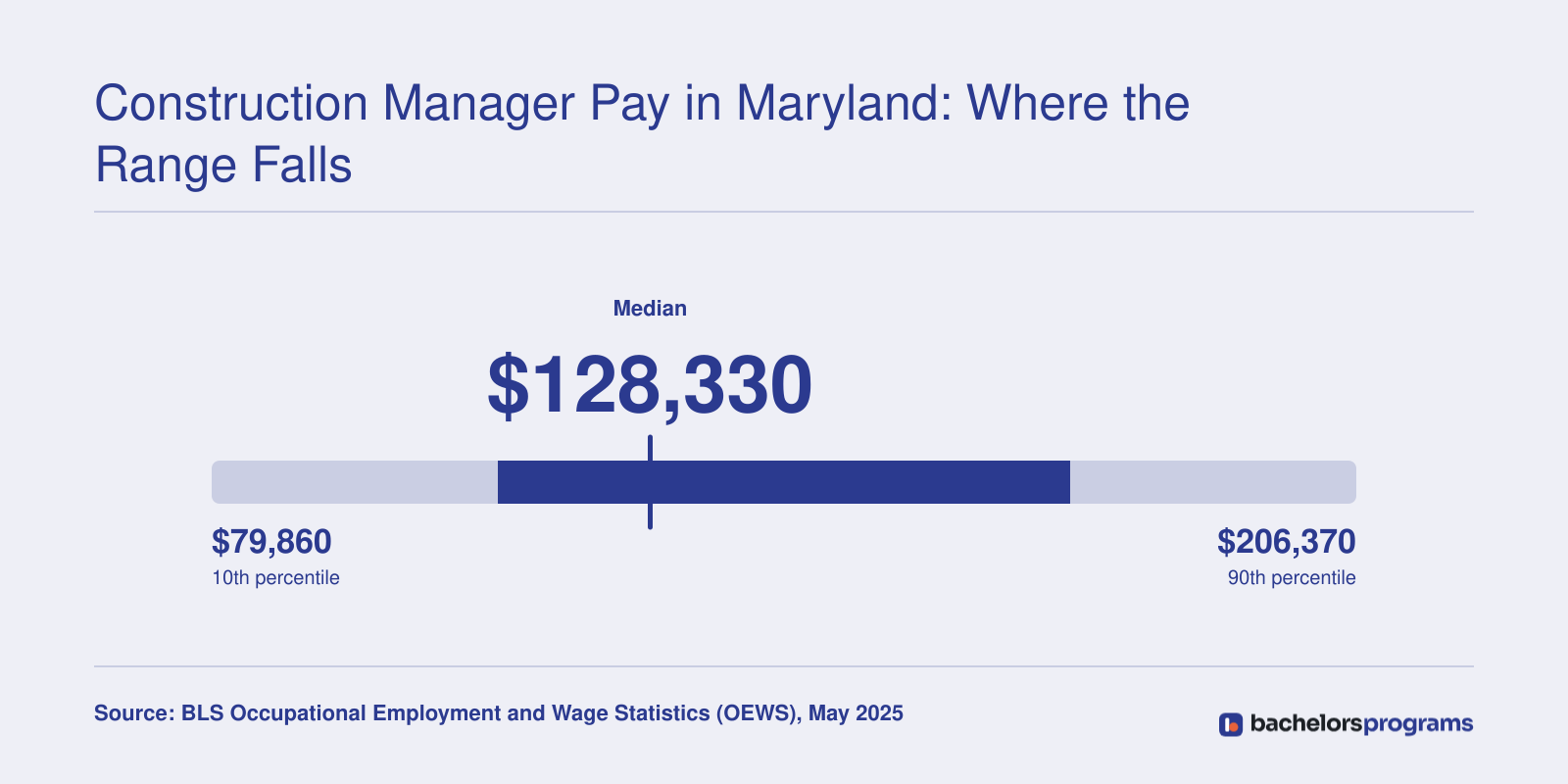
Maryland's 5,770 construction managers earned a median of $128,330 in May 2025. Pay ran from $79,860 at the 10th percentile to $206,370 at the 90th. These are statewide figures that blend the Baltimore area, the Washington suburbs and rural counties, so pay in any single local market may differ. The range covers managers at every career stage, so treat it as a picture of where a bachelor's degree in construction management can lead over a career, not a forecast of what new graduates earn in their first year.
Related Articles
Frequently Asked Questions About Construction Management Degrees in Maryland
These answers draw on the school comparisons, cost guidance, and career data covered above. Check each school's current program page before you apply, since tuition, delivery format, and requirements can change.
What is the best school for construction management in Maryland?
Does Maryland have a bachelor's degree in construction management?
Can I get a construction management degree online in Maryland?
How much does a bachelor's degree in construction management cost in Maryland?
Do you need a license to be a construction manager in Maryland?
How much do construction managers make in Maryland?
Compare Construction Management programs on the data that matters
Explore more Business & Management majors or browse every field of study.
All Business & Management programs Browse every field of study