Accelerated Construction Management Degree Programs
Compare 250+ accredited accelerated Construction Management programs, with net price after aid, graduation rates, earnings and debt from IPEDS and the U.S. College Scorecard.

A construction management bachelor's typically runs about 120 credits. Finishing in three years means heavier terms or transfer credit, and the payoff is real: a saved year of tuition and a year of wages. The risk is a compressed schedule colliding with a full-time site job. The programs below are ranked by shortest realistic path, then cost and outcomes.
Acceleration takes three forms: year-round enrollment, a three-year bachelor's, and a combined BS/MS. All three compress the calendar without cutting credits, so workload matters as much as the speed claim.
Key Points
- Expect roughly 120 credits; acceleration cuts calendar time, not coursework.
- Arkansas State's online B.S. costs $302 per credit, about $36,240 total.
- BLS reports a $114,990 median wage for construction managers (May 2025).
Best Accelerated Construction Management Degree Programs Ranked by Speed
These programs are ordered by the shortest realistic completion path, then by value. Completion time reflects what each school publishes about credit totals, transfer credit, and accelerated bachelor's-to-master's options rather than a standard four-year assumption. Read the details for each before applying, because "accelerated" means something different from one school to the next.
Concordia University-Wisconsin
#1Mequon, WI · ~$36,000/yr (est.)
Best for: Working adults with substantial transfer credit
Concordia University Wisconsin in Mequon is the quickest route on this list. Its accelerated Construction and Trades Management bachelor's is built for working adults: up to 84 transfer credits are accepted, and the degree can be completed in as little as two years, with classes offered online in asynchronous and live virtual formats. The 120-credit curriculum covers estimating, scheduling, codes, safety, and field inspection, with LEAN and Six Sigma options. The school's overall graduation rate is 68%, and the average net price is about $36,201.
- Up to 84 transfer credits accepted
- Degree completable in as little as two years with transfers
- 120 total credit hours
- Online asynchronous and virtual synchronous classes
- Accelerated format designed for working adults
- Coursework in cost estimating, scheduling, safety, and inspection
- LEAN or Six Sigma study options
University of Wisconsin-Platteville
#2Platteville, WI · $9,000 – $18,000/yr (est.)
Best for: Students eyeing a bachelor's-to-master's pathway
UW-Platteville offers a 120-credit Construction Management B.S. with a required internship and capstone, plus an accelerated bachelor's-to-master's pathway for students who want to keep going. The school's overall graduation rate is 56%, and the average net price is about $16,032.
- 120 total credit hours, with at least 42 at the 3000 level
- Accelerated Bachelor's to Master's pathway
- Required internship for field experience
- Capstone required
- 18 elective credits required
- More than 100 employers recruit from the program
- Third place in the 2026 national ABC construction management competition
Missouri State University
#3Springfield, MO · $18,000/yr (est. net price)
Best for: Career changers moving into project management
Missouri State awards a construction management bachelor's through its School of Construction, Design and Project Management, and it lays out two routes: a standard four-year plan and an accelerated master's in project management. The degree requires at least 125 credit hours on top of the university's general education requirements. The school's overall graduation rate is 58%, and the average net price is about $17,613.
- 125 total credit hours
- Choice of a four-year track or an accelerated master's in project management
- Housed in the School of Construction, Design and Project Management
- General education requirements completed alongside major coursework
- Separate advising and career outcomes sections published for majors
Norwich University
#4Northfield, VT · $22,000/yr (est. net price)
Norwich University's construction management bachelor's blends classroom theory with hands-on experiential study across residential, commercial, and industrial projects, and it offers an accelerated master's pathway plus preparation for at least two national certifications. The program reports a 100% job placement rate for its graduates. The average net price is about $22,257, and the school's overall graduation rate is 60%.
- Accelerated master's pathway available
- Program reports a 100% job placement rate
- Students can earn at least two national certifications
- Covers residential, commercial, and industrial construction
- Classroom theory paired with hands-on experiential study
- Training in planning, negotiation, and health and safety codes
Florida International University
#5Miami, FL · ~$9,000/yr (est.)
Florida International University's 120-credit construction management B.S. sits inside a large urban engineering college and includes a combined BS/MS accelerated pathway, a senior design capstone, internships and site visits, and electives in AI and construction robotics. It is the most affordable option here by net price, about $9,288, and it covers sectors from land development to heavy highway and marine work. The school's overall graduation rate is 74%, the highest on this list.
- 120 total credit hours
- Combined BS/MS accelerated pathway for qualified students
- Senior design capstone required
- Electives in AI and construction robotics
- Internships and site visits included
- Business minors in marketing or entrepreneurship available
- SAT or ACT scores required for admission
Marywood University
#6Scranton, PA · $20,000 – $25,000/yr (est.)
Marywood University runs a four-year construction management B.S. across eight sequential semesters, pairing construction technology with business courses in accounting, management, economics, and construction law. Students work in a LEED Gold-certified facility, and the program is a candidate for ACCE accreditation. The average net price is about $23,388, and the school's overall graduation rate is 72%.
- Four-year program across eight sequential semesters
- Candidate for ACCE accreditation
- Hands-on work in a LEED Gold-certified facility
- Internships with regional firms such as Sordoni Construction Services
- Joint coursework with architecture and business students
- Business courses in accounting, management, economics, and construction law
- Two annual career fairs
University of Northwestern-St Paul
#7Saint Paul, MN · ~$28,000/yr (est.)
University of Northwestern-St Paul delivers construction and property management as a concentration inside its business administration B.S., so the core is accounting, supply chain, project management, and small business management rather than engineering. The 126-credit program includes a senior capstone and an accelerated master's option, with internships available across the Twin Cities. The average net price is about $27,705, and the school's overall graduation rate is 68%.
- 126 total credit hours
- Business administration core with a construction and property management concentration
- Accelerated master's degree option
- Senior capstone in corporate strategy and policy
- Internships with Twin Cities area businesses
- Small classes with direct faculty access
- Guest speakers from Fortune 500 companies
North Dakota State University
#8Fargo, ND · ~$16,000/yr (est.)
North Dakota State University's construction management B.S. blends business, engineering, and construction technology, and every student completes a business administration minor. High achievers can use the accelerated bachelor's-to-master's option to earn both degrees in about five years. Students learn in updated facilities and join industry groups such as AGC and NAHB. The average net price is about $15,543, and the school's overall graduation rate is 64%.
- Accelerated bachelor's-to-master's option, both degrees in about five years
- Required business administration minor
- Curriculum blends business, engineering, and construction technology
- Program reports 95% of graduates employed or continuing education
- Student organizations including AGC and NAHB
- Dedicated academic advisor for majors
- Management-focused math load rather than heavy calculus
Washington State University
#9Pullman, WA · ~$15,000/yr (est.)
Washington State University's construction management B.S. is a tightly structured four-year program: one year of pre-professional coursework, then three years of professional study, with roughly 60 students admitted to the second year. The tradeoff for that structure is speed, since entry to the professional phase is competitive and there is no accelerated master's option listed. The average net price is about $14,971, and the school's overall graduation rate is 60%.
- Four-year program with one year of pre-professional coursework
- 3.3 GPA required for admission to the professional phase
- About 60 students admitted to the second year
- Fall start only, no spring admissions
- Transfer students considered each year
- Prerequisite courses require a C or better
Wayne State University
#10Detroit, MI · ~$13,000/yr (est.)
Wayne State University's construction management B.S. is the most flexible entry point on the list: rolling admissions, three start dates a year, full- or part-time study, 2+2 transfer agreements, and an accelerated 4+1 track that earns a B.S. and M.S. in five years. Students train on BIM, AutoCAD, and Primavera P6 and can work toward PMP, OSHA, and LEED credentials while interning with Detroit-area contractors. The average net price is about $12,766, and the school's overall graduation rate is 58%.
- Accelerated 4+1 track earning a B.S. and M.S. in five years
- Rolling admissions with three start dates per year
- Full-time and part-time study options
- Training in BIM, AutoCAD, and Primavera P6
- 2+2 transfer-friendly
- Certification preparation for PMP, OSHA, and LEED
- Flat locked tuition rate
- Student groups including NAHB and NECA
Cost & outcomes by school
Federal data for the highest-earning Construction Management programs, independent of the ranking above. Earnings are this field's bachelor's graduates four years after completing where the Scorecard reports them, else the school's undergraduate median.
| School | Net price / yr | Grad rate | Earnings | Debt | Grads/yr | Format |
|---|---|---|---|---|---|---|
| Ferris State University MI | $8,624 | 47% | $90,504 | $20,468 | 57 | Campus |
Sources: U.S. Department of Education. Net price, graduation rate, earnings and debt: College Scorecard (earnings and debt for this field's bachelor's graduates where reported, else school-wide); graduates: IPEDS. A dash means no figure is reported.
Cost, debt & payoff
Median earnings of this field's bachelor's graduates (4 yrs after completing, else the school's undergraduate median) vs. their median federal loan debt · U.S. College Scorecard
Across these programs the median graduate earns about $59,547 and finishes with roughly $21,500 in debt — a ratio that clears a common rule of thumb (keep debt below first-year salary). Net price and debt vary widely school to school, so check the per-school figures in the table above before you shortlist.
What Is an Accelerated Construction Management Degree? Three Paths Compared
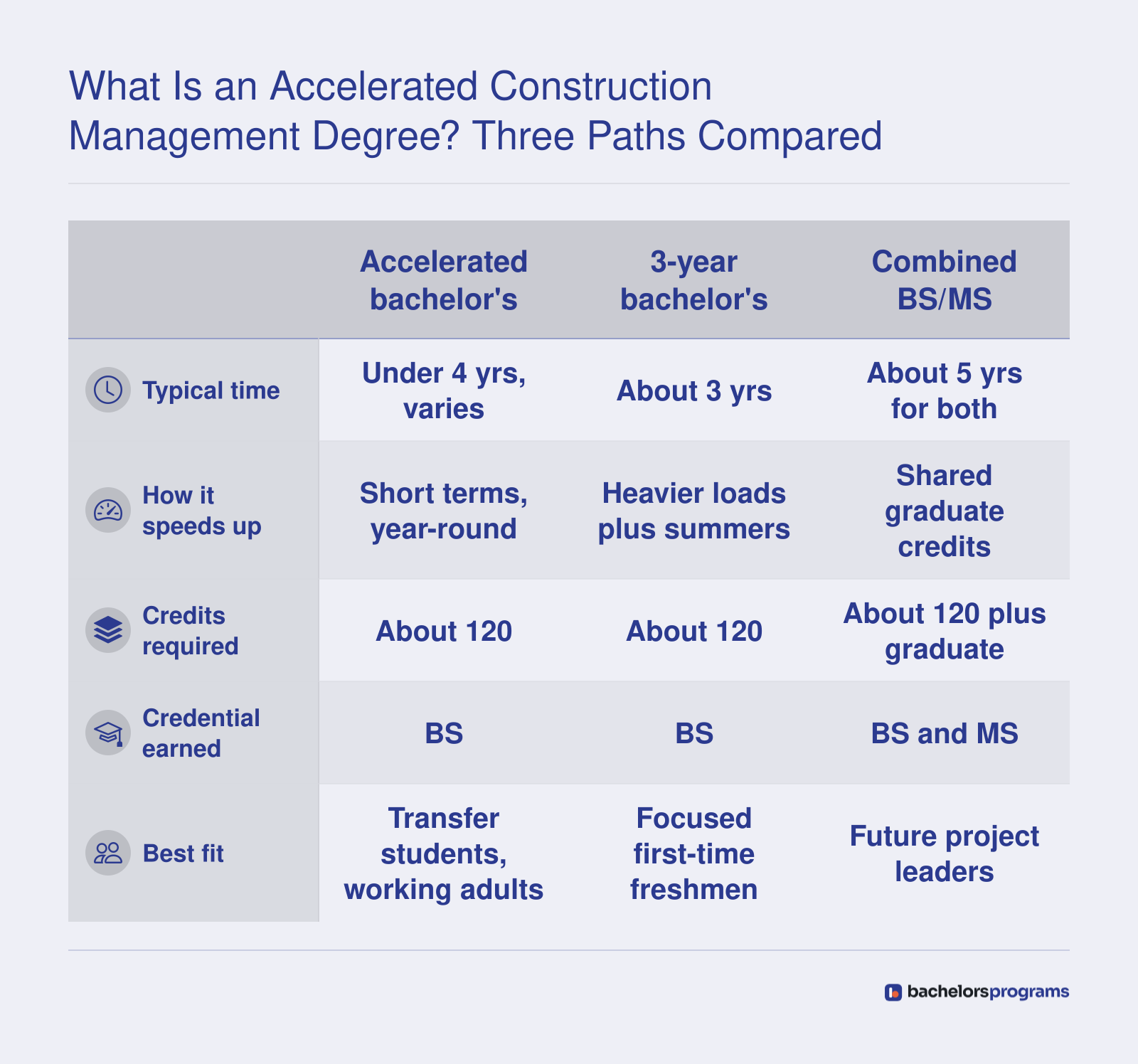
An accelerated construction management degree is a bachelor's program built to finish sooner than the traditional four-year schedule. Most still require roughly 120 credits, so the speed comes from pacing and transfer credit, not a shorter curriculum. The three main paths differ in how they compress that workload and what credential you leave with.
How We Ranked These Schools
Cost and outcome figures behind this ranking come from College Scorecard and IPEDS; program timelines come from official school pages. Only programs with an accelerated or shortest-completion pathway were eligible, whether that means a three-year bachelor's, a year-round format, or a combined bachelor's-to-master's track.
We weighted eligible programs on four factors:
- Completion speed: the shortest realistic time to a degree.
- Cost: net price for undergraduate programs, graduate tuition for combined tracks.
- Graduation rate: the institution-wide rate.
- Online availability: whether coursework can be completed remotely.
Two caveats apply. Graduation rates cover the whole school, not the construction management program alone. Net price is an aid-adjusted average, not a personal quote, so your own bill will differ.
Accelerated Construction Management Program Cost and Savings
Per-credit pricing makes total cost easy to estimate: Arkansas State's online B.S. charges $302 per credit with fees included, so 120 credits come to roughly $36,240, while LSU Online estimates $57,195 to $58,125 for its 123 to 125 credits before any transfer credit is applied. Finishing in three years instead of four rarely lowers tuition, because the credit total stays the same; the real savings come from one fewer year of living costs (College Board put the 2025-26 average annual budget for in-state public four-year students at $30,990) and one extra year of full-time earnings. Keep in mind that heavier course loads can raise your bill each term, summer terms may follow separate financial aid rules, and the yearly figures below are each school's average net price, so your own cost will depend on your aid package.
| School | Location | Format | Average Net Price (per year) | Speed or Transfer Feature |
|---|---|---|---|---|
| Florida International University | Miami, FL | On campus | $9,288 | Combined BS/MS accelerated pathway |
| Wayne State University | Detroit, MI | On campus | $12,766 | Accelerated 4+1 master's track, 3 start dates per year |
| Washington State University | Pullman, WA | On campus | $14,971 | Transfer students considered each year |
Related Articles
Accredited Online Construction Management Degrees: How to Verify ACCE and Regional Status
The American Council for Construction Education lists Boise State University's construction management bachelor's as accredited through February 2032, and Arizona State University's Construction Management and Technology program as accredited too. Those entries verify the degree program, not a separate online version; confirm the delivery format with the school.
Two layers that matter
Regional accreditation governs federal aid and credit transfer. ACCE accreditation is programmatic and speaks to employers and some certifications. Louisiana State University describes its online MS in Construction Management as ACCE-accredited; the directory confirms the program, not an online-only designation.
A three-step check
- Search the ACCE accredited program directory by institution, degree level, and location.
- Confirm the institution's regional accreditor on that accreditor's own site.
- Ask the department, in writing, that the online track is the accredited one.
ATMAE and ABET accredit construction engineering technology programs, a more technical degree; ACCE is the construction management standard. Bowling Green State University's listing shows a July 2024 expiration, so verify before relying on it.
Earnings and Outcomes After Graduation
Construction managers plan, budget, and oversee building projects, and the Bureau of Labor Statistics puts their median annual wage at $114,990 (May 2025).1 Employment is projected to grow 9% from 2025 to 2035, which BLS calls much faster than average, with about 49,700 openings a year.1 That is the occupational ceiling, not what a new graduate earns.
What Program Completers Earn
College Scorecard figures for construction management graduates start lower and climb. At Missouri State University, completers had median earnings of $73,731 one year after finishing and $89,605 five years out. Norwich University completers earned $46,751 at one year and $79,530 at five years. Washington State University completers reached $107,912 five years after finishing.
Debt and Return
Median debt for Missouri State completers was $22,500, or roughly $239 a month. Norwich completers carried $26,363, about $279 a month. Both payments look manageable against those earnings.
Why Starting Earlier Matters
The clearest financial case for acceleration is timing. Finishing a year sooner pulls a full year of professional pay forward, and that year still counts at the end of your career, not only at the start.
Is an Accelerated Path Right for You? Transfer Credit, Workload, and Aid
Starting from scratch versus arriving with credits, certifications, or military service: that difference decides whether acceleration saves a year or just adds pressure.
Prior learning assessment delivers the largest credit reductions.1 LSU Online awards 3 to 6 credits per professional certification,1 up to 21 credits for passing AIC Level 1 with a score of at least 70%, and up to 33 credits combined with Level 2.2 Military training can earn 3 to 27 credits after a Joint Service Transcript review.1 Fitchburg State caps undergraduate PLA credit at 30,3 while Northern Michigan allows up to 9.4 AP and CLEP policies vary, so ask each school how your scores apply.
Aid needs planning too. Federal aid generally requires at least half-time enrollment, so a light load in a short summer term can leave you without Pell funding. Confirm year-round Pell eligibility with your aid office.
Combined BS/MS tracks add a gate. FIU requires 75 completed credits, a 3.2 GPA, and an advisor recommendation. If your GPA slips, you may stay on the bachelor's-only track.
Accelerated paths reward students who arrive with transfer credit and can hold a steady schedule. If you work seasonal field jobs, a standard pace is usually safer.
Construction Management programs by state
Compare Construction Management programs on the data that matters
Explore more Business & Management majors or browse every field of study.
All Business & Management programs Browse every field of study