Best Construction Management Schools in Missouri
Compare 5 accredited Construction Management programs in Missouri, with net price after aid, graduation rates, earnings and debt from IPEDS and the U.S. College Scorecard.

A cheaper Missouri program may not offer the schedule or the site experience you need, and a pricier one may not either. Students here can earn the degree on campus or online from a Missouri-based school, and the usual credential is a Bachelor of Science.
The programs differ in accreditation status, admission standards, price after aid, and how much time they put you on job sites. Those differences matter because Missouri employers hire from several of these schools, and graduates compete for the same project engineer and assistant superintendent roles.
Missouri does not license construction managers at the state level, so your degree and internship record carry much of the weight.
Key Points
- In-state tuition runs from $9,502 (Missouri State) to $17,500 (Park University).
- Park University in Parkville lists an online construction management bachelor's option.
- Missouri issues no statewide construction manager or general contractor license.
Best Construction Management Schools in Missouri: Our Ranked List
The strongest construction management bachelor's programs in Missouri pair a technical core in estimating, scheduling and project controls with real building experience, usually through labs, internships or a team capstone. The five programs below combine that training with steady completion rates and net prices that a working student can plan around. The criteria behind the order are set out in the methodology section below.
Missouri State University
#1Springfield, MO · $18,000/yr (est. net price)
Best for: Students wanting an accelerated project management path
Missouri State University in Springfield houses its construction management degree in the School of Construction, Design and Project Management, and students choose between a four-year track and an accelerated path into a master's in project management. The degree takes at least 125 credit hours on top of the university's general education requirements, and the program site lists scholarships and financial aid options. The school's graduation rate is 58 percent, and federal earnings data for construction graduates shows a median of $73,731 one year after completion and $98,563 four years out.
- At least 125 total credit hours, plus general education requirements
- Four-year track with an accelerated master's in project management option
- Housed in the School of Construction, Design and Project Management
- Scholarships and financial aid described on the program site
- Separate sections cover learning outcomes, careers and advisement
University of Central Missouri
#2Warrensburg, MO · ~$14,000/yr (est.)
Best for: Transfer students from two-year construction programs
The University of Central Missouri in Warrensburg teaches construction management through cost estimating, engineering geology, and commercial plan work in CADD and BIM, covering residential, civil, industrial and commercial building. Internships can start as early as freshman year, and the student SOCM organization plus an annual ASC competition give students team experience before they graduate. The school's graduation rate is 54 percent, and federal earnings data for construction graduates shows a median of $74,177 one year after completion and $96,186 four years out. Articulation and transfer agreements with two-year schools make this a practical landing point for associate degree holders.
- ABET accreditation listed on program materials
- Prepares students for the Associate Constructor Certification Exam
- Some classes available online alongside campus coursework
- Internships typically begin after the freshman year
- Annual ASC student competition and active SOCM student organization
- Small classes taught by experienced industry professionals
Park University
#3Parkville, MO · $20,000 – $25,000/yr (est.)
Best for: Working adults needing a fully online degree
Park University, based in Parkville, delivers its construction management bachelor's entirely online, which suits students who need to keep working while they study. The 120-credit curriculum mixes planning, budgeting, scheduling, safety and materials analysis with business coursework in financial data, cost analysis and analytics, and the program prepares students for PMP certification. The school's graduation rate is 38 percent, and the program is accredited by the Higher Learning Commission, with transfer students welcomed.
- 120 total credit hours, delivered fully online
- Prepares students for PMP certification
- Internship opportunity available for practical experience
- Coursework includes sustainable construction and soil mechanics
- Business administration courses in cost analysis and analytics
- Blueprint reading, code compliance and contract administration covered
- Transfer students welcome
- Private school education at state school prices
University of Missouri
#4Columbia, MO · ~$20,000/yr (est.)
At the University of Missouri in Columbia, construction management sits inside the College of Engineering, so students pair a technical core in surveying, estimating, scheduling, safety and sustainable design with business and leadership coursework. The 120-credit degree leaves 23 elective credits that students use to build a focus in heavy construction, building systems, or business and economics. The school's graduation rate is 75 percent, the highest among the programs on this list, and advisors publish a semester-by-semester sample plan to keep students on pace.
- 120 total credit hours with a published sample semester plan
- 23 elective credits across three elective tracks
- Elective tracks: heavy construction, building systems, business and economics
- Covers scope, schedule, budget, quality, safety and contracts
- Work with building information modeling and construction documents
- Housed in the university's College of Engineering
- Degree audit tracks academic progress toward completion
- Advisor consultation required when choosing electives
Southeast Missouri State University
#5Cape Girardeau, MO · $16,000/yr (est. net price)
Southeast Missouri State University in Cape Girardeau made Construction Management and Design a standalone degree in its 2026 academic actions, and the program covers architectural drafting, building codes, cost estimating, contracts, scheduling and project administration. Labs and a required 240-hour internship give students time with AutoCAD, Revit and Procore, and a team capstone asks them to solve open-ended, real-world projects. The school's graduation rate is 58 percent, and the program reports that every 2025 construction management graduate had a signed contract before graduation.
- Minimum of 120 credit hours; capstone required
- 240-hour internship required before graduation
- Hands-on labs using AutoCAD, Revit and Procore
- Team-based capstone built around open-ended real projects
- Student chapter of the Associated General Contractors of Missouri
- Eligible for the state Fast Track grant
- Accelerated master's degree option available
- Prepares students for roles from project manager to estimator
Cost & outcomes by school
Federal data for the highest-earning Construction Management programs, independent of the ranking above. Earnings are this field's bachelor's graduates four years after completing where the Scorecard reports them, else the school's undergraduate median.
| School | Net price / yr | Grad rate | Earnings | Debt | Grads/yr | Format |
|---|---|---|---|---|---|---|
| Missouri State University MO | $17,613 | 58% | $98,563 | $22,500 | 45 | Campus |
| University of Central Missouri MO | $14,462 | 54% | $96,186 | $20,850 | 27 | Campus |
| University of Missouri MO | $20,268 | 75% | $63,403 | $20,500 | — | Campus |
| Park University MO | $21,032 | 38% | $56,309 | $21,685 | 33 | Online |
| Southeast Missouri State University MO | $15,882 | 58% | $44,030 | $21,500 | — | Campus |
Sources: U.S. Department of Education. Net price, graduation rate, earnings and debt: College Scorecard (earnings and debt for this field's bachelor's graduates where reported, else school-wide); graduates: IPEDS. A dash means no figure is reported.
Cost, debt & payoff
Median earnings of this field's bachelor's graduates (4 yrs after completing, else the school's undergraduate median) vs. their median federal loan debt · U.S. College Scorecard
Across these programs the median graduate earns about $63,403 and finishes with roughly $21,500 in debt — a ratio that clears a common rule of thumb (keep debt below first-year salary). Net price and debt vary widely school to school, so check the per-school figures in the table above before you shortlist.
How We Ranked Missouri's Bachelor's Degree in Construction Management Programs
Every school on this list offers a bachelor's degree in construction management, either on a Missouri campus or online through a Missouri-based institution. To order them, we focused on the factors that most affect what you pay and what the degree returns.
What We Looked At
- Net price: The average cost after grants and scholarships, which tells you more than sticker tuition.
- Graduation rate: The share of students who finish their degree, a signal of student support and success.
- Program earnings: What construction management graduates typically earn after finishing, where the data is published.
- Student debt: The typical federal loan balance graduates carry.
- Completers: How many students earn the degree, a rough gauge of program size and staying power.
- Accreditation: Whether the program holds accreditation from the American Council for Construction Education (ACCE), the field's main specialized accreditor.
How to Read the Numbers
Net price and graduation rate are averages for the whole institution, not for the construction management program alone. A school's graduation rate includes every major, so treat it as context rather than a program-level promise.
Earnings figures are medians, meaning half of graduates earned more and half earned less, measured at a set point after completion. Federal reporting withholds results for small graduating classes to protect privacy, so some programs have no published earnings figure. In those cases, we rely on the other factors rather than estimate.
Where the Data Comes From
Cost, outcome, debt and completion figures come from the latest U.S. Department of Education College Scorecard and IPEDS data. We checked each program's ACCE status separately against ACCE and school sources, and we pulled admissions details such as GPA expectations and transfer policies directly from each school's admissions pages.
ACCE Accreditation: Which Missouri Programs Have It and How They Differ
The American Council for Construction Education (ACCE) certifies construction programs at at least 100 educational institutions1, which makes it one of the main quality signals for a bachelor's degree in construction management. Accreditation means an outside body has reviewed a program's curriculum, faculty, resources and student outcomes against published standards. Employers who recruit on campus often recognize the ACCE name, so check it before you commit.
How to Confirm Status for Each School
Accreditation status can change at each review cycle, so treat any list, including this one, as a starting point. ACCE maintains a Degree Programs Finder on its website1, and that is the authoritative place to confirm current standing. Search each of the following by name and campus:
- Missouri State University (Springfield)
- University of Central Missouri (Warrensburg)
- Park University (Parkville)
- University of Missouri (Columbia)
- Southeast Missouri State University (Cape Girardeau)
Check the exact degree title and the accreditation term listed in the finder. Then compare it against what the school's own department page says. If the two do not match, ask the program's admissions or advising office directly.
Where the Programs Differ
Even with accreditation in place, the degrees are not interchangeable. Titles vary: Missouri State, Central Missouri and Park offer Construction Management, Mizzou lists a B.S. in Construction Management, and Southeast pairs it with design as Construction Management and Design. That naming can signal a different mix of coursework, such as more emphasis on design coordination at Southeast. Campus setting also varies, from a large research university in Columbia to smaller regional campuses.
Two other features deserve a look in each program's curriculum:
- Internships and co-ops: Hands-on work experience is a common part of construction education, but requirements differ by school. Confirm whether it is mandatory, how many credit hours or weeks it involves, and whether the department helps place students with contractors.
- Student competition teams: Regional competitions, such as those run through the Associated Schools of Construction, give students estimating and bidding practice. Look on each department's student organizations page to see whether a team is active.
Use accreditation as the baseline filter, then let internship structure, team involvement and campus fit decide between programs that clear it.
Online and Hybrid Bachelor's Options at Missouri Schools
Construction management has been slower than most business fields to move fully online, because so much of the learning still happens on job sites and in lab settings. Missouri does have an online option. Park University in Parkville lists its Construction Management B.S. in an online format. It is a 120-credit program with business administration courses, an available internship and an open door for transfer students. Before you enroll, ask Park's admissions office how delivery works today, including any proctored exams or in-person components.
Campus-Based Programs
The other schools ranked here deliver the bachelor's on campus:
- University of Missouri (Columbia): Main-campus B.S. in Construction Management.
- Missouri State University (Springfield): Campus program with a published community college transfer pathway into the B.S.1 Admission to the major is separate from admission to the university.
- University of Central Missouri (Warrensburg): Campus program, though the school notes that some classes are available online.
- Southeast Missouri State University (Cape Girardeau): Main-campus Construction Management and Design option with a required 240-hour internship.
None of these campus programs is presented as a hybrid or online degree-completion track. Plan on regular in-person attendance if you choose one.
Who Benefits From Online Study
Online delivery suits working tradespeople who already spend their days on job sites and want the management credential without giving up a paycheck. It also fits transfer students with an associate degree who need to finish their remaining coursework on a flexible schedule.
The trade-off is site-based learning. Campus programs build in internships, student competitions and industry chapters that put you in front of Missouri contractors. Online students should arrange their own field experience, ideally through a current employer, to get the same exposure.
Admission Requirements: GPA, Test Policy and Transfer Credit
The University of Missouri publishes the most detailed standards for transfer applicants: a 2.5 college GPA, a test-optional review and clear rules on which credits carry over. Missouri State University's construction management program lists Precalculus 2 (MTH 137) or higher as its math benchmark, which tells applicants how much algebra and precalculus preparation to bring. The University of Central Missouri, Park University and Southeast Missouri State University did not post construction-management-specific GPA, testing or transfer rules on the admissions pages we reviewed, so contact their admissions offices directly before you apply.
| School | GPA / Admit Standard | ACT/SAT Policy | Transfer Credit Policy |
|---|---|---|---|
| University of Missouri (Columbia) | Transfer applicants: 2.5 GPA on completed college-level credits, plus a C- or better in a transferable math or English composition course. Applicants with fewer than 24 college-level credits must also meet freshman admission requirements. | Test-optional. Applicants may submit a test score or choose test-optional review. | Credit from an accepted accredited college generally transfers when the coursework is geared toward a bachelor's degree. Some programs may require grades of C or higher. Technical, vocational, remedial and certificate coursework does not transfer. |
| Missouri State University (Springfield) | Program math benchmark: Precalculus 2 (MTH 137) or higher | N/A | N/A |
What a Construction Management Bachelor's Degree Costs in Missouri
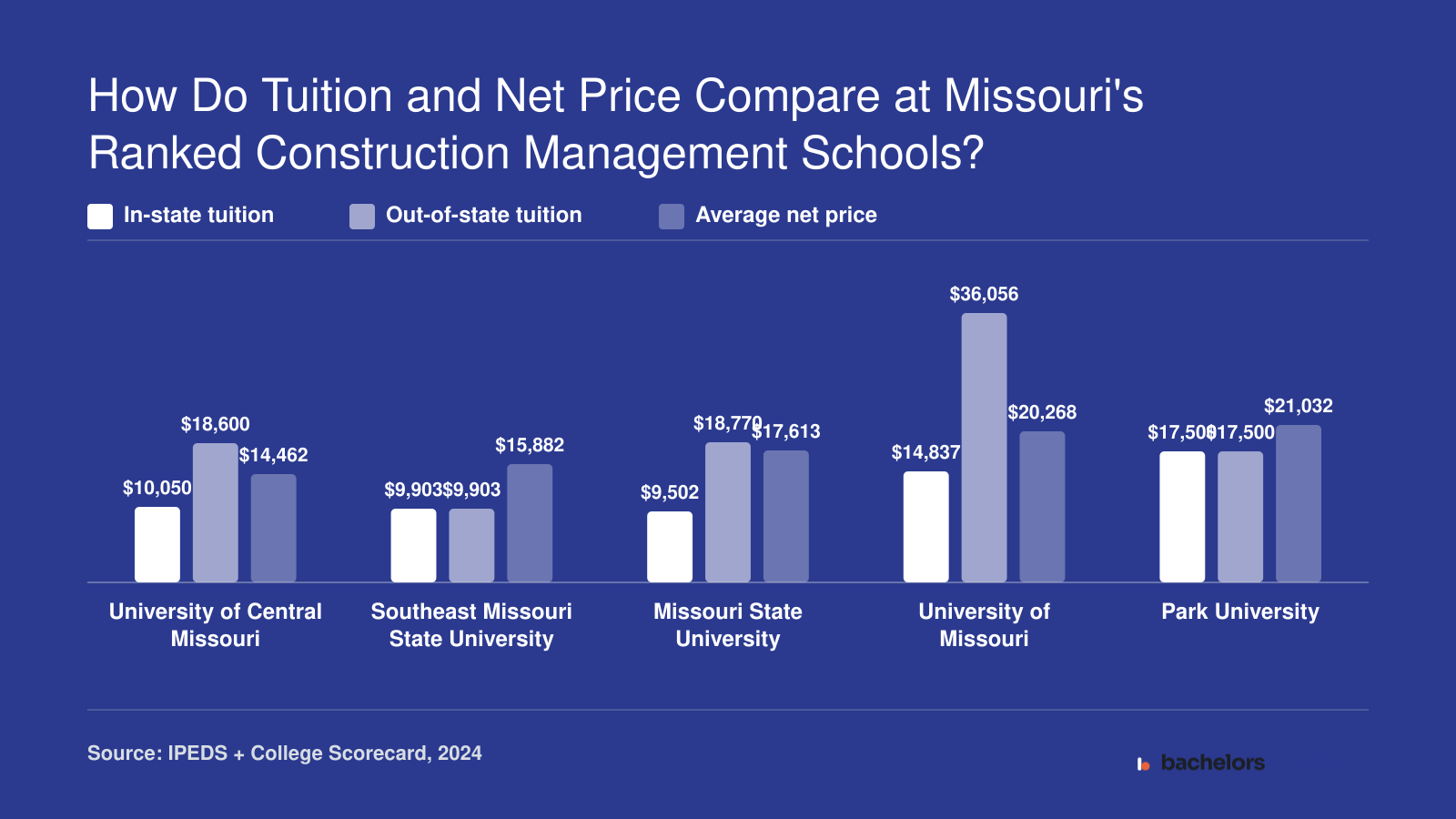
In-state tuition and fees for a bachelor's degree in construction management run from $9,502 at Missouri State University to $17,500 at Park University. Out-of-state sticker prices stretch from $9,903 to $36,056. Average net price after aid falls between $14,462 at the University of Central Missouri and $21,032 at Park.
The In-State and Out-of-State Gap
Residency matters most at the University of Missouri, where tuition and fees are $14,837 in-state and $36,056 out-of-state. Missouri State and Central Missouri sit near $18,600 to $18,770 for nonresidents, against roughly $9,500 to $10,050 for residents. Southeast Missouri State charges $9,903 regardless of residency, and Park, a private school, charges $17,500 to everyone.
Net price is an average across students who received aid, not a quote. Southeast averages $15,882, Missouri State $17,613 and Missouri $20,268. Your own bill depends on income, aid and housing.
Missouri Aid Programs
- Access Missouri: Awards of $1,750 to $3,500 a year at four-year schools, though actual amounts can be lower depending on funding and your aid package. You need a Student Aid Index of $12,000 or less, full-time enrollment (12 semester hours), no prior bachelor's degree and a 2.5 GPA to renew. It is available for up to 10 semesters.
- Bright Flight: For first-time, full-time students scoring in the top 5% on the ACT or SAT. Top 3% scorers can receive up to $3,000 a year. The schedule lists up to $1,000 for the 4th and 5th percentiles, but those tiers have not received awards because the top tier is funded first. Renewal requires a 2.5 GPA.
- A+ Scholarship: Capped at $240 per credit hour for 2026-27, but it applies to community college and vocational study. It will not cover tuition at these four-year programs, though it can help if you start at a two-year school and transfer.
School Scholarships and the FAFSA
Missouri State, Central Missouri, Southeast Missouri State and Park all say scholarships are available for their programs. Amounts and deadlines change, so check each program page and the school's financial aid office rather than assuming a construction-specific award exists. Southeast also notes eligibility for a Fast Track grant.
File the FAFSA as early as possible. Access Missouri requires it by February 1, and no later than April 1. It also opens the door to federal aid and most school awards.
Debt
Program-level figures show median debt of $20,850 for Central Missouri construction management graduates and $22,500 for Missouri State graduates. Comparable figures are not available for the other schools here.
How Do Tuition and Net Price Compare at Missouri's Ranked Construction Management Schools?
Sticker tuition and net price tell different stories. The widest gap belongs to the University of Missouri, where out-of-state tuition of $36,056 runs $15,788 above its average net price of $20,268. Southeast Missouri State charges the same $9,903 rate to residents and nonresidents. Net price is an institution-wide average for all undergraduates after grants and scholarships, not a figure specific to construction management. It also covers housing, books and other costs, so it often lands above in-state tuition.
Related Articles
Construction Management Careers and Salary in Missouri
A construction manager turns drawings and a budget into a finished building: scheduling trades, buying materials, holding the safety line, and answering to the owner when something slips. In Missouri the work pays well, and the hiring is concentrated in the state's larger metros.
What the Wage Data Shows
The most detailed Missouri numbers come from the St. Louis metro, where the Bureau of Labor Statistics counted 2,880 construction managers in May 2025, about 0.88 percent of area employment.1 Mean pay there was $57.79 an hour, or $120,210 a year.1 That is an average, so senior managers running large jobs pull it above what a newly promoted project engineer earns. For national context, BLS put the median annual wage for the occupation at $114,990 in May 2025.2 Pay climbs with the size and complexity of the projects you can run, which is why heavy industrial and health care work tends to sit at the top of the range.
What Graduates Actually Earn
Federal earnings data for these programs measures graduates, not the occupation, a different population entirely. Five years after completion, University of Central Missouri construction management graduates had median earnings of $104,389, and Missouri State University graduates had median earnings of $89,605. Those figures follow graduates wherever they work, in state or out, so read them as a signal about what a bachelor's degree in construction management is worth rather than as a Missouri salary.
Who Hires, and Where
- General contractors: the largest employer group, running commercial, institutional and multifamily projects.
- Specialty trades: mechanical, electrical and sitework firms that need managers for their own crews.
- Developers and owner's representatives: overseeing design and construction on the owner's behalf.
Residential builders hire as well, though volumes and margins differ from commercial work, and pay tends to track project size. Most people enter through the field, starting as project engineers, estimators or assistant superintendents before running their own jobs.
Outlook
BLS projects construction manager employment nationally to grow 9 percent from 2025 to 2035, from 609,100 jobs to 664,300, with roughly 49,700 openings a year as workers retire or leave the field.2 Missouri demand follows building activity in St. Louis and Kansas City, and replacement hiring makes up a steady share of it.
Licensure and Certifications for Missouri Construction Managers
Missouri asks little of construction managers by law, yet employers still lean on credentials to tell candidates apart. The state does not issue a statewide construction manager license or a general contractor license.1 Its statewide construction licensing is limited to electrical contractors.1 General contractor licensing is handled by cities and counties, which may add registration, exams, bonding and insurance.2 Check the rules wherever you plan to work.
Credentials Worth Knowing
- OSHA 30-Hour Construction card: A course-completion card from an OSHA-authorized trainer. It needs 30 hours and no prior experience.6 OSHA does not require it, but an employer, union or jobsite may.5
- LEED Green Associate: A voluntary green-building credential and a prerequisite route to LEED AP BD+C.3
- Associate Constructor (Level I): A voluntary professional certification, not a state license.4 Eligibility must match your education and experience.
- Certified Professional Constructor (Level II): The advanced voluntary credential in the same program.
- Certified Construction Manager (CCM): An experience-based credential. It takes 48 months of experience with a qualifying four-year degree, 72 months with a non-construction four-year degree, or 96 months with no degree.3 Applicants must pass the exam with at least 67% and recertify every three years.3
What to Pursue and When
OSHA 30, LEED Green Associate and the Associate Constructor credential suit students and early-career hires. The Certified Professional Constructor and CCM credentials come after field experience. No single credential here is universally required.
How Your Degree Helps
A bachelor's degree in construction management from an accredited program shortens the CCM experience requirement. The CCM accepts relevant degrees accredited by ACCE, ABET or NAAB.3 The same degree is also the usual groundwork for the constructor credentials.
Choosing the Right Missouri Construction Management School
Before you commit to a construction management program in Missouri, compare the things that actually differ between schools. The honest answer is that the right school depends on your budget, your transfer credits, and whether you plan to sit in a classroom or log in from a job site. Here is how to narrow it down.
Match the School to Your Situation
- In-state budget shopper: Weigh net price above everything else. Sticker tuition misleads; the number after aid is the one you will pay. Run the net price calculator for each Missouri school on your short list before you fall in love with a campus.
- Residential vs. commercial focus: Weigh internship access. Construction hiring in Missouri runs heavily through contractor relationships, so ask where students do their field work and whether the program places them with builders in the specialty you want.
- Transfer student: Weigh how your existing credits apply. Ask for a written credit evaluation before you enroll, and confirm which technical courses count toward the major rather than as electives.
- Online learner: Weigh delivery format, then accreditation. A program built for online delivery from the start handles lab and site-visit requirements differently than a campus program with remote sections bolted on.
A Practical Next Step
Do three things this week. Compare net price calculators side by side, confirm the program's ACCE status directly with the school, and request information from two or three programs so you get real answers instead of marketing copy. Ask each one about internship placement, credit transfer, and how online students complete hands-on work.
Find Your Program
Use the program listings on bachelorsprograms.com to request information from Missouri construction management schools and start comparing your options directly.
Compare Construction Management programs on the data that matters
Explore more Business & Management majors or browse every field of study.
All Business & Management programs Browse every field of study