Best Construction Management Schools in Utah
Compare 4 accredited Construction Management programs in Utah, with net price after aid, graduation rates, earnings and debt from IPEDS and the U.S. College Scorecard.

Construction work in Utah keeps expanding, and the jobs that run it go to estimators, schedulers and field supervisors. A bachelor's degree in construction management, most often the Bachelor of Science (B.S.) in Construction Management, is the credential that moves graduates into those seats. Brigham Young University, Utah Valley University, Weber State University and Southern Utah University all confer it.
Coursework at each leans on estimating, scheduling, contracts and field hours. What separates them is price, admission gates and how much of the work can be finished remotely. Net price after aid separates these programs more than the coursework does.
Key Points
- Brigham Young University ranks first, requiring a 300-hour work placement.
- Weber State graduates post the highest program earnings four years out.
- Utah's DOPL licenses contractors, typically requiring two years or 4,000 hours.
Best Bachelor's in Construction Management Schools in Utah, Ranked
Brigham Young University takes the top spot for a bachelor's degree in construction management in Utah, pairing the strongest completion rate in the state with a required 300-hour work placement and a deep elective menu. The four ranked schools below all award a Bachelor of Science in Construction Management or a closely related construction degree. Each card gives you in-state tuition, an approximate net price after aid, and the institution-wide graduation rate so you can weigh cost against completion.
Brigham Young University
#1Provo, UT · $15,000 – $20,000/yr (est.)
Best for: Students wanting a required industry work placement
Brigham Young University offers its construction management emphasis inside the Bachelor of Science in Construction and Facilities Management, so graduates learn the full building lifecycle as well as project delivery. The 85- to 86-credit degree requires a 300-hour construction work placement, a senior seminar, and structured advisement, with electives in virtual design and construction, real estate development, and risk management. In-state tuition is about $6,700 a year and the average net price after aid is roughly $15,600. The institution-wide graduation rate is about 81%, the highest among the Utah schools in this ranking.
- 85 to 86 total credit hours
- Requires 300 hours of construction work experience
- Only 9 credits below a C- allowed
- Choose from 27 program electives
- Electives include virtual design and construction and risk management
- Experiential learning and a senior seminar required
- Ethics emphasized among program learning outcomes
Utah Valley University
#2Orem, UT · $5,000 – $10,000/yr (est.)
Best for: Career changers targeting heavy civil construction
Utah Valley University runs its Bachelor of Science in Construction Management through the Clyde Institute of Construction Management, with a 120-credit structure built from general education, a 76-credit discipline core, and 14 elective credits. Students choose a 15-credit specialization in Heavy/Civil or Commercial/Residential and finish with a senior capstone and a one-credit internship that can be replaced by an upper-division elective for students with management experience. In-state tuition is about $6,500 a year and the average net price after aid is roughly $6,400, the lowest total on this list. The institution-wide graduation rate is about 45%.
- 120 total credit hours
- 15-credit specialization in Heavy/Civil or Commercial/Residential
- 2.0 GPA minimum, with no core grade below C-
- Senior capstone required
- One-credit internship, waivable with management experience
- Lab exercises and site visits built into coursework
- Building information modeling coursework
- Construction Industry Seminar taken twice
Weber State University
#3Ogden, UT · ~$10,000/yr (est.)
Best for: Working professionals needing evening and online classes
Weber State University's construction management bachelor's degree covers project management, cost estimation, contract administration, safety, and quality control, the core skills behind project manager, estimator, site superintendent, and safety manager roles. Courses meet in the evening in person and online, which lets working professionals stay on the job while they finish the degree, and the department guides students through preparation for the Associate Constructor exam. In-state tuition is about $6,600 a year and the average net price after aid is roughly $10,300. The institution-wide graduation rate is about 46%.
- Evening in-person and online course options
- Guidance preparing for the Associate Constructor exam
- Students can join the Sigma Lambda Chi honor society
- Coursework in estimating, scheduling, and contract administration
- Safety and quality control coursework
- Prepares students for project manager and site superintendent roles
Southern Utah University
#4Cedar City, UT · $7,000 – $21,000/yr (est.)
Southern Utah University lists ABET accreditation for its Bachelor of Science in Construction Management, which blends project management and budgeting coursework with hands-on lab work. Students pick from five emphases: general construction, AI and data analytics, business and project finance, surveying and geospatial technologies, and heavy civil and infrastructure. The construction lab has students working on real project homes, and students also get access to the Thunderworks Makerspace. In-state tuition is about $7,000 a year, the average net price after aid is roughly $10,500, and the institution-wide graduation rate is about 61%.
- Lists ABET accreditation
- Five emphases, from general construction to heavy civil
- AI and data analytics emphasis option
- Business and project finance emphasis option
- Surveying and geospatial technologies emphasis option
- Students work on real project homes in the construction lab
- Access to the Thunderworks Makerspace
- Prepares graduates for project engineer and general contractor roles
Cost & outcomes by school
Federal data for the highest-earning Construction Management programs, independent of the ranking above. Earnings are this field's bachelor's graduates four years after completing where the Scorecard reports them, else the school's undergraduate median.
| School | Net price / yr | Grad rate | Earnings | Debt | Grads/yr | Format |
|---|---|---|---|---|---|---|
| Weber State University UT | $10,258 | 46% | $105,738 | $15,928 | 18 | Campus |
| Brigham Young University UT | $15,564 | 81% | $98,073 | $12,364 | 98 | Campus |
| Utah Valley University UT | $6,376 | 45% | $55,486 | $14,750 | 84 | Campus |
| Southern Utah University UT | $10,462 | 61% | $50,296 | $12,500 | — | Campus |
Sources: U.S. Department of Education. Net price, graduation rate, earnings and debt: College Scorecard (earnings and debt for this field's bachelor's graduates where reported, else school-wide); graduates: IPEDS. A dash means no figure is reported.
Cost, debt & payoff
Median earnings of this field's bachelor's graduates (4 yrs after completing, else the school's undergraduate median) vs. their median federal loan debt · U.S. College Scorecard
Across these programs the median graduate earns about $76,780 and finishes with roughly $13,625 in debt — a ratio that clears a common rule of thumb (keep debt below first-year salary). Net price and debt vary widely school to school, so check the per-school figures in the table above before you shortlist.
How We Ranked Utah Construction Management Schools
The cheapest program and the strongest program are rarely the same one, so this ranking weighs cost against outcomes rather than crowning a single winner. Four factors decided the order, and each is spelled out below.
What we looked at
- Federal outcomes data: Graduation rates, student debt, and post-enrollment earnings from the U.S. Department of Education's College Scorecard.
- Price: Published in-state tuition alongside average net price, which shows what students actually pay once financial aid is applied.
- Programmatic accreditation: Whether the construction management degree carries recognition from a specialized accreditor, which matters to employers and to some certification paths.
- Delivery format: Whether coursework runs on campus in Provo, Orem, Ogden, or Cedar City, or whether online and hybrid scheduling is available for students already working in the trades.
What the numbers can and cannot tell you
Graduation rate, net price, and institution-wide earnings describe the university as a whole, not the construction management department specifically. A large school with a strong engineering and technology college can still post modest campus-wide figures, and the reverse happens too.
Where the Scorecard publishes earnings and debt for the construction management field itself, we use those program-level figures instead, because they are far more relevant to your decision. Where it does not, we say so rather than guess. Treat the order below as a starting point for your own shortlist.
Online and Hybrid Bachelor's Options at Utah Schools
Can you earn a construction management bachelor's degree online in Utah? None of the ranked programs is fully online. At the Utah schools ranked here, the bachelor's is built around campus instruction, so a student who needs 100% remote delivery should plan on attending in person at least part of the time.
On-Campus Delivery at the Utah Schools Ranked Here
Brigham Young University, Utah Valley University and Southern Utah University all list construction management as a campus program. UVU's degree leans on hands-on lab work and site visits in Orem, and Southern Utah emphasizes lab tools and its makerspace in Cedar City. None of the three describes a hybrid or fully online bachelor's in the field.
Weber State: Evening Classes Plus Some Online Coursework
Weber State comes closest to a flexible format. Its B.S. in Construction Management runs as an evening, in-person program in Ogden, with some online or virtual courses aimed at working professionals. Weber also offers a fully online Construction Management Certificate, and those credits can apply toward an associate or bachelor's degree. Treat the certificate as a stepping stone rather than a separate online bachelor's completion path.
A Practical Tip for Working Students
Before you register, ask an advisor two questions: whether the online or virtual sections you want count toward the B.S., and how certificate credits would slot into the degree. Getting both answers in writing keeps an evening schedule from quietly turning into a longer timeline.
Admissions: GPA, Test Policy, and Transfer Credit at Utah Schools
Some Utah schools admit you once, at the university level; others admit you first to the university, then review you again before you can register for upper-division construction courses. Knowing which model applies where saves a semester of guesswork.
GPA and Test Standards by School
- Southern Utah University: A 2.00 minimum GPA, with SAT or ACT scores listed among the requirements for the construction management bachelor's degree.1
- Weber State University: A 2.0 cumulative GPA for admission to the major, alongside the program's course requirements, as cataloged for 2024-2025.
- Utah Valley University: The 2026-2027 catalog lays out the degree, including 40 upper-division credits, but publishes no separate program GPA or test-score rule; admission runs through the university's undergraduate application.
- Brigham Young University: A private university, BYU sets its own undergraduate admission standards, so check its admissions page directly for current GPA and testing expectations.
Weber State's current test-score policy for the major is not spelled out on its program materials, so confirm with an advisor whether scores are needed.
Moving Credits From a Two-Year Program
Utah community college courses numbered 1000 and above generally carry to the state's four-year schools as general education, major, or elective credit. Courses below 1000 do not transfer. Students arriving with at least 30 credits at the 1000 level typically do not need to send high school transcripts or ACT/SAT scores. Weber State accepts associate degrees on both the applied and transfer tracks toward the construction management bachelor's, and completing a general education certificate before you move can reduce the credits you still owe.
Program-Specific Steps to Watch
Weber State requires a C or better in all major, business, and support courses on top of the 2.0 cumulative GPA before you enter the program, so a low grade in a business class can stall you even when your overall average looks healthy. Treat community college transfer plans as planning tools rather than official degree audits, and have an advisor at both schools confirm which credits count.
Questions to Ask Yourself
Do you want to start at a community college and transfer, or enroll directly in a bachelor's program?
Do you need an online or hybrid format, or can you commute to campus?
Which segment of the industry do you want to work in: heavy civil, commercial, or residential?
Earnings, Debt, and Return on Investment by Program
Does a construction management bachelor's degree in Utah earn enough to justify the debt?
Earnings, four years out
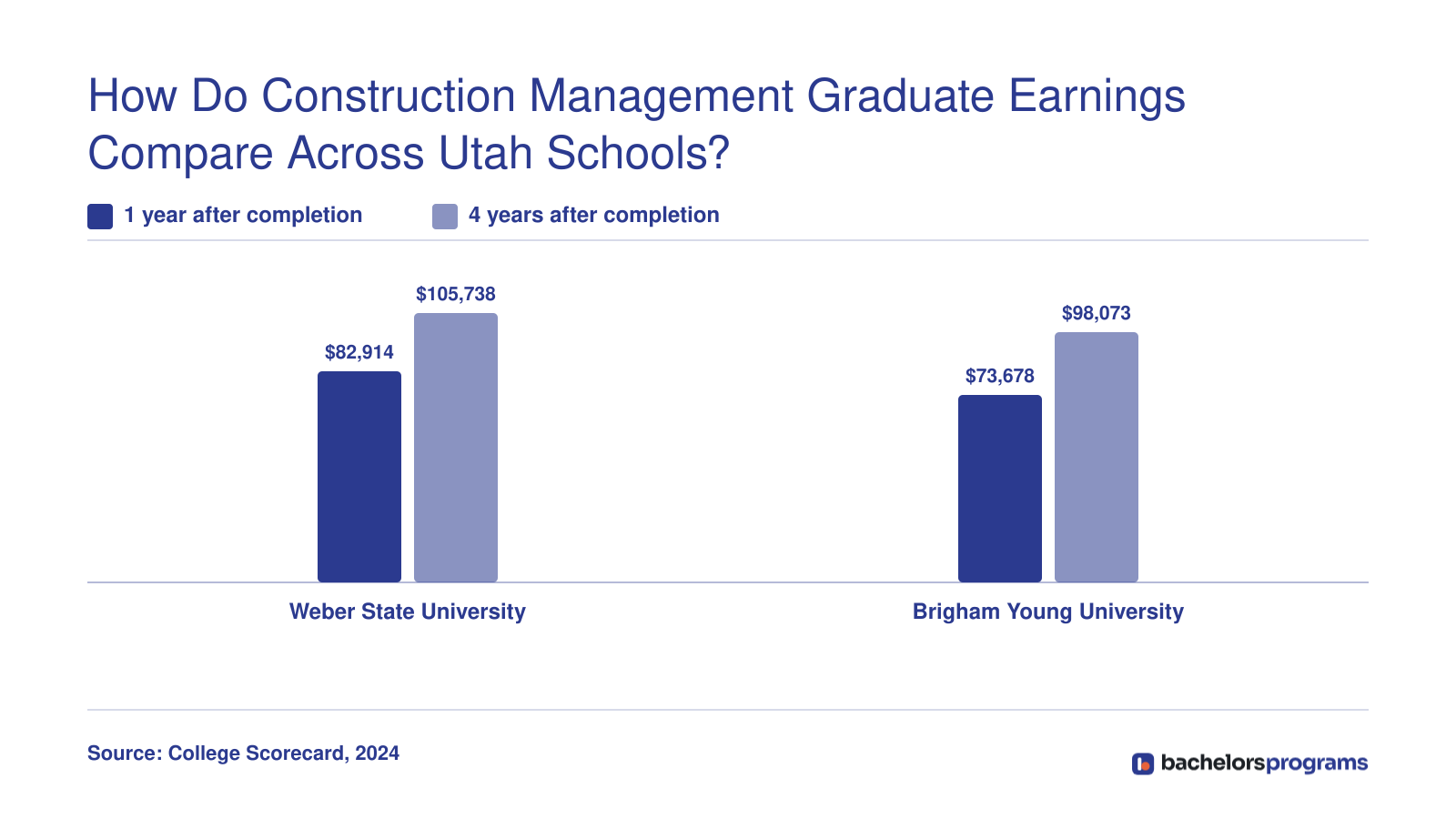
Weber State University reports the highest program-level earnings figure on this page: graduates of its construction management program earned a median $105,738 four years after completion, and $82,914 one year out. Brigham Young University reports $98,073 four years after completion, $93,016 at five years, and $73,678 one year after finishing. Utah Valley University and Southern Utah University do not report program-level earnings, so there is no earnings figure to compare for those two programs.
Debt on the other side
BYU graduates carry a median $12,228 in federal student debt, against roughly $15,000 at Weber State. Pairing the second-highest four-year earnings with the smallest debt load gives BYU the strongest earnings-to-debt balance among the schools ranked here. Weber State still comes out well ahead once its higher debt is subtracted from its higher earnings.
What Program Size Tells You
Completions show how many students actually finish in a given year: BYU awards roughly 62 construction management bachelor's degrees, Southern Utah University about 33, and Weber State about 12. A larger cohort usually means more course sections, a deeper alumni network, and steadier employer recruiting on campus.
Borrowing stays modest at every Utah school here, so the earnings gap between programs drives most of your return.
How Do Construction Management Graduate Earnings Compare Across Utah Schools?
This chart compares median earnings for bachelor's degree in construction management graduates at Weber State University and Brigham Young University, measured at the same points: one year and four years after completing the program. Weber State graduates post the higher median at both points, and both programs show strong growth between the first and fourth year. Utah Valley University and Southern Utah University do not have program-level earnings reported in federal data, so they are left out of the chart.
Related Articles
Construction Management Careers and Pay in Utah
A bachelor's degree in construction management leads to well-paid, in-demand work in Utah, even though the state's median pay trails the national figure.
Common Job Paths
Graduates of the programs at Brigham Young University, Utah Valley University, Weber State University, and Southern Utah University typically start in field and office roles that feed the construction manager title:
- Project engineer: Handles submittals, RFIs, schedules, and documentation for a project team.
- Assistant project manager: Supports budgets, subcontractor coordination, and owner communication.
- Estimator: Prices bids from plans and quantity takeoffs.
- Superintendent: Runs daily jobsite operations, safety, and sequencing, usually after field experience.
The degree supplies the technical base for these roles: scheduling, cost control, contracts, and building systems. Internships and co-ops are where the degree turns into a job offer. A summer or semester on a real jobsite often leads straight to a project engineer or estimating offer, and employers weigh that experience heavily.
Wages and Demand
Bureau of Labor Statistics data for May 2025 puts Utah's median construction manager wage at $105,200 a year, or $50.58 an hour.1 Nationally, the median is $114,990, with the middle range running from $88,550 at the 25th percentile to $151,640 at the 75th.2 The lowest tenth earn under $69,690 and the top tenth earn above $189,440.2 Those are experienced managers, not entry-level hires, so expect new graduates to start below these medians.
Nationally, BLS projects 9% employment growth from 2025 to 2035, much faster than average, with about 49,700 openings a year.3 Utah's own state projections show roughly 7,667 construction manager jobs rising to 8,754, about 1.42% growth a year, with around 710 openings annually.4 The state data does not state its projection years, so treat it as a sign of steady demand rather than a direct match for the national rate.
Putting Program Earnings in Context
When you compare the Scorecard earnings for the schools ranked here, measure them against these benchmarks. Early-career pay will sit below the statewide median, and the gap closes as you move from project engineer toward project manager and superintendent.
Utah Contractor Licensing at a Glance
Utah Construction Management Degree FAQs
What is the best construction management school in Utah?
Can I transfer from a Utah community college to a Utah bachelor's program in construction management?
Do I need a bachelor's degree to become a construction manager in Utah?
How long does a bachelor's degree in construction management take?
Compare Construction Management programs on the data that matters
Explore more Business & Management majors or browse every field of study.
All Business & Management programs Browse every field of study