Best Construction Management Schools in Virginia
Compare 6 accredited Construction Management programs in Virginia, with net price after aid, graduation rates, earnings and debt from IPEDS and the U.S. College Scorecard.

What does a bachelor's degree in construction management actually lead to in Virginia? The degree usually appears as a Bachelor of Science (B.S.) in Construction Management, though the schools here also teach the field through engineering, engineering technology and business routes.
The work is varied. Northern Virginia brings commercial and federal-adjacent building, Hampton Roads has shipyard, port and infrastructure projects, and Richmond adds institutional and public-sector construction.
The real decision is which route fits you. A title like "construction engineering and management" or "civil engineering technology" can lead to similar jobs, but the coursework, accreditation and format differ.
Key Points
- Virginia Tech construction graduates reach a $95,165 median after four years.
- Liberty University offers a fully online construction management concentration requiring 120 credits.
- Virginia's Class A contractor license covers single contracts of $120,000 and up.
Best Construction Management Schools in Virginia: Our Ranked List
Construction management in Virginia is taught three ways: as a standalone degree, as a concentration inside civil engineering, and as an online business degree with a construction cognate. Each of the six programs below takes a different route to the same job site, and the notes on each entry point out the credit load, the capstone or thesis requirement, and the kind of student the program suits.
Virginia Polytechnic Institute and State University
#1Blacksburg, VA · $25,000/yr (est. net price)
Best for: Future builders wanting a dedicated construction school
Virginia Tech anchors this list with the Myers-Lawson School of Construction, where construction is treated as its own discipline rather than an add-on to a civil engineering degree. Undergraduates in Construction Engineering and Management pair engineering fundamentals with business and management coursework, and can add a Construction Safety Leadership major. The university reports a four-year graduation rate of about 86 percent, among the strongest on this list.
- ABET-accredited blend of civil engineering and building construction
- Offered through the Myers-Lawson School of Construction
- Optional Construction Safety Leadership major
- Engineering and business management focus areas to tailor the degree
- Prepares graduates for Professional Engineering licensure
University of Virginia
#2Charlottesville, VA · $22,000/yr (est. net price)
Best for: Engineers who want a research thesis
The University of Virginia folds construction management into its civil engineering department, where the Construction Engineering and Management concentration sits inside the B.S. in Civil Engineering. Students take hands-on laboratories and computer modeling courses, then finish with a required senior thesis built around a real project. It is the most selective campus on this list, admitting well under one in five applicants.
- 128-credit civil engineering degree with a construction management focus
- Required senior thesis built around a real infrastructure project
- Hands-on laboratories and computer modeling coursework
- 2.0 GPA minimum to stay in the program
- Prepares graduates for Professional Engineer licensure
George Mason University
#3Fairfax, VA · $15,000 – $20,000/yr (est.)
Best for: Washington-area students eyeing urban projects
George Mason puts its construction focus inside a civil and infrastructure engineering degree, a fit for students who want to build in the fast-growing Northern Virginia corridor. Coursework covers construction systems, administration, building information modeling, estimating and scheduling, and a two-semester senior design project serves as the capstone. A Green Leaf designation reflects the program's sustainability emphasis, and the surrounding region supplies a steady mix of urban, suburban and exurban projects.
- 123-credit ABET-accredited civil and infrastructure engineering degree
- Courses in construction systems, administration, BIM, estimating and scheduling
- Two-semester senior design project as the capstone
- Green Leaf designation for sustainability in design
- Technical electives in construction plus five other specialties
Liberty University
#4Lynchburg, VA · ~$29,000/yr (est.)
Liberty is the flexible option here: its construction management cognate sits inside an online business administration and data analysis degree, so students study estimating and project management alongside finance, marketing and operations. The 120-credit program is built for working adults and strongly recommends an internship for hands-on experience. It is the only fully online entry on this list.
- 120-credit online business degree with a construction management cognate
- Courses in construction fundamentals, materials, methods and cost estimating
- Internship strongly recommended for hands-on experience
- Minimum C in upper-level courses and a 2.0 GPA overall
- Courses taught from a Christian worldview
Old Dominion University
#5Norfolk, VA · $13,000 – $34,000/yr (est.)
Old Dominion houses its Construction Management concentration in the civil engineering technology department, which gives the degree a hands-on, application-first flavor. Students take scheduling, project management, cost estimating and sustainable building courses, then finish with a senior design capstone. Distance learning options and community college transfer pathways make it workable for people already in the trades, and the university reports a four-year graduation rate of about 46 percent.
- ABET-accredited civil engineering technology degree
- Construction management concentration with scheduling and cost estimating
- Senior design capstone required
- Prepares graduates for the Fundamentals of Engineering exam
- Distance learning options and community college transfer pathways
Norfolk State University
#6Norfolk, VA · ~$15,000/yr (est.)
Norfolk State offers a standalone Construction Management Engineering Technology degree rather than a concentration inside a civil engineering program, and it is the only historically Black university on this list. The 121-credit curriculum runs from building codes and architectural drafting through surveying, cost estimating and steel structures, with management courses in scheduling, supervision and labor relations. A capstone project and a minimum grade of C in every course keep the standards explicit.
- 121-credit construction management engineering technology degree
- Building codes, architectural drafting, surveying and cost estimating
- Statics, strength of materials and steel structures coursework
- Management courses in scheduling, supervision and labor relations
- Capstone project and a minimum grade of C in every course
Cost & outcomes by school
Federal data for the highest-earning Construction Management programs, independent of the ranking above. Earnings are this field's bachelor's graduates four years after completing where the Scorecard reports them, else the school's undergraduate median.
| School | Net price / yr | Grad rate | Earnings | Debt | Grads/yr | Format |
|---|---|---|---|---|---|---|
| Virginia Polytechnic Institute and State University VA | $24,953 | 86% | $95,165 | $27,000 | 120 | Campus |
| University of Virginia VA | $21,565 | 96% | $86,863 | $17,500 | — | Campus |
| George Mason University VA | $17,915 | 68% | $76,343 | $19,500 | — | Campus |
| Old Dominion University VA | $14,638 | 46% | $54,914 | $24,000 | — | Campus |
| Liberty University VA | $29,357 | 65% | $44,813 | $24,500 | — | Online |
| Norfolk State University VA | $15,282 | 39% | $44,666 | $29,000 | — | Campus |
Sources: U.S. Department of Education. Net price, graduation rate, earnings and debt: College Scorecard (earnings and debt for this field's bachelor's graduates where reported, else school-wide); graduates: IPEDS. A dash means no figure is reported.
Cost, debt & payoff
Median earnings of this field's bachelor's graduates (4 yrs after completing, else the school's undergraduate median) vs. their median federal loan debt · U.S. College Scorecard
Across these programs the median graduate earns about $65,629 and finishes with roughly $24,250 in debt — a ratio that clears a common rule of thumb (keep debt below first-year salary). Net price and debt vary widely school to school, so check the per-school figures in the table above before you shortlist.
How We Ranked Bachelor's Degree in Construction Management Programs
The programs on this list take three recognizable shapes: Virginia Tech's engineering-based construction engineering and management degree, Old Dominion's civil engineering technology track, and Liberty's online business administration concentration in construction management.
The Factors Behind the Ranking
Accreditation comes first. ACCE accredits construction management programs, ABET covers engineering and engineering technology, and ACBSP covers business schools. Knowing which body a program answers to tells you how much calculus and structural coursework to expect.
Cost comes next. Net price is what a first-year student pays on average after grants and scholarships. It is published for the whole institution, so treat it as a school-level figure rather than a price tag for one major.
Outcomes round it out: graduation rates, completions, and whether a program publishes the internship and employer partners it places students with. Internship access matters in a field that hires on experience as much as coursework, so a program that names its general contractors and builders ranks above one that does not. Graduation rate is school-wide too. Earnings and debt are the program-level numbers.
Reading the Numbers Correctly
A salary labeled four years after finishing measures the graduating class four years out. It is not a starting salary, and it is not the school's average across all majors. Keep school-wide graduation rates and program-level earnings in separate boxes; they describe different groups of students.
Which Type Fits Which Goal
- Bachelor of Science in Construction Management: the straightest route into estimating, scheduling, and project delivery.
- Construction engineering and management: heavier math and structural coursework; suits large infrastructure and design-build employers.
- Business-school concentration: best for development, finance, or eventually running a firm.
ACCE vs. ABET vs. ACBSP: Accreditation and Specializations Across Virginia Schools
Three accreditors matter here. ACCE (American Council for Construction Education) certifies construction education programs, so it is the most direct signal for a construction management degree. ABET accredits engineering and technology programs, which matters if you are looking at construction engineering and management or civil engineering routes. ACBSP accredits business programs, which is relevant when construction management sits inside a business degree.
Accreditation by School
- Virginia Tech (Building Construction): ACCE-accredited.
- Virginia Tech (Construction Engineering and Management): ABET-accredited, through the Engineering Accreditation Commission for the engineering side and the Applied and Natural Science Accreditation Commission for management.
- Liberty University (Business Administration and Data Analysis: Construction Management): ACBSP-accredited. ACCE and ABET: not listed.
- Norfolk State University (Construction Management Engineering Technology): accredited by the Association of Technology, Management and Applied Engineering (ATMAE), not ACCE, ABET or ACBSP.1
- University of Virginia, George Mason University, Old Dominion University: no ACCE, ABET or ACBSP accreditation for these specific programs appears in the results we verified.
Does Virginia have ACCE-accredited programs? Yes. Virginia Tech's Bachelor of Science in Building Construction carries ACCE accreditation, and it is the only ACCE listing among the verified results for the schools here.
Specialty Tracks
Virginia Tech's construction engineering and management degree offers two named tracks: Construction Engineering and Management and Construction Safety Leadership. Liberty's online program does not label formal tracks, but its coursework covers cost estimating, project oversight, construction materials and methods, and project management for construction. Norfolk State's program page identifies no tracks or concentrations.1
No school here publishes a dedicated commercial, residential, infrastructure or sustainability track in the information we reviewed. George Mason's program is a civil and infrastructure engineering degree, so infrastructure is its broader focus. If one of those niches matters to you, ask the department which electives and employer connections support it.
Online and Hybrid Construction Management Bachelor's Options at Virginia Schools
Liberty University is the Virginia school here that delivers a construction management bachelor's fully online. Its Business Administration & Data Analysis (B.S.) with a Construction Management concentration runs online, requires 120 credit hours and a 2.0 minimum GPA, and requires a C in upper-level courses. The degree is business-based rather than engineering-based.
Campus-Only Programs
The remaining programs are campus-based:
- Virginia Tech: The Bachelor of Science in Construction Engineering and Management and the Bachelor of Science in Building Construction are both in-person in Blacksburg, with classroom instruction, labs, field trips and guest lectures.
- Norfolk State University: The Bachelor of Science in Construction Management Engineering Technology (121 credits) is in-person.1
- University of Virginia, George Mason University and Old Dominion University: Each delivers its program on campus. Old Dominion's program notes distance learning opportunities for technical personnel, but it is not an online bachelor's.
None of these schools describes a hybrid bachelor's option. Individual courses may be offered differently, so confirm with each department.
Who Each Format Suits
Working tradespeople who cannot relocate or step off a job site will find Liberty's online format the practical fit. Full-time students who want labs, faculty access and a campus network will get more from the in-person programs.
Field Exposure in Online Formats
Online coursework rarely replaces time on a job site. Liberty strongly recommends an internship rather than requiring one, so online students should arrange their own placement. Old Dominion lists internship and co-op opportunities, and Norfolk State highlights hands-on work with local construction management companies.1 Virginia Tech describes internships and co-ops as opportunities, not graduation requirements.
Related Articles
Cost of a Construction Management Bachelor's Degree in Virginia
Virginia's average in-state tuition and fees for 2026-27 is $15,356, up $510 (3.4%) from last year. School-level figures below are the most recent federally reported numbers, so treat them as approximate and confirm current rates with each bursar.
Tuition and Net Price at the Schools Ranked Here
Published in-state tuition and fees across the six schools here range from $10,180 at Norfolk State University to $22,465 at Liberty University. Net price, an institution-wide average after grants rather than a construction-specific figure, starts at $14,638 at Old Dominion University and reaches $29,357 at Liberty.
- Norfolk State: $10,180 tuition, $15,282 net price
- Old Dominion: $12,750 tuition, $14,638 net price
- George Mason: $14,220 tuition, $17,915 net price
- Virginia Tech: $15,948 tuition, $24,953 net price
- UVA: $21,803 tuition, $21,565 net price
- Liberty: $22,465 tuition, $29,357 net price
Virginia Aid for Undergraduates
The Commonwealth Award is need-based aid at public colleges. There is no separate application: file the FAFSA or VASA by your college's deadline. Amounts vary by school and cannot exceed tuition and required fees. The Virginia Guaranteed Assistance Program (VGAP) adds support for full-time Virginia high school graduates with at least a 2.5 GPA, and the neediest students receive at least tuition.
At eligible private nonprofits, the Virginia Tuition Assistance Grant (VTAG) pays up to $5,250 a year for on-campus study in 2026-27, or $2,625 per term, and $3,400 for distance learners. The priority deadline is September 15, 2026; applications through December 1 are funded only if money remains. Confirm with Liberty whether its online program qualifies.
Debt and Ways to Spend Less
Institution-wide median graduate debt ranges from $17,500 at UVA to $29,000 at Norfolk State. Virginia Tech's construction engineering and management graduates report a $27,000 median. Your own borrowing will depend on your aid package.
- Stay public and in-state: Norfolk State and Old Dominion carry the lowest sticker prices here.
- Start at a Virginia community college: Old Dominion lists transfer pathways, and a $1,000 state Transfer Grant rewards qualifying associate degree completers.
- Earn while you learn: Paid co-ops, offered at Old Dominion, offset living costs.
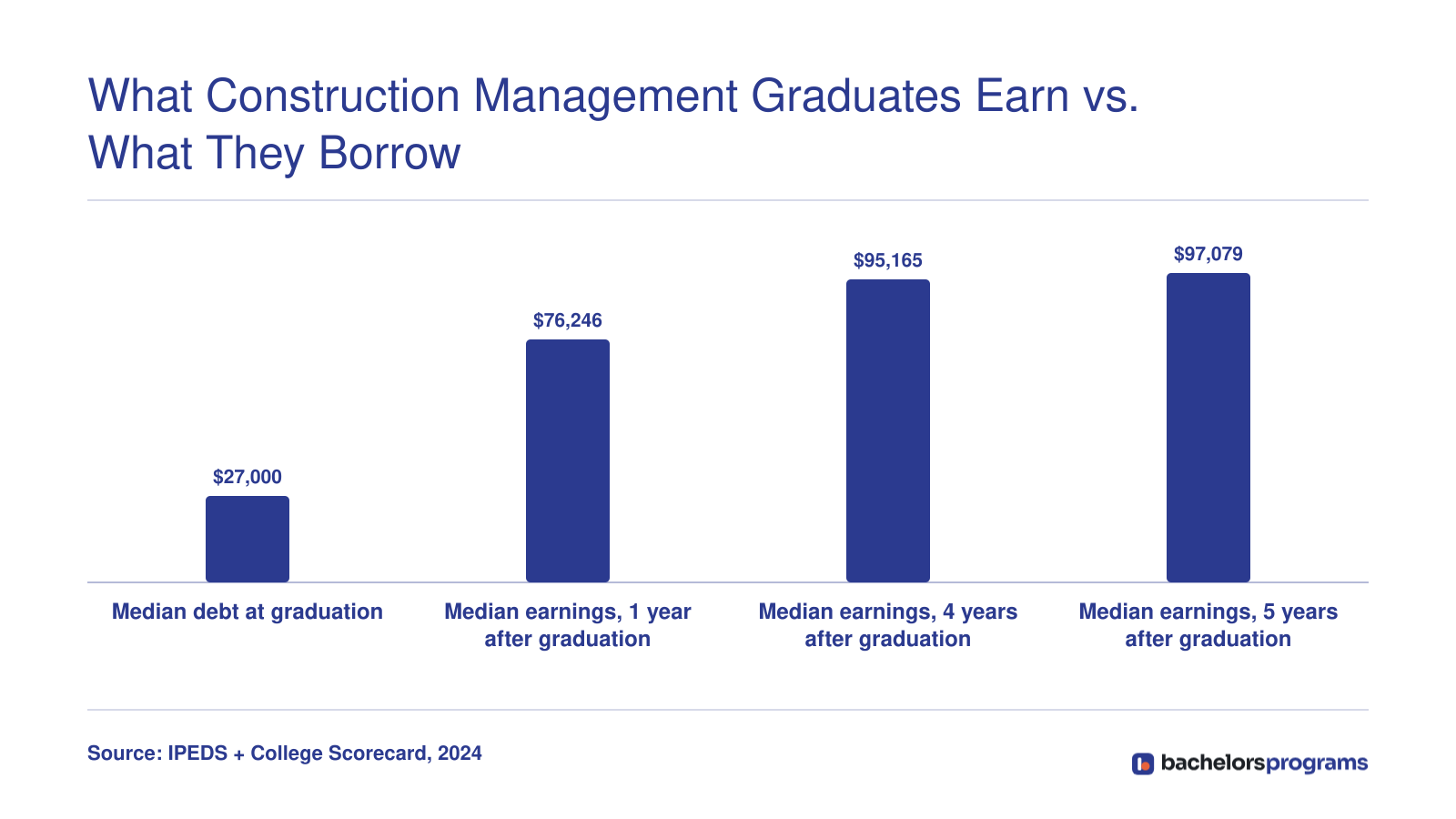
What Construction Management Graduates Earn vs. What They Borrow
Virginia Tech's Construction Engineering and Management bachelor's has published program-level earnings and median debt, so it anchors this comparison. Graduates earn a median of $76,246 one year after finishing, $95,165 after four years and $97,079 after five years, against median debt of $27,000. Among the schools ranked here, Virginia Tech shows the strongest documented earnings-to-debt balance, with first-year earnings about 2.8 times what the typical graduate borrows.
Internships, Employers and Careers for Construction Management Graduates in Virginia
Internships and Employer Networks by School
Virginia Tech's Construction Engineering and Management program draws on a career fair held each fall and spring for undergraduate and graduate students. Employers there recruit for internships, co-ops, part-time roles and full-time jobs. They span residential, commercial, industrial, highway, land-development and specialty-contractor work. Information sessions, resume books and student group partnerships add more routes to recruiters.
The University of Virginia runs an Internship Placement Program with set structures. A semester internship is 10 hours a week for 15 weeks, a summer internship is 20 hours a week for 8 weeks, and a 1-credit seminar accompanies it. Old Dominion University accepts construction management students into internships open to engineering-related majors and hosted a spring career fair on March 26, 2026.
Employer examples include Allan Myers (heavy-civil, 3 to 6 month internships), NVR/Ryan Homes (a paid 12-week construction management internship, driver's license required) and Shawmut Design and Construction, which strongly prefers prior construction experience. Treat these as examples of what employers post, not guarantees of a placement.
Job Titles and Where They Cluster
Typical entry titles include assistant project manager, estimator, field engineer, project engineer and superintendent. Hiring tends to concentrate in Northern Virginia, Richmond and Hampton Roads, with Charlottesville and the New River Valley supplying smaller markets near their campuses.
How to Ask a Program About Placement
For Liberty University, George Mason University and Norfolk State University, start by confirming whether an internship is required for graduation. Then put these questions to any program:
- Internship rate: What share of students complete at least one internship before graduating?
- Career fairs: How many are held each year, and are construction firms present?
- Recruiters: Which general contractors, heavy-civil firms and federal contractors hired graduates in the last two years?
- Support: Does career services offer resume books, site visits or alumni introductions?
Specific employer names and recent hire counts say more than a general placement claim.
How Much Construction Managers Make in Virginia
Construction managers earn well above typical U.S. wages, and Northern Virginia appears to pay more than the national figure.
Virginia Contractor Licensing and Construction Manager Certifications at a Glance
Construction Management Schools in Virginia: Common Questions
Accreditation, delivery formats and licensing rules change over time, so check each point below against the source before you apply. These answers show you where to look.
Does Virginia have ACCE accredited construction management programs, and can I earn the degree online?
Do I need a license to work as a construction manager in Virginia?
Can I transfer from a community college into a construction management bachelor's program?
Where can I find ongoing career and program information?
Compare Construction Management programs on the data that matters
Explore more Business & Management majors or browse every field of study.
All Business & Management programs Browse every field of study