Best Engineering Technology Degree Programs
Compare 350+ accredited Engineering Technology programs at 210+ colleges, with net price after aid, graduation rates, earnings and debt from IPEDS and the U.S. College Scorecard.

Engineering technology hands you a hands-on, employable degree, but it can narrow the licensure path unless you plan for it. A bachelor's degree in engineering technology, usually the Bachelor of Science (B.S.) in Engineering Technology, is built around applied work, with labs in testing, manufacturing, controls, and field implementation rather than theoretical design.
That applied focus is the draw. Graduates tend to move into roles such as automation technologist, quality engineer, or manufacturing specialist, where they make existing systems run better.
The trade-off is that accreditation, state licensing rules, and employer expectations vary, so two programs with the same title can lead to different careers.
Key Points
- A bachelor's in engineering technology typically requires 120 to 128 semester credits.
- Engineering licensure for technology graduates varies by state and often takes longer.
- Strong online and hybrid programs build in a deliberate plan for labs.
Best Engineering Technology Schools at a Glance: Our Top 10
Below are ten engineering technology schools, ordered by our ranking and spanning campus, hybrid and fully online formats, so you can compare options without filtering by delivery mode first. Each card gives the school's location, format, net price and institution-wide graduation rate, then the program specifics that make the degree distinct.
Purdue University
#1West Lafayette, IN · ~$15,000/yr (est.)
Best for: Robotics and mechatronics lab enthusiasts
Purdue Polytechnic delivers its engineering technology bachelor's degree across statewide Indiana locations, including Anderson, Columbus, Kokomo, New Albany, Richmond and South Bend, so students can stay near home while earning the same credential. A 37-credit concentration in technology integration, robotics or mechatronics sits alongside applied statics, strength of materials, manufacturing systems and a two-course senior capstone. Purdue has widened its industry-engagement model to cover sponsored capstone projects, internships, applied research and donated equipment, and a partnership with Rittal and Eplan added electrical engineering technology and technology-manufacturing labs with scholarships and internships attached.
- 120 credits: 49 major, 34 program, 37 concentration
- Concentrations in Technology Integration, Robotics or Mechatronics
- Two-course senior capstone sequence required
- 2.0 graduation GPA; each course attempt limited to three
- Offered at statewide Indiana locations including Anderson and Columbus
- Civics literacy and intercultural or professional requirements apply
- Core includes applied statics, strength of materials, quality control
- At least 32 semester hours of junior-level resident study required
Farmingdale State College
#2Farmingdale, NY · $11,000/yr (est. net price)
Best for: New York commuters seeking applied technical degrees
Farmingdale State College, which describes itself as SUNY's largest college of applied science and technology, houses its engineering technology degrees in the Pasternack School of Engineering Technology on a Long Island campus. Undergraduates choose electrical, computer or construction management engineering technology, and each track pairs laboratory practice with coursework in semiconductors, embedded systems or project estimating. The electrical option is ABET accredited and structured to lead toward Professional Engineer licensure, while the construction track adds internships, occupational health and safety training and advanced construction techniques. Modest SUNY tuition keeps the total cost of attendance low for in-state students.
- ABET-accredited BS in the Pasternack School of Engineering Technology
- Prepares graduates for Professional Engineer licensure
- Careers in electronics, semiconductors and signal processing
- Coursework also covers renewable energy and power
- Balanced practical and theoretical training on campus
- ABET-accredited BS with internships and industry connections
- Coursework in project planning and estimating techniques
- Occupational health and safety training included
- Prepares students for Professional Engineer licensure
- Career paths include construction manager and project engineer
- Covers logic design, embedded systems and networks
- Prepares students for hardware and software roles
- Leads toward Professional Engineer licensure
- Part of the Pasternack School of Engineering Technology
Brigham Young University-Idaho
#3Rexburg, ID · ~$8,000/yr (est.)
Best for: Aspiring production managers seeking hands-on training
BYU-Idaho maps its manufacturing engineering technology bachelor's degree to an explicit four-year plan, so students can see each semester before they enroll on the Rexburg campus. The sequence runs from parametric mechanical CAD and engineering mechanics through materials science, computer numerical control, manufacturing quality and operations management, with AI tools folded into factory workflow and real-time process monitoring work. The structured plan and business fundamentals suit students who want a predictable path into manufacturing engineering, industrial production management or mechatronics roles.
- Four-year class plan published semester by semester
- Sequence runs from parametric CAD and statics to materials science
- Coursework in automation, quality control and operations management
- Applies AI tools to factory workflow and real-time process monitoring
- Includes CNC, technical drawings and design software
- Business fundamentals built into the technical curriculum
SUNY College of Technology at Alfred
#4Alfred, NY · ~$15,000/yr (est.)
Alfred State's Mechanical and Electrical Engineering Technology department offers four-year bachelor's degrees in computer, electrical, mechanical and civil engineering technology on a campus with more than 200 labs, and the labs mirror tools used in industry. Students can arrive with a two-year associate degree already in hand, or start the AAS on the same campus and continue into the BS, which adds system design and leadership coursework. U.S. News ranks the computer engineering technology program third in New York, and the civil track layers in a capstone, OSHA construction safety standards and field testing.
- Ranked third in New York by U.S. News & World Report
- Coursework includes programming, electronics theory and communications
- BS adds system design, advanced problem solving and leadership
- Two-year AAS in the same field also available
- Entering students need algebra, geometry and algebra 2
- Electronics labs from the first semester
- BS covers control, communication and power systems
- Ranked fifth in New York by U.S. News & World Report
- Two-year associate degree also offered in the same field
- Hands-on lab work on lathes and milling machines
- Career paths in automotive design and HVAC
- Taught within Mechanical and Electrical Engineering Technology
- Prerequisite coursework required before entry
- Capstone required in the final year
- Water, sewer and roadway projects in the coursework
- Covers municipal project engineering requirements
- OSHA construction safety standards taught
- Field tests and lab experiments included
- Prepares students for PE licensure
Ferris State University
#5Big Rapids, MI · ~$9,000/yr (est.)
Ferris State's electronics and automation engineering technology bachelor's degree runs on the Big Rapids campus, fully online or in a mixed format, and requires 69 credits, 60 of them inside the major. Coursework covers industrial automation and PLCs, robotics and mechatronics, renewable energy and power distribution, and embedded systems and IoT, with a required internship and a senior capstone. Internship hosts have included John Deere, Boeing, Ford and Gentex, and the program reports that 80% of students receive offers before graduation. A Ferris IEEE student chapter gives students a professional outlet alongside their lab work.
- 69 credits: 60 in the major, 9 in technical related courses
- Classes on campus, online or in a mixed format
- Covers industrial automation, PLCs, robotics and mechatronics
- Also covers renewable energy, power distribution and embedded IoT
- Admission requires a related associate degree plus math placement
- Internship hosts include John Deere, Boeing, Ford and Gentex
- 80% of students receive offers before graduation
- Ferris IEEE student chapter on campus
Weber State University
#6Ogden, UT · ~$10,000/yr (est.)
Weber State's manufacturing engineering technology bachelor's degree is ABET accredited and lets students choose an emphasis in plastics and composites, manufacturing engineering technology or welding engineering technology. A year-long senior project anchors the final year, with past teams working on satellites, hybrid electric vehicles and computer-integrated manufacturing cells, and students can add a cooperative work experience with a local employer. The program sits in the College of Engineering, Applied Science & Technology alongside an associate degree and post-baccalaureate certificates in quality and lean manufacturing and in systems and sustainable engineering.
- ABET accredited through the Engineering Technology Accreditation Commission
- Three emphases: plastics and composites, manufacturing, welding
- Year-long senior project required before graduation
- Past projects include satellites and hybrid electric vehicles
- Cooperative work experience with a local organization available
- Post-baccalaureate certificates in quality and lean manufacturing
- Associate of Applied Science in the same field also offered
Clover Park Technical College
#7Lakewood, WA · $10,000/yr (est. net price)
Clover Park Technical College in Lakewood offers a Bachelor of Applied Science in Mechatronics Engineering Technology and Automation, which it describes as the first mechatronics bachelor's degree in the Pacific Northwest. The degree builds on associate-level coursework and adds engineering math and physics plus work with IIOT, digital twins, sustainable manufacturing and data analytics. Full-time students finish in about 21 months at roughly 45 hours a week, while part-time students take an estimated 36 to 42 months, with entry points in fall and spring quarters. Graduates move into automation engineer, applications engineer, robotic integrator and PLC programmer roles.
- Builds directly on associate degree coursework
- Adds engineering math and physics to the technical base
- Curriculum covers IIOT, digital twins and data analytics
- Includes sustainable manufacturing and automation controls
- Full-time students finish in about 21 months
- Part-time option takes an estimated 36 to 42 months
- Fall and spring quarter start dates
- Prepares automation engineers, integrators and PLC programmers
Seminole State College of Florida
#8Sanford, FL · ~$9,000/yr (est.)
Seminole State College of Florida offers a 128-credit Bachelor of Science in Engineering Technology built for students who already hold an associate or bachelor's degree, with co-ops, internships and active construction site visits woven into the curriculum. Students complete required courses such as statics, applied thermodynamics and fluid mechanics, and a senior design capstone, then pick a specialization in Engineering and Project Management or Mechatronics and Robotics. The college has run built-environment programs for more than 20 years and keeps scholarships available for transfer students entering the upper division.
- 128 credits, including 40 credits of required courses
- Specializations: Engineering and Project Management or Mechatronics and Robotics
- Required courses include statics and applied thermodynamics and fluid mechanics
- Senior Design Capstone required for graduation
- Admission requires an associate or bachelor's degree with a 2.0 GPA
- Co-ops, internships and active construction site visits built in
- Prerequisite coursework includes motors and controls and hydraulic systems
- Specialization blocks carry 51 credits
Vermont State University
#9Randolph, VT · $15,000 – $20,000/yr (est.)
Vermont State University has taught engineering on its Randolph campus since 1957 and awarded its first Associate of Engineering degree in 1965, and it now offers bachelor's degrees in electrical, electromechanical and mechanical engineering technology there. The programs emphasize practical labs and professional work experience, and the university reports that 99% of engineering graduates were employed or continuing their education six months after graduation, based on a survey of 2019 to 2022 graduates. Mechanical students choose a manufacturing or renewable energy concentration, while the electromechanical track integrates mechanical, electrical and software technologies starting from an associate degree.
- Bachelor of Science taught in person at Randolph
- Focus on control and automation applications
- Associate of Engineering in the same field also offered
- Practical labs and professional work experience built in
- Uses tools found at much larger universities
- Integrates mechanical, electrical and software technologies
- Starts with an associate degree in electrical or mechanical engineering
- In-Person Plus format on the Randolph campus
- Prepares students for cross-disciplinary technical roles
- Design, analyze and manufacture mechanical devices
- Career paths in aviation, automotive and renewable energy
- One of two concentration options in the mechanical program
- Renewable energy concentration within mechanical engineering technology
- Coursework emphasizes energy systems alongside mechanical design
- Same Randolph campus labs as the other engineering degrees
University of Southern Mississippi
#10Hattiesburg, MS · ~$22,000/yr (est.)
The University of Southern Mississippi offers its industrial engineering technology bachelor's degree fully online, which lets students complete the credential without relocating to the Hattiesburg campus. The 120-hour curriculum covers manufacturing processes, statistical quality control, production management, automation and computer-aided manufacturing on a base of technical sciences and applied math. The program is accredited by the Engineering Technology Accreditation Commission of ABET, and graduates move into technical and management positions across manufacturing, service and government employers.
- 120 credit hours delivered fully online
- Accredited by the Engineering Technology Accreditation Commission of ABET
- Coursework in statistical quality control and production management
- Automation and computer-aided manufacturing focus
- Built on technical sciences and applied mathematics
- Minimum grade of C required in core program courses
- Graduates work in manufacturing, service and government sectors
Cost & outcomes by school
Federal data for the highest-earning Engineering Technology programs, independent of the ranking above. Earnings are this field's bachelor's graduates four years after completing where the Scorecard reports them, else the school's undergraduate median.
| School | Net price / yr | Grad rate | Earnings | Debt | Grads/yr | Format |
|---|---|---|---|---|---|---|
| Purdue University IN | $14,600 | 83% | $97,594 | $16,750 | 181 | Campus |
| Cal Poly Maritime Academy CA | $20,555 | 60% | $94,784 | $24,965 | — | Campus |
| California Polytechnic State University-San Luis Obispo CA | $16,665 | 86% | $90,768 | $18,500 | — | Campus |
| Capitol Technology University MD | $22,102 | 43% | $85,035 | $20,264 | — | Campus |
| Drexel University PA | $38,509 | 78% | $84,648 | $25,325 | — | Campus |
| New Jersey Institute of Technology NJ | $16,504 | 73% | $84,276 | $21,000 | — | Campus |
| Embry-Riddle Aeronautical University-Daytona Beach FL | $41,272 | 67% | $84,131 | $23,666 | — | Online |
| University of Southern Mississippi MS | $21,708 | 49% | $82,848 | $22,875 | 26 | Online |
| San Jose State University CA | $13,760 | 69% | $78,988 | $15,000 | — | Campus |
| Excelsior University NY | — | — | $78,493 | $13,769 | — | Online or campus |
| Michigan Technological University MI | $14,182 | 68% | $78,198 | $24,990 | — | Campus |
| Seminole State College of Florida FL | $8,970 | 41% | $76,753 | $11,047 | 17 | Campus |
Sources: U.S. Department of Education. Net price, graduation rate, earnings and debt: College Scorecard (earnings and debt for this field's bachelor's graduates where reported, else school-wide); graduates: IPEDS. A dash means no figure is reported.
Cost, debt & payoff
Median earnings of this field's bachelor's graduates (4 yrs after completing, else the school's undergraduate median) vs. their median federal loan debt · U.S. College Scorecard
Across these programs the median graduate earns about $51,491 and finishes with roughly $21,543 in debt — a ratio that clears a common rule of thumb (keep debt below first-year salary). Net price and debt vary widely school to school, so check the per-school figures in the table above before you shortlist.
How We Ranked Each Bachelor's Degree in Engineering Technology
Every school on this list offers an undergraduate engineering technology credential at a regionally accredited U.S. institution. Graduate certificates, associate degrees, and standalone certificates were set aside, so only bachelor's programs are compared.
The factors we weighed
- Net price after aid: What students actually pay after grants and scholarships, not the sticker tuition. This is the number that determines whether a program is realistic for your budget.
- Institution-wide graduation rate: A rough signal of whether students who enroll finish. Schools that retain and graduate their students tend to have stronger advising and support structures.
- Program-level earnings after completion: Federal College Scorecard reporting on what graduates of the field earn after leaving school, reported outcomes rather than marketing copy.
- Median federal debt at completion: How much borrowing a typical graduate carries out the door. Debt paired with earnings tells you more than either figure alone.
- Delivery format: On-campus, hybrid, and fully online options all appear, because a working technician and a traditional 18-year-old need different schedules.
What these numbers cannot tell you
Be honest with yourself about the limits. Graduation rates are reported for the whole institution, not the engineering technology department specifically, so a strong campus figure does not guarantee a strong program. Net price is an institution-wide average, so your actual cost shifts considerably with family income and aid eligibility. And some programs have no published earnings data at all, usually because the graduating cohort is too small to report.
Accreditation was not scored. ABET's Engineering Technology Accreditation Commission (ETAC) status matters enormously for licensure and employer recognition, so confirm it directly on ABET's site for any program you are serious about. A checklist later on this page shows what to check.
Engineering Technology vs. Engineering Degree: Which Is Right for You?
Both paths lead to a bachelor's degree and to technical careers, but they train you for different roles. The rows below compare them on curriculum, math, accreditation, job titles and pay, using ABET descriptions and 2025 median pay from the U.S. Bureau of Labor Statistics.
| Category | B.S. in Engineering Technology | B.S. in Engineering |
|---|---|---|
| Core focus | Application and implementation of engineering principles, with current industrial practices and practical workplace skills | Theory and conceptual design, with more foundational analysis of problems |
| Typical math sequence | Algebra, trigonometry and applied calculus, with practical rather than theoretical mathematics | Multiple semesters of calculus plus calculus-based theoretical science courses, a deeper sequence than applied calculus |
| Lab hours | Hands-on lab work is central to the curriculum; exact hours vary by school | Labs tied to science and design courses; exact hours vary by school, so compare each program's plan of study |
| ABET accreditation commission | Technology Accreditation Commission (ETAC) | Engineering Accreditation Commission (EAC) |
| Common job titles | Electrical and electronic engineering technologist or technician; mechanical engineering technologist or technician | Electrical engineer; mechanical engineer |
| Typical pay (2025 median) | Electrical: $78,190 per year. Mechanical: $74,510 per year | Electrical: $120,630 per year. Mechanical: $104,110 per year |
| PE licensure path | Possible in some states, but requirements vary and may add steps or experience. Check your state licensing board before enrolling | Most direct route: an EAC-accredited degree, then the licensing exams and supervised experience your state requires |
| Best suited for | Hands-on builders and troubleshooters who want to apply engineering in the field, plant or lab and prefer applied math | Students aiming for design authority and a PE stamp who are comfortable with advanced math and theory |
Can You Become a Licensed Engineer With an Engineering Technology Degree?
Licensure rules for engineering technology graduates remain a patchwork, and the answer changes at state lines. Often the answer is yes, but it depends on the state, and the process usually takes longer than it does for a graduate of an engineering (EAC) program.
The Standard Path
The typical sequence is the Fundamentals of Engineering (FE) exam, several years of progressive engineering experience, then the Principles and Practice of Engineering (PE) exam. NCEES Model Law lists an ETAC/ABET bachelor's as a qualifying education pathway, but it is a model, not a license.1 Its Model Rules require progressive engineering-project experience, and only post-graduation work counts toward it.2 Each state board decides who actually sits for the exams.
How States Differ
- Oklahoma: The board accepts a four-year engineering or engineering-technology bachelor's from EAC/ABET or ETAC/ABET programs, with four years of progressive experience before the PE.3 Its six-year figure applies to approved related-science degrees, not ETAC/ABET engineering technology.
- Florida: State law allows the engineering exam with an approved engineering-technology curriculum of four or more years at a board-approved school.4 Check current board rules for your exact degree.
- Georgia: The board recognizes four-year engineering-technology degrees from approved schools.5 It lists four years of experience for an ABET engineering degree and seven for non-ABET or related-science degrees, so confirm which category your program falls into.
- Nebraska: A comity rule excludes applicants who hold only an ETAC/ABET degree, which restricts licensing by comity for those graduates.6
California shows what a non-traditional path costs in practice. It requires six qualifying years in total, crediting four for an approved engineering curriculum and two for a non-approved one.7
Do You Even Need a PE?
Many engineering technology careers in manufacturing, controls, field service, and quality never require a license. Licensure matters most in civil and consulting work, where a PE stamp may be needed to sign and seal drawings.
Before you enroll, confirm current rules with the licensing board of the state you intend to work in. Rules change, and your program's accreditation can decide which pathway you qualify for.
Online and Hybrid Engineering Technology Degree Programs
A bachelor's degree in engineering technology can be completed online or in a hybrid format without sacrificing hands-on training, provided the program has a deliberate plan for labs. The programs ranked here use a mix of campus, online, and hybrid delivery, and the online options are not all built the same way.
How Online Labs Work
- At-home kits and simulation software: ECPI University's online electronic systems and mechanical engineering technology degrees use at-home lab kits, simulations, live instruction, and guided projects.
- Scheduled on-site labs: Excelsior University's hybrid electrical engineering technology option requires a three-hour on-site session every other week, about 12 hours per course per term, at its St. Petersburg, Florida location.
- Fully online with lab details to confirm: Southern Illinois University Carbondale and Thomas Edison State University offer online paths in electrical and electronics systems engineering technology. Ask each school directly how lab requirements are satisfied.
Who Each Format Suits
Online and hybrid programs fit working technicians and A.A.S. holders who want to build on existing training without leaving a job. Southern Illinois Carbondale describes its online completion path as roughly two to three years part-time for students who already hold a related associate degree.1 Thomas Edison State built its online program for working electronics technologists.2
Campus programs suit first-time students who want full lab access, co-ops, and internships. Ferris State University's electronics and automation program offers classes on campus, online, or mixed, while several campus-based schools ranked here emphasize co-op or industry placement.
Verify Before You Enroll
Confirm whether an online offering is fully remote or requires on-site visits, and whether the online version holds the same ETAC accreditation as the campus version. Accreditation applies to a specific degree and delivery location. ECPI, for example, names its online program alongside its Newport News and Virginia Beach locations.3 Ask the school to put the answer in writing before you apply.
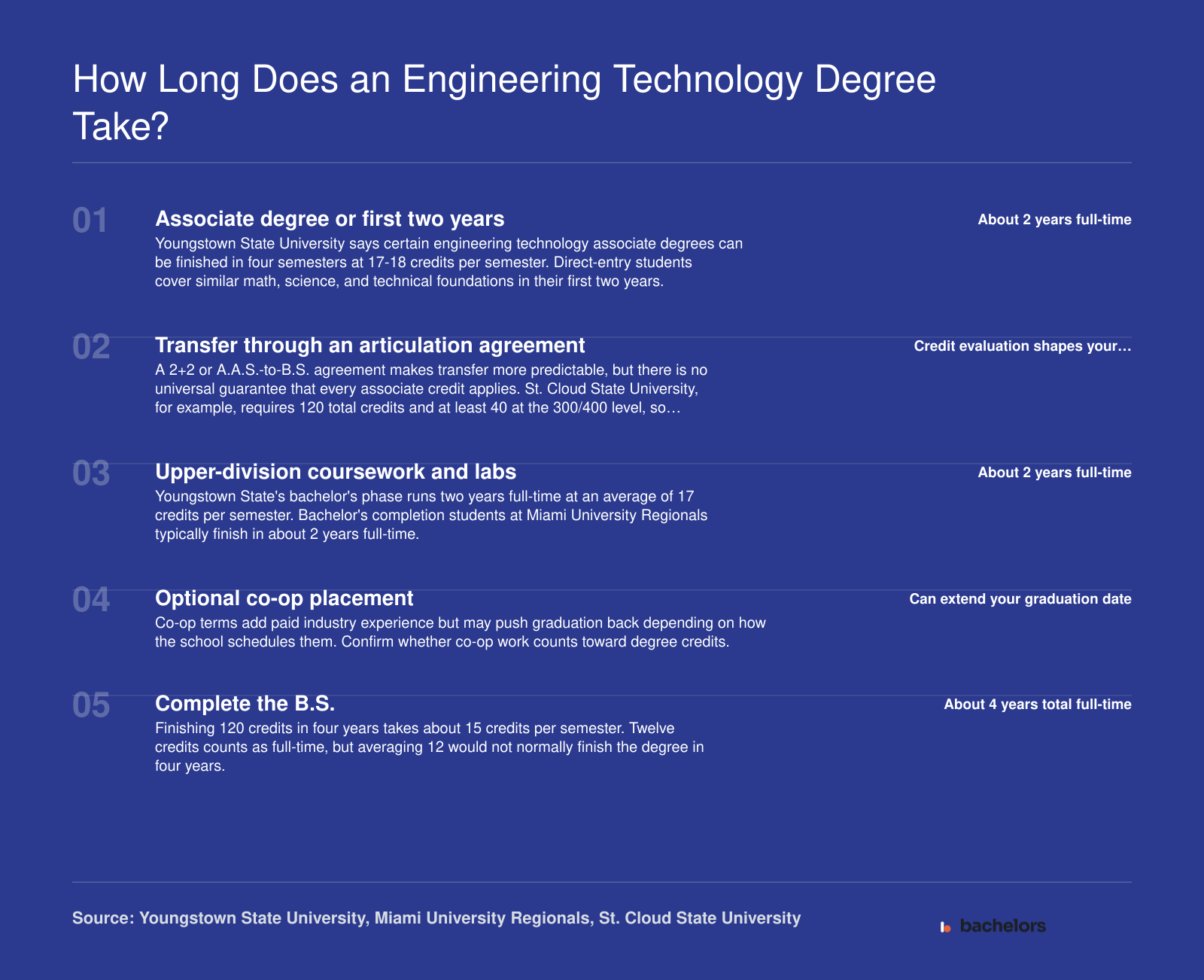
How Long Does an Engineering Technology Degree Take?
A bachelor's degree in engineering technology typically requires about 120-128 semester credits (roughly 180-192 on a quarter calendar), which works out to about four years at 15 credits per semester. Part-time timelines have no single standard: bachelor's completion students at Miami University Regionals typically need 3 or more years part-time, compared with about 2 years full-time. An optional co-op can also stretch your schedule, so ask each school how work terms fit into its course sequence.
Related Articles
What Engineering Technologists Earn Nationally
Look up current pay data yourself so you compare like with like.
Questions to Ask Yourself
Do you want a PE license in a state that restricts engineering technology graduates?
Would you rather troubleshoot equipment in a lab than work through Calculus III and differential equations?
Can you travel for on-campus lab intensives, or do you need a program that is fully online?
Do you already hold an A.A.S. that a 2+2 or degree-completion pathway would count toward the bachelor's?
How to Choose an Engineering Technology School
Use this checklist to compare programs side by side before you commit to a bachelor's degree in engineering technology.
- Confirm ABET ETAC accreditationABET's Engineering Technology Accreditation Commission (ETAC) accredits associate and bachelor's engineering technology programs. Its Engineering Accreditation Commission (EAC) accredits engineering programs, and the two standards are not interchangeable. Accreditation applies to individual programs, not whole schools. Search ABET's Accredited Program Search for the exact program name, commission, degree level, campus and current status.
- Check lab accessAsk what equipment you will use hands-on and how often. For online programs, ask whether labs run through kits, simulations or on-campus intensives.
- Ask about co-ops and employersRequest placement rates for co-ops and internships, and ask which companies hire graduates.
- Review transfer policiesIf you hold an A.A.S. or community college credits, get a written estimate of how many will count toward the degree.
- Verify state licensure fitMany licensing boards require graduation from an ABET-accredited program, but boards differ on engineering technology degrees. If a PE license is your goal, contact your state board before you enroll.
- Compare the true costUse the net price figures in our ranking, not sticker tuition, and estimate how much you would need to borrow.
Engineering Technology programs by state
Compare Engineering Technology programs on the data that matters
Explore more Science & Engineering majors or browse every field of study.
All Science & Engineering programs Browse every field of study