Best Construction Management Schools in Washington
Compare 7 accredited Construction Management programs in Washington, with net price after aid, graduation rates, earnings and debt from IPEDS and the U.S. College Scorecard.
Washington's building market runs on projects that need someone who can read a schedule, hold a budget and keep a job site safe, and a bachelor's degree in construction management is the standard entry route. Most programs award the Bachelor of Science (B.S.) in Construction Management, though a few title it construction engineering or technology.
Three Washington programs hold American Council for Construction Education accreditation. The tension is cost and capacity: tuition runs from community-college rates to private sticker prices, the strongest programs cap enrollment, and most seats are on campus rather than online.
Key Points
- In-state tuition runs from $5,418 at Pierce College to $55,480 at Gonzaga.
- Meeting UW-Seattle's prerequisites doesn't guarantee a seat in its capacity-constrained major.
- ACCE's 2026 directory lists Central Washington University and UW-Seattle as accredited.
Best Construction Management Schools in Washington: Ranked List
What separates the top spots here is how completely each program commits to construction management, and how directly it connects students to the contractors who do the hiring. The strongest entries pair a construction-specific curriculum with lab space, internships and advisory boards that keep coursework current. A few notable options sit outside that mold, including an engineering-based program and a project management degree with a construction concentration, and those suit different goals.
Central Washington University
#1Ellensburg, WA · ~$18,000/yr (est.)
Best for: In-state students drawn to heavy/civil work
Central Washington University in Ellensburg runs a Bachelor of Science in Construction Management built around estimating, scheduling, safety, sustainability and project management, with an industry advisory council that keeps the curriculum tied to what contractors actually hire for. Concentrations in general construction and heavy/civil construction let students tilt toward vertical building or infrastructure work. Northwest contractors recruit on campus and support the program. Program graduates reported median earnings near $97,700 four years after completion, with median debt around $24,100.
- Concentrations in general construction and heavy/civil construction
- Curriculum covers estimating, scheduling, safety, risk and sustainability
- Industry advisory council shapes coursework and recruiting
- Prepares students for project manager, estimator and safety roles
- Hands-on training from planning through project closeout
Pierce College District
#2Lakewood, WA · ~$10,000/yr (est.)
Best for: Working professionals holding an associate degree
Pierce College's Bachelor of Applied Science in Construction Management builds on an associate degree, so it fits students who already hold a technical credential and want to move into project leadership rather than start over. Evening and part-time scheduling supports working professionals, and internships connect students to contractors around Lakewood and the South Sound. Coursework spans blueprints, construction documents, scheduling, estimating, building codes and accounting, with attention to sustainability and accident prevention.
- Requires a related associate degree for entry
- Evening and part-time options for working students
- Coursework covers blueprints, estimating, scheduling and codes
- Sustainability and accident prevention emphasized
- Internships link students to the local construction community
- Financial aid and scholarships available
- Leads to estimating, facilities management and planning roles
University of Washington-Seattle Campus
#3Seattle, WA · ~$14,000/yr (est.)
Best for: Seattle students wanting BIM and green building
The University of Washington's Seattle campus offers a Bachelor of Science in Construction Management accredited by the American Council for Construction Education, with coursework in green building, building information modeling, cost estimating, contracting and site analysis. Students work in a 25,000-square-foot lab and classroom facility, complete a capstone, and can pair the degree with Architectural Design. Admission to the major is capacity constrained and separate from general UW admission, with three entry pathways and a 2.5 GPA minimum on prerequisites.
- American Council for Construction Education accredited
- 180 total credits with a required capstone
- 2.5 GPA minimum plus prerequisite coursework
- Three admission pathways and a separate departmental application
- Coursework includes BIM, green building and cost estimating
- 25,000 square feet of lab and classroom space
- Dual degree option with Architectural Design
- Annual career expo draws more than 100 companies
Gonzaga University
#4Spokane, WA · ~$35,000/yr (est.)
Gonzaga's construction offering sits inside the B.S. in Civil Engineering as a Construction Engineering & Management subdiscipline, blending design work with scheduling, budgeting, subcontractor oversight and site safety. Students test concrete, steel and wood at full scale in the High Bay Lab, and faculty bring professional consulting experience to the classroom. Graduates typically enter as project engineers with general contractors or specialty firms, a good fit for students who want engineering depth alongside management skills.
- Subdiscipline within the B.S. in Civil Engineering
- Covers scheduling, budgeting and subcontractor management
- Includes design work performed during construction
- Site safety stressed throughout the curriculum
- High Bay Lab for full-scale materials testing
- Prepares graduates for project engineer roles
- Technical electives available in the senior year
Washington State University
#5Pullman, WA · ~$15,000/yr (est.)
Washington State University's Bachelor of Science in Construction Management runs one pre-professional year followed by three professional years, and is accredited by the American Council for Construction Education with membership in the Associated Schools of Construction. Admission to the professional phase is competitive at a 3.3 GPA, with about 60 students admitted each fall; the program is expanding toward roughly 75 and eventually 100 seats with backing from regional contractors. Program graduates reported median earnings near $107,500 four years after completion, and the department describes near-total job placement with many offers arriving before graduation.
- Accredited by the American Council for Construction Education
- One pre-professional year, then three professional years
- 3.3 GPA and a C or better in every prerequisite
- About 60 students admitted to the professional phase
- Expanding toward roughly 75 and then 100 seats
- Fall start only, with no spring admission
- Transfer students considered each year
Eastern Washington University
#6Cheney, WA · ~$14,000/yr (est.)
Eastern Washington University's Bachelor of Science in Construction Management Technology emphasizes hands-on labs, simulations and a required internship, capped by a senior project that tackles a real production problem. The 12-quarter, 180-credit program covers estimating, building codes, surveying, materials and methods alongside engineering economics, project management and safety. Graduates move into estimating, field engineering and inspection roles, often advancing into supervisory positions, and the faculty bring industry experience to a small, career-focused cohort in Cheney.
- 12-quarter, 180-credit four-year program
- 2.5 GPA minimum for the major
- Capstone tackles a real production problem
- Internships available for credit or pay
- Coursework includes estimating, surveying and building codes
- Industry-experienced faculty
- Engineering College of Distinction for 2025-26
Columbia Basin College
#7Pasco, WA · ~$8,000/yr (est.)
Columbia Basin College offers a Bachelor of Applied Science in Project Management with an optional construction concentration, covering all five project management process groups plus agile, procurement, quality, risk and contracts. The program holds accreditation from the PMI Global Accreditation Center, offers fully online options, and runs rolling admissions with starts in any quarter, which makes it the most flexible schedule on this list. It is also the most project-management-forward route here, suited to students aiming at project controls, program management or construction coordination roles.
- Optional construction concentration
- Accredited by the PMI Global Accreditation Center
- Covers all five project management process groups
- Fully online certificate and degree options
- Rolling admissions with starts in any quarter
- Reduces the PMP experience requirement by 12 months
- Articulation pathway to a graduate program at City University of Seattle
Cost & outcomes by school
Federal data for the highest-earning Construction Management programs, independent of the ranking above. Earnings are this field's bachelor's graduates four years after completing where the Scorecard reports them, else the school's undergraduate median.
| School | Net price / yr | Grad rate | Earnings | Debt | Grads/yr | Format |
|---|---|---|---|---|---|---|
| Washington State University WA | $14,971 | 61% | $107,531 | $19,500 | — | Campus |
| Central Washington University WA | $18,476 | 54% | $97,651 | $24,120 | 14 | Campus |
| Gonzaga University WA | $35,119 | 86% | $78,892 | $24,454 | — | Campus |
| University of Washington-Seattle Campus WA | $14,091 | 85% | $78,466 | $14,615 | — | Campus |
| Eastern Washington University WA | $13,886 | 44% | $57,897 | $19,500 | — | Campus |
| Pierce College District WA | $10,222 | 31% | $47,532 | $12,000 | 6 | Campus |
| Columbia Basin College WA | $8,317 | 33% | $46,680 | $14,829 | — | Campus |
Sources: U.S. Department of Education. Net price, graduation rate, earnings and debt: College Scorecard (earnings and debt for this field's bachelor's graduates where reported, else school-wide); graduates: IPEDS. A dash means no figure is reported.
Cost, debt & payoff
Median earnings of this field's bachelor's graduates (4 yrs after completing, else the school's undergraduate median) vs. their median federal loan debt · U.S. College Scorecard
Across these programs the median graduate earns about $78,466 and finishes with roughly $19,500 in debt — a ratio that clears a common rule of thumb (keep debt below first-year salary). Net price and debt vary widely school to school, so check the per-school figures in the table above before you shortlist.
How We Ranked Washington Bachelor's Programs in Construction Management
The order you see reflects what a Washington construction management bachelor's degree actually costs and what graduates tend to earn, not name recognition.
What Moves a School Up or Down
Four things carry the most weight. Net price, meaning what students pay after grant aid, comes first, because a construction management degree that leaves you with modest debt is a better start than a prestigious one that does not. Program-level earnings and debt come next: median pay a few years after graduation, and how much students borrowed. Completions matter too, since a program that graduates its students is doing something right. Selectivity and retention round it out as a rough signal of who enrolls and who stays.
Reading the Numbers Fairly
Two caveats. Net price and graduation rate are institution-wide figures, so they describe the whole university, not the construction management department alone. Earnings and debt figures are medians for graduates in the federal data, meaning half earned more and half earned less. A median is a midpoint, not a promise.
Why the List Is Short
Only schools with a construction management bachelor's program listed in federal College Scorecard data appear here. Several Washington colleges teach construction or project management, but without that program-level record they cannot be compared on the same terms, so the list runs shorter than the state's full roster of four-year schools.
Treat the ranking as a starting shortlist for your own campus visits and questions, not a verdict.
Washington Schools Compared: Specializations, Locations and ACCE Accreditation
In this table, "accredited" means the bachelor's program appears in the American Council for Construction Education (ACCE) directory, which lists 77 accredited bachelor's programs nationally. In Washington, ACCE's 2026 directory includes Central Washington University, the University of Washington-Seattle Campus and Washington State University, which ACCE describes as fully accredited; any program we could not match to that directory is marked as not verified rather than assumed either way. Placement figures are not comparable across these schools: ACCE notes that Washington State University consistently reports strong placement, with many graduates employed before or shortly after graduation, but no school here publishes a numeric rate with a stated definition, so ask each department how it counts graduates and over what time window.
| School | Campus Location | Program | Concentration or Emphasis | ACCE Accreditation |
|---|---|---|---|---|
| Central Washington University | Ellensburg, WA | Construction Management Major, BS | General Construction; Heavy/Civil Construction | Accredited |
| Pierce College District | Lakewood, WA | Construction Management | Estimating, scheduling, safety and building codes; requires an associate degree in a related field | Not verified in ACCE directory |
| University of Washington-Seattle Campus | Seattle, WA | Construction Management | Green building and sustainable construction; dual degree with Architectural Design available | Accredited (dual degree with Architectural Design is not ACCE-accredited) |
| Gonzaga University | Spokane, WA | Construction Engineering & Management | Engineering-based track preparing for project engineer roles | Not verified in ACCE directory |
| Washington State University | Pullman, WA | Construction Management | One year of pre-professional coursework followed by three professional years | Fully accredited |
| Eastern Washington University | Cheney, WA | Construction Management Technology Major | Construction supervision, estimating, surveying and building codes | Not verified in ACCE directory |
| Columbia Basin College | Pasco, WA | Project Management | Construction concentration within a project management degree | Not verified in ACCE directory |
Online and Hybrid Bachelor's Options at Washington Schools
Every bachelor's degree in construction management in our data for Washington is listed as a campus program, not a fully online one. That includes the four-year degrees at Central Washington University, Washington State University, Eastern Washington University, the University of Washington and Gonzaga, as well as the applied bachelor's at Pierce College District. If your goal is a construction management degree you can finish entirely from a laptop, Washington is not currently the state that offers it.
What flexibility does exist
The field itself resists full online delivery. Central Washington describes its program as activity-based and lab-oriented, with a required internship. The University of Washington's degree runs in Seattle, takes 180 credits, and its listing indicates classes are not scheduled for evenings or weekends. Columbia Basin College's project management degree, with a construction concentration, is the outlier: the college advertises fully online certificate and degree options on that pathway.
Pierce College District's applied bachelor's in Lakewood is the clearest working-adult route. The college points to a flexible schedule with evening classes, and students can enroll full-time at 15 credits per quarter or part-time at 10. Published descriptions of the format are not consistent across sources, so verify the schedule rather than assume it.
Matching format to your situation
- Site-based workers: An evening-weighted applied bachelor's keeps you earning while you study.
- Community college transfers: Pierce's applied degree expects a related associate degree first, and state transfer pathways feed the four-year programs.
- Career changers: The residential programs at WSU, EWU, Central and UW trade flexibility for lab space, internships and employer networks.
Call or email the program office before you apply. Delivery formats shift from year to year, and a page can lag behind the schedule.
Admission Requirements for a Bachelor's Degree in Construction Management in Washington
UW Construction Management: Getting Into the Major
The University of Washington-Seattle Campus treats construction management as a capacity-constrained major. Meeting the prerequisites or UW's minimum admission requirements does not guarantee a seat. UW offers some direct first-year admission, where a freshman is admitted to the university and the major at the same time. Most other students apply to the major later, after completing prerequisites. That later route has an April 5 deadline for autumn quarter. The department weighs academic performance, the extent and quality of relevant experience (extracurriculars included) and each applicant's stated motivation.
UW publishes no admit rate for the construction management major itself. Its admissions page instead lists entering transfer students from Washington community colleges by GPA band, from 3.75 to 4.00 down to 2.49 and below. Each band holds somewhere between fewer than five and six students. Treat this as a picture of a small, varied cohort, not as an acceptance rate or a cutoff. For context, the federal College Scorecard puts UW Seattle's school-wide admission rate at about 39%.
GPA, Prerequisites and Test Policy by School
- University of Washington: 2.5 GPA minimum, required prerequisite courses and three admission pathways.
- Washington State University: 3.3 GPA minimum, prerequisites completed with a C or better and one year of pre-professional coursework before three professional years. Enrollment is capped at 60 students, entry is fall only and the school-wide admission rate is about 87%.
- Eastern Washington University: 2.5 GPA minimum. The school-wide admission rate is about 91%.
- Central Washington University: The program materials we reviewed list no GPA minimum. The school-wide admission rate is about 91%.
- Gonzaga University: The school-wide admission rate is about 82%.
- Pierce College District: Applicants need an associate degree in a related field.
- Columbia Basin College: Rolling admissions, required prerequisites and starts in any quarter.
None of the program pages we reviewed state an SAT or ACT policy. Confirm testing rules with each university's admissions office.
Community College Transfer Routes
Washington's Direct Transfer Agreement (DTA) associate degree generally covers lower-division general education at the state's public universities. Major Related Program (MRP) versions of the DTA add coursework aimed at a specific field. The materials we reviewed do not spell out construction management conditions under either pathway at any school here. Course-by-course credit equivalencies also vary. Check each school's transfer equivalency guide and meet with an advisor before you pick classes. WSU says it considers transfer students every year, and UW's April 5 deadline applies to transfer applicants. Pierce College's bachelor's program is built to follow an associate degree, which makes it a natural next step for students already holding one.
Related Articles
Cost of a Construction Management Bachelor's Degree in Washington
A bachelor's degree in construction management in Washington costs far less at a public school than the private sticker price suggests, and state aid narrows the gap further.
Tuition and Net Price
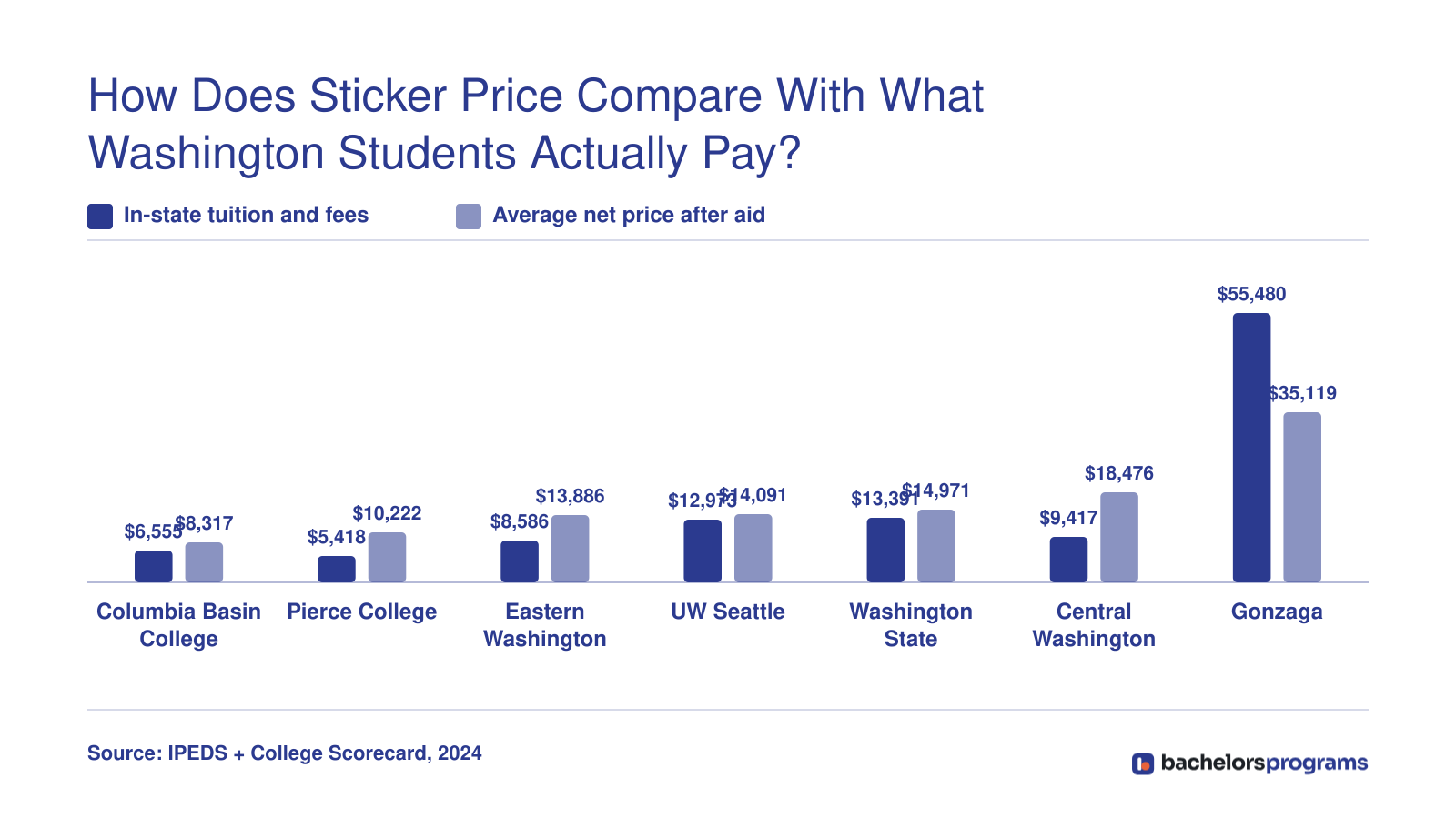
Annual in-state tuition and fees at the public schools run from $5,418 at Pierce College District to $13,391 at Washington State University. Net price, the average a student pays after grants, ranges from $8,317 at Columbia Basin College to $35,119 at Gonzaga University, whose $55,480 tuition applies to every student. Net price can exceed tuition because it also counts housing and living costs.
- Pierce College District: $5,418 tuition, $10,222 net price
- Columbia Basin College: $6,555 tuition, $8,317 net price
- Eastern Washington University: $8,586 tuition, $13,886 net price
- Central Washington University: $9,417 tuition, $18,476 net price
- University of Washington-Seattle: $12,973 tuition, $14,091 net price
- Washington State University: $13,391 tuition, $14,971 net price
Out-of-state students pay more at the public universities: $25,959 at EWU, $27,526 at CWU, $29,950 at WSU and $43,209 at UW.
Central Washington's construction management program reports its own median graduate debt of $24,120, about $256 a month on a 10-year repayment plan.
Washington College Grant
Washington residents without a bachelor's degree can qualify based on income.1 For 2026-27, a family of four earning up to $83,500 can receive the full award, and reduced awards extend to $139,500.1 Starting in 2026-27, the maximum award at private nonprofit colleges such as Gonzaga is set below the public-university level.1 Filing the FAFSA or WASFA is the only way to see your exact award.
Construction Scholarships
- AGC Education Foundation: $2,000 to $10,000 per year for full-time students in Washington construction-related programs.2
- UW Department of Construction Management: $100 to $10,000 for accepted undergraduates, awarded each spring.3
- Becky Wallace Scholarship: Listed for women studying construction management or civil engineering at WSU; confirm current availability before applying.2
Net price is an institution-wide average, not a personal quote. Your actual cost depends on your income, residency and aid package.
How Does Sticker Price Compare With What Washington Students Actually Pay?
Published in-state tuition and fees run from $5,418 at Pierce College to $55,480 at Gonzaga University, but the average net price after grants and scholarships tells a different story. At Gonzaga, aid brings the average net price down to $35,119, roughly $20,000 below the sticker price. At the public schools, net price often exceeds tuition because it reflects the full cost of attendance, including housing, books and living expenses, minus grant aid. Net price is an approximate institution-wide average for all undergraduates, not a figure specific to construction management students, so use each school's net price calculator for a personal estimate.
Careers and Salaries for Construction Management Graduates in Washington
First-year pay and five-year pay look very different for Washington construction management graduates. Early salaries reflect entry roles, and the bigger jumps come as graduates take on full project responsibility.
What Graduates and Construction Managers Earn
Central Washington University's construction management bachelor's graduates earned a median of $81,666 one year after completing the program. That rose to $97,651 at four years and $103,530 at five years. Washington State University's program shows a median of $107,531 four years out and $107,912 at five years. The other schools here have no program-level earnings figures for this field, so compare them on internships and employer connections instead.
The Washington Employment Security Department (ESD) estimates about 6,550 construction managers work in the state, with wages updated to mid-2025.1 The median is $53.55 an hour, the 75th percentile is $66.68 and the 90th percentile is $81.75.1 The mean hourly wage of $70.98 works out to roughly $147,600 a year at full-time hours. ESD notes these are its own estimates, not an official BLS series. Nationally, BLS reports a May 2025 median of $114,990 a year and projects 9% growth from 2025 to 2035, with about 49,700 openings a year.2
Few graduates start with the construction manager title. Typical first jobs include:
- Assistant project manager: Supports budgets, submittals and owner communication.
- Field engineer: Handles on-site coordination, layout and quality checks.
- Estimator: Builds bids and cost models during preconstruction.
Hiring comes from general contractors, specialty subcontractors, public agencies and owners' facilities groups. Eastern Washington University lists Boeing and Lamb Weston among its graduates' employers.
Do You Need a License to Be a Construction Manager in Washington?
No. Washington has no separate state license for the construction manager title. Contractor registration with the Department of Labor & Industries, including bonding and insurance, is a separate matter. It generally applies to businesses that contract directly with owners. Electrical, plumbing and other regulated trades also carry their own licensing. A manager working for a registered contractor is in a different position than someone bidding work independently, so confirm requirements with the state before contracting on your own.
Optional Credentials Worth Knowing
- Certified Construction Manager (CCM): A national professional certification, not a state license. Eligibility generally combines education, experience and an exam, so it fits mid-career professionals moving into owner's representative or program management roles.
- EIT and PE: The Engineer in Training designation follows the FE exam and an application to the Washington Board of Registration for Professional Engineers and Land Surveyors. A PE later requires progressive experience and the PE exam. These matter most for engineering-track graduates, such as those from Gonzaga University's Construction Engineering & Management program.
Choosing the Right Washington Construction Management School
The strongest program on paper is not always the best fit for your life; prestige and practicality often pull in different directions. Start with your own situation, then let one factor guide the shortlist.
First-Year Freshman
If you are heading straight from high school, the admission pathway matters most. Review each school's GPA and test expectations in the admissions section above so you know which campuses, such as the University of Washington-Seattle Campus or Washington State University, are realistic targets and which are safer bets.
Community College Transfer
Transfer credit decides how long and how expensive your degree will be. Pierce College District and Columbia Basin College offer starting points close to home, and the admissions section explains how credits move to a four-year campus. Confirm with an advisor before you register for courses.
Working Adult or Career Changer
Format should drive your choice. Check the online and hybrid section for programs that fit around a job, and ask each school how much of the coursework and any site-based requirements can be completed remotely.
Heavy-Civil Focus
Concentration is the deciding factor. Gonzaga University's Construction Engineering & Management program and the options at Central Washington University and Eastern Washington University lean in different directions, so compare the specializations in the table above against the kind of projects you want to build.
Your Next Step
Whatever your profile, keep cost in view by comparing in-state tuition with net price in the cost section. Then narrow the list to the schools that fit, review their program pages side by side, and request information from each one. Admissions staff can answer questions about deadlines, aid and credit transfer that no list can.
Common Questions About Construction Management Degrees in Washington
Rankings, costs, formats and outcomes change, so use this section to know where to confirm each detail before you apply. Each answer points to the source that should settle one decision.
What is the best construction management school in Washington?
How much does a construction management bachelor's degree cost in Washington?
What is the acceptance rate for UW Construction Management?
Is there a construction management bachelor's degree online in Washington?
Do you need a license to be a construction manager in Washington?
Compare Construction Management programs on the data that matters
Explore more Business & Management majors or browse every field of study.
All Business & Management programs Browse every field of study