Best Cybersecurity Schools in Washington
Compare 12 accredited Cybersecurity programs in Washington, with net price after aid, graduation rates, earnings and debt from IPEDS and the U.S. College Scorecard.

Washington employers fill security roles faster than the state's colleges can graduate candidates, and that gap shapes how the degree is built. A bachelor's degree in cybersecurity here connects students to Seattle-area tech, defense, and cloud employers, from Puget Sound cloud providers to the military installations near Tacoma.
The Bachelor of Science in Cybersecurity is the common label here, though several schools award applied or informatics variants instead. Those labels matter because they change math requirements, lab hours, and how easily credits transfer.
The real trade-off is between a research university's depth and a two-year college's lower cost and completion-degree format, so the best fit depends on where you start.
Key Points
- The NSA designates 7 Washington institutions as Centers of Academic Excellence.
- In-state tuition and fees at the cheapest programs run $4,436 to $6,634.
- Clover Park, Highline, and Bellevue offer applied bachelor's degrees in cybersecurity.
Best Cybersecurity Schools in Washington: 10 Bachelor's Programs Ranked
These ten bachelor's programs are ordered using cost, completion, earnings, and format data, and the result runs from short applied completion degrees at two-year colleges to a full research-university option in Bothell. Each entry shows what the program actually asks of you and what the numbers say about the school behind it.
Green River College
#1Auburn, WA · $4,700 – $5,000/yr (est.)
Best for: Working adults seeking flexible applied training
Green River College stacks a Bachelor of Applied Science in Cybersecurity and Networking on top of its associate degree, with in-person, hybrid, and online classes available. Its Cyber Security Center partners with K-12 schools and industry on internships. Net price after aid is about $13,803, and the overall graduation rate is 39 percent.
- 180 credits over six quarters, roughly two years
- In-person, hybrid, and online instruction at the Main campus
- Associate AAS-T in Cybersecurity and Networking (92 credits) feeds in
- Stackable certificates in network security, cloud, and IT security
- Leads to security analyst and network administrator roles
Central Washington University
#2Ellensburg, WA · ~$18,000/yr (est.)
Best for: Career switchers wanting a business-facing IT core
Central Washington University houses cybersecurity as a specialization inside its BS in IT Management, so majors pair security coursework with an 8-credit cooperative education internship. The program follows the 2026-2027 catalog and assigns each student an IT Management advisor. Net price after aid is about $18,476, and the overall graduation rate is 54 percent.
- Cybersecurity specialization inside the BS in IT Management
- 28 credits of security coursework, including digital forensics
- 8-credit cooperative education internship required
- Curriculum follows the 2026-2027 catalog
- Early application to the major encouraged; advisor assigned
Eastern Washington University
#3Cheney, WA · ~$14,000/yr (est.)
Best for: Future defenders drawn to hands-on cyber operations
Eastern Washington University runs a BS in Computer Science Cyber Operations built around cryptography, reverse engineering, digital forensics, and secure coding in hands-on labs. Upper-division courses meet at the Spokane Catalyst Building, and students can join a cybersecurity club that competes nationally. Net price after aid is about $13,886, and the overall graduation rate is 43 percent.
- 180 credits with a senior capstone and 2.3 GPA minimum
- Cryptography, reverse engineering, digital forensics, secure coding
- Designated NSA Center of Academic Excellence in Cyber Operations
- Maps to Department of Defense cybersecurity workforce roles
- Upper-division courses meet at the Spokane Catalyst Building
- Advanced Programming Exam required for entry
University of Washington-Seattle Campus
#4Seattle, WA · ~$14,000/yr (est.)
The University of Washington offers an Information Assurance and Cybersecurity option inside a BS in Informatics at UW Bothell, blending software engineering and data structures with secure systems and network design electives. This school's graduates post the highest median earnings on the list, $78,466 ten years after entry. Net price after aid is about $14,091, and the overall graduation rate is 85 percent.
- 180 credits, including 15 credits of option electives
- Core coursework in software engineering and data structures
- Admissions require programming, Calculus I and II, and composition
- 2.0 GPA to graduate; final 45 credits at UW Bothell
- Capstone project required
City University of Seattle
#5Seattle, WA
City University of Seattle delivers its BS in Cybersecurity entirely online for working adults moving into cyber defense and information security roles. Coursework covers threat investigation, data misuse assessment, and practical defense strategies, with admission open to high school graduates. Graduates report median earnings of $69,460 ten years after entry.
- Fully online format built for working adults
- Covers threat investigation, data misuse assessment, and defense
- Admission requires a high school diploma or equivalent
- Includes foundational computing and technical security training
Washington State University
#6Pullman, WA · ~$15,000/yr (est.)
Washington State University offers cybersecurity as an independent major, with 120 credits built around hands-on labs in hardware, software, wireless, and critical infrastructure security. The first two years mirror the computer science core before security courses and a capstone. Net price after aid is about $14,971, and the overall graduation rate is 60 percent.
- Independent major with 120 credits over four years
- 74 credits in computer science and cybersecurity
- 16 credits each in math and statistics; 30 in general education
- Covers hardware, software, wireless, and infrastructure security
- Capstone project plus planned cybersecurity electives
- Requires admission to WSU first, then major criteria
Clover Park Technical College
#7Lakewood, WA · $10,000/yr (est. net price)
Clover Park Technical College has the lowest net price after aid on this list, about $9,864, for a Bachelor of Applied Science in Cybersecurity taught in a hybrid format with evening and weekend classes. Full-time students finish in roughly 18 months, and admission opens every quarter. The overall graduation rate is 43 percent.
- Hybrid evening and weekend classes for working adults
- Full-time completion in about 18 months; part-time about 36
- Risk assessment, malware analysis, cloud security, vulnerability work
- Admission open in all quarters
- Prepares for security analyst and penetration tester roles
Highline College
#8Des Moines, WA · ~$10,000/yr (est.)
Highline College offers a Bachelor of Applied Science in Cybersecurity and Digital Forensics designed as a two-year completion track for students who already hold an associate degree. Coursework is applied and hands-on, covering the protection of systems, networks, and devices. Net price after aid is about $9,879, and the overall graduation rate is 35 percent.
- Two-year completion for students with an associate degree
- Hands-on practice protecting systems, networks, and devices
- Applied, industry-relevant coursework
- Financial aid options available
Whatcom Community College
#9Bellingham, WA · ~$12,000/yr (est.)
Whatcom Community College runs a cohort-based Bachelor of Applied Science in IT Networking with a cybersecurity focus, admitting students who already hold an IT-related associate degree earned within five years. Entry is selective and scored on a 100-point rubric that rewards industry certifications. Net price after aid is about $11,795, and the overall graduation rate is 36 percent.
- Selective entry scored on a 100-point applicant rubric
- Requires an IT-related associate degree earned within five years
- 2.0 GPA overall and in IT coursework
- Cisco CCNA, CompTIA Network+ or Security+ certification adds points
- Fall, winter, and spring starts in a cohort structure
- Two professional references and a personal statement required
Bellevue College
#10Bellevue, WA · $11,000/yr (est. net price)
Bellevue College offers a Bachelor of Applied Science in Cybersecurity of 180 to 182 credits, with courses in network security, digital forensics, system hardening, and security automation. The program admits selectively and finishes with a capstone or internship. Net price after aid is about $11,430, and the overall graduation rate is 36 percent.
- 180-182 credits with network security, forensics, and automation
- Selective admission; associate degree and 2.0 GPA required
- $50 application fee; 45 credits must be in residence
- Capstone or internship options
- 30 upper-division credits required
Cost & outcomes by school
Federal data for the highest-earning Cybersecurity programs, independent of the ranking above. Earnings are this field's bachelor's graduates four years after completing where the Scorecard reports them, else the school's undergraduate median.
| School | Net price / yr | Grad rate | Earnings | Debt | Grads/yr | Format |
|---|---|---|---|---|---|---|
| University of Washington-Seattle Campus WA | $14,091 | 85% | $78,466 | $14,615 | — | Campus |
| City University of Seattle WA | — | — | $69,460 | $25,000 | — | Online |
| Washington State University WA | $14,971 | 61% | $68,905 | $19,500 | — | Campus |
| Saint Martin's University WA | $28,119 | 52% | $62,092 | $22,500 | — | Campus |
| Central Washington University WA | $18,476 | 54% | $61,580 | $19,500 | — | Campus |
| Eastern Washington University WA | $13,886 | 44% | $57,897 | $19,500 | — | Campus |
| Bellevue College WA | $11,430 | 36% | $56,310 | $12,375 | — | Hybrid |
| Green River College WA | $13,803 | 39% | $50,712 | $11,891 | — | Hybrid |
| Highline College WA | $9,879 | 36% | $47,869 | $9,500 | — | Campus |
| Columbia Basin College WA | $8,317 | 33% | $46,680 | $14,829 | — | Campus |
| Whatcom Community College WA | $11,795 | 36% | $44,092 | $10,643 | — | Campus |
| Clover Park Technical College WA | $9,864 | 43% | $41,787 | $12,112 | — | Hybrid |
Sources: U.S. Department of Education. Net price, graduation rate, earnings and debt: College Scorecard (earnings and debt for this field's bachelor's graduates where reported, else school-wide); graduates: IPEDS. A dash means no figure is reported.
Cost, debt & payoff
Median earnings of this field's bachelor's graduates (4 yrs after completing, else the school's undergraduate median) vs. their median federal loan debt · U.S. College Scorecard
Across these programs the median graduate earns about $57,104 and finishes with roughly $14,722 in debt — a ratio that clears a common rule of thumb (keep debt below first-year salary). Net price and debt vary widely school to school, so check the per-school figures in the table above before you shortlist.
What Sits Behind Our Washington Cybersecurity Rankings
Some figures here describe one program, while others describe an entire school. Knowing which is which keeps your comparisons honest.
Program-Level Figures
Earnings, completers' debt, and completions come from the specific program. Completions show how many students finish each year, which hints at program size. Earnings come with a time window, such as one year or several years after graduation, so compare only figures measured over the same span. When a school reports only institution-wide earnings, treat them as background about the college, not a forecast for cybersecurity graduates.
Institution-Wide Figures
The graduation rate and the average net price both come from College Scorecard, and both describe the whole school rather than the cybersecurity major. A school's graduation rate reflects every bachelor's student on campus. Net price is the average cost after grant aid, and it is only approximate. Your own aid offer, housing choice, and course load will move the real number up or down.
Scope
The programs below are bachelor's degrees at Washington schools. That includes online programs offered by Washington-based schools, so you can compare campus and remote options side by side.
NSA-Designated and ABET-Accredited Cybersecurity Programs in Washington
Two independent stamps of approval come up repeatedly in cybersecurity education, and they are not the same thing: the NSA's Centers of Academic Excellence designation and ABET accreditation. Neither is a ranking, and neither is granted to a school permanently. Knowing what each one covers, and how to check it yourself, keeps you from enrolling on an outdated claim.
Two Different Stamps, Two Different Reviewers
The NSA's Centers of Academic Excellence program designates specific cybersecurity programs whose curriculum maps to national standards for cyber defense or cyber operations. It is a program-level designation with a limited term, so schools reapply to keep it. ABET accreditation is also program-level, granted after a self-study and peer review of a computing program and reviewed on a recurring cycle.
Both attach to a named program at a specific degree level, not to a university as a whole. A designation earned by a Bachelor of Science in Cybersecurity does not automatically cover a cybersecurity option inside another degree, such as an informatics or computer science major, and the reverse holds too.
Where to Confirm Current Status
- The NSA CAE directory: the official listing lets you search by institution and see which program and designation is recognized.
- ABET's accredited program search: filter by institution and program title to see the accredited name and review cycle.
- The school's own program page: look for the exact degree title and any accreditation statement in the program's own words.
Appearing on any list, including our rankings, does not prove a program currently holds either status. Designations expire, programs get renamed or folded into other departments, and published pages can lag a change by a term or more.
A Short Verification Checklist
- Name it exactly: confirm the program title and degree level, since a Bachelor of Science in Cybersecurity, a Bachelor of Applied Science, and a cybersecurity option inside another major are different credentials.
- Search both directories: look up that exact name in the NSA and ABET tools and note the date you checked.
- Get it in writing: ask the admissions or program office to confirm by email that the program you would actually enroll in holds the status for your start year, and ask when that status comes up for renewal.
Career Data Is Not Program Verification
Career resources such as BLS.gov's Occupational Outlook Handbook, plus associations including ISC2, ISACA and CompTIA, explain roles, certifications and hiring demand. They do not verify whether a particular program holds NSA or ABET status, so use them for career context only.
Online, Evening, and Hybrid Bachelor's in Cybersecurity at Washington Schools
Flexibility and in-person lab time pull in opposite directions, and Washington's bachelor's programs in cybersecurity sit at different points along that line. Knowing where each one falls saves you from enrolling in a schedule you cannot keep.
Fully online
City University of Seattle offers its B.S. in Cybersecurity online. Its program materials describe it as flexible for working adults, and the listed admission requirement is a high school diploma. It suits someone who needs to study around a job without relocating.
Hybrid and evening
Clover Park Technical College runs its Bachelor of Applied Science in Cybersecurity as a hybrid program with evening and weekend classes, designed for working adults. Full-time students can finish in 18 months, part-time students in 36, and admission is open in all quarters. Classes meet at Lakewood, South Hill, and the Eastside Training Center.
Green River College lists in-person, hybrid, and online instruction for its cybersecurity and networking program, with classes at its main campus in Auburn. Bellevue College's Cybersecurity BAS is also hybrid, though entry is selective and requires an associate degree.
Traditional campus
Central Washington University (Ellensburg), Eastern Washington University (Cheney), Washington State University (Pullman), and the University of Washington-Seattle Campus teach their programs on campus. So do Highline College and Whatcom Community College. Whatcom uses a cohort model with fall, winter, and spring starts, while Highline offers a two-year completion option for applicants who arrive with an associate degree. WSU's cybersecurity major follows a four-year track that resembles its computer science degree for the first two years, which suits students who want a full residential experience.
Which format fits
- Working adults: City University of Seattle for fully online study, or Clover Park for evening and weekend hybrid classes.
- Community college transfers: Highline, Bellevue, Whatcom, and Clover Park build on an earlier associate degree, so they fit students who have already completed one.
- Traditional students: The four-year campus programs at CWU, EWU, WSU, and UW offer the most lab, club, and internship access.
Schedules and delivery change, so confirm the current format on each program page before you apply.
Getting Into a Bachelor's Degree in Cybersecurity Program in Washington
What GPA does a Washington cybersecurity program actually require? It depends on the school, and the answer is often a program-level threshold rather than a campus-wide one.
Washington State University
WSU admits students to the university first, then to the cybersecurity major. Undergraduate admission is test-free, so SAT or ACT scores are not required.2 To enter the major, you declare your intention and show calculus readiness. Qualifying routes include an ALEKS score of 78 percent or higher, MATH 108 and MATH 171 with a C or better, AP Calculus scores of 2 or 3, an IB higher-level 5, or a CLEP score of 50.1 The major then requires MATH 171, MATH 216, and MATH 220 or 225, each passed with at least a C, plus a 2.5 cumulative GPA.1
Transfer Rules and the Community College Route
WSU sets no minimum transfer credit total.3 Applicants with fewer than 27 semester (40 quarter) credits must also send a final high school transcript.3 Without a transferable associate degree, a 2.5 cumulative GPA is the usual bar, and lower GPAs get a comprehensive review.
The cleanest two-plus-two route runs through WSU Everett. Its assured-transfer rules list the AA-DTA, the AS-T, and the Computer Science AAS-DTA as qualifying credentials, with a 2.5 cumulative transfer GPA including prerequisites.4 A general DTA calls for early consultation with Everett admissions.
Other Schools
- Eastern Washington University: The program lists a 2.3 GPA minimum and an Advanced Programming Exam.
- Bellevue College: Selective entry, a 2.0 GPA, and an associate degree prerequisite. Transfer credit needs a C or better, with 45 credits in residence.
- Whatcom Community College: Selective, cohort-based entry with a 2.0 GPA and an IT-related associate degree earned within five years. Applicants also submit a personal statement and two references.
- Highline College: Admission requires an associate degree.
- University of Washington-Seattle Campus: Competitive admission to the informatics option, with programming prerequisites and Calculus I and II.
- City University of Seattle: A high school diploma is listed.
- Central Washington University: Early application to the major is encouraged.
Green River College and Clover Park Technical College publish no minimum GPA or test requirement, so confirm with admissions. The same goes for SAT/ACT policies at most schools above, since only WSU's was confirmed.
Selectivity Context
These institution-wide Scorecard figures describe each university overall, not the cybersecurity major. The admission rate is about 87 percent at WSU, 91 percent at Eastern Washington, and 91 percent at Central Washington, versus about 39 percent at UW-Seattle. Pell grant recipients make up roughly 59 percent of WSU undergraduates and 63 percent at UW-Seattle.
How Much a Cybersecurity Bachelor's Degree Costs in Washington
At the lowest-cost Washington cybersecurity programs, in-state tuition and fees run from $4,436 to $6,634 a year. The average net price after grants is higher, $8,317 to $11,795, because it also counts housing, books and living costs, and it is an approximate school-wide figure rather than a price for the cybersecurity major alone. For 2026-27, the Washington College Grant gives the maximum award to a family of four earning up to $83,500, with partial awards up to $139,500, for residents who have no prior bachelor's degree; it works at public colleges and many private schools, though private for-profit schools lose eligibility this year. Students enrolled in the College Bound program (family-of-four limit of $90,500) and those applying for each college's own scholarships have more ways to lower the bill.
| School | City | In-State Tuition and Fees (per year) | Average Net Price After Aid (per year) | Median Debt at Graduation (all programs, school-wide) |
|---|---|---|---|---|
| Columbia Basin College | Pasco | $6,555 | $8,317 | $14,829 |
| Clover Park Technical College | Lakewood | $6,634 | $9,864 | $12,112 |
| Highline College | Des Moines | $4,772 | $9,879 | $9,500 |
| Bellevue College | Bellevue | $4,436 | $11,430 | $12,375 |
| Whatcom Community College | Bellingham | $5,115 | $11,795 | $10,643 |
Cybersecurity Careers and Salaries in Washington
Cybersecurity pay in Washington comes down to two numbers that answer different questions. One is what the occupation pays across the state. The other is what graduates of a specific program earn. The occupational figure is the one to plan around before you enroll, and the one state and federal wage data report most precisely.
What the Occupation Pays
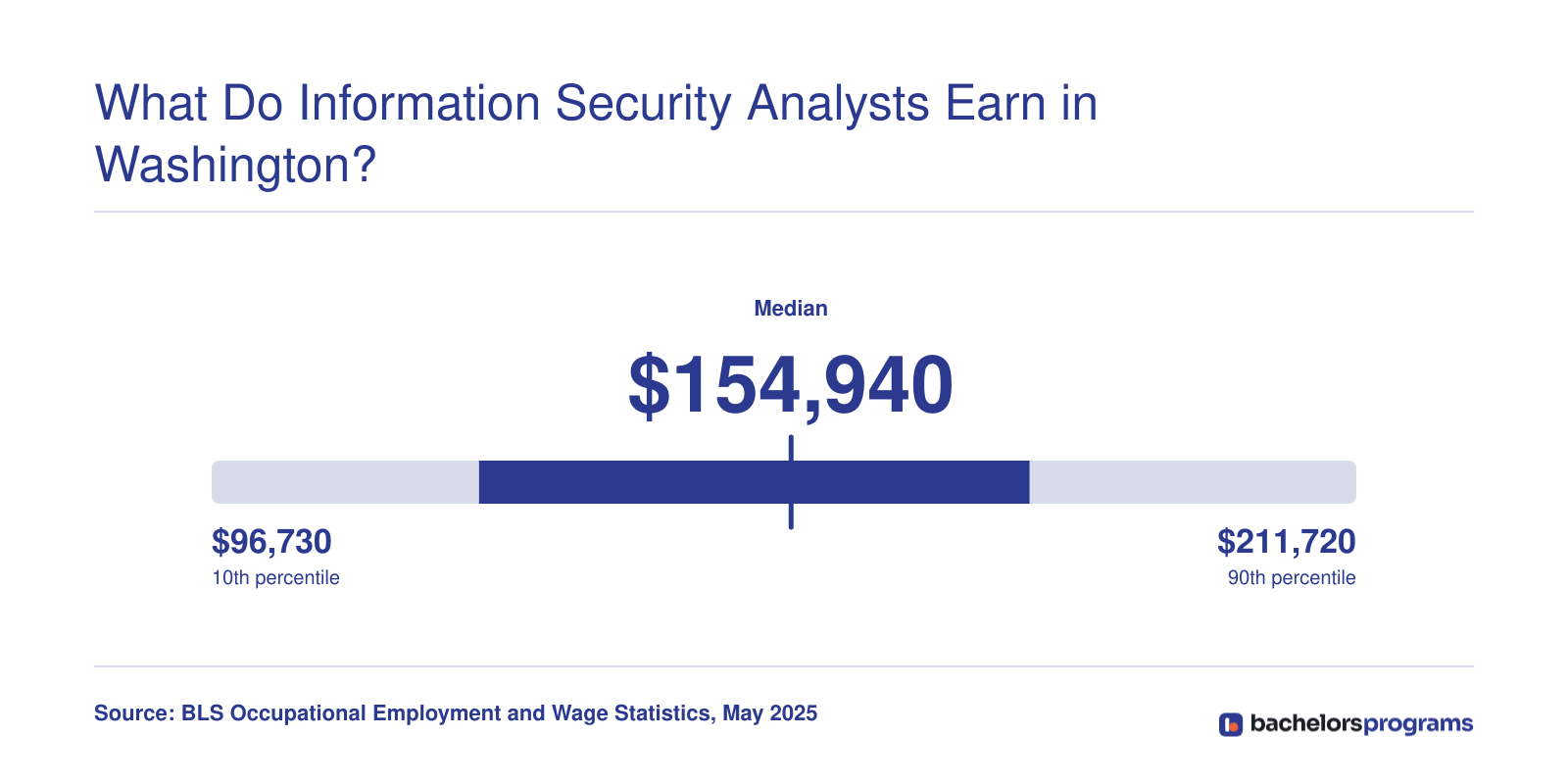
Information security analysts in Washington earned a median annual wage of $154,940 in May 2025, according to BLS Occupational Employment and Wage Statistics, and the state employed about 6,830 of them.1 The Seattle-Tacoma-Bellevue metro holds the majority of those jobs and pays above the statewide figure, well above the national median for the role.2 These are occupational wages for the job itself, not earnings of graduates from any particular school.
Where the Jobs Are
Postings list security analyst, SOC analyst and cloud security engineer roles, all under the umbrella occupation of information security analyst. Entry often starts in a security operations center, where monitoring and incident response build the foundation for engineering or architecture work later.
Employers cluster in a few areas: - Technology: Microsoft in Redmond anchors a broad Puget Sound cloud and software sector. - Defense and federal contracting: roles often require a DoD 8140/8570 IAM-qualifying certification at hire, with CISSP or CISM at IAM Level III (CASP+ also accepted).4 - Government: state and local agencies run their own security teams.
Certifications and Licensure
Security+ is the certification Washington postings request most often, and it is a realistic first credential to pair with a bachelor's degree.3 CISSP, CISM, and CISA appear on senior and management listings. Washington does not license cybersecurity roles, so there is no state credential to earn or renew; certifications carry that weight instead.
What Do Information Security Analysts Earn in Washington?
These figures show what working information security analysts earn across Washington, from early-career pay at the 10th percentile to senior pay at the 90th. They describe the occupation as a whole, not the earnings of recent graduates from the schools ranked here, so treat them as a picture of where a cybersecurity career can lead rather than a first-year salary.
Related Articles
Choosing the Right Washington Cybersecurity School for You
Picking a cybersecurity school in Washington means matching three things: the kind of institution, the format you can realistically attend, and the price you will pay after aid. Start with your goals, then let the program details narrow the field.
Match the School Type to Your Goal
Large public research universities suit students who want a broad computing foundation and a wide professional network. The University of Washington-Seattle Campus offers an Information Assurance and Cybersecurity option inside its Informatics degree, and Washington State University offers a standalone B.S. in Cybersecurity. Regional publics such as Central Washington University and Eastern Washington University are more hands-on. Eastern's Cyber Operations program carries an NSA Center of Academic Excellence designation, which matters for federal and defense-adjacent careers. Online-focused City University of Seattle fits students who need flexibility above all.
Match the Format to Your Life
Campus programs give you hands-on labs, competitions, and in-person networking. Working adults should look at City University of Seattle (online) or Clover Park Technical College, whose hybrid bachelor's offers evening and weekend classes. Bellevue College and Green River College also offer hybrid or flexible delivery. If you are starting at a community college, a 2+2 route works well: Highline College, Bellevue College, and Whatcom Community College build their upper-division cybersecurity programs around an earlier associate degree.
Weigh Cost, Credentials, and Specialization Together
Net price after aid varies widely in the data, from about $9,864 at Clover Park Technical College and $9,879 at Highline College to $18,476 at Central Washington University. Compare that against NSA designation and ABET accreditation, since a cheaper program with weaker credentials may not serve a federal-track goal. Then check the specialization itself. Highline emphasizes digital forensics, Eastern emphasizes cyber operations and cryptography, and Washington State covers hardware, software, wireless, and critical infrastructure security.
The Short Version
Choose the institution type that fits your career target, the format that fits your schedule, and then test the finalists on net price, NSA and ABET status, and specialization. The right school is the one that clears all three, not just the cheapest or the most famous.
Cybersecurity Degree Questions Washington Students Ask
These answers cover the questions Washington students raise most often about transfer routes, licensing, and certifications for a bachelor's degree in cybersecurity.
How does WWU's 2+2 cybersecurity pathway work?
Do you need a license to work in cybersecurity in Washington?
Is a bachelor's in cybersecurity enough, or do you also need certifications like Security+?
Can community college credits transfer toward a Washington cybersecurity bachelor's?
Compare Cybersecurity programs on the data that matters
Explore more Computers & IT majors or browse every field of study.
All Computers & IT programs Browse every field of study