Best Online Economics Degree Programs
Compare 30+ accredited online Economics programs, with net price after aid, graduation rates, earnings and debt from IPEDS and the U.S. College Scorecard.

A typical aid-receiving student pays roughly $9,500 to $18,600 a year in net price at the online economics programs ranked here, after grants and scholarships. Yes, an economics degree can be earned fully online: every program on this list is 100% online, with no campus residency and no hybrid component.
Format is settled; the quantitative load is not. Programs diverge on how much calculus, statistics and econometrics they require, and a BS track carries noticeably more data work than a BA. Median earnings five years out range from about $50,700 to $90,100, a spread worth weighing against each program's course sequence.
Key Points
- Washington State University's economics bachelor's reports the highest program-level median earnings.
- Net price after grants, not sticker price, shows true yearly cost.
- BLS says economists typically need at least a master's degree.
Top 10 Best 100% Online Economics Degree Programs
Every economics program on this list can be completed entirely online, with no hybrid or in-person component required. The ten schools range from large public research universities to regional business colleges, and each delivers a full economics major with the flexibility working adults need. Cost, outcomes, and institutional quality are summarized on each card so you can compare programs side by side.
University of Oklahoma
#1Norman, OK · $15,000 – $20,000/yr (est.)
Best for: Working adults with prior college credit
A flagship public research university in Norman, Oklahoma, with a large and established online division. Its economics bachelor's is a 120-credit completion program built for transfer students and working adults, taught through asynchronous eight-week courses. Students progress from principles of microeconomics and macroeconomics into statistical analysis and calculus-based intermediate theory before choosing electives in international, labor, environmental, and health economics. Faculty are research active, and graduates move into market research, financial analysis, budget and policy analysis, and data analysis roles.
- $550 per credit for Oklahoma residents and out-of-state students alike
- 120 credit hours, built for transfer students and working professionals
- Fully asynchronous 8-week courses
- 2.0 GPA minimum, $50 application fee, rolling admissions
- Electives in international, labor, environmental, and health economics
- Median earnings of $52,212 one year after completion
- Alumni network of more than 250,000
- Employer tuition reimbursement supported
University of North Carolina at Charlotte
#2Charlotte, NC · $15,000 – $20,000/yr (est.)
Best for: Analytics-minded students in business economics
A large public research university in Charlotte, North Carolina, whose Belk College of Business holds AACSB accreditation. The online economics degree is a Bachelor of Science with a Business Administration concentration, delivered asynchronously and focused on markets, pricing, competitive strategy, and analytics. Students work through econometrics, forecasting, and economic modeling, with academic and career support from the Niblock Student Center. An Early Entry pathway lets strong undergraduates begin a master's in economics while finishing the bachelor's.
- AACSB-accredited Belk College of Business
- 120 credit hours with three start dates per year
- 100% asynchronous online coursework
- 2.7 GPA minimum for transfer admission
- Coursework in econometrics, forecasting, and economic modeling
- Early Entry pathway to the M.S. in Economics
- Niblock Student Center academic and career support
Montclair State University
#3Montclair, NJ · ~$16,000/yr (est.)
Best for: Investment and asset management aspirants
A public university in Montclair, New Jersey, where the Feliciano School of Business houses the economics department. Undergraduates choose between a General Economics concentration and an Asset Management focus that pairs with accounting and finance for hands-on portfolio and investment work. A student-managed investment fund and a 4+1 MBA pathway give students practical experience and a faster route to a graduate degree. Graduates move into finance, consulting, government, nonprofits, and research, or continue on to graduate school and law school.
- General Economics or Asset Management concentration
- Finish in as few as 16 months
- Fully online option with no campus requirement
- Student-managed Red Hawk Investment Fund
- 4+1 MBA pathway available
- Fall start with financial aid available
- Median earnings of $39,375 one year after completion
University of Michigan-Dearborn
#4Dearborn, MI · ~$9,000/yr (est.)
A public university in Dearborn, Michigan, and one of the University of Michigan's three campuses. Its economics degree emphasizes quantitative and analytical skills and applies economic models to real data and current policy questions such as inflation, unemployment, and global trade. The curriculum is unusually flexible, with only three required courses and a wide set of upper-level electives, plus a behavioral and experimental economics lab and internship options. A 4+1 pathway leads to a master's in finance, and rolling admissions keeps entry straightforward.
- Only three required courses plus five upper-level electives
- Electives in money and banking, health, environmental, and international economics
- Behavioral and Experimental Economics and Policy Laboratory
- 4+1 pathway to the Master of Science in Finance
- Rolling admissions and Go Blue Guarantee tuition support
- Median earnings of $49,665 one year and $82,126 five years after completion
Washington State University
#5Pullman, WA · ~$15,000/yr (est.)
A public research university based in Pullman, Washington, with a long-running online degree operation. Its economics program awards either a quantitative Bachelor of Science or a flexible Bachelor of Arts, and both are available fully online with spring, summer, and fall starts. Coursework covers microeconomic and macroeconomic theory, data management, and econometrics, capped by a required capstone and optional internship. The department also offers a specialization in business and financial markets for students aiming at corporate and finance roles.
- Separate quantitative BS and flexible BA tracks
- 120 credit hours with spring, summer, and fall starts
- Capstone project required, with internship options
- Business and financial markets specialization available
- Median earnings of $39,762 one year and $90,097 five years after completion
- Prepares students for MBA, law school, or graduate study
The University of Texas at Arlington
#6Arlington, TX · ~$14,000/yr (est.)
A large public research university in Arlington, Texas, part of the University of Texas System. Its economics degree leans heavily on data work, teaching students to capture, clean, and interpret data alongside economic theory and modeling. A required capstone in regression analysis gives graduates an empirical project to show employers, and core business courses in accounting, finance, and statistics round out the degree. Graduates move into data analysis, economic research, and business consulting, and the program also prepares students for graduate study.
- 120 credit hours with a capstone in economic regression analysis
- Training in data analysis, visualization, and econometrics
- Core business courses in accounting, finance, and statistics
- Economics electives that let students tailor the degree
- Median earnings of $46,416 one year and $80,774 five years after completion
- Strong preparation for graduate study in economics
University of New Mexico
#7Albuquerque, NM · ~$15,000/yr (est.)
New Mexico's largest public research university, located in Albuquerque. Its economics department keeps the major compact, at 33 credit hours of economics coursework, with an online option and a strong emphasis on applied learning. Students take part in capstone projects, Fed mimic meetings, and the Stock Market Game, and can add honors work or study abroad. A shared-credit arrangement lets undergraduates earn both a bachelor's and a master's in five years.
- 33 credit hours of economics coursework
- Online and on-campus options
- Earn a bachelor's and master's in five years through shared credit
- Capstone projects, Fed mimic meetings, and the Stock Market Game
- Coursework in policy, development, environmental, and business economics
- Honors program and study abroad available
- Median earnings of $43,656 one year after completion
University of North Dakota
#8Grand Forks, ND · ~$19,000/yr (est.)
A public research university in Grand Forks, North Dakota, whose economics program is accredited by AACSB. The major is available fully online with both synchronous and asynchronous sections, so students can choose a live class schedule or work entirely on their own time. Coursework spans intermediate theory, empirical methods, public finance, international trade, and money and banking. A quantitative track prepares students for graduate economics or actuarial science, and an accelerated route combines the bachelor's with a master's in applied economics in about five years.
- AACSB-accredited program
- 120 credit hours with synchronous and asynchronous online options
- No campus visits required
- Quantitative track for graduate study or actuarial science
- Bachelor's and master's in applied economics in about five years
- Free online tutoring and a personal academic advisor
University of West Georgia
#9Carrollton, GA · $13,000/yr (est. net price)
A public university in Carrollton, Georgia, whose Richards College of Business holds AACSB accreditation. Its economics major is delivered as a Bachelor of Business Administration, combining a full business core with specialized economics courses in microeconomic and macroeconomic theory, international trade, and business operations. The degree is a common route to law school or an MBA, and the 120-credit structure leaves room for electives that match a student's career target. Students can complete the program entirely online.
- AACSB-accredited Richards College of Business
- 120 credit hours with fall, spring, and summer starts
- Fully online coursework option
- Business core plus specialized economics electives
- Prepares students for law school or an MBA
- Out-of-state online tuition savings
- Median earnings of $39,899 one year after completion
University of Wisconsin-Milwaukee
#10Milwaukee, WI · $10,000 – $22,000/yr (est.)
A public research university in Milwaukee, Wisconsin, with a large urban campus and strong ties to regional employers. Its economics major emphasizes applied analysis, with concentrations available in international economic relations, quantitative methods, and graduate school preparation. An independent research paper and a combined BA/MA in economics let motivated students go deeper than a standard course sequence. Alumni have landed at companies including Kimberly-Clark, Northwestern Mutual, and Procter and Gamble.
- Concentrations in international economic relations, quantitative methods, or graduate preparation
- 120 credit hours with three start dates per year
- Independent research paper required
- Combined BA and MA in economics in five years
- Same curriculum and faculty as the on-campus program
- Advisors, peer mentors, and success coaches
- Median earnings of $44,327 one year after completion
None of the ranked Economics programs match the online lens yet. The full ranking is at the link above.
Cost, debt & payoff
Median earnings of this field's bachelor's graduates (4 yrs after completing, else the school's undergraduate median) vs. their median federal loan debt · U.S. College Scorecard
Across these programs the median graduate earns about $62,909 and finishes with roughly $22,750 in debt — a ratio that clears a common rule of thumb (keep debt below first-year salary). Net price and debt vary widely school to school, so check the per-school figures in the table above before you shortlist.
How We Ranked Fully Online Economics Programs
How do you tell which online economics programs are actually worth your time? Narrowing the field came first; what remained was compared on measurable outcomes rather than name recognition.
The Online-Only Filter
Only programs delivered fully online qualified. Hybrid programs were excluded, including those that require campus residencies or regular in-person classes. Every program on this list can be completed from home.
What We Measured
Scoring drew on College Scorecard data: program-level earnings and debt for economics graduates, plus institution-level net price, graduation rates and retention rates.
Institution-level rankings lean on a school's overall prestige; this list scores the online economics program itself. A famous university does not automatically place high if its economics graduates earn less or borrow more than graduates elsewhere.
Limits to Keep in Mind
- Institution-wide averages: Graduation rates and net price describe the whole school, not only economics majors or online students, so treat them as a general signal.
- Missing earnings: Some programs have no published Scorecard earnings because their graduating cohorts are too small. Those programs were judged on the remaining measures.
- Your own situation: Net price varies with aid and transfer credits, so confirm current costs, credit policies and accreditation with each school before you apply.
Online BA vs. BS in Economics vs. Business Economics: Which Fits Your Goals?
The letters on the diploma matter less than the math inside the degree, so compare the required courses rather than the label. An economics BA, an economics BS and a business economics degree can all lead to the same job titles, but they demand very different amounts of calculus and quantitative work.
The BS: more math, more modeling
Arizona State's online BS in Economics through the College of Liberal Arts and Sciences is the most quantitative version documented here. It starts at MAT 210, MAT 270 or MAT 265, with a second course from MAT 211, MAT 271 or MAT 266, then one approved statistics course (ECN 221, ECN 231, STP 226 or STP 420) and ECN 310 or ECN 425 in econometrics. Placement is set by a math assessment, and students who do not place directly take a preparatory course first. The emphasis is math, statistics, data analysis and econometrics.
Business economics: economics plus corporate skills
ASU's W. P. Carey version keeps MAT 210 or 270 and MAT 211 or 271 alongside ECN 221 Business Statistics, then layers on accounting, computer applications and a set of business skill courses.1 It is built for students heading into finance, operations or management rather than graduate study in economics.
The BA: breadth and flexibility
Penn State World Campus's online BA requires ECON 106 Statistical Foundations for Econometrics, then ECON 306 Introduction to Econometrics, with ECON 102 and ECON 104 at a C or better before you can change into the major, for 120 total credits.2 Its listed requirements center on statistics and econometrics rather than calculus, which suits policy, law school and general analyst paths.
Matching the degree to your goal
- PhD or data science: choose the BS, and confirm calculus, a second math course and a dedicated econometrics sequence are actually required.
- Policy, law school, government: a BA with solid econometrics coverage is usually enough.
- Corporate finance and management: a business-housed economics degree signals the right skill set.
Because many online economics degrees are BAs or sit inside business schools, anyone aiming at a PhD should verify the calculus and econometrics requirements course by course before enrolling.
How Much Does an Online Economics Degree Cost?
Net price matters most: it is roughly what a typical aid-receiving student actually pays for a year after grants and scholarships, not the sticker price a school advertises. Across the programs ranked here, that annual average runs from about $4,904 at Eastern New Mexico University up to roughly $15,261 at Bemidji State University. Treat it as a planning benchmark, not a quote. Your own number depends on income, state aid, and transfer credit.
Residency Rules Work Differently Online
Published tuition still carries a big residency gap at most of these universities. The University of West Georgia lists $6,088 in-state against $17,800 out-of-state, and UT Arlington lists $11,950 against $29,582. Online programs frequently sidestep that split with a flat e-tuition rate. Bemidji State publishes the same $10,237 for residents and nonresidents, and Oregon State says Ecampus students are never charged nonresident rates. Public universities anchor the affordable end of this list; private institutions start from much higher published tuition and rely on institutional aid to close the gap.
Per-Credit Math for a 120-Credit Degree
- University of Wisconsin-Milwaukee: $395 per credit, which the university puts at about $47,400 in total program tuition for 120 credits.
- Empire State University: $295 per credit, or roughly $35,400 in tuition across 120 credits.
- ASU Online: $580 per credit for 2026-27, plus program fees.1 At 120 credits that is $69,600 before fees, books, and living costs.
- Oregon State Ecampus: $409 per quarter credit for 2026-27, a rate that already includes the $15-per-credit distance education fee. The economics degree requires 180 quarter credits (equivalent to 120 semester credits), so tuition alone reaches $73,620, or about $613.50 per semester-credit equivalent. Add a one-time $450 matriculation fee for newly admitted degree-seeking students, and Oregon State's books-and-supplies estimate of $16.67 per credit would add roughly another $3,000.
What Graduates Actually Borrow
Median federal loan debt reported for economics graduates specifically, rather than for the university as a whole, clusters tightly: about $18,750 at UT Arlington, $21,625 at West Georgia, $25,000 at Washington State, $25,125 at UW-Milwaukee, $25,565 at Radford, and $27,287 at Michigan-Dearborn. Those medians sit at or below what a single year of out-of-state tuition costs at several of these same schools.
Most Affordable 100% Online Economics Programs
These public universities post the lowest average net price after grants and scholarships among the fully online economics programs here, based on 2024 IPEDS and College Scorecard data from the U.S. Department of Education. Their institution-wide graduation rates run from 43% to 58%, so the lowest price does not automatically signal lower quality, and University of Michigan-Dearborn leads that measure. Net price is an institutional average for students who receive aid, so your own cost will depend on your income, residency, and aid eligibility.
| School | Location | Sector | Program | Average Net Price (After Aid) | In-State Tuition & Fees | Institution-Wide Graduation Rate |
|---|---|---|---|---|---|---|
| Eastern New Mexico University | Portales, NM | Public | Bachelor of Business Administration, Emphasis in Economics and Finance | $4,904 | $7,194 | 45% |
| University of Michigan-Dearborn | Dearborn, MI | Public | Economics | $9,492 | $15,640 | 58% |
| Indiana State University | Terre Haute, IN | Public | Economics Degree (BS) | $10,873 | $10,258 | 43% |
Related Articles
Online Economics Degree Salary Outcomes and ROI
Is an online economics degree worth the tuition? Program-level median earnings and debt reported for the schools ranked here answer it concretely.
What Graduates Earn
Reported median earnings run from $90,097 five years after finishing (Washington State University) down to $62,981 four years after finishing (University of Massachusetts-Dartmouth). Most programs report a five-year figure between about $62,000 and $82,000, and several clear $74,000. University of Wisconsin-Milwaukee, for instance, advertises roughly $47,400 in total program tuition against $68,869 in median earnings five years out. Economics graduates move into data analysis, banking, consulting, and policy work, where pay tends to compound over a career.
Debt Against Early Earnings
A few standouts show how manageable the borrowing can be:
- Washington State University: $90,097 five years out against $25,000 in median debt, about $265 a month on a standard 10-year plan.
- University of Texas at Arlington: $80,774 five years out against $18,750 in debt, roughly $199 a month.
- Arizona State University: $74,632 five years out against $16,461 in debt, about $175 a month.
In each case the monthly payment works out to well under 5% of the graduate's early annual earnings, leaving room for rent, savings, and emergencies.
Employment and Financial Stability
Employment one year after finishing ranges from 81% at University of Michigan-Dearborn to 97% at University of Wisconsin-Milwaukee, and nearly every program with published figures lands at 87% or higher. Washington State pairs its top earnings figure with 94% employment and 94.5% of graduates earning above the poverty threshold. Share above poverty runs from 88% to 95% where reported, with Oklahoma, Washington State, and Arizona State all at 93% or above.
Read these as program-level medians, not guarantees. Salary outcomes track concentration, internship history, and whether a graduate heads into finance, government, or graduate study.
Top Program-Level Earnings Among Ranked Online Economics Degrees
Among the programs ranked here, Washington State University's economics bachelor's reports the highest program-level median earnings.
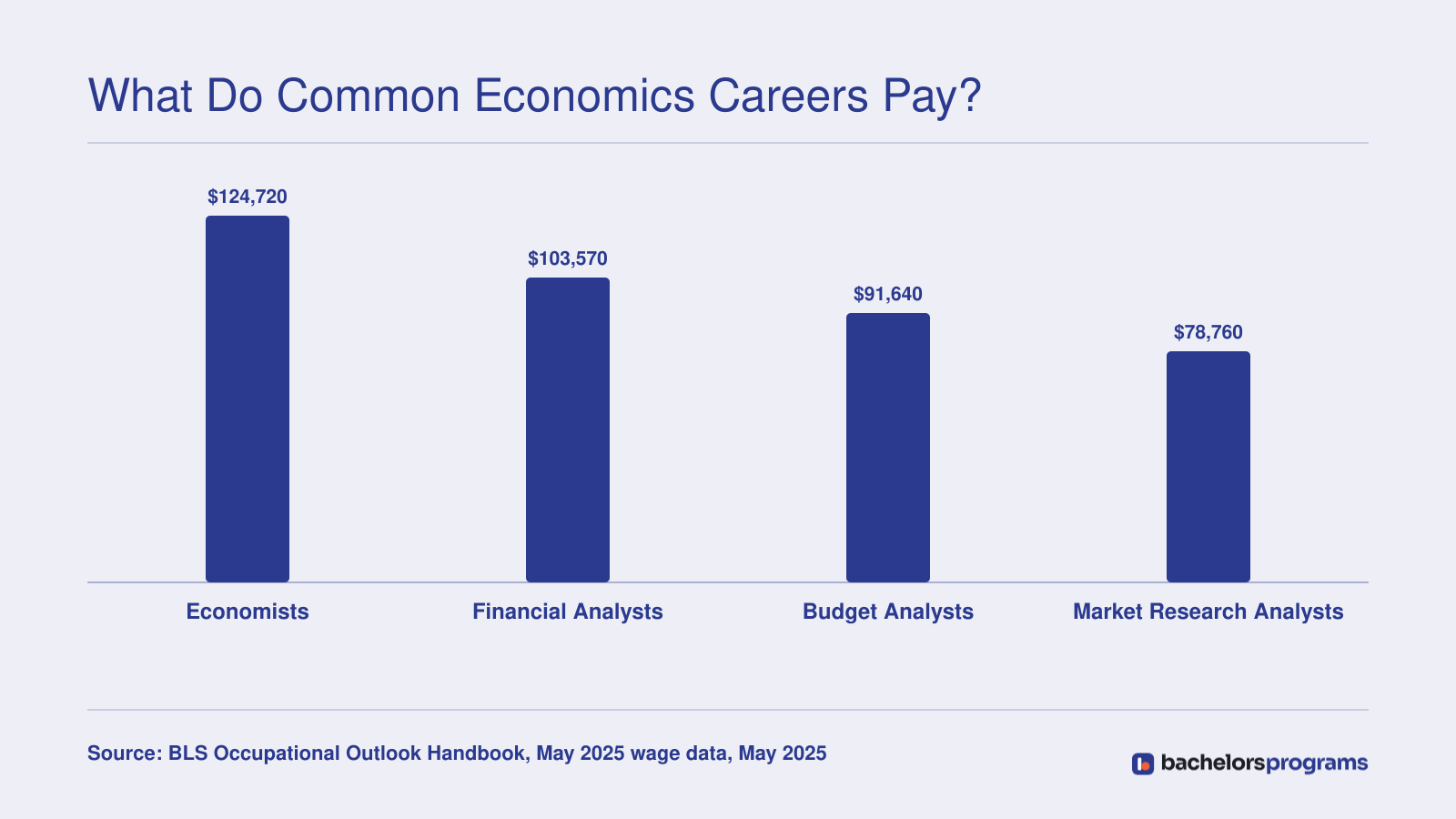
What Do Common Economics Careers Pay?
Economists earn the highest median wage of these four roles, but the Bureau of Labor Statistics says they typically need at least a master's degree. Some, mainly in government, start with a bachelor's, while others need a Ph.D. Financial analysts, budget analysts and market research analysts typically enter with a bachelor's, which makes them the most direct paths for graduates of an online economics degree. Each figure is a median, so half of workers in that occupation earned more and half earned less.
Economics programs by state
Online Economics Degree FAQs
These answers cover the questions prospective students ask most about format, exams, and accreditation. Delivery details vary by school and sometimes by instructor, so confirm specifics with your program before you apply.
Can you get an economics degree fully online?
Is an online economics degree worth it?
Do online economics programs require proctored exams or campus visits?
Are online economics classes live or self-paced?
How do I confirm an online economics degree is accredited?
Compare Economics programs on the data that matters
Explore more Business & Management majors or browse every field of study.
All Business & Management programs Browse every field of study