Best Entrepreneurship Degree Programs
Compare 620+ accredited Entrepreneurship programs at 590+ colleges, with net price after aid, graduation rates, earnings and debt from IPEDS and the U.S. College Scorecard.

A business school cannot hand anyone a profitable company, but it can teach the mechanics founders otherwise learn by losing money: opportunity screening, venture finance, and investor pitches. A bachelor's degree in entrepreneurship, awarded as a Bachelor of Science (B.S.) or Bachelor of Arts (B.A.) in Entrepreneurship, packages those skills into a major or an upper-division track.
The real test is proof. Florida State's entrepreneurship graduates earn a median $48,625 one year out, at a school with a net price of $11,297. Many programs publish no major-level earnings at all.
Only undergraduate programs appear here, not MBAs or graduate certificates. For most students, cost after aid shapes the return more than any school's startup reputation.
Key Points
- Rankings weigh net price, completion, and earnings against debt, not startup hype.
- Options range from a Wharton concentration to a Tallahassee upper-division major.
- Early-career earnings near a 1:1 ratio with debt signal solid value.
Top 10 Bachelor's Programs for Future Founders in 2027
Every spot below was earned on what students pay and what graduates earn, not on the polish of a startup pitch. The list runs from a Wharton concentration to a two-year upper-division major in Tallahassee, and each program pushes students into real ventures before they finish. Familiar names help, but the details on each card matter more.
University of Pennsylvania
#1Philadelphia, PA · $29,000/yr (est. net price)
Best for: Students set on venture capital networks
Wharton's entrepreneurship offering runs as a Bachelor of Science in Entrepreneurship and Innovation, with 37 course units and a senior capstone at the end. Venture Lab, a joint effort of Wharton, Penn Engineering, and the Weitzman School of Design, gave eight Startup Challenge finalist teams more than $200,000 in cash prizes and startup resources in 2026. The school graduates 97% of students.
- 37 course units across four years
- Senior capstone required
- Backed by the Goergen Entrepreneurial Management Program
- Wharton Venture Lab support for student ventures
- Covers venture capital, intellectual property strategy, social entrepreneurship
- Students write real business plans and complete field projects
Florida State University
#2Tallahassee, FL · ~$11,000/yr (est.)
Best for: Community college transfers entering upper division
Entrepreneurship at Florida State lives in the Jim Moran College of Entrepreneurship, which runs a two-year upper-division major for students who arrive with 52 semester hours already done. A separate STEM Entrepreneurship option lets students pair venture coursework with a science or technology focus. The school graduates 86% of students.
- Two-year upper-division major, 120 total credit hours
- 57 credit hours inside the major
- Admission needs 52 semester hours and a 3.00 prerequisite GPA
- Required internship (ENT 4943) plus an entrepreneurship capstone
- Careers include owner, franchise operator, consultant, and investor
- Seven concentration options in a STEM field
- Three specialized STEM entrepreneurship courses
- 120 total credit hours with prerequisites
- Prepares students for product and data roles at startups, biotech, and tech firms
- Internship opportunities available
Fashion Institute of Technology
#3New York, NY · $6,000 – $17,000/yr (est.)
Best for: Creative students building fashion businesses
FIT's entrepreneurship degree is built for the fashion and design industries and taught by faculty who work in them. The Jay and Patty Baker School of Business and Technology pairs business coursework with a liberal arts foundation, and the curriculum is revised as the field's trends and tools change. The school graduates 81% of students.
- Bachelor of Science in Entrepreneurship for the Fashion and Design Industries
- Faculty of practicing industry professionals
- Strong liberal arts foundation alongside business coursework
- Curriculum evolves with industry trends and technology
- Housed in the Jay and Patty Baker School of Business and Technology
University of Minnesota-Twin Cities
#4Minneapolis, MN · ~$17,000/yr (est.)
The Carlson School's entrepreneurial management major sits inside a large research university with a startup scene of its own, from the statewide MN Cup to the Gary S. Holmes Center for Entrepreneurship. Students choose a track in entrepreneurship, intrapreneurship, or social entrepreneurship, and an international experience is required to finish the degree. The school graduates 85% of students.
- 120 total credit hours over four years
- International experience required for graduation
- Tracks: Entrepreneurship, Intrapreneurship, Social Entrepreneurship
- Statewide MN Cup competition and BizPitch
- Gary S. Holmes Center for Entrepreneurship and Gopher Founders mentors
University of Southern California
#5Los Angeles, CA · ~$33,000/yr (est.)
USC's entrepreneurship emphasis is a 12-unit addition for Marshall and Leventhal business majors, so it rewards students already inside the business school who want new-venture coursework on top of the core. Los Angeles supplies the investor and internship network that makes the emphasis pay off. The school graduates 92% of students.
- Open to current Marshall and Leventhal undergraduates
- Requires sophomore standing and introductory entrepreneurship coursework
- 12 upper-division emphasis units plus 8 units of electives
- Covers small business management and new enterprise creation
- Built on the full business administration core
University of Illinois Urbana-Champaign
#6Champaign, IL · ~$14,000/yr (est.)
Gies College of Business runs a 124-credit strategy, innovation, and entrepreneurship major that treats venture creation as a discipline: generate ideas, test them, assemble resources, manage risk. The iVenture Accelerator seminar and small business consulting work give students something concrete to show. The school graduates 85% of students.
- 124 credit hours over four years
- iVenture Accelerator seminar available
- Small business consulting and social enterprise labs
- Covers opportunity evaluation, resource assembly, and risk mitigation
- Prepares for both for-profit and nonprofit venture creation
Texas A&M University-College Station
#7College Station, TX · ~$21,000/yr (est.)
Texas A&M's entrepreneurial leadership track is one of four inside the management major, so students finish the full business core before specializing in opportunity recognition, business planning, and team leadership. The program is campus-based in College Station, with the university's alumni network behind it. The school graduates 84% of students.
- One of four tracks in the management major
- 60 lower-level business hours plus 60 upper-level hours
- Covers opportunity recognition, business plans, and team leadership
- Upper-level admission requires specific completed coursework
Grove City College
#8Grove City, PA · ~$22,000/yr (est.)
Grove City is a small private college in western Pennsylvania whose business school runs its own VentureLab and Center for Entrepreneurship + Innovation, both of which put funding behind student teams. The entrepreneurship major spans 67 to 68 credit hours and can be paired with several venture-focused minors. The school graduates 83% of students.
- ACBSP-accredited business program
- 67 to 68 credit hours
- Minors in digital, social, redemptive, and missional entrepreneurship
- VentureLab and Center for Entrepreneurship + Innovation fund student teams
- Internships with startups, incubators, family businesses, and nonprofits
Arizona State University
#9Tempe, AZ · ~$15,000/yr (est.)
ASU's W. P. Carey School of Business makes entrepreneurship a full major rather than an add-on, with the Center for Entrepreneurship supplying mentors and ecosystem connections. Class projects push students to evaluate opportunities and build plans they could take to launch. The school graduates 68% of students.
- Financial aid and scholarships available
- Opportunity recognition and business planning coursework
- W. P. Carey Center for Entrepreneurship mentorship
- Prepares founders and intrapreneurs for new or existing ventures
University of Oklahoma
#10Norman, OK · $15,000 – $20,000/yr (est.)
Oklahoma's entrepreneurship and venture management degree runs through a five-step sequence that starts with the Integrated Business Core and ends with the Governor's Cup. The Tom Love Center for Entrepreneurship and a 10-week summer Startup Launch Pad carry students from idea to launch. The school graduates 75% of students.
- Five-step sequence starting with the Integrated Business Core
- Governor's Cup competition and field studies
- 10-week summer Startup Launch Pad
- Tom Love Center for Entrepreneurship
- AACSB-accredited business college since 1926
Cost & outcomes by school
Federal data for the highest-earning Entrepreneurship programs, independent of the ranking above. Earnings are this field's bachelor's graduates four years after completing where the Scorecard reports them, else the school's undergraduate median.
| School | Net price / yr | Grad rate | Earnings | Debt | Grads/yr | Format |
|---|---|---|---|---|---|---|
| Boston College MA | $41,704 | 91% | $132,903 | $19,000 | 49 | Campus |
| Babson College MA | $40,514 | 93% | $123,938 | $20,000 | — | Campus |
| Carnegie Mellon University PA | $31,944 | 94% | $114,862 | $21,750 | — | Campus |
| University of Pennsylvania PA | $28,699 | 97% | $111,371 | $15,715 | 34 | Campus |
| Lehigh University PA | $36,931 | 88% | $105,584 | $21,960 | — | Campus |
| Rensselaer Polytechnic Institute NY | $36,228 | 84% | $102,051 | $23,750 | — | Campus |
| University of Arizona AZ | $16,674 | 68% | $99,722 | $24,425 | 46 | Campus |
| Brigham Young University UT | $15,564 | 81% | $97,085 | $11,069 | 41 | Campus |
| Northeastern University MA | $30,915 | 91% | $92,538 | $24,250 | — | Campus |
| University of Southern California CA | $32,740 | 92% | $92,498 | $18,000 | — | Campus |
| University of California-Berkeley CA | $13,481 | 93% | $92,446 | $13,000 | — | Campus |
| University of Virginia VA | $21,565 | 96% | $86,863 | $17,500 | — | Campus |
Sources: U.S. Department of Education. Net price, graduation rate, earnings and debt: College Scorecard (earnings and debt for this field's bachelor's graduates where reported, else school-wide); graduates: IPEDS. A dash means no figure is reported.
Cost, debt & payoff
Median earnings of this field's bachelor's graduates (4 yrs after completing, else the school's undergraduate median) vs. their median federal loan debt · U.S. College Scorecard
Across these programs the median graduate earns about $54,856 and finishes with roughly $22,990 in debt — a ratio that clears a common rule of thumb (keep debt below first-year salary). Net price and debt vary widely school to school, so check the per-school figures in the table above before you shortlist.
Inside Our Scoring: Outcomes, Cost, and Selectivity Over Hype
A program's score summarizes four things a family can verify: what the degree costs after aid, whether students actually finish it, what graduates earn and owe once they leave, and how selective the school is.
What the Numbers Actually Reward
- Net price after aid: the sticker price minus federal, state, and institutional grant aid, the figure that shapes real borrowing.
- Completion: graduation and retention rates, read as a sign of whether students stay and finish.
- Money in and money out: program-level earnings and typical debt after graduation, drawn from federal College Scorecard data.
- Access and selectivity: admit rates alongside the share of students receiving Pell Grants, so a school is not rewarded for prestige alone.
Why the Big Entrepreneurship Lists Read Differently
The Princeton Review and Entrepreneur Top Undergraduate Schools for Entrepreneurship ranking for 2026 covers 50 undergraduate and 50 graduate programs1. It is built from a survey fielded from June through August 2025, with responses from nearly 300 schools across the U.S., Canada, Mexico, and Europe, and it weighs more than 40 data points1. Those points lean on school-reported activity: the range of courses (new technology, social entrepreneurship, venture capital), faculty who have started, bought, or run a business, mentorship and pitch competitions, how many students produced an actionable launch plan, and companies alumni founded in the past five and 10 years along with the investor money they raised. University of Houston took No. 1 for 2026, with UT Austin at No. 21. Because the answers come from the institutions themselves, a high placement reflects what a school reports about its own programming.
How to Read a "Top 25 for Entrepreneurship" Badge
Ask three questions: which list published it, for which year, and what that list measures. A strong showing on a survey-driven ranking signals a busy, well-resourced entrepreneurship ecosystem. It does not, by itself, say anything about what graduates earn.
Where the Data Stops
Graduation rates and net prices are institution-wide averages, not figures for one major. Some entrepreneurship programs have no published earnings at all, which means any comparison is partly a comparison of what happens to be reported.
What a Bachelor's Degree in Entrepreneurship Covers: B.S. vs. B.A. vs. Business Concentration
Two entrepreneurs can graduate with the same word on their diploma and arrive with very different training: one built a spreadsheet-heavy finance toolkit, the other paired entrepreneurship with a second major in design or computer science.
The B.S. and the B.A.
The B.S. typically leans quantitative and business-core heavy, with accounting, finance, and statistics anchoring the degree before students move into venture work. The B.A. trades some of that technical core for liberal arts breadth, and it is often easier to combine with a second major or a minor outside the business school.
Most programs run about 120 credits, or four years full-time, though several run longer. Credit totals vary by institution: Western Carolina and Long Island both list 120 credits, Belmont lists 1281, and Long Island's required major coursework alone comes to 44 credits.2 Expect core courses in new venture creation, entrepreneurial finance, opportunity recognition, innovation management, and a business plan or venture capstone.
Major vs. concentration
A standalone major makes entrepreneurship the primary field and usually sequences a larger venture-creation block across several semesters. A concentration inside a BBA or business administration degree adds a smaller cluster of entrepreneurship courses on top of a broader business core. Concentrations give wider functional exposure and are usually simpler to switch into, since you already sit inside the business school. Employers read both as business degrees; what separates candidates is the work they can show.
What is the best degree for an entrepreneur?
There is no single best degree. If you intend to build in a technical field, a computer science, engineering, or design major with an entrepreneurship minor often beats a pure entrepreneurship major, because you bring a product to the table instead of only a plan.
Affordable Entrepreneurship Degree Programs: The Three Lowest Net Prices
Net price is the average that aided students at a school pay after grants and scholarships, drawn from the U.S. Department of Education's IPEDS and College Scorecard data, so your own cost will shift with family income, residency, and the aid you receive. Published private tuition often looks high, but aid can narrow the gap: privately run American Public University System charges the same $8,400 for in-state and out-of-state students, while out-of-state rates at the two Florida publics run roughly three to four times their in-state rates, so run each school's net price calculator before you compare offers. Where it is published, the program's median monthly payment on a 10-year repayment plan is the most concrete measure of debt burden; for Florida State's entrepreneurship graduates, that figure is $174 a month.
| School | Format and Sector | Net Price After Aid | In-State Tuition and Fees | Out-of-State Tuition and Fees | Pell Grant Recipients | Program Median Debt | Median Monthly Payment (10-Year Plan) |
|---|---|---|---|---|---|---|---|
| American Public University System (Charles Town, WV) | Online, private for-profit | $9,597 | $8,400 | $8,400 | 86.6% | $33,678 | N/A |
| Florida State University (Tallahassee, FL) | Campus, public | $11,297 | $5,656 | $18,786 | 59.8% | $17,100 | $174 |
| Florida Gulf Coast University (Fort Myers, FL) | Campus, public | $12,568 | $6,118 | $25,162 | 59.8% | N/A | N/A |
Related Articles
Earning an Entrepreneurship Degree Online or in a Hybrid Format
Campus immersion and fully online study lead to the same credential, but they feel very different. Yes, you can earn a bachelor's degree in entrepreneurship online. The highest-ranked programs are taught on campus, so online learners generally turn to other universities, such as American Public University System, Old Dominion, Liberty, and Lamar.
How Online Formats Typically Work
Most online programs require about 120 credits, though Unity Environmental University's applied bachelor's is 90. Many schools use 8-week terms, Old Dominion, Liberty, and Lamar among them, but formats vary. Johnson & Wales runs 7 or 15 weeks, and American InterContinental University uses 5. Start dates are frequent. APUS enrolls monthly, Lynn University starts three times a year, and Liberty and Old Dominion publish several upcoming dates.
Transfer policy is where online study can save the most time. APUS, Old Dominion, and Liberty accept up to 90 credits, though Old Dominion requires at least 30 to be completed there. Unity accepts up to 60 toward its 90.
Accelerated and Completion Paths
If you already have college credit, look for a completion route. Old Dominion offers one for students with some college. Generations College uses a 2+2 model: 61 associate credits transfer, then 60 upper-division credits take about five semesters. Faster calendars also help. Lamar runs six terms a year, and Unity runs eight. Actual time to degree still depends on your transfer credits and course load.
What Online Students May Miss
Online learners can lose out on in-person pitch nights, campus incubators, and the casual founder networking that happens between classes. Some programs offer virtual alternatives, so ask admissions whether remote pitch events or accelerators exist and how often they run.
Confirm the Credential Before You Enroll
Before you apply, verify that the online degree carries the same diploma and the same accreditation as the on-campus version. Check the school's accreditation page and ask whether the transcript distinguishes the delivery format.
What Business Leaders Earn Nationally
Many business graduates move into management roles before, or instead of, launching a venture of their own.
Entrepreneurship Degree Salary: What Graduates Actually Make
An entrepreneurship degree salary is not a single number. It is a set of outcomes measured at different points after graduation, and the spread is wide. How much do entrepreneurship majors make? It depends on the window, and on whether the graduate works for an employer or for a company they founded.
Reading the Program Medians
Medians for the programs ranked here show how wide that spread runs. The University of Houston reports $52,752 one year after completion. Boston College reports $132,903 four years out. Washington State University reports $77,036 five years out. Within the four-year window, the University of Miami ($73,489), the University of Vermont ($68,395), and the University of Delaware ($56,895) show how much variation exists even when the timing is the same. A one-year figure catches graduates in entry-level roles or still launching; a four-year figure reflects more settled careers. The lowest and highest figures also sit in different windows, so compare like with like. Treat each number as a snapshot of a specific cohort, not a promise.
Why Founder Income Is Missing
BLS wage surveys cover wage-and-salary workers in nonfarm establishments but exclude self-employed workers and owners of unincorporated businesses. A founder who pays themselves a modest salary while reinvesting revenue can look underpaid in tax records, and some founders never appear in W-2 data at all. Early-stage founder income is often a runway decision rather than a market wage. BLS profiles do list self-employment among related roles, including 14% of management analysts and 27% of top executives, but those shares describe those occupations, not founder earnings.
The Jobs That Fund the Launch
Most graduates build a track record before a venture pays them. Product management, business development, corporate innovation, and operations are common first stops. BLS median annual wages from May 2025 put management analysts at $101,860, sales managers at $148,270, advertising, promotions, and marketing managers at $165,780, and top executives at $108,780. The median across all occupations was $50,980. The sequence is usually deliberate: learn how a company sells, ships, and hires, then apply that knowledge to your own company. For founders, the corporate years are not a detour; they are the apprenticeship.
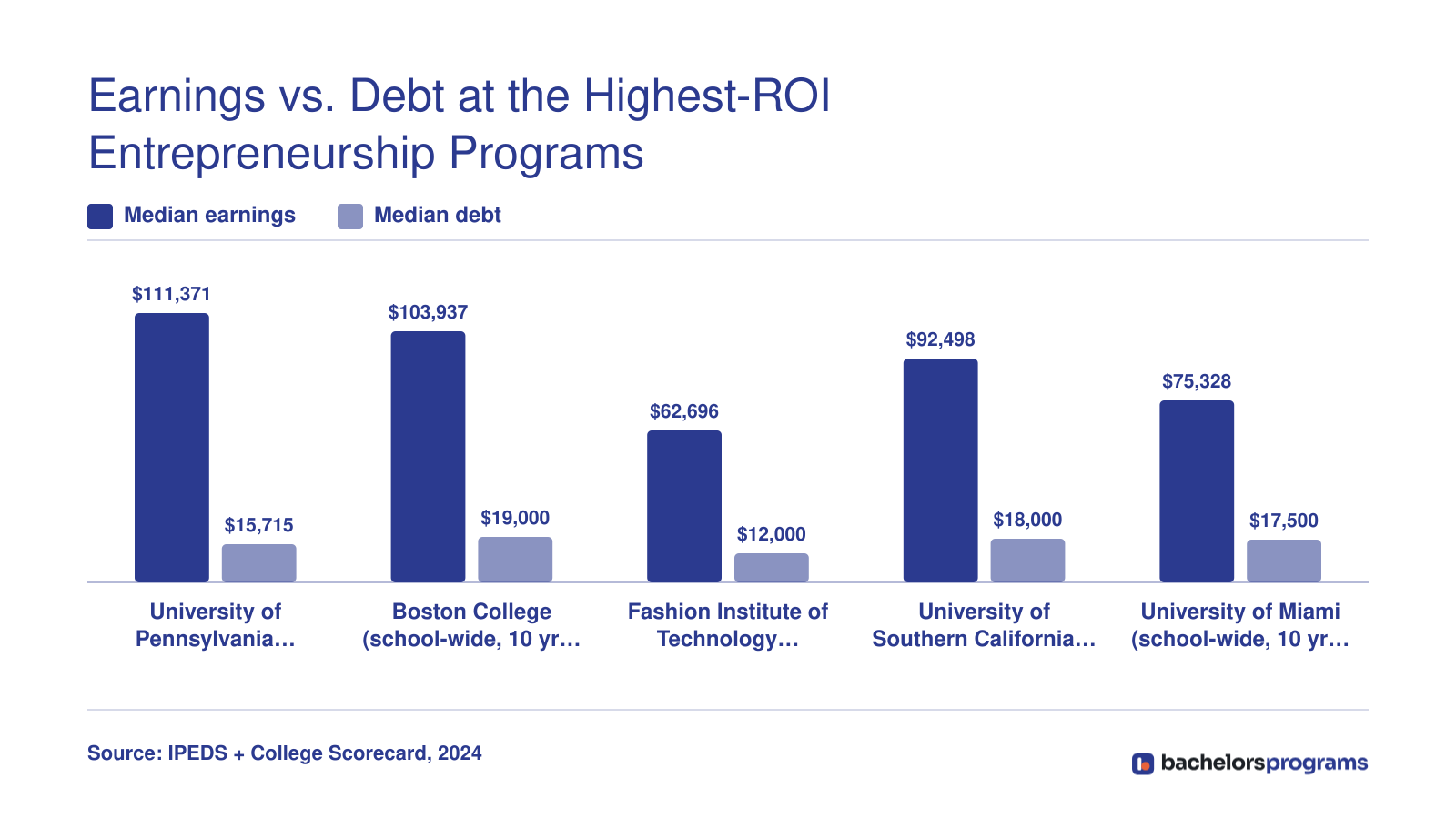
Earnings vs. Debt at the Highest-ROI Entrepreneurship Programs
The schools charted here post the strongest earnings-to-debt ratios among the programs ranked on this page. Each bar uses school-wide figures: median earnings 10 years after entry against median graduate debt. Early-career earnings near or above 1:1 with debt signal a manageable loan burden, and every school here clears that bar easily, from about 4:1 at Miami to roughly 7:1 at Penn.
Questions to Ask Yourself
What kind of venture do you actually want to build?
Would an MBA or a corporate job be your backup plan?
Do you need a campus incubator, or the flexibility of an online program?
How many transfer credits will count, and what will the remaining degree cost?
Entrepreneurship programs by state
Compare Entrepreneurship programs on the data that matters
Explore more Business & Management majors or browse every field of study.
All Business & Management programs Browse every field of study