Best Online Entrepreneurship Degree Programs
Compare 120+ accredited online Entrepreneurship programs, with net price after aid, graduation rates, earnings and debt from IPEDS and the U.S. College Scorecard.

Entrepreneurship has moved from a business-school elective to a standalone major that students can finish without visiting a campus. A bachelor's degree in entrepreneurship is typically awarded as a Bachelor of Science (B.S.) or Bachelor of Arts (B.A.) in Entrepreneurship, and programs differ most in price and graduate outcomes.
Every school here delivers the degree 100% online, and hybrid programs were left out. The comparison weighs net price, graduate earnings, career paths, and how a dedicated entrepreneurship major differs from a business degree with a concentration.
Many graduates still take salaried jobs before launching anything, so what a program costs and how much students borrow matter as much as the curriculum.
Key Points
- Every program ranked here runs fully online, with no campus residency.
- Central Michigan graduates borrowed a median $27,000, roughly $286 monthly.
- 2024 federal data shows net price after grants, not just sticker tuition.
10 Best Fully Online Bachelor's Degree in Entrepreneurship Programs for 2027
Every program below is built to be completed entirely online, with no campus residency or in-person class meetings. Only entries that clear that bar made the list; from there, cost after aid, completion strength and the depth of each school's venture coursework set the order. Some are standalone bachelor's degrees in entrepreneurship, while others build the major into a business administration or applied management core, which changes what appears on the diploma.
American Public University System
#1Charles Town, WV · $5,000 – $10,000/yr (est.)
Best for: Military learners launching startups
American Public University System runs entirely online and was built around adult and military learners, with monthly course starts and no scheduled login times. The entrepreneurship degree is a standalone B.A. rather than a concentration buried inside a general business major, and the coursework ends with students pitching a venture and writing a full business plan. Faculty are practicing entrepreneurs, and students can transfer up to 90 credits, which shortens the path for anyone arriving with prior college work.
- 120 credit hours, accredited by the ACBSP
- Asynchronous classes with 12 start dates a year
- Five concentration options, including small business and analytics
- Transfer up to 90 credits toward the degree
- Capstone: pitch your venture and finish a business plan
- Faculty are working entrepreneurs
Florida State College at Jacksonville
#2Jacksonville, FL · under $5,000/yr (est.)
Best for: Transfer students wanting seven-week courses
Florida State College at Jacksonville awards a B.S. in Business Administration with an entrepreneurship concentration, so graduates leave with a broad business core alongside the venture coursework. Most classes run in an accelerated seven-week format, and the whole program can be finished online. It is a practical route for students who already carry some college credit and want a faster term structure than a standard semester calendar.
- 120 credit hours in an ACBSP-accredited business program
- Entrepreneurship is one of four concentration options
- Accelerated seven-week courses; fully online option available
- Prepares for operations, sales and administrative services management
Pasco-Hernando State College
#3New Port Richey, FL · $5,000 – $10,000/yr (est.)
Best for: Supervisors moving toward business ownership
Pasco-Hernando State College places its entrepreneurship concentration inside a Bachelor of Applied Science in Supervision and Management, a structure aimed at students who already hold an associate degree and want management credentials rather than a traditional business B.B.A. The college lists dozens of degrees and certificates that can be completed fully online and maintains e-learning support for students who never come to campus. Entrepreneurship here sits alongside health care management, organizational administration and other management tracks, so the core leans toward supervision and administration.
- Entrepreneurship concentration within a supervision and management bachelor's
- One of 37 programs the college lists as completable fully online
- E-learning support and resources for online students
Palm Beach State College
#4Lake Worth, FL · $3,100 – $11,000/yr (est.)
Palm Beach State College offers the same applied-science model: a B.A.S. in Supervision and Management with an entrepreneurship concentration, open to students who hold an associate degree with at least a 2.0 GPA. The program builds in an internship and collaboration with industry professionals, and it starts three times a year. Students choose among entrepreneurship, general management, health management and project management tracks.
- 120 credit hours; associate degree and 2.0 GPA required
- Four concentrations: entrepreneurship, general management, health, project management
- Starts in fall, spring and summer
- Internship and industry collaboration built into the coursework
- Accredited by the Accreditation Council for Business Schools and Programs
University of Nevada-Las Vegas
#5Las Vegas, NV · ~$10,000/yr (est.)
The University of Nevada, Las Vegas houses its entrepreneurship degree in the Lee Business School, where the Department of Management and Entrepreneurship runs the program. Coursework centers on building workable business models, writing funding plans for startups and organizing resources to move a product to market. Published four-year plans of study and degree worksheets lay out the path to graduation semester by semester, which helps students in a large public university keep track of requirements.
- Housed in the Lee Business School's management and entrepreneurship department
- Coursework on business models, funding plans and operations strategy
- Four-year plans of study and degree worksheets published
- Focus on launching ventures and innovating inside companies
Kennesaw State University
#6Kennesaw, GA · ~$15,000/yr (est.)
Kennesaw State University's Coles College of Business launched the first entrepreneurship bachelor's of its kind in Georgia and has been recognized as a national model program. Students work through new venture creation, family business, social stewardship and corporate innovation, with access to the Family Enterprise Center and the Shore Entrepreneurship and Innovation Center. A Double Owl pathway lets strong students begin an MBA while finishing the undergraduate degree.
- 120 credit hours; online option available
- First entrepreneurship program of its kind in Georgia
- Access to the Family Enterprise Center and the Shore Entrepreneurship and Innovation Center
- Double Owl pathway to an MBA
- Starts fall, spring and summer
Yavapai College
#7Prescott, AZ · $2,900 – $9,000/yr (est.)
Yavapai College is a two-year-rooted institution that added a Bachelor of Science in Business with an entrepreneurship concentration, aimed at working adults and transfer students. Classes run in eight-week terms with part-time and full-time pacing, and the college accepts up to 60 credits for prior learning. The college advertises no textbook costs or fees, and advisors sit inside the classes rather than in a separate office.
- 121 credit hours in eight-week classes
- Up to 60 prior learning credits accepted
- Part-time or full-time pacing with five start dates a year
- Advertises no textbook costs or fees
- Advisors embedded in classes; guest speakers from the field
Lake Washington Institute of Technology
#8Kirkland, WA · $6,000 – $12,000/yr (est.)
Lake Washington Institute of Technology takes an applied approach: the Bachelor of Applied Science in Applied Management with an entrepreneurship focus asks students to launch something, lead a team and manage money while they study. Six quarters of coursework cover startup strategy, finance, accounting, creative product development and AI for business, ending in a capstone business plan. It is an open-enrollment college, so admission is less selective than at a research university.
- Six-quarter degree ending in a capstone business plan
- Coursework in startup strategy, finance, accounting and AI for business
- Open enrollment college with fall, winter and spring starts
- Built around launching a venture, not just studying one
University of Colorado Denver/Anschutz Medical Campus
#9Denver, CO · $10,000 – $15,000/yr (est.)
The University of Colorado Denver runs its entrepreneurship emphasis through the Jake Jabs Center, pairing coursework with mentoring from faculty and outside professionals experienced in new business development. Students take a dedicated block of entrepreneurship core courses, including a build-your-business sequence and a business plan project. Guest lectures from practicing founders supplement the casework, and scholarships are available for students in the emphasis.
- Entrepreneurship emphasis taught through the Jake Jabs Center
- 18 credit hours of entrepreneurship core courses
- Build-your-business sequence and business plan creation
- Mentoring from faculty and outside professionals
- Guest lectures from practicing entrepreneurs
Central Wyoming College
#10Riverton, WY · $10,000 – $15,000/yr (est.)
Central Wyoming College folds entrepreneurship into a Bachelor of Applied Science in Organizational Management and Leadership, an option built for students moving into management in public, private, government or nonprofit organizations. The degree requires 120 credit hours, including 45 upper-division credits, a business internship and a capstone in business and entrepreneurship. The college also offers an associate degree in entrepreneurship, so students can start there and continue into the bachelor's.
- 120 credit hours, including 45 upper-division credits
- Business internship and entrepreneurship capstone required
- 30 general education credits; electives need advisor approval
- College also offers an associate degree in entrepreneurship
Cost & outcomes by school
Federal data for the highest-earning Entrepreneurship programs, independent of the ranking above. Earnings are this field's bachelor's graduates four years after completing where the Scorecard reports them, else the school's undergraduate median.
| School | Net price / yr | Grad rate | Earnings | Debt | Grads/yr | Format |
|---|---|---|---|---|---|---|
| University of Florida FL | $4,815 | 85% | $71,588 | $15,000 | — | Online |
| CUNY Brooklyn College NY | $3,103 | 54% | $60,752 | $11,000 | — | Online or campus |
Sources: U.S. Department of Education. Net price, graduation rate, earnings and debt: College Scorecard (earnings and debt for this field's bachelor's graduates where reported, else school-wide); graduates: IPEDS. A dash means no figure is reported.
Cost, debt & payoff
Median earnings of this field's bachelor's graduates (4 yrs after completing, else the school's undergraduate median) vs. their median federal loan debt · U.S. College Scorecard
Across these programs the median graduate earns about $54,856 and finishes with roughly $22,990 in debt — a ratio that clears a common rule of thumb (keep debt below first-year salary). Net price and debt vary widely school to school, so check the per-school figures in the table above before you shortlist.
Inside Our Process: Online-Only Filters, Scorecard Data and Accreditation Checks
Mixing campus, hybrid and fully online options into one list answers a different question than most readers are asking. This list starts with delivery format: any program requiring regular campus attendance, or running as a hybrid, was removed before other factors were weighed.
Where the Numbers Come From
Figures for net price, graduation rate, program-level earnings and student debt come from the U.S. Department of Education's College Scorecard and IPEDS, the federal postsecondary data system. Two caveats apply to those figures: neither the graduation rate nor the average net price is specific to the entrepreneurship major, so read them as signals about the school rather than the program.
Accreditation: Two Layers, Not One
Institutional accreditation covers the entire college and is the layer most directly tied to federal student aid eligibility. The Department of Education retired the formal "regional" and "national" labels in 20191, yet the former regional accreditors remain the strongest transfer signal; the receiving institution still decides what it will accept, sometimes as elective credit only.
Programmatic business accreditation sits on top. AACSB reviews the business school itself and reported more than 1,100 accredited schools worldwide in 2026. ACBSP emphasizes teaching, learning outcomes and continuous improvement.2 IACBE weighs mission fit and outcomes. None of the three replaces institutional accreditation, and ACBSP notes that program accreditation alone may not be sufficient when another college evaluates your credits. AACSB carries the widest international recognition, but that is an employer signal, not a transfer guarantee or a shortcut into graduate school.
Check the Directory, Not the Brochure
A marketing page may advertise an accredited business school without confirming that the entrepreneurship major falls inside the accredited scope. Look the school up in the accreditor's own online directory, and confirm institutional accreditation separately, before you apply.
Online Entrepreneurship Degree Tuition Comparison: Net Price vs. Sticker Price
This table is sorted from lowest average net price. It places each school's published in-state and out-of-state tuition beside what students actually paid after grants and scholarships, using 2024 IPEDS and College Scorecard data from the U.S. Department of Education. Net price is a school-wide average for students who receive aid, not a personal quote, so use each school's net price calculator to estimate your own cost. CUNY Brooklyn College has the lowest net price at $3,103 and the University of Nevada-Las Vegas has the highest at $10,359, a spread of $7,256. Florida State College at Jacksonville has the lowest published in-state tuition at $2,657. The University of Michigan-Flint shows how much aid can narrow the gap: it lists $14,236 in-state but averages $7,007 after aid. American Public University System, a private school, charges $8,400 regardless of where you live, while public out-of-state rates here reach as high as $27,790. If you live in another state, confirm whether a public program offers in-state or e-tuition pricing to online students before you enroll.
| School | Sector | Published In-State Tuition | Published Out-of-State Tuition | Average Net Price After Aid | Median Federal Debt at Graduation (School-Wide) |
|---|---|---|---|---|---|
| CUNY Brooklyn College | Public | $7,452 | $15,402 | $3,103 | $11,000 |
| Florida State College at Jacksonville | Public | $2,657 | $9,631 | $4,128 | $13,562 |
| University of Florida | Public | $3,876 | $16,579 | $4,815 | $15,000 |
| Pasco-Hernando State College | Public | $3,155 | $12,032 | $5,203 | $9,535 |
| Lake Washington Institute of Technology | Public | $5,997 | $12,062 | $6,817 | $15,047 |
| University of Michigan-Flint | Public | $14,236 | $27,790 | $7,007 | $25,000 |
| Yavapai College | Public | $2,948 | $9,486 | $8,683 | $9,000 |
| Palm Beach State College | Public | $3,050 | $10,910 | $9,182 | $7,081 |
| Lamar University | Public | $8,905 | $18,745 | $9,366 | $21,250 |
| American Public University System | Private (for-profit) | $8,400 | $8,400 | $9,597 | $21,743 |
| University of Nevada-Las Vegas | Public | $9,748 | $27,411 | $10,359 | $19,450 |
What Business Owners Actually Earn
Use this salaried benchmark to judge what running your own company needs to beat. It counts employees, not owners.
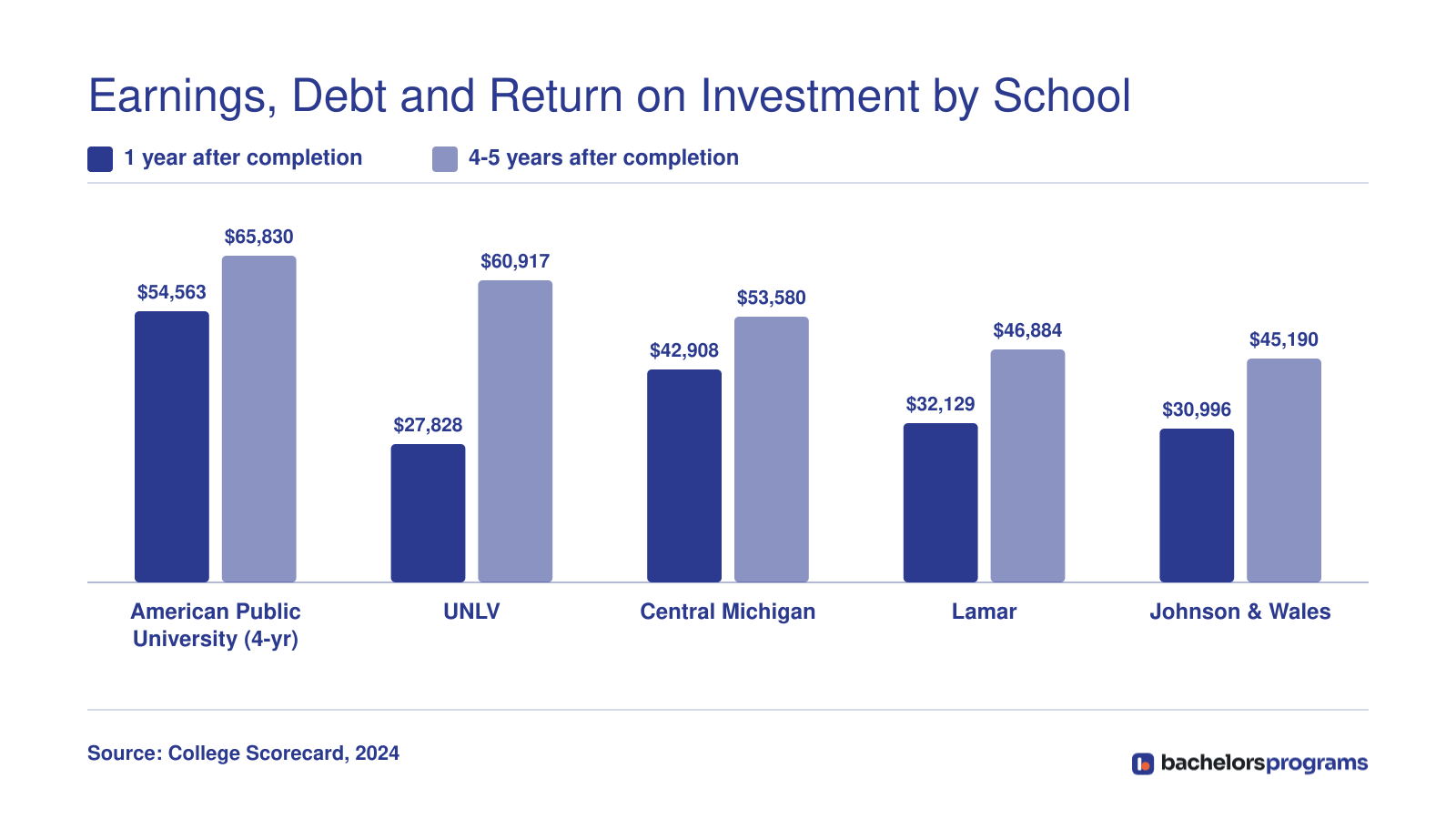
Earnings, Debt and Return on Investment by School
Median earnings for entrepreneurship graduates climb between the first year after completion and four to five years out, when payback starts to matter. Central Michigan graduates borrowed a median $27,000, about $286 a month over 10 years, against $53,580 five years out. At Lamar it is $26,160 ($277 a month) against $46,884, and at Johnson & Wales $25,125 ($266 a month) against $45,190. Wages are only part of the picture: the Census Bureau's Annual Business Survey records owners' highest degree and field earned before they established, purchased or acquired a business, so its owner data counts buyers as well as founders. Treat any single "startup rate" for entrepreneurship majors with caution.
Related Articles
Entrepreneurship Degree vs. Business Degree With an Entrepreneurship Concentration
A dedicated entrepreneurship degree and a business degree with an entrepreneurship concentration lead to many of the same jobs, so the choice comes down to how much of your education you want spent on starting ventures.
How the Two Paths Differ
- Coursework share: A B.S. or B.A. in Entrepreneurship puts venture-focused classes at the center of the major. A BSBA or BBA with a concentration usually adds a handful of entrepreneurship electives to a standard business core.
- Business breadth: The concentration route typically covers more accounting, finance, operations and management fundamentals.
- Career flexibility: Concentration graduates map easily onto finance, marketing, operations and management roles. Entrepreneurship graduates commonly land in general management, management analysis, marketing and sales management, and business development.
- Employer perception: An entrepreneurship major is generally read as a business degree with a venture specialization. Federal data tracks occupations, not this distinction, so no reliable pay gap between the two is established.
- Capstone: Expect a venture plan or startup pitch in the dedicated degree, and more often a general strategy or consulting project in the concentration track.
One earnings source reports a national median of $61,027 four years after graduation for entrepreneurship bachelor's holders, with reported salaries spanning $38,487 to $88,452. That figure covers 2017-2019 graduates and has no matched concentration comparison, so treat it as a rough benchmark only.
Variants and Degree Types
You will see labels such as technology entrepreneurship, innovation, and entrepreneurial leadership. These usually adjust the emphasis, not the underlying business foundation. A B.S. tends to lean quantitative, with more analytics, finance and technology requirements. A B.A. generally leaves more room for electives and liberal arts.
A Rule of Thumb
Choose the dedicated degree if you already have a venture idea, want to build it during your coursework, and value a venture-plan capstone. Choose the business degree with a concentration if you are hedging toward corporate roles, want a broader core, or may pivot into finance or operations later. Either way, most managerial titles still require work experience after graduation.
Questions to Ask Yourself
Are you launching a specific venture in the next two years, or building a business foundation you will use inside an existing company?
Would a general business major with an entrepreneurship concentration keep accounting, finance or marketing roles open if you change direction?
Do you want a capstone where you build and pitch your own business plan, or a broader strategy course?
What to Look for in an Online Entrepreneurship Program
Before you apply to any online bachelor's degree in entrepreneurship, check each program against the criteria below. Most of these details are on a school's website or can be confirmed with an admissions counselor.
- Regional accreditation plus business-school accreditationRegional (institutional) accreditation protects your eligibility for federal aid and credit transfer. AACSB, ACBSP or IACBE accreditation shows the business school meets an outside quality standard.
- Truly online deliveryLook for programs with no required campus residencies and with live sessions that are limited or optional. That flexibility lets you study around a job or a startup that is already running.
- Transfer-friendly policies and accelerated termsGenerous transfer credit and shorter terms, such as seven- or eight-week courses, can cut both time to degree and total cost.
- Experiential access for remote studentsAsk whether online students can join virtual incubators, mentorship networks and pitch or seed-funding competitions. Some competitions, such as e-Fest, take first-round entries online, though finalists pitch in person in Minneapolis. Other programs mix virtual and on-campus sessions, so confirm which dates require travel.
- Faculty with founder or venture-capital experienceInstructors who have launched companies or invested in them can offer practical feedback and industry contacts that a textbook cannot.
- Military and veteran supportYellow Ribbon schools split remaining private or out-of-state tuition and fees with the VA, which matches the school's contribution dollar for dollar. Eligibility is limited to veterans at the maximum Post-9/11 rate and some transferees, so active-duty members and their spouses do not qualify. Ask each school about its tuition-assistance rate and credit for military training.
Entrepreneurship programs by state
Online Entrepreneurship Degree FAQs
These answers cover the questions prospective students ask most about an online bachelor's degree in entrepreneurship. Policies change, so confirm details with each school before you apply.
What is the best online entrepreneurship degree?
How much does an online entrepreneurship degree cost?
Is an entrepreneurship degree worth it?
Is a certificate in entrepreneurship enough, or do I need the full bachelor's?
How fast can you finish an online bachelor's in entrepreneurship if you already have college credits?
Will I have to log in at set times, or is everything self-paced?
Can GI Bill or military tuition assistance cover an online entrepreneurship degree?
Compare Entrepreneurship programs on the data that matters
Explore more Business & Management majors or browse every field of study.
All Business & Management programs Browse every field of study