Best Finance Schools in Florida
Compare 44 accredited Finance programs in Florida at 38 colleges, with net price after aid, graduation rates, earnings and debt from IPEDS and the U.S. College Scorecard.

A public research university in Gainesville and a private college in Lakeland can both award a Bachelor of Science (B.S.) in Finance, yet the net price students pay after aid runs from roughly $6,500 to $28,500 a year. That spread, more than the published tuition rate, drives the decision.
A bachelor's degree in finance in Florida leads into banking, corporate finance and wealth management work concentrated in Miami, Tampa, Orlando and Jacksonville, where employers screen on internships and financial modeling ability as closely as they screen on GPA.
Key Points
- Public in-state tuition starts at $4,879 a year at Florida Atlantic University.
- Florida International University runs a fully online finance BBA.
- Expect two admission gates: the university first, then the business college.
Best Bachelor's Degree in Finance Programs in Florida: Our Top 10
Ten Florida schools make this list, from large public research universities to a private college in Lakeland and an online option based in Orlando. In-state tuition at the public options runs from roughly $4,900 to $6,600 a year, and the schools offering this program report institution-wide graduation rates ranging from about 57 percent to 91 percent. Where federal data publishes finance-specific earnings, the figures below are quoted four years after completion.
University of Florida
#1Gainesville, FL · ~$7,000/yr (est.)
Best for: Wealth-management students seeking CFP-aligned courses
Florida's flagship public university houses its finance degree in the Heavener School of Business in Gainesville, where the curriculum runs from valuation and capital structure through financial modeling and risk management. Students complete 120 credits, six credits of career readiness coursework, and a 150-hour internship before senior year. A partnership with Schwab Advisor Services has widened access to registered investment adviser conferences, industry software, and professional development for students on the wealth-management pathway. Finance graduates report median earnings of $106,153 four years after completion, the highest on this list.
- 120 total credit hours with a 2.0 GPA minimum
- Six credits of career readiness coursework
- 150-hour internship required before senior year
- CAPSIM comprehensive exam required for graduation
- Coursework in valuation, capital structure, and financial modeling
- Study abroad, student leadership, and research opportunities
Florida State University
#2Tallahassee, FL · ~$11,000/yr (est.)
Best for: Aspiring portfolio managers wanting live trading experience
Florida State's finance major sits in the College of Business in Tallahassee and leans heavily on practice: a Student Investment Fund and a dedicated Trading Room let undergraduates manage real money and build portfolio models. Students also get the Closing Bell Speaker Series, internships, and international programs, plus active organizations like The Finance Society. Finance graduates report median earnings of $87,089 four years after completing the degree.
- Student Investment Fund and dedicated Trading Room
- Closing Bell Speaker Series brings industry speakers to campus
- Internships and international study programs available
- Home to The Finance Society and Willow Partners student groups
- Scholarships available to finance majors
Florida International University
#3Miami, FL · ~$9,000/yr (est.)
Best for: Working adults wanting a fully online option
FIU's business school in Miami runs one of the largest finance enrollments in the state, with a 120-credit degree that can also be completed online. Coursework covers capital markets, commercial bank management, securities analysis, and international financial management, and finance courses require a grade of C or higher. The university has also partnered with Truist on financial-literacy programming in Miami-Dade classrooms. Median earnings for finance graduates are $71,355 four years after completion.
- 120 total credit hours
- Online BBA in Finance available for working students
- Finance courses require a grade of C or higher
- Coursework in capital markets, securities analysis, and bank management
- Financial aid and scholarships available
University of Central Florida
#4Orlando, FL · ~$10,000/yr (est.)
UCF's finance program in Orlando pairs standard corporate finance and investment coursework with Bloomberg terminals used in class, and students can earn Bloomberg Market Concepts certification or work through CFA-level material. The Miller College of Business also offers certificates in banking, corporate finance, and investments, plus a fintech minor. The school's FinTech-AI Lab gives students project work with industry mentors on fraud and credit-risk problems. Median earnings for finance graduates reach $82,007 four years after completion.
- 120 total credit hours; starts fall, spring, or summer
- Bloomberg terminals used in coursework
- Bloomberg Market Concepts certification available
- Certificates in banking, corporate finance, and investments
- Fintech minor offered
- Capstone required, with an Honors in the Major option
Florida Atlantic University
#5Boca Raton, FL · $4,900 – $17,000/yr (est.)
FAU's finance major in Boca Raton deliberately narrows its focus to financial operations, banking, and investment analysis rather than general business administration. The College of Business holds AACSB accreditation and gives undergraduates access to a trading room plus dedicated advising. Students can add related minors in finance or real estate. Median earnings for finance graduates are $70,078 four years after completion.
- Housed in the AACSB-accredited College of Business
- Covers planning, managing, and analyzing financial operations
- Trading Room available to undergraduate finance students
- Finance and real estate minors available
- Dedicated undergraduate advising for business students
University of North Florida
#6Jacksonville, FL · $10,000 – $15,000/yr (est.)
At UNF in Jacksonville, finance majors build a foundation in accounting, economics, and statistics before choosing electives in corporate finance, investments, or real estate. A strategic management capstone closes the degree in the final semester, and students must earn at least a C in required courses. The Coggin College of Business also accepts military benefits. Median earnings for finance graduates come in at $75,475 four years after completion.
- Tracks: corporate, investments, real estate
- 21 prerequisite credit hours in accounting, economics, statistics
- Grade of C or better required in required courses
- Strategic management capstone in final semester
- Six elective credits must carry the FIN prefix
- Military benefits accepted
University of West Florida
#7Pensacola, FL · $5,000 – $10,000/yr (est.)
UWF in Pensacola structures its finance degree around two specializations: financial management, which builds toward the CFA, and financial planning, which covers the curriculum for the CFP designation. The Lewis Bear Jr. College of Business holds AACSB accreditation, and classes are delivered face to face, hybrid, and online. Coursework spans accounting, data analytics, business ethics, investments, and financial institutions. Median earnings for finance graduates are $66,463 four years after completion.
- Two specializations: Financial Management and Financial Planning
- Financial Planning track covers the CFP designation curriculum
- Financial Management track builds toward the CFA designation
- Classes offered face to face, hybrid, and online
- AACSB-accredited Lewis Bear Jr. College of Business
Florida Gulf Coast University
#8Fort Myers, FL · ~$13,000/yr (est.)
FGCU's finance degree in Fort Myers offers three concentrations, and the financial services track meets Certified Financial Planner Board education requirements. Students need a 2.0 FGCU GPA and C-or-better grades in the common prerequisites to move into the major, and the last 30 business credits must be taken at FGCU. A Destination FGCU transfer pathway guarantees admission for Associate in Arts graduates from three partner state colleges. Median earnings are $75,767 four years after completion.
- 120 total credit hours; 42 must be upper division
- Three concentrations: financial analysis, financial services, real estate
- Financial Services track meets CFP Board education requirements
- 2.0 FGCU GPA and C grades in prerequisites to enter major
- Last 30 business credits must be taken at FGCU
- Business Strategy capstone plus a service-learning requirement
Ana G. Mendez University
#9Orlando, FL · ~$20,000/yr (est.)
Ana G. Mendez University delivers its finance and economics degree entirely online from Orlando, built for working adults and military students. The curriculum pairs corporate finance with economic analysis and prepares graduates for budget analysis, cost estimation, consulting, and research roles in private firms or public agencies. The program is approved for VA and military benefits.
- Fully online BBA delivered from Orlando
- Approved for VA and military benefits
- Combines corporate finance with economic analysis
- Prepares students for budget analysis, cost estimating, consulting
- Suited to working adults and military commitments
Florida Southern College
#10Lakeland, FL · $29,000/yr (est. net price)
Florida Southern's finance program in Lakeland holds CFA Institute University Affiliate status, and undergraduates manage a real portfolio through the Student Managed Investment Fund. Case studies, simulations, and internships supplement the coursework, and students can join Delta Sigma Pi or the Real Estate Club. Freshman admission is test-optional, with SAT or ACT scores accepted if an applicant chooses to submit them.
- CFA Institute University Affiliate status
- Student Managed Investment Fund with a real portfolio
- Case studies, simulations, and internships in the curriculum
- Delta Sigma Pi business fraternity and Real Estate Club
- Freshman admission is test-optional; SAT or ACT accepted
Cost & outcomes by school
Federal data for the highest-earning Finance programs, independent of the ranking above. Earnings are this field's bachelor's graduates four years after completing where the Scorecard reports them, else the school's undergraduate median.
| School | Net price / yr | Grad rate | Earnings | Debt | Grads/yr | Format |
|---|---|---|---|---|---|---|
| University of Miami FL | $37,244 | 84% | $110,240 | $14,500 | 434 | Campus |
| University of Florida FL | $6,541 | 91% | $106,153 | $16,681 | 265 | Campus |
| The University of Tampa FL | $36,211 | 64% | $90,485 | $25,250 | 284 | Campus |
| Florida State University FL | $11,297 | 86% | $87,089 | $16,740 | 785 | Campus |
| Stetson University FL | $19,372 | 62% | $85,033 | $24,990 | 43 | Campus |
| University of Central Florida FL | $10,411 | 78% | $82,007 | $17,584 | 410 | Campus |
| Florida Gulf Coast University FL | $12,568 | 57% | $75,767 | $19,267 | 136 | Campus |
| University of North Florida FL | $10,154 | 69% | $75,475 | $14,750 | 157 | Campus |
| University of South Florida FL | $9,812 | 77% | $73,933 | $16,691 | 469 | Campus |
| Florida International University FL | $9,288 | 74% | $71,355 | $16,500 | 517 | Online |
| Rasmussen University FL | $21,909 | 42% | $70,838 | $24,433 | 4 | Online |
| Jacksonville University FL | $25,180 | 51% | $70,456 | $22,000 | 19 | Campus |
Sources: U.S. Department of Education. Net price, graduation rate, earnings and debt: College Scorecard (earnings and debt for this field's bachelor's graduates where reported, else school-wide); graduates: IPEDS. A dash means no figure is reported.
Cost, debt & payoff
Median earnings of this field's bachelor's graduates (4 yrs after completing, else the school's undergraduate median) vs. their median federal loan debt · U.S. College Scorecard
Across these programs the median graduate earns about $66,302 and finishes with roughly $21,500 in debt — a ratio that clears a common rule of thumb (keep debt below first-year salary). Net price and debt vary widely school to school, so check the per-school figures in the table above before you shortlist.
How We Ranked Florida Bachelor's in Finance Programs
Many college rankings quietly blend different credentials and time frames, which makes finance programs look easier to compare than they really are. This list covers undergraduate bachelor's programs only, in both campus and online formats.
What the Data Covers
Each school was reviewed using College Scorecard outcomes, IPEDS tuition and net price figures, and graduation rates. These are federal sources that apply the same definitions to every school, so one school's numbers line up with the next.
Institution-Wide vs. Program-Specific Figures
Some measures describe the whole school, not just the finance major. Graduation rate, net price, and 10-year earnings are institution-wide, so they reflect students across every field of study. Earnings and debt figures tied to the finance program are program-specific and speak more directly to what finance graduates experience. Keep that difference in mind when you read any school's numbers.
Keeping Comparisons Fair
Lists drawn from mixed sources can combine credential levels and outcome windows, such as earnings one year after graduation next to earnings a decade out. Those blends can make a school look stronger or weaker than it is. These rankings keep bachelor's programs together and measure like against like.
The 5 Cheapest Bachelor's in Finance Programs in Florida
For in-state students, value means more than a low sticker price. It means paying the least after grants and scholarships while still earning a degree from a school that graduates its students. Using 2024 federal data from IPEDS and the College Scorecard, the University of Florida posts the lowest average net price here at $6,541, about $2,800 less than the University of West Florida at $9,364, and it pairs that cost with a 91% graduation rate.
| School | City | Program Format | In-State Tuition & Fees | Out-of-State Tuition & Fees | Average Net Price | Graduation Rate |
|---|---|---|---|---|---|---|
| University of Florida | Gainesville | Campus | $6,381 | $28,659 | $6,541 | 91% |
| New College of Florida | Sarasota | Campus | $6,916 | $29,944 | $7,195 | 67% |
| Florida Atlantic University | Boca Raton | Online | $4,879 | $17,324 | $8,752 | 63% |
| Florida International University | Miami | Online | $6,565 | $18,964 | $9,288 | 74% |
| University of West Florida | Pensacola | Campus | $6,360 | $19,241 | $9,364 | 59% |
Online and Hybrid Bachelor's in Finance Options at Florida Schools
Which Schools Offer Online Finance Degrees
The documented online options are business-administration degrees with a finance major, not programs titled exactly B.S. in Finance.
- Florida International University: a fully online Bachelor of Business Administration in Finance, 120+ credits, listed at $235.57 per credit plus fees.1
- University of West Florida: an online BSBA in Finance, 120 credits, typically 24 to 48 months, listed at $220.23 per credit (about $26,428 total).2
- Rasmussen University: an online 90-credit finance bachelor's built for degree completion, at $332 per credit. The $235 per-credit rate applies only with continuous enrollment.3
- Florida Atlantic University and Ana G. Mendez University: both are tagged online in our program data, so confirm the format on each school's page.
UF and UCF list a Finance BSBA, but their program pages do not establish a fully online format. FSU, UNF, FGCU, and Florida Southern College describe campus programs and publish no online option on the pages we checked.
Do Online Students Get In-State Rates?
Not automatically. FIU and UWF publish separate in-state and out-of-state per-credit rates, and UWF adds an out-of-state waiver tier. Your residency sets the price, so check the school's online tuition page.
Online or Campus: Practical Tips
- Choose campus if you want a structured internship path. UF, for example, requires a 150-hour internship before senior year.
- Campus programs usually offer the strongest networking, such as Florida Southern's Student Managed Investment Fund.
- Choose online if you work full time or are transferring credits. UWF accepts up to 90 transfer credits.
Related Articles
Admissions for Florida Bachelor's in Finance Programs: GPA, Test Policy, and Transfer Credit
Getting into a Florida finance program usually happens in two stages: the university admits you, then the business college admits you to the major. The second gate is the one that trips students up.
GPA expectations and test policy
Florida's public universities publish admission standards at the university level and leave the sharper screens to the business school, so very few post a single hard GPA cutoff for first-year applicants. They report admitted-class profiles instead, which shift year to year. Selectivity varies widely across the public programs here: the University of Florida and Florida State University each admit roughly a quarter of applicants, while Florida Atlantic University, the University of West Florida and Florida Gulf Coast University admit a clear majority. Those are institution-wide figures, not finance-specific ones, so treat them as context rather than a target. On the private side, Florida Southern College lists the SAT and ACT as optional.
Entry into the finance major
Most Florida programs admit students to business first and apply grade conditions before upper-division finance coursework:
- University of Florida: 2.0 core, major and institutional GPAs, a 3.0 across required accounting coursework, and a B+ in the core finance course.1
- University of Central Florida: 2.75 across 3000-level and higher finance courses taken at UCF, 2.0 across business coursework, and a C or better in business courses.
- University of North Florida: 21 credit hours of prerequisites, each passed with a C or better.
- Florida International University and Florida Gulf Coast University: finance coursework at C or higher, with FGCU holding a 2.0 minimum and prerequisite requirements.
Transferring with a Florida AA
The Florida College System associate in arts remains the cleanest route in. Statewide common course numbering means prerequisites such as financial and managerial accounting carry over, and UF evaluates equivalent transfer coursework against the Florida Common Course Prerequisites.1 Florida State University asks transfer applicants for at least 12 transferable credit hours earned after high school.2 UCF accepts transfer credit only at C or higher, so a C- will not count.
Clear calculus or business calculus and financial accounting early, with strong grades. Those two courses decide more finance admissions than anything else on your transcript.
Cost of a Bachelor's Degree in Finance in Florida: Tuition, Net Price, and State Aid
In Florida, your aid package shapes the cost of a bachelor's degree in finance more than the published tuition rate does. At the public universities ranked here, annual in-state tuition and fees run from $4,477 at the University of Florida to $6,368 at the University of Central Florida.
Sticker Price vs. Net Price
Net price adds housing, books and other costs, then subtracts grants and scholarships. Among the public schools, it ranges from $6,541 at the University of Florida to $12,568 at Florida Gulf Coast University. The private options start higher. Ana G. Mendez University lists $13,575 in tuition and a $19,775 net price. Florida Southern College charges $44,040 in tuition but averages $28,551 after aid. Net price is an institution-wide average for aided students, not a quote for the finance program, so your own cost will vary with income, residency and housing.
Florida's State Aid Programs
- Bright Futures Florida Academic Scholars: Pays 100% of tuition and specified fees at eligible Florida institutions for 2026-27. 2025-26 graduates need an ACT 29, CLT 95 or SAT 1330.1
- Bright Futures Florida Medallion Scholars: Pays 75% of tuition and specified fees. Minimums are ACT 24, CLT 82 or SAT 1190.1
- Florida Student Assistance Grant (FSAG): A need-based grant for Florida-resident, degree-seeking undergraduates with no prior bachelor's degree. Awards start at $200, and the Legislature sets the maximum each year.3 Public university students need at least 6 credit hours per term. Private college students need at least 12.3
Bright Futures also requires a qualifying Florida diploma and 16 college-preparatory courses.2 You also need approved service or work hours, Florida residency, and U.S. citizenship or eligible noncitizen status. Recipients must enroll in at least 6 credit hours.2 Federal Pell Grants can stack with state aid, narrowing the gap between public and private costs for students with financial need.
Your Next Step
File the FAFSA early, because FSAG requires an error-free FAFSA by each school's deadline. Then submit the Florida Financial Aid Application. For 2025-26 high school graduates seeking 2026-27 Bright Futures funding, the window runs from October 1, 2025, to August 31, 2026.1
Finance Careers in Florida and Earnings for Bachelor's Graduates
A bachelor's degree in finance typically leads to roles such as financial analyst, personal financial advisor, bank officer or insurance professional. Florida's metros supply plenty of that work, from Miami's banking and wealth management firms to Tampa, Orlando and Jacksonville.
Program Earnings and Debt
Program-level figures cover graduates' median earnings one year and four years after finishing, plus median debt. Use them as rough guides, not promises.
- University of Florida: $70,663 at one year, $106,153 at four years, median debt $16,681.
- Florida State University: $56,516 at one year, $87,089 at four years, median debt $16,740.
- University of North Florida (Jacksonville): $51,118 at one year, $75,475 at four years, median debt $14,750.
- Florida International University (Miami): $51,633 at one year, $71,355 at four years, median debt $16,500.
What the Job Market Pays
BLS counted 21,490 personal financial advisor jobs in Florida in May 20251, including 8,390 in the Miami-Fort Lauderdale-West Palm Beach area.2 The state-level median wage was not available to us, so here are the national medians: $105,070 for personal financial advisors3 and $103,570 for financial analysts.4 Florida pay may differ.
Licensing in Florida
Finance has no general state license. Particular roles do carry requirements:
- Securities: The FINRA Series 7 requires firm sponsorship and the Securities Industry Essentials exam.5 Whether you also need the Series 66 depends on your role and employer.
- Insurance: Florida's life and health license (class 2-15) covers life, health and annuities, including variable annuities.5 Applicants must be at least 18 and complete 60 hours of prelicensing study within four years.5 Some alternative routes exist, so confirm the current options with the state.6
- Variable annuities: Selling them takes both insurance authority and securities registration.5
CFA and CFP Pathways
The CFA charter requires three exams (Levels I to III), usually taking three to four years at about 300 study hours per level.7 It also requires 4,000 hours of relevant work over at least 36 months, plus professional references.7 Check the current education prerequisite before you enroll. CFP certification generally combines a bachelor's degree, approved financial planning coursework, an exam and supervised experience. Verify the current details with the certifying board. In both cases, a finance bachelor's degree supplies the coursework base and often leads to the entry-level jobs that count toward experience.
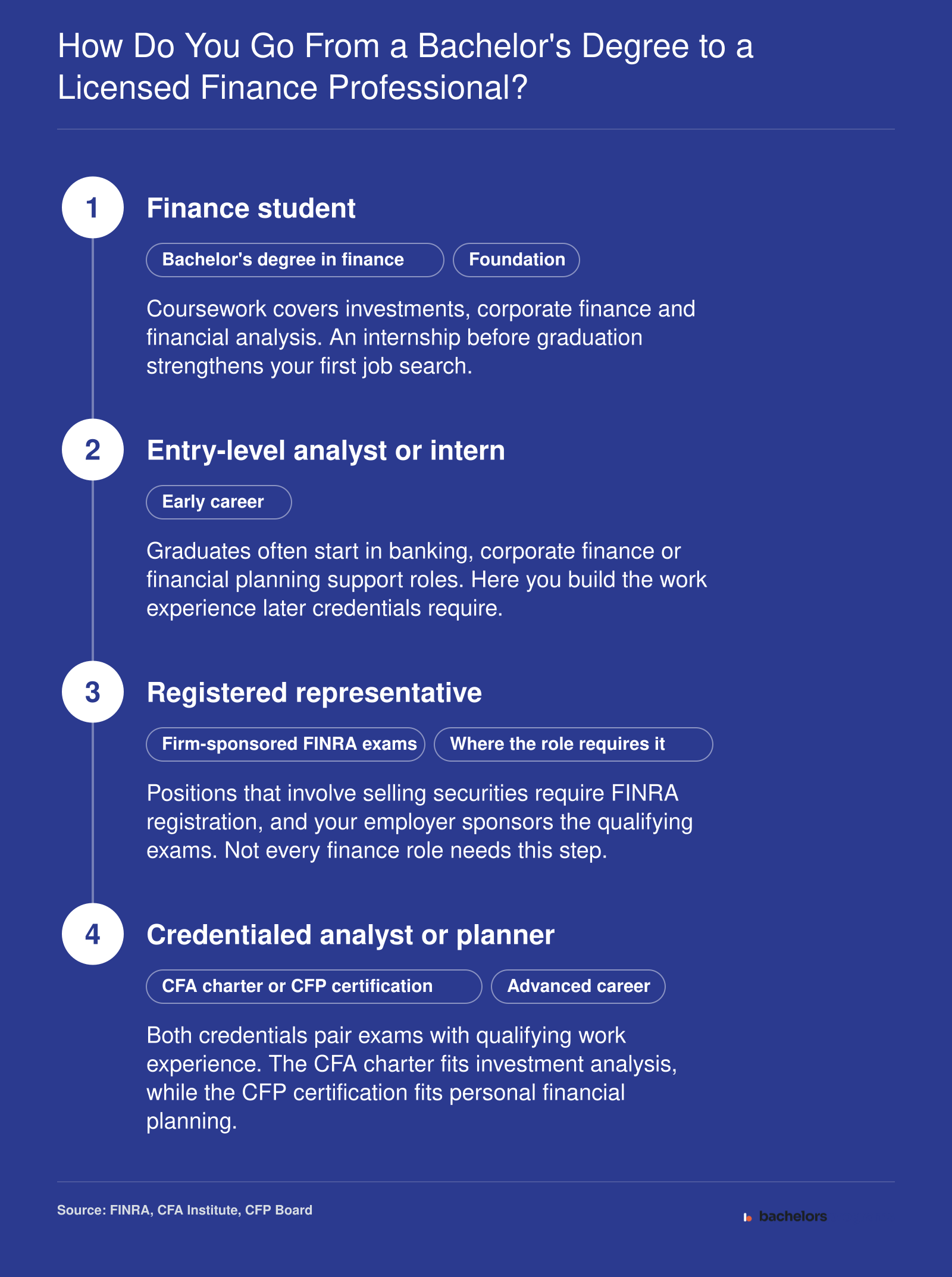
How Do You Go From a Bachelor's Degree to a Licensed Finance Professional?
A bachelor's degree in finance is the starting point, not the finish line. Most finance careers build in stages, with exams and professional credentials added once you are working. Here is the typical order.
Florida Finance Degree Questions, Answered
These quick answers draw on the 2026 figures and findings covered earlier on this page. Confirm current tuition and program details with each school before you apply.
Which Florida school is best for an undergraduate finance degree?
Which Florida finance programs offer the best value for in-state students?
Are there online bachelor's in finance programs at Florida schools?
Do you need a license to work in finance in Florida?
Compare Finance programs on the data that matters
Explore more Business & Management majors or browse every field of study.
All Business & Management programs Browse every field of study