Best Online Finance Degree Programs
Compare 190+ accredited online Finance programs, with net price after aid, graduation rates, earnings and debt from IPEDS and the U.S. College Scorecard.

An online finance degree is priced nothing like the same degree on campus. Average net price after aid at the schools ranked here runs from $8,752 to $22,383 a year, and those figures are averages, not quotes. The degree is usually a Bachelor of Science (B.S.) in Finance, and the online version carries the same accreditation as its on-campus counterpart.
What separates programs is rarely curriculum. It is transfer credit caps, live session times, and whether an associate degree clears general education. Those rules decide the final bill more than tuition does.
Key Points
- Every ranked program can be finished online, with no campus residency.
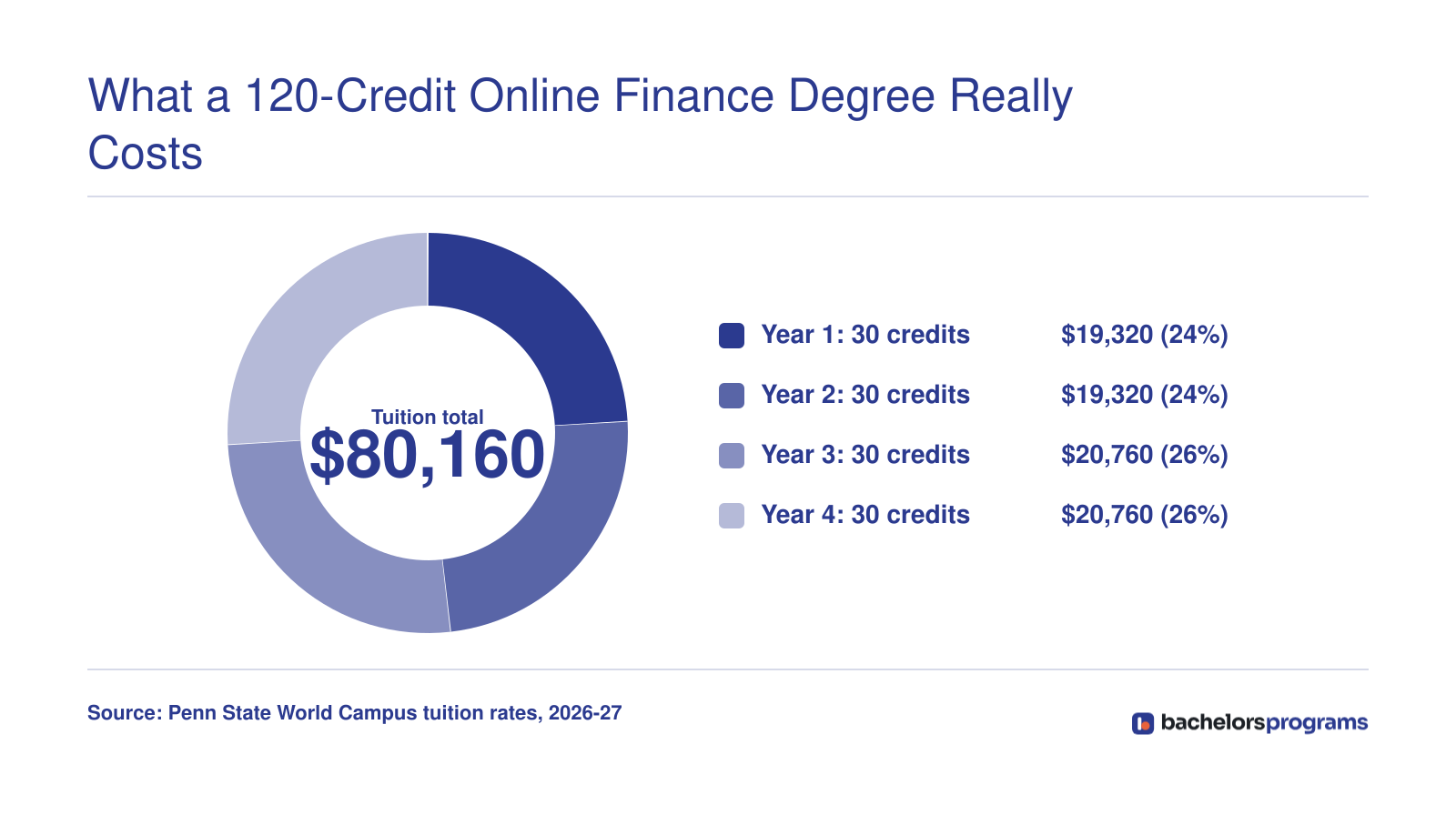
- At Penn State World Campus, 120 credits cost about $80,160 in tuition.
- Compare net price, not sticker tuition: aid lowers what students actually pay.
Best Fully Online Finance Degree Programs: Our Top 10 for 2027
Every program on this list can be finished entirely online, with no required campus residency, weekend intensive, or in-person exam standing between you and the credential. We ordered the ten by a blended quality composite that starts with what students actually pay and how quickly they can finish, then folds in earnings, debt, and the range of concentration options each school offers.
Florida International University
#1Miami, FL · ~$9,000/yr (est.)
Best for: Florida residents balancing work and study
FIU's online BBA in Finance runs 120 credits through capital markets, corporate finance, and risk management, and every finance course requires a grade of C or better, which keeps the cohort's fundamentals sharp. Net price after aid is $9,288 and 74% of students finish institution-wide, while finance graduates earned a median $71,355 four years after finishing, carrying $16,500 in median debt.
- 120 total credit hours
- Coursework in capital markets, corporate finance, investments
- Finance courses require a grade of C or higher
- Careers as financial analyst, portfolio analyst, risk manager
- Financial aid and scholarships available
Florida Atlantic University
#2Boca Raton, FL · $4,900 – $17,000/yr (est.)
Best for: Aspiring banking and investment analysts
Florida Atlantic deliberately narrows its finance major instead of surveying general business, teaching students to plan, manage, and analyze the money operations of banks and enterprises. An AACSB-accredited business school, a Trading Room, and dedicated undergraduate advising support the work. Net price after aid is $8,752, 63% of students finish institution-wide, and finance graduates earned a median $70,078 four years after finishing, with $15,458 in median debt.
- AACSB-accredited College of Business
- Focus on analyzing and managing financial operations
- Trading Room access and undergraduate advising
- Related minors in finance or real estate
- Prepares for corporate finance, banking, and investment roles
Thomas Edison State University
#3Trenton, NJ · $5,000 – $10,000/yr (est.)
Best for: Adults transferring years of prior credit
Thomas Edison State University is built for adults who arrive with credit already earned, letting students assemble 120 credits from courses, exams, and prior learning assessment before a strategic management capstone. The BSBA in Finance covers financial markets, institutions, and investments, and the published tuition is among the lowest of the ten. Nothing in the schedule requires a campus visit.
- 120 total credit hours, capstone required
- Covers financial markets, institutions, and investments
- Credit awarded for exams and prior learning assessment
- Business ethics coursework strongly recommended
University of Massachusetts-Amherst
#4Amherst, MA · $20,000 – $25,000/yr (est.)
UMass Amherst runs its online finance BBA with a corporate finance concentration, moving through financial modeling, bank management, and international finance with real-world cases throughout. The Isenberg School holds AACSB accreditation and staffs a dedicated Office of Career Success for online students, though entrants need at least 27 transferable credits. Net price after aid is $22,383, the highest here, yet 83% of students finish and finance graduates earned a median $96,995 four years after finishing, the strongest earnings on this list, against $20,500 in median debt.
- Corporate finance concentration
- Coursework in financial modeling and investments
- AACSB-accredited Isenberg School of Management
- Dedicated Office of Career Success for online students
- Minimum of 27 transferable credits required
Bismarck State College
#5Bismarck, ND · $10,000 – $15,000/yr (est.)
Bismarck State College frames its applied finance degree around practice: an internship, financial modeling exercises, and stackable certificates in accounting, analytics, and leadership that let students build credentials as they go. Admission opens at a 2.0 GPA, and prior college credit transfers in, which shortens the path for students arriving with coursework behind them. Net price after aid is $10,270, and 47% of students finish institution-wide.
- Internship applies finance theory to real organizations
- Stackable certificates in accounting, analytics, leadership
- Previous college credit accepted
- 2.0 GPA minimum, with fall and summer starts
Wayne State University
#6Detroit, MI · ~$13,000/yr (est.)
Wayne State's Ilitch School of Business lets finance majors choose a B.A. with foreign language coursework or a B.S., with electives spanning investment risk, bank management, and futures and options. Internships and mentorship feed a Detroit employer base that includes General Motors and Ally. Net price after aid is $12,766, 58% of students finish institution-wide, and finance graduates earned a median $74,703 four years after finishing.
- B.A. pathway adds foreign language coursework
- B.S. option also available
- Topics include investment risk, bank management, futures and options
- Internships and mentorship through the Ilitch School
- Honors track for students at a 3.5 GPA or higher
University of North Carolina at Greensboro
#7Greensboro, NC · $11,000/yr (est. net price)
UNC Greensboro's Bryan School pairs a finance core in investments, fintech, taxation, and international finance with a student investment club that runs CFA exam prep and company spotlights for networking. The business school holds AACSB accreditation, and an accelerated master's adds only one year with no GRE or GMAT. Net price after aid is $10,965 and 56% of students finish institution-wide, while finance graduates earned a median $64,077 four years after finishing, with $22,520 in median debt.
- AACSB-accredited Bryan School
- Coursework in investments, fintech, taxation, international finance
- Spartan Investment Club with CFA exam preparation
- Accelerated master's in one extra year, no GRE or GMAT
Ana G. Mendez University
#8Orlando, FL · ~$20,000/yr (est.)
Ana G. Mendez University puts corporate finance and economic analysis in the same frame, aimed at students who want budget analysis, cost estimation, or consulting work in private firms or public agencies. The program is approved for VA and military benefits, a practical draw for service members finishing a degree between assignments. Net price after aid is $19,775, and 69% of full-time students return for a second year.
- Pairs corporate finance with economic analysis
- Approved for VA and military benefits
- Prepares for budget analysis, cost estimation, consulting
- Tracks toward private companies and public agencies
Oregon State University
#9Corvallis, OR · $15,000 – $20,000/yr (est.)
Oregon State's finance degree runs through the AACSB-accredited College of Business, with options in financial planning and international business and a CFP Board registered track that satisfies Certified Financial Planner education requirements. The online format is nationally ranked for online learning, and 450 companies recruit students each year. Net price after aid is $19,604, 70% of students finish institution-wide, and finance graduates earned a median $78,427 four years after finishing, with $21,000 in median debt.
- AACSB-accredited College of Business
- Coursework in risk assessment and capital market analysis
- Finance and Financial Planning clubs
- Accelerated Master's Platform option
- Deloitte Scholarship offered
- CFP Board registered program
- Fulfills CFP education requirements
- CFA Institute University Affiliation Program
- Coursework in fixed income and commercial banking
- Thesis or capstone option
- International finance coursework
- Experiential learning requirement
- Coursework in investments and risk
- Student-managed multi-million-dollar portfolio
Georgia State University
#10Atlanta, GA · $9,000 – $25,000/yr (est.)
Georgia State's Robinson College gives finance majors a $500,000 student-managed portfolio, Bloomberg terminal work, and national competitions including the CFA Institute Research Challenge. A fully online completion track lets transfer students finish at their own pace with advisor support. Net price after aid is $15,931 and 53% of students finish institution-wide, but finance graduates earned a median $82,688 four years after finishing, with $21,625 in median debt.
- 120 credits across a four-year plan
- Manage a $500,000 student stock portfolio
- Bloomberg Essentials certification program
- CFA Institute Research Challenge participation
- Online completion track for transfer students
Cost & outcomes by school
Federal data for the highest-earning Finance programs, independent of the ranking above. Earnings are this field's bachelor's graduates four years after completing where the Scorecard reports them, else the school's undergraduate median.
| School | Net price / yr | Grad rate | Earnings | Debt | Grads/yr | Format |
|---|---|---|---|---|---|---|
| University of Massachusetts-Amherst MA | $22,383 | 83% | $96,995 | $20,500 | 383 | Online |
| Florida International University FL | $9,288 | 74% | $71,355 | $16,500 | 517 | Online |
Sources: U.S. Department of Education. Net price, graduation rate, earnings and debt: College Scorecard (earnings and debt for this field's bachelor's graduates where reported, else school-wide); graduates: IPEDS. A dash means no figure is reported.
Cost, debt & payoff
Median earnings of this field's bachelor's graduates (4 yrs after completing, else the school's undergraduate median) vs. their median federal loan debt · U.S. College Scorecard
Across these programs the median graduate earns about $65,651 and finishes with roughly $22,989 in debt — a ratio that clears a common rule of thumb (keep debt below first-year salary). Net price and debt vary widely school to school, so check the per-school figures in the table above before you shortlist.
How We Scored 100% Online Finance Programs
Fully online versus partly on campus: that split came first. Any program with a residency, hybrid component or required campus visit was cut before anything else was weighed, so every school ranked here can be finished without a trip to campus.
The remaining programs were compared on figures you can verify yourself:
- Cost: average net price from the College Scorecard, meaning what students actually pay after grants and scholarships.
- Completion: institution-wide graduation and retention rates, a signal of whether students who start actually finish.
- Outcomes: earnings and debt for finance graduates specifically, where that data is published.
Each measure has limits. Graduation and retention rates cover the whole school, not just finance majors or online students. Net price reflects what aid recipients paid on average, so your own bill may land above or below it. Some programs graduate too few students for earnings to be reported, and those were judged on cost and completion alone.
Plenty of ranking pages credit a "proprietary scoring" system they never explain. Every input here comes from public federal data, so you can look up any school on this list and find the same numbers we did.
What a Bachelor's Degree in Finance Online Covers
An online finance curriculum has to balance breadth against depth, and where a program lands shapes what you can do on day one of a job. A bachelor's degree in finance typically opens with a shared business core, then moves into upper-division finance courses that ask for more quantitative work. The standard award is the Bachelor of Science (B.S.) in Finance, though some schools confer a B.B.A.
The Business Core Comes First
Expect accounting, economics, statistics, and management before the advanced finance sequence. These courses build the vocabulary and analytical habits that later finance classes assume. In an online format, the core is also where delivery varies most: some programs run live sessions, while others rely on recorded lectures and weekly deadlines.
The Finance Major Adds Valuation and Modeling
Upper-division courses usually include corporate finance, investments, financial markets and institutions, and financial statement analysis. Compared with a general business degree, the finance major goes deeper into valuation, portfolio analysis, and spreadsheet modeling. You build models, compare investment choices, and trace how capital moves through markets. That quantitative tilt is the main difference between a finance major and a broad management track.
Concentrations Narrow the Degree
Common concentrations include financial planning, corporate finance, banking, and investments. In the programs ranked here, the University of Massachusetts Amherst program lists corporate finance as its concentration. Where a program does not list one, the upper division stays broad. A concentration can signal the kind of entry-level role a program is built for, so compare required courses rather than the label alone.
Online Finance Degree Cost: Net Price and Tuition at the Most Affordable Schools
Published tuition is the sticker price a school charges. Net price is what students actually paid on average after grants and scholarships, based on U.S. Department of Education IPEDS and College Scorecard data. Every school below is public, and that matters, because private colleges generally post much higher sticker prices. The University of Michigan-Flint has the lowest average net price here at $7,007 a year, but nonresidents face a $28,320 published rate before aid. For online students, residency can matter less than expected: LSU Shreveport lists $306 per credit with no out-of-state fee, and Southeastern Oklahoma State lists $343 per credit plus a $67 per-credit online enhancement fee. Net price is an average across aid recipients, not a personal quote, so confirm current online rates and fees with each school before you apply.
| School | Type | Average Net Price After Aid (per year) | In-State Tuition and Fees (per year) | Out-of-State Tuition and Fees (per year) | Published Online Rate |
|---|---|---|---|---|---|
| University of Michigan-Flint | Public | $7,007 | $14,704 | $28,320 | N/A |
| Louisiana State University Shreveport | Public | $7,022 | $7,518 | $7,518 | $306 per credit, no out-of-state fee |
| Purdue University Global | Public | $7,770 | $10,101 | $14,412 | N/A |
| Southeastern Oklahoma State University | Public | $8,039 | $7,530 | $16,740 | $343 per credit plus $67 per-credit online enhancement fee (verify current rate) |
| Florida Atlantic University | Public | $8,752 | $4,879 | $17,324 | N/A |
| Florida International University | Public | $9,288 | $6,565 | $18,964 | N/A |
| Bismarck State College | Public | $10,270 | $5,247 | $7,331 | N/A |
| University of Houston-Downtown | Public | $10,542 | $7,708 | $17,548 | N/A |
| University of North Carolina at Greensboro | Public | $10,965 | $7,661 | $24,012 | N/A |
| University of Wisconsin-Parkside | Public | $11,772 | $8,270 | $17,429 | N/A |
What a 120-Credit Online Finance Degree Really Costs
Penn State World Campus charges $644 per credit until a student reaches 60 accumulated credits and $692 per credit after that for 2026-27, so a student taking 10 credits a term (billed per credit) would pay about $80,160 in tuition for the 120-credit B.S. in Finance, split by year below. The school's tuition page lists no separate online technology fee for this program, and books and materials are an added cost. Each credit you transfer in shrinks the tuition portion by $644 to $692, which is why transfer policies matter when you compare programs.
Related Articles
Fully Asynchronous vs. Scheduled Live Classes: What Each Ranked Program Requires
A fully asynchronous finance program runs on deadlines rather than set meeting times. There are no set login times: you complete lectures, discussion posts and assignments on your own schedule as long as you meet the weekly due dates. For working adults, that structure is what makes a bachelor's degree manageable alongside a full-time job.
What We Can Confirm
Every school at the top of this list delivers its finance degree online, including FIU, the University of Memphis, UAB and Thomas Jefferson University.1 Beyond that, session-level rules are set by each department, and they change. Some online finance courses add scheduled live sessions, cohort meetings or exams that must be taken at a set time. We could not verify those details school by school, so get any claim of "fully asynchronous" confirmed in writing.
Oklahoma State, which stands out for collaborative learning, is worth asking directly how group projects are scheduled. Several schools, UNC Greensboro among them, also run on-campus versions of the same major, so ask which format the online section follows.
Proctoring and Campus Visits
Exams are where flexibility most often ends. Schools commonly use webcam-based online proctoring software or an approved testing center near you. Ask which applies, whether exam windows are fixed, and whether a campus visit or residency is ever required. Nothing in our data points to a required visit at the schools ranked here, but confirm it before you apply.
A Practical Rule
Shift workers and parents should confirm live-session policies course by course. Core courses may be fully asynchronous while a finance elective meets at a set hour. Ask an advisor for syllabi from two or three upper-level courses before you commit.
Questions to Ask Yourself
Do you already hold 60 or more transferable credits?
Can your schedule absorb required live sessions and proctored exam windows?
Are you targeting the CFP credential or the CFA and corporate finance track?
Does your state's public university charge online students in-state rates?
Financial Analyst Pay at a Glance
Finance programs by state
Online Finance Degrees: Quick Answers Before You Compare Programs
These short answers cover the questions readers ask most often about a bachelor's degree in finance earned online. Use them to set expectations on cost, format, and credentials before you compare individual schools.
What is the best online finance degree program?
How much does an online finance degree cost?
What is the cheapest online finance degree?
Can you get a finance degree fully online?
Are online finance degrees worth it?
Can I transfer credits into an online finance degree?
Do employers treat an online B.S. in Finance differently from a campus degree?
Does an online finance bachelor's satisfy the CFA Program's education requirement?
Compare Finance programs on the data that matters
Explore more Business & Management majors or browse every field of study.
All Business & Management programs Browse every field of study