Best Finance Schools in Kansas
Compare 20 accredited Finance programs in Kansas at 18 colleges, with net price after aid, graduation rates, earnings and debt from IPEDS and the U.S. College Scorecard.

Finance programs in Kansas differ less in curriculum than in price and payoff. A bachelor's degree in finance covers money management, investing, corporate finance and risk, and in Kansas the Bachelor of Business Administration (BBA) with a finance major is the more common credential. In-state tuition runs from $5,923 at Fort Hays State University to $12,102 at the University of Kansas.
Every school here works for students studying in Kansas or online through a Kansas-based institution. The ranking weighs College Scorecard outcomes and cost, and flags the cheapest and highest-earning options alongside admissions and Kansas career data.
The tradeoff is real: one year out, KU finance graduates earn a median $57,884, about $10,600 more than Fort Hays graduates.
Key Points
- Tuition and fees: $5,923 at Fort Hays State, $12,102 at KU.
- Fort Hays State and Ottawa University offer the clearest online finance routes.
- Selling securities in Kansas requires the SIE, Series 7, and state licensing.
Best Bachelor's in Finance Schools in Kansas, Ranked
Ten bachelor's degree in finance programs in Kansas make this list, from large public research universities to private colleges and one fully online option based in Overland Park. Each entry lists in-state tuition, an approximate net price after aid, the school's overall graduation rate, and whether the program is offered on campus, online, or both.
University of Kansas
#1Lawrence, KS · $12,000 – $30,000/yr (est.)
Best for: Jayhawks targeting investment banking recruiting
The University of Kansas anchors this list for scale and reach. Finance majors at the Lawrence campus build analytical, accounting and communication skills, and graduates move into corporate finance, commercial banking, underwriting, asset management, real estate, investment banking, and financial planning or wealth management. Students can join the Jennett Finance Scholars Program, the KU Insurance Club, Finance Club, Women in Finance, Rock Chalk Investment Club or Consulting Club, and can stack a certificate in banking or the Jack Lockton Certificate in Insurance and Risk Management on top of the major. Top recruiters include Grant Thornton, Koch Industries, Shamrock Trading and Walmart Corp.
- Coursework spans corporate finance, banking, asset management and real estate
- Recruiters include Grant Thornton, Koch Industries, Shamrock Trading and Walmart
- Prepares students for the CFA designation
- Jennett Finance Scholars Program for selected students
- Certificate in banking available alongside the major
- Jack Lockton Certificate in Insurance and Risk Management option
- Clubs include Finance Club, Women in Finance and Rock Chalk Investment Club
- Finance area industry mentors provide advising
Kansas State University
#2Manhattan, KS · $11,000 – $29,000/yr (est.)
Best for: Wildcats wanting real-money portfolio experience
Kansas State University's Manhattan campus pairs a traditional finance major with unusually deep statewide ties. The program holds CFA Institute Affiliation, and students help manage a real-money investment fund worth more than $1.7 million, an experience rare at other Kansas schools. The Student Finance Association handles networking, and roughly $300,000 in merit-based scholarships supports majors. The university's Institute for Financial Education and Prosperity partners with the Kansas Department of Insurance, the Kansas Bankers Association and K-State Extension, supporting the state's new financial-literacy graduation requirement that phases in for high school students entering in fall 2026.
- Manage a real-money investment fund worth over $1.7 million
- CFA Institute Affiliation aligns coursework with investment practice
- Finance Scholars Program is a selective cohort
- Student Finance Association for networking
- Approximately $300,000 in merit-based scholarships
- Concentration in financial management available
- Four concentration options within the major
- Reported 90% job placement rate
- Student portfolio worth over $1.5 million
- Financial lab with 12 Bloomberg terminals
- 47 Thomson Reuters Eikon terminals for research
- Trips to New York, Boston and Dallas
- Careers in CFO roles, investment banking and consulting
- Accounting, economics and management coursework
Pittsburg State University
#3Pittsburg, KS · $16,000/yr (est. net price)
Best for: Students wanting Excel modeling and stock simulations
Pittsburg State University's finance major prepares students to manage money, investments and financial assets, with coursework in risk management, financial markets and portfolio analysis. Hands-on financial modeling workshops in Excel have students build projections and analyze data, and a competitive stock market simulation sharpens investment strategy in class. The program is AACSB accredited and majors can dual major with other BBA degrees; the active Finance Club brings in guest speakers and students have won national FBLA competitions. Career paths include financial officer, credit analyst, budget analyst, bank manager, investment broker and auditor.
- AACSB accredited business program
- Stock market simulation game in coursework
- Hands-on financial modeling workshops using Excel
- Finance Club hosts guest speakers
- Students have won national FBLA competitions
- Dual major possible with other BBA degrees
- Field trips to major finance cities
- Alumni network for internships and entry-level roles
Fort Hays State University
#4Hays, KS · ~$13,000/yr (est.)
Fort Hays State University offers a Bachelor of Business Administration with a major in Finance, covering corporate financial management, investments, financial institutions, international finance, real estate finance and risk management. Students can add concentrations in banking, economics or financial planning, and the banking track includes a 120-credit curriculum plus access to the Robbins Banking Institute. The Investment Analytics Lab gives majors 10 Bloomberg terminals, and Ph.D.-level faculty provide personalized advising and research project supervision. Graduates are prepared for the CFP, CFA and CFM credentials and for forecasting, statement analysis and capital budgeting roles in the public and private sectors.
- Three concentration options including banking, economics, financial planning
- Access to 10 Bloomberg terminals in the Investment Analytics Lab
- Taught by Ph.D.-level faculty
- Prepares students for CFP, CFA and CFM certifications
- Personalized advising and research projects
- Courses in corporate financial management and investments
- 120 total credit hours
- Prepares for loan officer and bank examiner roles
- Study of state and federal banking regulations
- Commercial banking and financial services focus
- Robbins Banking Institute available
Washburn University
#5Topeka, KS · ~$15,000/yr (est.)
Washburn University's BBA in Finance prepares students for banking, real estate, insurance, corporate financial management, security analysis and government service. Coursework covers financial decision-making, interest rate determination, monetary policy, risk-return tradeoffs and accounting analysis, and the Applied Portfolio Management course has students run the Washburn Student Investment Fund using the Mayo Schmidt Finance Lab. The Brenneman School of Business is AACSB accredited, business students consistently score in the 80th percentile on the Major Field Test, and more than $400,000 in annual scholarships goes to business students. Internships with major regional employers and the Finance Society round out the Topeka advantage.
- AACSB accredited business school
- Student-managed Washburn Student Investment Fund
- Mayo Schmidt Finance Lab for hands-on analysis
- Business students score in the 80th percentile on the Major Field Test
- Over $400,000 in annual scholarships for business students
- Internships with major regional employers
- Networking through the Finance Society
Wichita State University
#6Wichita, KS · ~$13,000/yr (est.)
Wichita State University's Bachelor of Business Administration in Finance teaches students to manage money, analyze markets and make investment decisions, with coursework in financial management, financial modeling, investments and risk management. Electives reach into real estate finance, international finance and fixed income securities, and the major requires 21 credit hours plus 12 upper-division finance elective credits, with up to 3 cooperative education credits accepted. The program offers an emphasis in real estate and a path toward the Certified Financial Planner credential, and Wichita's business base supports co-op experience in banking, corporate finance, personal financial planning, insurance and government.
- Major requires 21 credit hours
- 12 upper-division finance elective credits
- Up to 3 co-op credits accepted toward the major
- Emphasis in real estate available
- Path toward the Certified Financial Planner credential
- Careers in banking, real estate, insurance and government
- Prerequisite courses required before upper-division work
Benedictine College
#7Atchison, KS · $28,000/yr (est. net price)
Benedictine College in Atchison offers a Bachelor of Arts in Finance through its School of Business, focused on financial modeling and analysis so graduates can assess an organization's financial health and allocate resources. Each student works with a finance advisor to build an academic plan, and the program's mission stresses persuasive communication and character alongside finance theory and practice. The department also offers accounting, international business, management and marketing degrees, giving students room to combine interests. Graduates head into corporate finance, banking and investments.
- Bachelor of Arts housed in the School of Business
- Career areas include corporate finance, banking and investments
- Develops financial modeling and analysis skills
- Each student plans the degree with a finance advisor
Ottawa University-Online
#8Overland Park, KS · ~$13,000/yr (est.)
Ottawa University's online Bachelor of Science in Finance is the flexible option on this list, built for students who need to keep working while they study. The accelerated curriculum covers accounting principles, financial instruments, capital planning, budgeting, investments and portfolio management, with topics such as behavioral finance, international economics, money and banking, and crypto assets. A capstone seminar applies the coursework to real-world cases, and the program is ACBSP accredited. The university holds a GOLD Military Friendly designation, and the degree is offered online and at campus locations.
- ACBSP accredited business program
- Accelerated online degree format
- Capstone seminar required
- Also offered at campus locations
- Covers budgeting, financial analysis and portfolio management
- Foundation in accounting and capital planning
- Prepares for CFP, CFA and Series 7 certifications
- GOLD Military Friendly designation
MidAmerica Nazarene University
#9Olathe, KS · ~$32,000/yr (est.)
MidAmerica Nazarene University in Olathe offers a Bachelor of Arts in Finance that blends accounting and economics with personal finance, investments, portfolio and strategy management, and financial statement analysis. The 126-credit program is taught on site in Olathe, and students in the Investment Club research real stock portfolios to raise scholarship funds. Business programs are ACBSP accredited, and graduates pursue roles such as treasurer, controller or chief financial officer, or continue into professional certifications or graduate school. The campus setting is small and faith-based.
- ACBSP accredited business programs
- 126 total credit hours
- On-site classes in Olathe
- Blend of accounting and economics coursework
- Student Investment Club manages real portfolios
- Careers as treasurer, controller or chief financial officer
- Prepares for finance certifications and graduate study
- Fall start with financial aid and scholarships available
Sterling College
#10Sterling, KS · ~$22,000/yr (est.)
Sterling College offers business administration as a major with a finance concentration, one of five tracks alongside entrepreneurship, management, marketing and real estate. The small Christian liberal arts campus in Sterling frames the major as preparation for a rapidly evolving global economy, and the concentration lets students pair finance coursework with another business track. Class sizes are small and the setting is residential, which suits students who want a close faculty relationship over a large lecture format.
- Finance concentration inside the Business Administration major
- Five concentration tracks total, including entrepreneurship and marketing
- Small residential campus setting
- Framed around skills for a global economy
Cost & outcomes by school
Federal data for the highest-earning Finance programs, independent of the ranking above. Earnings are this field's bachelor's graduates four years after completing where the Scorecard reports them, else the school's undergraduate median.
| School | Net price / yr | Grad rate | Earnings | Debt | Grads/yr | Format |
|---|---|---|---|---|---|---|
| University of Kansas KS | $18,059 | 69% | $86,453 | $20,218 | 229 | Campus |
| Washburn University KS | $15,280 | 53% | $76,175 | $21,136 | 50 | Campus |
| Pittsburg State University KS | $15,784 | 57% | $76,033 | $19,500 | 28 | Campus |
| Kansas State University KS | $19,406 | 71% | $75,705 | $23,250 | 168 | Campus |
| Benedictine College KS | $27,891 | 62% | $72,769 | $26,919 | 42 | Campus |
| Rasmussen University-Kansas KS | $23,980 | 46% | $70,838 | $24,433 | — | Online |
| Fort Hays State University KS | $12,569 | 48% | $64,524 | $15,000 | 221 | Campus |
| Wichita State University KS | $13,194 | 51% | $64,060 | $23,250 | 61 | Campus |
| Baker University KS | $25,301 | 58% | $63,855 | $25,000 | — | Campus |
| MidAmerica Nazarene University KS | $32,165 | 54% | $62,972 | $15,000 | 6 | Campus |
| Southwestern College KS | $29,824 | 36% | $55,646 | $25,000 | 3 | Campus |
| Ottawa University-Online KS | — | 43% | $55,552 | $21,500 | 1 | Online |
Sources: U.S. Department of Education. Net price, graduation rate, earnings and debt: College Scorecard (earnings and debt for this field's bachelor's graduates where reported, else school-wide); graduates: IPEDS. A dash means no figure is reported.
Cost, debt & payoff
Median earnings of this field's bachelor's graduates (4 yrs after completing, else the school's undergraduate median) vs. their median federal loan debt · U.S. College Scorecard
Across these programs the median graduate earns about $63,958 and finishes with roughly $23,250 in debt — a ratio that clears a common rule of thumb (keep debt below first-year salary). Net price and debt vary widely school to school, so check the per-school figures in the table above before you shortlist.
Most Affordable Kansas Schools for a Bachelor's in Finance
In-state tuition and fees range from $5,923 at Fort Hays State University to $12,102 at the University of Kansas, so the lowest sticker price here is roughly half of KU's. After grants and scholarships, the gap narrows to about $5,500 a year ($12,569 vs. $18,059). The net price figures are approximate averages for all aided students at each public university, based on 2024 U.S. Department of Education data (IPEDS and College Scorecard), and are not quotes for the finance program itself. On outcomes, Pittsburg State and Washburn both keep average net price under $16,000, and their finance graduates earn about $50,000 one year after graduation and roughly $76,000 four years out. KU costs more, but its finance graduates post the highest first-year earnings in this group, at $57,884.
| School | City | In-State Tuition & Fees | Avg. Net Price After Aid | Graduation Rate | Finance Grads' Median Earnings (1 Year) |
|---|---|---|---|---|---|
| Fort Hays State University | Hays | $5,923 | $12,569 | 47.7% | $47,313 |
| Wichita State University | Wichita | $9,684 | $13,194 | 51.0% | $49,302 |
| Washburn University | Topeka | $9,945 | $15,280 | 53.0% | $49,500 |
| Pittsburg State University | Pittsburg | $8,400 | $15,784 | 56.6% | $50,450 |
| University of Kansas | Lawrence | $12,102 | $18,059 | 68.8% | $57,884 |
Online and Hybrid Bachelor's in Finance Options at Kansas Schools
Fort Hays State University and Ottawa University offer the clearest online routes to a bachelor's in finance at Kansas-based schools, and Rasmussen University-Kansas also lists an online program. Online is not always cheaper: for 2026-27, Fort Hays charges every online student $275.65 per credit, while Kansas residents taking on-campus courses pay $215.84 per credit. Online study suits working adults and transfer students who need flexibility. First-year students who want investment funds, Bloomberg labs and campus recruiting events may be better served by a campus program.
| School | Program | Format | Online tuition per credit (2026-27) | Notes |
|---|---|---|---|---|
| Fort Hays State University | BBA in Finance | Online or on campus | $275.65 (on-campus resident/regional rate: $215.84) | 120 credit hours. Estimated $4,134.75 per semester online vs. $3,237.60 on campus at 15 credits. Rates are subject to change by the Kansas Board of Regents. |
| Fort Hays State University | BBA in Finance (Banking) | Online or on campus | $275.65 (on-campus resident/regional rate: $215.84) | 120 credit hours. FHSU bills each course at either the on-campus rate or the FHSU Online rate. |
| Fort Hays State University | BBA in Finance (Economics) | On campus only | N/A (on-campus resident/regional rate: $215.84) | 120 credit hours, taught in Hays. |
| Ottawa University-Online | B.S. in Finance | Online, accelerated format | Not published | Based in Overland Park. ACBSP accredited. Listed annual tuition of $13,296, compared with $35,880 at the Ottawa campus. |
| Ottawa University-Ottawa | B.S. in Finance | Campus, with an online option | Not published | Same B.S. in Finance, offered at the residential campus in Ottawa. The school lists the program at four locations. |
| Ottawa University-Kansas City | B.S. in Finance | Online, with campus locations | Not published | Overland Park site that shares Ottawa's accelerated online B.S. in Finance. |
| Rasmussen University-Kansas | Bachelor's in Finance | Online | $332 | Live interactive online sessions. Lists 90 credit hours over 18 months and $29,880 in total program tuition. |
| University of Kansas | Finance | On campus | N/A | Lawrence. Jennett Finance Scholars Program. |
| Kansas State University | Finance | On campus | N/A | Manhattan. Students manage a real-money fund worth $1.7 million. |
| Pittsburg State University | Finance | On campus | N/A | Pittsburg. AACSB accredited. |
| Washburn University | BBA in Finance | On campus | N/A | Topeka. Student-managed investment fund. |
| Wichita State University | BBA in Finance | On campus | N/A | Wichita. Up to 3 co-op credits accepted. |
| Benedictine College | Finance | On campus | N/A | Atchison. Bachelor of Arts through the School of Business. |
| MidAmerica Nazarene University | Finance | On campus | N/A | On-site classes in Olathe. 126 credit hours. |
| Sterling College | Finance | On campus | N/A | Sterling. Finance concentration within Business Administration. |
Admissions Requirements for Kansas Bachelor's in Finance Programs
Admission rules for a bachelor's degree in finance differ by school and by applicant type. The published 2026-27 standards below come from KU and K-State admissions and business school pages. For every other school ranked here, get the current requirements directly from its admissions office.
- University of Kansas: freshman entry to the School of BusinessKU offers a test-optional pathway for 2026-27. It requires a minimum 3.4 high school GPA, weighted or unweighted. Applicants who submit scores qualify through a Business Index of ACT/10 plus GPA, with a minimum of 5.55. An SAT equivalent uses Math plus EBRW scores. Official scores are required.
- University of Kansas: transfer students (finance major)Transfer applicants need sophomore standing, which means 30 credits. They must complete ACCT 200, BSAN 202 and ECON 142 for a grade. They also need a 2.5 minimum cumulative GPA, which covers both the overall transfer GPA and the professional business GPA, including economics.
- University of Kansas: current KU studentsAfter 60 college credits, students apply to the School of Business and must meet four separate 2.5 GPA measures. Listed foundation courses must be completed for a grade. A statistics course with a College Algebra-or-higher prerequisite, such as MATH 365, satisfies the math and statistics requirement. Grades of D+ or lower don't satisfy a requirement but still count in the admission GPA.
- University of Kansas: credit limitsThe degree requires 120 credits. No more than 64 community college credits can count toward that total.
- Kansas State University: transfer studentsTransfer applicants need a 2.0 cumulative GPA on all transferable coursework by their start date. Applicants with fewer than 24 transferable hours must also show a 3.25 high school GPA or a 21 ACT or 1060 SAT. K-State accepts credit from community colleges, technical colleges and other universities, including older coursework.
- Other schools ranked hereFor Pittsburg State, Fort Hays State, Washburn, Wichita State and the private colleges on this list, confirm the minimum GPA, test policy and transfer-credit rules with each admissions office before applying for 2026-27.
Related Articles
What a Bachelor's Degree in Finance Costs in Kansas
Two numbers drive the cost of a finance degree in Kansas, and they rarely match: the published tuition rate a school advertises, and the net price a family pays once grants and scholarships are subtracted. Both matter, but only the second one shows up on your bill.
Sticker Price vs. Net Price
Published tuition is the per-credit or per-year rate before any aid. Multiply it by four years, add required fees, and you have the sticker total. Net price is that figure minus every dollar of gift aid you do not repay: federal Pell funds, state grants, and institutional scholarships. Kansas publics, the University of Kansas, Kansas State University, Wichita State University and Fort Hays State University, charge residents a lower in-state rate and nonresidents substantially more, so research Kansas residency rules through the Board of Regents early if you are moving in from out of state. Private colleges in Kansas post a single rate for everyone, then discount it heavily through institutional awards, which is why their net price often lands far below the sticker number. The net-price comparison, not the advertised rate, is the better starting point.
Kansas State Aid Worth Filing For
File the FAFSA first, because Kansas ties its awards to it.6
- Kansas State Grant: Need-based aid for Kansas undergraduates, awarded from state funds through the Board of Regents.1 Amounts depend on need and available appropriations rather than a fixed figure.
- Kansas State Scholar: Up to $1,000 per year ($500 per semester) for designated students with demonstrated need, renewable across four undergraduate years, or five in a designated five-year program.1
- Kansas Promise Scholarship: A last-dollar award covering tuition, required fees, books, and materials after other gift aid, capped at 68 funded credit hours or $20,000. It requires U.S. citizenship, Kansas residency, a Promise agreement, and an error-free FAFSA, with household income limits of $100,000 for one or two people, $150,000 for three, and $4,800 more per additional member.2 Recipients commit to living in Kansas for 24 months after finishing.3
A Practical Way to Spend Less
Promise funds two-year degrees and certificates, not four-year business degrees, but business, accounting, and data analytics are listed eligible areas.5 You can start at an eligible Kansas community or technical college on Promise money, then transfer general education and lower-division business credit into a Kansas finance bachelor's, removing two years of tuition from the total. Application deadlines fall July 1 for summer, October 1 for fall and March 1 for spring4; confirm transfer equivalencies with the receiving school before you enroll.
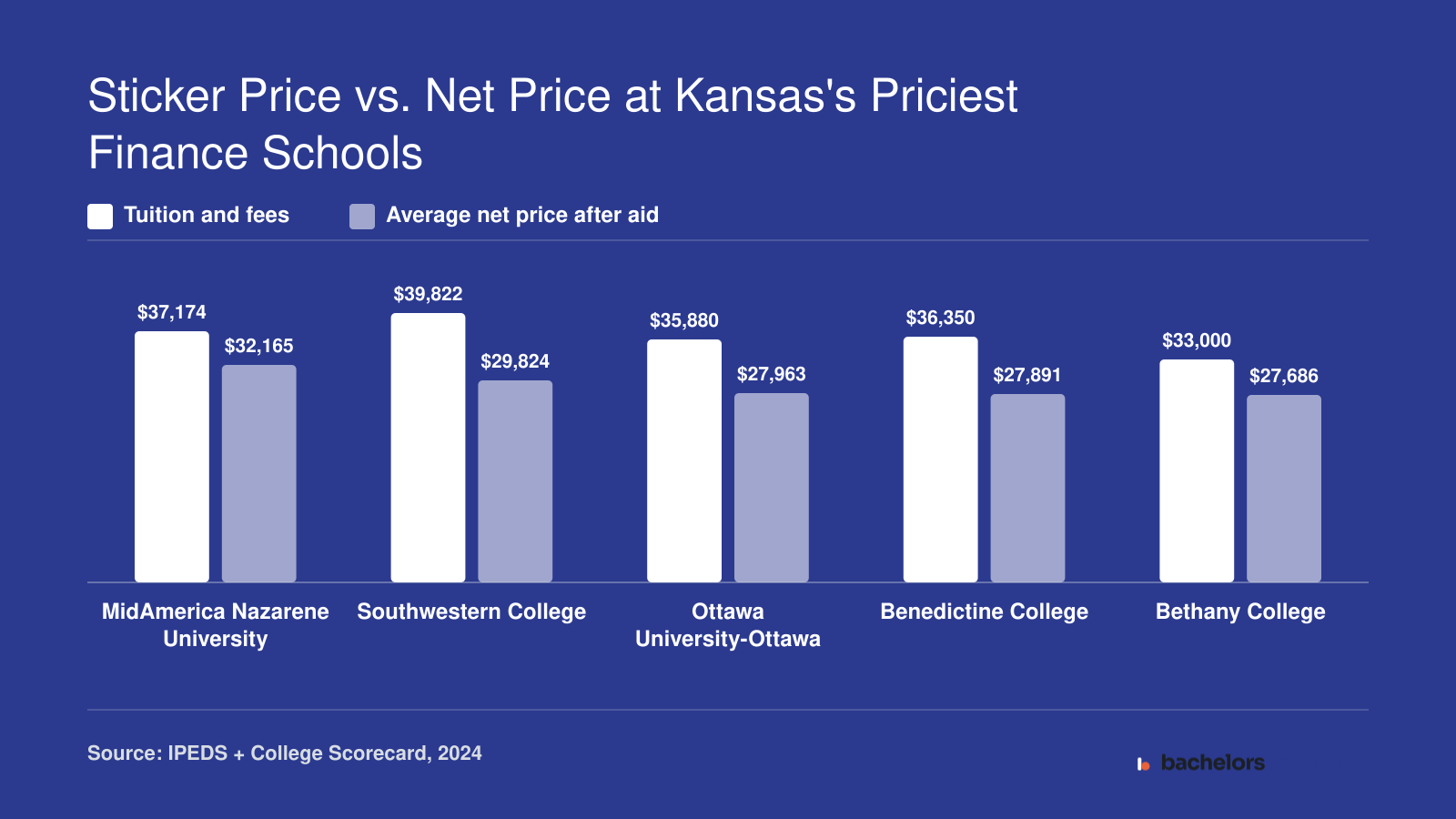
Sticker Price vs. Net Price at Kansas's Priciest Finance Schools
At the highest-cost private colleges offering a bachelor's degree in finance in Kansas, grants and scholarships cut the published price by roughly $5,000-$10,000 a year. Southwestern College shows the widest gap, and MidAmerica Nazarene University keeps the highest net price. Net price is an approximate average for aided students, not a quote for every student, so run each school's net price calculator for your own estimate.
AACSB vs. ACBSP, Concentrations, and CFA/CFP Pathways
What Business Accreditation Means
Business accreditation is an outside review of a college's business school. Reviewers check faculty, curriculum and student outcomes against published standards, then return to the school on a regular cycle. Two bodies dominate in the U.S. AACSB (the Association to Advance Collegiate Schools of Business) is the older and more selective of the two, and it weighs faculty research and academic credentials heavily. ACBSP (the Accreditation Council for Business Schools and Programs) puts more weight on teaching quality and is common at smaller, teaching-centered colleges.
The difference matters most in two places. Some large employers in corporate finance and investment roles recruit heavily from AACSB schools. Graduate business programs may also look closely at where your undergraduate coursework came from. For community banking or small-business finance, either credential, or a strong regional reputation, usually serves you well.
Where Kansas Schools Stand
- Kansas State University: The College of Business Administration is AACSB-accredited1.
- Wichita State University: The Barton School of Business is AACSB-accredited1.
- Washburn University: AACSB accreditation was reaffirmed2 for 2025-2026, and the listing names the BBA in Finance, including its banking option.
- Other schools here: Accreditation covers a business school or named programs, not every degree automatically. Search the AACSB and ACBSP online directories to confirm current status for the University of Kansas, Fort Hays State, MidAmerica Nazarene, Baker and the smaller private colleges before you apply.
Concentrations and Certification Pathways
K-State's finance major offers four specializations: financial analyst, financial management, financial controllership and financial services. K-State also holds CFA program affiliation, which signals coursework aligned with investment-management practice and exam preparation. KU's finance major belongs to the CFA university affiliation program, and KU says its curriculum reflects the CFA Candidate Body of Knowledge.
The CFP route works differently. Candidates must complete coursework through a CFP Board Registered Program. If financial planning is your goal at Fort Hays State or any other school, confirm the program appears on the CFP Board's registered program list before you enroll.
A Quick Rule of Thumb
- Investment analysis or portfolio management: Favor a CFA-affiliated program such as KU or K-State.
- Personal financial planning: Choose a CFP Board Registered Program.
- Corporate finance or a future MBA: Lean toward an AACSB-accredited school.
- Kansas banking: Consider Washburn's banking-focused BBA, or any accredited program with strong local internship ties.
Finance Careers and Salaries in Kansas
Kansas finance graduates with a bachelor's degree take one of two broad paths, client-facing work or desk-based analysis, and the two pay quite differently. Personal financial advisors and loan officers work directly with clients, and their pay often includes commissions or incentives. Financial analysts and credit analysts evaluate investments, budgets, and borrower risk for a salaried employer.
Where the Jobs Are
Most openings cluster in three markets. The Kansas City area spans both Kansas and Missouri and offers the widest mix of banks, insurers, investment firms, and corporate finance departments. Wichita adds commercial lenders, credit unions, and finance teams inside larger companies. Topeka, the state capital, offers roles with state agencies, regional banks, and insurers.
Kansas Wage Snapshot
These figures come from Bureau of Labor Statistics occupational wage surveys.1 Most annual figures are calculated from median hourly pay and assume full-time, year-round work. Survey years differ by area, so compare with care.
- Personal financial advisors: $157,560 statewide (May 2023)1; $80,496 in Kansas City, MO-KS (May 2022)2; $80,288 in Wichita (May 2021)3.
- Financial and investment analysts: $38.07 median hourly pay and $82,250 average annual pay statewide (May 2023)1; $76,544 in Wichita (May 2021).
- Loan officers: $76,918 statewide (May 2023)1; $63,377 in Wichita (May 2021).
- Credit analysts: $66,976 statewide (May 2023)1; $75,296 in Kansas City, MO-KS (May 2022)2; $62,733 in Wichita (May 2021).
The statewide advisor figure sits far above the older metro numbers. Advisor pay varies widely with client base and compensation structure, so treat any single figure as a rough guide rather than a starting salary.
Early Career vs. Mid-Career Pay
The early-career earnings for program graduates shown in the ranking table generally run below these occupational figures, because the BLS surveys cover workers at every experience level, not just recent graduates.
Kansas Finance Licensing: Series Exams, CFP, and State Registration
Compare Finance programs on the data that matters
Explore more Business & Management majors or browse every field of study.
All Business & Management programs Browse every field of study