Best Finance Schools in Maryland
Compare 16 accredited Finance programs in Maryland at 15 colleges, with net price after aid, graduation rates, earnings and debt from IPEDS and the U.S. College Scorecard.

Earning a bachelor's degree in finance in Maryland typically means a Bachelor of Science (B.S.) in Finance: roughly 120 credits of accounting, corporate finance, investments, and statistics.
Geography shapes the payoff. Baltimore's banks and asset managers, the D.C. corridor, and Northern Virginia sit within commuting range of most campuses, so internships can run during the school year rather than only in summer. The tension is cost. Published tuition and the net price students actually pay after grants diverge sharply, and recruiting strength does not track price in a straight line.
Key Points
- University of Maryland Eastern Shore posts the lowest average net price here.
- UMGC offers a fully online finance degree at $337 per credit.
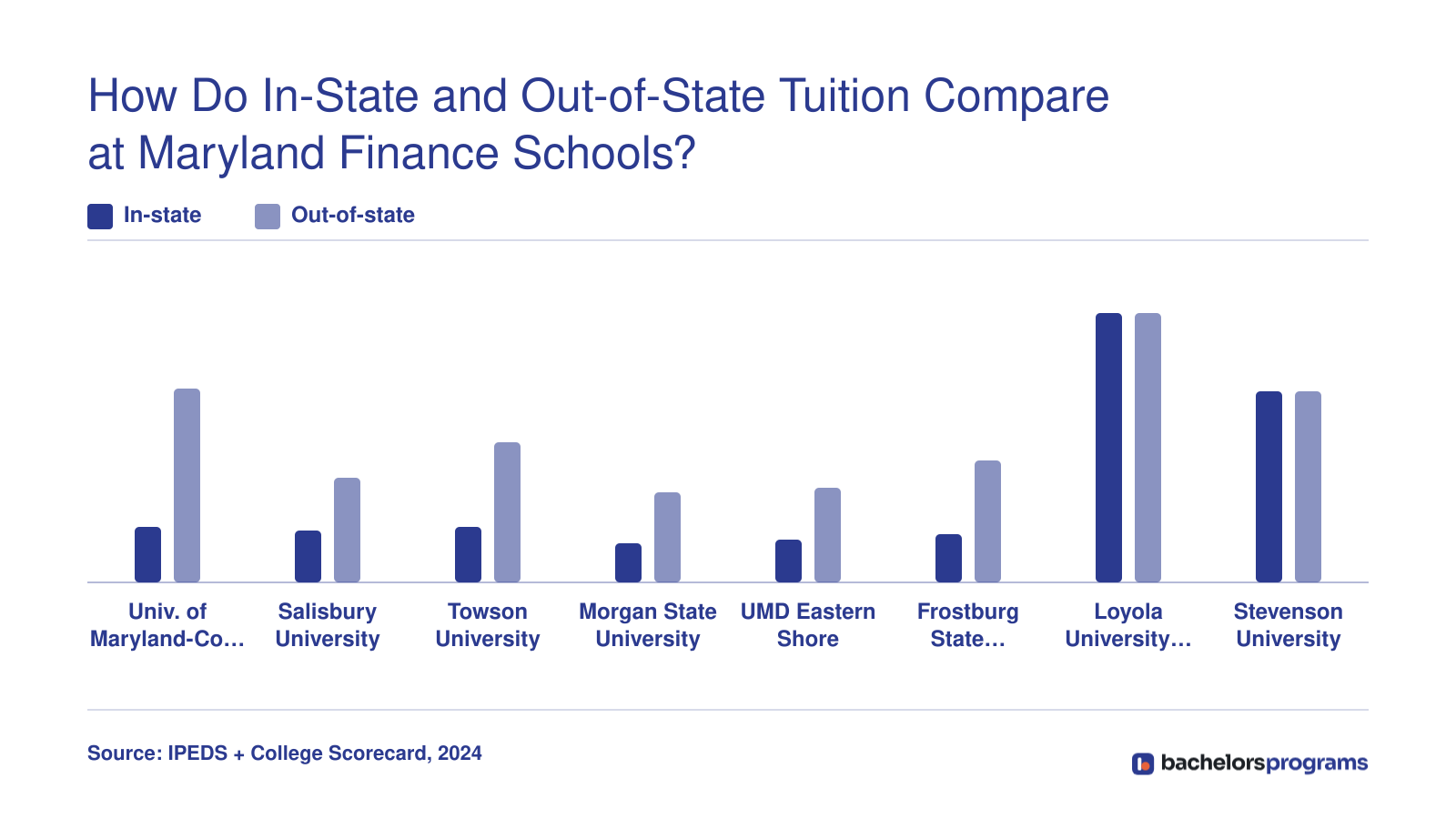
- Loyola and Stevenson charge one tuition rate regardless of Maryland residency.
Best Bachelor's in Finance Schools in Maryland: Our Top 10
Maryland's finance programs cluster around Baltimore, the Washington suburbs, and the Eastern Shore, and they range from a large public business school with national recruiting to small private colleges where undergraduates manage real money. The net prices below are averages across students who receive federal aid, so treat them as a general guide to what a year costs rather than a quote for any one family.
University of Maryland-College Park
#1College Park, MD · $16,000/yr (est. net price)
Best for: Maryland residents targeting investment banking
The state's largest finance program sits inside the Robert H. Smith School of Business at College Park, where roughly 376 bachelor's degrees in finance are awarded in a typical reporting year. It is the most selective public option here, admitting about 45 percent of applicants, and 89 percent of students complete a degree. Maryland residents see an average net price near $15,678 after aid, and eligible in-state students from families earning $75,000 or less may qualify for the Terrapin Commitment, which covers tuition and fees. Program graduates reported a median $110,648 four years after finishing, alongside median debt of $19,500.
- Major housed in the Robert H. Smith School of Business
- 376 bachelor's degrees in finance conferred in the latest data year
- Coursework spans corporate finance, investment management, banking and analysis
- Advising handled through the Office of Undergraduate Programs
- Median debt for program graduates: $19,500
Salisbury University
#2Salisbury, MD · ~$18,000/yr (est.)
Best for: Students wanting a declared finance track
Salisbury runs a Bachelor of Science in Finance with three declared tracks: Financial Planning, Investments, and Corporate Finance, so students pick a direction early. Admission to the professional program is separate from general admission and asks for a 2.5 GPA across the pre-professional core, which makes the cohort more focused than the university's 87 percent acceptance rate suggests. Net price after aid averages about $17,743, and 68 percent of students complete a degree. Program graduates earned a median $80,478 four years after finishing, with median debt of $22,000.
- Three tracks: Financial Planning, Investments, and Corporate Finance
- Professional Program admission requires a 2.5 GPA in core courses
- 40 college credits and 9 of 11 pre-professional courses needed to apply
- Applied learning option: 100-hour internship over 10 weeks
- Up to 6 credits may transfer from AACSB-accredited schools
- 120 credits to graduate, including 30 upper-division credits
- 30 of the final 37 credits must be taken at Salisbury
Loyola University Maryland
#3Baltimore, MD · ~$31,000/yr (est.)
Best for: Aspiring analysts wanting live portfolio experience
Loyola's Sellinger School pairs an AACSB-accredited finance major with a trading floor running Bloomberg, Capital IQ, and Morningstar, and students in the Sellinger Applied Portfolio Fund manage real money the university backs with up to $500,000. A dedicated Path to Wall Street sequence, credit-bearing internships, and executives-in-residence give the Baltimore program a strong placement orientation, and graduates are hired by firms such as J.P. Morgan Chase and Morgan Stanley. Net price after aid averages about $30,574, the highest on this list, and 79 percent of students complete a degree.
- AACSB-accredited Sellinger School of Business
- SELL trading room with Bloomberg, Capital IQ and Morningstar
- Student-managed Sellinger Applied Portfolio Fund
- Path to Wall Street advising sequence
- Credit-bearing internships at 10 to 20 hours per week
- Executives-in-residence mentor undergraduates
Hood College
#4Frederick, MD · ~$21,000/yr (est.)
Hood offers a Bachelor of Arts in Finance through the Delaplaine School of Business and Communication, a newer major at the college whose first graduate finished in 2023. Coursework reaches into financial derivatives, fixed income, financial economics, and financial statement analysis, and students work in the Virginia Munson Hammell Trading Room with a live ticker and investment software. Net price after aid averages about $20,873, and 57 percent of students complete a degree. It suits students who want a small liberal arts college in Frederick with a hands-on finance lab rather than a large business school.
- Bachelor of Arts in Finance through the Delaplaine School
- Trading room with stock ticker and investment software
- Electives in financial derivatives and fixed income
- Courses in financial economics and financial statement analysis
- Newest major at the school; first graduate finished in 2023
Morgan State University
#5Baltimore, MD · $10,000 – $15,000/yr (est.)
Morgan State's Bachelor of Science in Finance offers General Finance and International Finance tracks and builds internships into the degree. The program's student-managed investment fund launched in 2024 with $120,000 and can now draw on up to $4 million through UNCF Project ACCLAIM, and Morgan students have earned more than 584 Bloomberg certifications and won first place in the 2025 Bloomberg HBCU Trading Challenge. Net price after aid is about $14,985, among the lowest here, and 41 percent of students complete a degree. Program graduates reported a median $67,828 five years after finishing.
- Two tracks: General Finance and International Finance
- 24 credits beyond the business core, including 18 in finance
- Student Managed Investment Fund launched in 2024
- More than 584 Bloomberg certifications earned by students
- First place in the 2025 Bloomberg HBCU Trading Challenge
- Internships built into the degree
University of Maryland Eastern Shore
#6Princess Anne, MD · ~$13,000/yr (est.)
UMES offers finance as a bachelor's degree on its Princess Anne campus, following the same 120-credit structure and residency rules as the rest of the university's undergraduate programs. Net price after aid is the lowest on this list at about $13,338, and admission is close to open, with 96 percent of applicants accepted. About 35 percent of students finish a degree, so students should plan to use advising and the residence requirement deliberately. For a low-cost option on the Eastern Shore, the price is hard to beat.
- 120 semester credit hours required for the degree
- 2.00 cumulative average required, excluding developmental courses
- Final 30 credits must be taken in residence at UMES
University of Maryland Global Campus
#7Adelphi, MD · $22,000/yr (est. net price)
UMGC delivers a fully online Bachelor of Science in Finance built for working adults, with year-round course starts, up to 90 transfer credits, and no-cost digital materials in place of textbooks. The 120-credit curriculum ends in a capstone and follows a CFP Board-approved course of study, and the school advertises preparation for the CMA and CFP exams. Net price after aid averages about $22,063, and 33 percent of students complete a degree, which reflects a largely part-time adult population. Program graduates reported a median $61,003 one year after finishing and $78,512 four years out, with median debt around $20,150.
- Fully online 120-credit Bachelor of Science in Finance
- Up to 90 transfer credits accepted
- Capstone applies finance concepts to real business scenarios
- CFP Board-approved course of study
- Prepares students for CMA and CFP certification
- No-cost digital materials replace textbooks
- Courses run year-round
Towson University
#8Towson, MD · ~$17,000/yr (est.)
Towson's finance major sits inside a Bachelor of Science in Business Administration and carries CFA Institute University Recognition, which signals a curriculum aligned with professional investment practice. Students add a Bloomberg Market Concepts certification and work in Excel modeling, the Bloomberg Terminal, and data visualization, with a Corporate Finance concentration for those headed into corporate roles. Admission to the major is screened, requiring a 2.0 GPA and a C or better in the foundational courses. Net price after aid averages about $17,413, and 69 percent of students complete a degree.
- 120 total credit hours
- Screened admission with a C or higher in six courses
- Shared business administration core with a finance focus
- Sample four-year plan of study published
- Mentored reflective professional experience required
- Corporate Finance concentration within the finance major
- CFA Institute University Recognition Program
- Bloomberg Market Concepts certification earned
- Excel modeling, Bloomberg Terminal and data visualization
- Faculty advisors coach students for finance competitions
- Prepares for financial analyst, credit analyst and risk analyst roles
Stevenson University
#9Owings Mills, MD · ~$27,000/yr (est.)
Stevenson awards a Bachelor of Science in Business Administration with a finance track, one of four tracks in an IACBE-accredited business school. Students invest real funds through the Dennis A. Starliper Applied Finance Lab, and a BS to MS option lets strong undergraduates continue into a graduate business degree. Net price after aid averages about $26,505, with 68 percent of students completing a degree. It fits students who want a smaller, career-focused business school outside Baltimore with applied investing built in.
- Bachelor of Science in Business Administration with a finance track
- IACBE specialized accreditation
- Dennis A. Starliper Applied Finance Lab invests real funds
- BS to MS option attached to the same degree
- Four tracks, including entrepreneurship and international business
- Finance employers such as Northwestern Mutual recruit on campus
Frostburg State University
#10Frostburg, MD · $10,000 – $26,000/yr (est.)
Frostburg offers finance as a concentration inside its business administration major, alongside Global Business and Marketing, which keeps the degree flexible if interests shift. The Department of Marketing and Finance runs a Finance Club with a stock market challenge, and classes are small enough that faculty serve as academic advisors. Net price after aid averages about $16,715, and 50 percent of students complete a degree. It is one of the lowest-cost routes to a finance credential in western Maryland.
- Finance concentration inside the business administration major
- Other concentrations include Global Business and Marketing
- Finance Club runs a student stock market challenge
- Small classes with faculty serving as academic advisors
Cost & outcomes by school
Federal data for the highest-earning Finance programs, independent of the ranking above. Earnings are this field's bachelor's graduates four years after completing where the Scorecard reports them, else the school's undergraduate median.
| School | Net price / yr | Grad rate | Earnings | Debt | Grads/yr | Format |
|---|---|---|---|---|---|---|
| University of Maryland-College Park MD | $15,678 | 89% | $110,648 | $19,500 | 426 | Campus |
| Loyola University Maryland MD | $30,574 | 79% | $82,652 | $27,000 | 85 | Campus |
| Salisbury University MD | $17,743 | 68% | $80,478 | $22,000 | 44 | Campus |
| University of Maryland Global Campus MD | $22,063 | 33% | $78,512 | $18,308 | 180 | Online |
| Towson University MD | $17,413 | 70% | $64,390 | $18,718 | — | Campus |
| Washington Adventist University MD | $18,526 | 29% | $64,249 | $30,500 | — | Campus |
| Mount St. Mary's University MD | $22,655 | 65% | $64,072 | $25,391 | — | Campus |
| Stevenson University MD | $26,505 | 69% | $62,079 | $26,000 | — | Campus |
| University of Baltimore MD | $13,868 | 38% | $61,335 | $23,250 | — | Online |
| Hood College MD | $20,873 | 57% | $57,089 | $25,000 | 6 | Campus |
| Frostburg State University MD | $16,715 | 50% | $55,493 | $21,105 | — | Campus |
| Bowie State University MD | $19,298 | 38% | $54,537 | $22,985 | — | Campus |
Sources: U.S. Department of Education. Net price, graduation rate, earnings and debt: College Scorecard (earnings and debt for this field's bachelor's graduates where reported, else school-wide); graduates: IPEDS. A dash means no figure is reported.
Cost, debt & payoff
Median earnings of this field's bachelor's graduates (4 yrs after completing, else the school's undergraduate median) vs. their median federal loan debt · U.S. College Scorecard
Across these programs the median graduate earns about $63,076 and finishes with roughly $24,125 in debt — a ratio that clears a common rule of thumb (keep debt below first-year salary). Net price and debt vary widely school to school, so check the per-school figures in the table above before you shortlist.
Cheapest Finance Schools in Maryland by Net Price
Sticker tuition shows what a school charges. Average net price shows what students actually pay after grants and scholarships, which makes it a fairer way to compare costs. University of Maryland Eastern Shore has the lowest average net price below at $13,338. University of Maryland-College Park charges the highest in-state tuition of these schools, yet its net price stays under $16,000, and its finance graduates carry the lowest program debt reported here. Figures come from IPEDS and College Scorecard (2024) data. The University of Baltimore appears in our directory alongside the ranked schools.
| School | City | Average Net Price | In-State Tuition and Fees | Median Debt, Finance Program | Median Debt, All Graduates |
|---|---|---|---|---|---|
| University of Maryland Eastern Shore | Princess Anne | $13,338 | $9,076 | N/A | $27,000 |
| University of Baltimore | Baltimore | $13,868 | $9,992 | N/A | $23,250 |
| Morgan State University | Baltimore | $14,985 | $8,229 | $25,875 | $27,250 |
| University of Maryland-College Park | College Park | $15,678 | $11,809 | $19,500 | $19,000 |
| Frostburg State University | Frostburg | $16,715 | $10,220 | N/A | $21,105 |
Related Articles
Online and Hybrid Bachelor's in Finance Options at Maryland Schools
University of Maryland Global Campus (UMGC) lists its finance degree at $337 per credit across 120 total credit hours, with every course available online. It is the only fully online option among the schools here, though hybrid courses suit students who want some in-person contact.
Sorting the Schools by Format
- Fully online: UMGC.
- Campus-based: University of Maryland-College Park, Salisbury University, Loyola University Maryland, Hood College, Morgan State University, University of Maryland Eastern Shore, Towson University, Stevenson University and Frostburg State University deliver their finance programs on campus.
If you want a Maryland-based school but cannot relocate or commute, UMGC is the practical starting point. The others expect you in classrooms, trading rooms and internships.
Standalone Major or Finance Concentration
Some schools offer finance as a standalone major. College Park, Loyola, Hood, Morgan State, UMES and UMGC list finance directly, and Salisbury's B.S. in Finance adds concentration options within it. Towson, Stevenson and Frostburg instead place finance inside a Business Administration degree, as a concentration. A standalone major usually means more finance coursework. A concentration gives you a broader business foundation with a finance emphasis. Both lead to a bachelor's degree, so compare the course lists, not just the diploma title.
Which Format Fits You
Transfer students with an associate degree or earlier college credit should look hard at UMGC, which accepts up to 90 transfer credits and also accepts military benefits. Working adults who need evening or anytime access will usually find the online format easier to fit around a job. Full-time students coming straight from high school tend to get more from the campus programs, where student-managed funds, trading rooms and internships are part of the experience.
Billing Can Differ Online
Online students at Maryland-based schools may be billed differently than on-campus students, with per-credit pricing, different fees and sometimes different residency rules. Ask each school's bursar for the full per-credit cost before you compare.
Admissions for a Bachelor's Degree in Finance in Maryland: GPA, Test Policy, and Transfer Credit
There is no single admissions standard for a bachelor's degree in finance in Maryland. The University of Maryland, College Park publishes the most specific first-year guidance among the schools ranked here, and it shows how much a large public flagship leaves to holistic review.
First-year GPA and test policy
UMD publishes no minimum or target high school GPA for first-year applicants, and no separate finance GPA for admission to the major.1 Its admissions page says most admitted freshmen earned primarily A's and B's and took challenging honors, AP, IB, or Advanced Level courses. UMD is test-optional for the Spring and Fall 2027 application cycles: you choose whether to send SAT or ACT scores, UMD superscores both, and subject tests or the writing section are not required.2 Where a school publishes no GPA floor or test policy, ask admissions in writing before you plan a retake or skip the test.
Sorting schools by admission rate
Admission rates give a rough first sort. UMD is the most selective of the schools ranked here, admitting about 45% of applicants. Loyola University Maryland, Hood College, Stevenson University, and Towson University form a moderately selective middle, with rates from 75% to 82%. Salisbury University, Frostburg State University, Morgan State University, and University of Maryland Eastern Shore are the broadest-access group at roughly 82% to 96%, so a complete application and a steady record carry real weight. University of Maryland Global Campus does not report a comparable first-year admission rate, which fits its online transfer-friendly model.
Transfer credit and community college pathways
UMD does not cap the number of transfer courses it accepts, but it caps how many apply to the degree: up to 70 credits from two-year institutions and up to 90 from a combination of two-year, four-year, and prior-learning credit for students matriculating in Fall 2022 or later.3 Maryland statewide guidance similarly limits community college credit to about half the bachelor's requirement and no more than 70 credits.4 UMD has articulated programs with each Maryland public community college; completing the specified courses with acceptable grades guarantees transfer without loss of credit, though that does not mean every credit counts toward the finance major. The Maryland Transfer Advantage Program requires 30 credits or an associate degree, a 3.0 cumulative GPA, at least one semester of participation, and your last 15 credits at a participating community college.5 Admission through MTAP is not guaranteed at the Universities at Shady Grove.
How Do In-State and Out-of-State Tuition Compare at Maryland Finance Schools?
These are published annual tuition and fee prices before any grants or scholarships, so most students will pay less. Maryland residents save the most at public universities, while private schools such as Loyola and Stevenson charge the same rate regardless of residency. For online students, University of Maryland Global Campus lists $336 per credit on its finance program page, and its published annual tuition and fees run $8,136 in-state and $12,336 out-of-state. At University of Maryland-College Park, full-time business juniors and seniors also pay a $3,375 yearly differential.
What a Bachelor's Degree in Finance Costs in Maryland: Net Price and State Aid
In Maryland, the published tuition price is rarely what a finance major actually pays, and the gap between sticker price and net price is widest at the state's private universities.
Sticker Price vs. Average Net Price
At the public universities ranked here, in-state tuition runs from roughly $8,100 at University of Maryland Global Campus to $11,015 at University of Maryland-College Park, while out-of-state sticker prices climb to $42,266 at College Park. Average net price after grant aid tells a different story. University of Maryland Eastern Shore reports the lowest figure among the schools ranked here at about $13,338, followed by Morgan State near $14,985, College Park near $15,678, Frostburg State near $16,715 and Towson near $17,413.
The private schools post much higher sticker prices but discount them heavily. Loyola University Maryland lists $57,150 in tuition and reports an average net price near $30,574. Hood College lists $47,700 against about $20,873, and Stevenson University lists $40,560 against about $26,505. On net price, a private finance degree can land within reach of a public one.
State Grants That Cut the Bill
Maryland's largest need-based award, the Howard P. Rawlings Guaranteed Access Grant, covers up to 100% of calculated adjusted need for the first two academic years, capped at $18,000 a year with a $100 minimum.1 The final amount depends on cost of attendance, living arrangement and need, and it is not settled until the institution certifies it. The Educational Assistance Grant shares the same March 1, 2026 filing deadline and is worth reviewing alongside it.2
The Maryland 2+2 Transfer Scholarship pays $1,000 a year, or $500 per term, to business majors.3 Business falls outside the science, teaching, engineering, computer science, mathematics and nursing fields that receive $2,000.3 Applicants need a Maryland community college associate's degree earned between July 2025 and December 2026, a 2.5 GPA and enrollment at a Maryland four-year school.4 The application opens January 15, 2026, closes October 15, 2026, and can fund up to three years.5 No Maryland state scholarship is reserved for business majors, so finance students compete for these broad programs.6
Pell Share as an Aid Signal
Pell participation at these schools ranges from about 26% at Loyola to roughly 77% at University of Maryland Global Campus, with Morgan State near 71% and University of Maryland Eastern Shore near 74%. A high share means the aid office handles need-based packages constantly. It does not mean any individual student pays less.
The One Deadline That Matters
File the FAFSA and the MHEC One-App by March 1, 2026.2 Guaranteed Access Grant awards begin the first week of April 2026 and continue until funds run out, and supporting documents are due August 1, 2026.1
Finance Careers and Earnings in Maryland: Baltimore, D.C., and Northern Virginia
What do finance jobs in Maryland actually pay, and how do you check the numbers yourself before committing to a program?
Pull the numbers from OEWS yourself
Go to BLS.gov and open the Occupational Employment and Wage Statistics pages. Select Maryland statewide, then the Baltimore-Columbia-Towson metro and the Washington-Arlington-Alexandria metro, which reaches into Northern Virginia and the D.C. suburbs. For each area, read the median and mean annual wage and the employment column for financial and investment analysts (13-2051), personal financial advisors (13-2052), and loan officers (13-2072).1 OEWS publishes once a year in spring, so confirm the release date stamped on the page before you rely on it.
Where BLS stops
Wage tables cannot tell you placement rates or starting salaries for a specific program. Check whether the finance and financial-planning program pages at the Maryland schools ranked here publish first-destination outcomes. Professional bodies such as the CFP Board, NAPFA, and the American Bankers Association also run compensation surveys that separate credentialed pay from entry-level pay.
Licensure: what actually applies
Maryland imposes no general occupational license on financial analysts, personal financial advisors, or loan officers.2 The exceptions matter: mortgage loan originators register through NMLS, investment advisers and broker-dealer representatives fall under SEC and FINRA registration, and the CFP designation carries its own coursework and exam requirements. Verify with the Maryland Commissioner of Financial Regulation, part of the Department of Labor, Licensing and Regulation, and the relevant federal registry before assuming you are clear.
A ten-minute checklist
- Match the geography to where you will actually work.
- Compare Baltimore against D.C. and Northern Virginia on local cost of living, not salary alone.
- Note the OEWS reference period so you know how current the figures are.
- Cross-check with active job postings or a recruiter conversation for real-time ranges.
Finance Programs in Maryland With CFA and CFP Preparation
A school's designation can make exam preparation easier, but it never replaces the credential itself. The charter or certification is earned only after exams, work experience, and ethics requirements are met.
What the Designations Mean
The CFA university recognition program flags schools whose curriculum covers a meaningful share of the CFA body of knowledge. CFP Board Registered Programs are schools whose financial planning coursework satisfies the CFP education requirement. Neither one awards a credential.
Maryland Schools That Match
- Towson University: Its finance major is in the CFA recognition program, covering at least 70% of the candidate body of knowledge. Its financial planning major is also a CFP Board Registered Program.
- University of Maryland Global Campus: It offers CFP Board-approved coursework that satisfies the CFP education portion, and it is an online-friendly option.
Available research does not confirm a designation for the other schools on this page. Ask each finance department directly before you count on one.
Credential Requirements
- CFA: You need a bachelor's degree, or be within 23 months of graduating when you sit Level I, or have 4,000 hours of work and/or higher education over at least 36 months. Candidates pass Levels I, II, and III, and they need 4,000 hours of relevant experience over at least 36 months.1 That experience can come before, during, or after the exams. Membership and professional conduct commitments also apply.
- CFP: Education means CFP Board coursework through a registered program or approved pathway. A bachelor's degree is required, but it may be finished up to five years after passing the exam. The exam costs $825 early, $925 standard, or $1,025 late with permission, according to UMGC. Experience is either 6,000 hours (Experience Pathway) or 4,000 hours (Apprenticeship Pathway).2 Ethics standards must also be met, and certified planners complete 30 hours of continuing education every two years.
- CMA: This is the management accounting credential. The sources behind this page do not establish its current U.S. education, exam, and experience rules, so confirm them with its credentialing body before planning around it.
Matching the Credential to Your Career
Choose the CFA for investment analysis and portfolio work, the CFP for financial planning with individual clients, and the CMA for corporate or management accounting roles. Towson fits the first two paths, and UMGC fits the planning path, especially if you need flexibility.
How to Choose the Right Maryland Finance School
Pick a Maryland finance school on sticker price alone, or on name recognition alone, and you can land in the same regret: a degree that fits neither your budget nor your career plan. A better approach is to rank your own priorities first, then work through them one at a time.
Start With What You Can Afford
Net price after aid matters more than published tuition. Compare each school's net price with the in-state figures for Maryland publics, and check whether you qualify for Maryland state grant programs before you rule a private school out. A higher sticker price with strong aid can beat a lower one without it.
Match Format to Your Life
If you work full time or live far from campus, check which Maryland schools deliver the finance curriculum remotely. Campus programs offer recruiting and internship access that online formats rarely match, so weigh that against flexibility rather than assuming one is better.
Line Up the Credential With the Job
Students aiming at investment analysis or asset management should look at programs with CFA preparation; those heading into personal financial planning should prioritize CFP tracking. Corporate finance and banking roles care more about internships and accounting coursework. The CFA and CFP section maps this out.
Settle the Transfer Question Early
If you are arriving with credits from a community college or another university, confirm the transfer policy and the maximum credits accepted before you apply. GPA expectations, test policy and transfer credit rules differ by school, so read each admissions page directly.
Next Step
Shortlist the schools that clear your budget and format requirements, then request information from each one directly. Ask about net price after aid, credit transfer, and internship placement, and let those answers make the final cut.
Maryland Finance School FAQs
These answers draw on the figures given earlier in this article. Costs and earnings vary by student, so confirm current numbers with each school.
Which Maryland schools offer a bachelor's degree in finance online?
How much does a bachelor's degree in finance cost in Maryland?
What is the average salary with a finance degree in Maryland?
Which Maryland finance programs prepare you for the CFA or CFP exam?
Is there a finance major at the University of Maryland, and how is it ranked?
Compare Finance programs on the data that matters
Explore more Business & Management majors or browse every field of study.
All Business & Management programs Browse every field of study