Best Finance Schools in New Jersey
Compare 32 accredited Finance programs in New Jersey at 27 colleges, with net price after aid, graduation rates, earnings and debt from IPEDS and the U.S. College Scorecard.

New Jersey sells finance students on geography: Rutgers-Newark sits four miles from Lower Manhattan, and analyst pay across the Newark and Jersey City corridor tracks New York benchmarks. The tradeoff is cost: a public bachelor's degree in finance runs a fraction of a private one, while private names carry deeper alumni networks.
The common credential is the Bachelor of Science (B.S.) in Finance, and AACSB accreditation separates the strongest programs from the rest. Rankings rest on federal College Scorecard earnings, debt, net price and graduation figures rather than reputation surveys. Four-year completion, not sticker price, decides the real cost.
Key Points
- William Paterson University offers a fully online Bachelor of Science in Finance.
- Rutgers-New Brunswick estimates $15,381 in-state tuition for 2026-2027, plus $4,008 fees.
- New York-Newark-Jersey City, the largest analyst market nationally, employed 53,870 analysts.
Best Finance Schools in New Jersey: Top 10 Ranked
Every school below offers a bachelor's degree in finance, and each card gives you the essentials fast: what the program emphasizes, what the school costs after aid, and how many of its students finish. Net prices are approximate institution-wide averages after grants and scholarships, not a quote for the finance major, and graduation rates describe the whole institution rather than the finance program. Campus and online options are mixed together in ranked order.
Rutgers University
#1New Brunswick, NJ · $24,000/yr (est. net price)
Best for: Wall Street hopefuls wanting Manhattan internships
Rutgers University in New Brunswick pairs the resources of a large public research university with a business school close enough to Manhattan for regular internships. Finance majors build a foundation in accounting, statistics, and financial management before moving into investment analysis, derivatives, and corporate finance, and a fixed income and credit analysis concentration adds specialist depth. Recruiters from J.P. Morgan Chase, Merrill Lynch, and Bank of New York visit campus, and schools offering this program graduate about 84% of students. The approximate net price after aid is around $24,400.
- Coursework in investment analysis, derivatives, and corporate finance
- Electives in asset pricing, global capital markets, real estate finance
- Fixed income and credit analysis concentration, 9 credits
- B or higher required to declare the concentration
- Recruiters include J.P. Morgan Chase, Merrill Lynch, Bank of New York
- Manhattan access for internships, networking, and alumni events
Ramapo College of New Jersey
#2Mahwah, NJ · $15,000 – $20,000/yr (est.)
Best for: Hands-on traders wanting Bloomberg lab access
Ramapo College of New Jersey is a mid-sized public college in Mahwah whose finance major is built around practice as much as theory. Students work on Bloomberg terminals in the Global Financial Markets Trading Laboratory, use FactSet data in real time, and can earn Bloomberg certification before graduating. Every student gets a faculty advisor, and graduates have landed at Goldman Sachs and J.P. Morgan Chase. Schools offering this program graduate about 70% of students, and the approximate net price after aid is around $18,200.
- Bloomberg terminals in the Global Financial Markets Trading Laboratory
- Real-time FactSet data access for classwork
- Bloomberg terminal certification available
- Paid internships and faculty research are common
- Every student is assigned a faculty advisor
- 4+1 Flex MBA option finishes both degrees in five years
- Study abroad in China and at the American University of Rome
Rutgers University-Newark
#3Newark, NJ · $20,000/yr (est. net price)
Best for: Real estate focused finance students
Rutgers University-Newark runs the same finance core as the New Brunswick business school but adds a real estate track that few New Jersey programs match. Seven courses beyond the business core cover real estate finance, law, development, and capital markets, with ARGUS certification and support from a large industry advisory board. Classes meet in downtown Newark, minutes from Manhattan, and a six-month internship option lets students work while enrolled. Schools offering this program graduate about 64% of students, and the approximate net price after aid is around $19,700.
- Real Estate track: seven courses, 21 credits, beyond the core
- Track covers real estate finance, law, development, and capital markets
- ARGUS software training and certification
- Center for Real Estate Studies with a 90+ member advisory board
- Guest speakers from leading real estate firms
- Six-month finance internship option
- Live-streamed and recorded courses for flexible scheduling
Rutgers University-Camden
#4Camden, NJ · $15,000 – $20,000/yr (est.)
Rutgers University-Camden offers a Bachelor of Science in Finance with unusually hands-on analytics training for a public commuter campus. Students work with Bloomberg data, run trades in the TraderEx simulation, and build models in Excel and with SAS or SPSS. A supervised internship, independent study, and an honors thesis give students ways to specialize before they graduate. Schools offering this program graduate about 67% of students, and the approximate net price after aid is around $18,700.
- Bloomberg data integrated into finance lessons
- TraderEx simulation for equity trading
- Excel financial modeling plus SAS or SPSS statistics
- Electives in business valuation, mergers, derivatives, fixed income
- Supervised finance internship for academic credit
- Honors thesis and independent study with finance faculty
Stockton University
#5Galloway, NJ · $21,000/yr (est. net price)
Stockton University in Galloway builds its finance degree on a broad liberal arts base, with a capstone in Strategic Financial Management tying the pieces together. Classes in the major are capped at 35 students, and a financial planning track adds seven CFP-specific courses and exam preparation for students aiming at wealth management. An accelerated path lets strong students finish a bachelor's and an MBA in about five years. Schools offering this program graduate about 69% of students, and the approximate net price after aid is around $20,700.
- Capstone course in Strategic Financial Management
- Financial Planning track with seven CFP-specific courses
- CFP exam preparation through Brett Danko
- Finance classes capped at 35 students
- Accelerated bachelor's and MBA option in about five years
- Semi-annual career fair and Accounting and Finance Society
- 80 credit hours in the major
Rowan University
#6Glassboro, NJ · $22,000/yr (est. net price)
Rowan University's Rohrer College of Business runs one of the larger undergraduate finance programs in the state, with 690 finance majors enrolled in Fall 2025. A FinTech concentration adds exposure to the platforms and tools reshaping the industry, and a supervised internship can count toward the degree. A Finance Advisory Board and regular recruiting from J.P. Morgan Chase, Vanguard, and Prudential give students a direct line to employers. Schools offering this program graduate about 67% of students, and the approximate net price after aid is around $22,400.
- FinTech concentration pairs finance theory with emerging platforms
- 690 finance majors in Fall 2025; 118 graduates in 2024-2025
- Supervised internship can count as a free elective
- Finance Advisory Board supports career development
- Recruiters include JP Morgan Chase, Vanguard, and Prudential
- Mentorship programs and student finance clubs
Centenary University
#7Hackettstown, NJ · $20,000 – $25,000/yr (est.)
Centenary University in Hackettstown keeps its finance cohort small, and the finance concentration sits inside a Bachelor of Science in Business Administration rather than a standalone degree. Students complete a full business core in management and marketing before advanced accounting, investment, and financial analysis courses, and they run a VITA tax assistance program for local residents. A 150-credit dual major with accounting can lead to CPA licensure in four years. Schools offering this program graduate about 56% of students, and the approximate net price after aid is around $20,500.
- Finance concentration inside the B.S. in Business Administration
- Students run a VITA tax assistance program for local residents
- 150-credit dual major with Accounting, CPA licensure in four years
- Experiential component built on real business projects
- Employers include Big Four firms, Mars, and ADP
- Graduates often continue to MBA, MS Finance, CFP, or CFA study
Saint Peter's University
#8Jersey City, NJ · ~$12,000/yr (est.)
Saint Peter's University in Jersey City delivers its finance degree fully online through the School of Professional Studies, built in consultation with the Guarini School of Business. The 54-credit curriculum stacks economics and business statistics under corporate finance, accounting, and law, with 15 credits of finance electives and a closing capstone seminar. It is the least expensive option on this list after aid, at roughly $12,200, and it suits students who need to keep working while they study. Schools offering this program graduate about 58% of students.
- 54 credit hours, delivered fully online
- Offered by the School of Professional Studies with the Guarini School of Business
- 15 credits of finance electives to customize the degree
- Capstone seminar integrates the full curriculum
- Foundation in macro and microeconomic theory plus business statistics
Seton Hall University
#9South Orange, NJ · $31,000/yr (est. net price)
Seton Hall University in South Orange has built its finance program around professional credential preparation. It holds CFA University Recognition status, embeds roughly 70% of the CFA Candidate Body of Knowledge in the coursework, and offers CFA scholarships alongside a CFP Board recognized planning path. Students trade in a live Trading Room, manage the Hall Street Fund, and present at the annual Capital Markets Colloquium. Schools offering this program graduate about 69% of students, and the approximate net price after aid is around $31,400.
- CFA University Recognition Program embeds 70% of the CFA body of knowledge
- CFA scholarships available to enrolled students
- Live Trading Room and the student-managed Hall Street Fund
- Annual Capital Markets Colloquium and Investment Research Challenge
- CFP Board recognition for the financial planning path
- SEC internship opportunities cited by the program
Fairleigh Dickinson University
#10Madison, NJ · ~$23,000/yr (est.)
Fairleigh Dickinson University teaches finance at two New Jersey campuses, Florham and Metropolitan, with a curriculum that mixes financial analysis, management, and systems. The program is affiliated with the CFA Institute, so graduates can sit for Level 1, and a separate CFP Board approved path suits students heading into wealth management. Students get 24 Bloomberg terminals, a Student Managed Investment Fund, and internship or co-op placements. Schools offering this program graduate about 67% of students, and the approximate net price after aid is around $22,800.
- Offered at the Florham and Metropolitan campuses
- CFA Institute affiliation; graduates can sit for CFA Level 1
- CFP Board approved path toward the CFP exam
- 24 Bloomberg terminals and a Student Managed Investment Fund
- Electives in sports finance, portfolio management, and derivatives
- Internships and co-op positions available
Cost & outcomes by school
Federal data for the highest-earning Finance programs, independent of the ranking above. Earnings are this field's bachelor's graduates four years after completing where the Scorecard reports them, else the school's undergraduate median.
| School | Net price / yr | Grad rate | Earnings | Debt | Grads/yr | Format |
|---|---|---|---|---|---|---|
| Stevens Institute of Technology NJ | $41,346 | 87% | $108,772 | $27,000 | — | Campus |
| Rutgers University NJ | $24,406 | 84% | $100,695 | $20,620 | 502 | Campus |
| Rutgers University-Newark NJ | $19,703 | 64% | $100,695 | $20,620 | 187 | Campus |
| Rutgers University-Camden NJ | $18,745 | 67% | $100,695 | $20,620 | 38 | Campus |
| Seton Hall University NJ | $31,446 | 70% | $89,994 | $21,500 | 170 | Campus |
| Rider University NJ | $24,792 | 61% | $88,405 | $26,185 | 42 | Campus |
| Fairleigh Dickinson University NJ | $22,829 | 67% | $84,606 | $25,000 | 24 | Campus |
| Fairleigh Dickinson University-Metropolitan Campus NJ | $15,404 | 53% | $84,606 | $25,000 | 12 | Campus |
| New Jersey Institute of Technology NJ | $16,504 | 73% | $84,276 | $21,000 | — | Campus |
| Rowan University NJ | $22,408 | 67% | $75,697 | $21,500 | 118 | Campus |
| The College of New Jersey NJ | $27,646 | 86% | $73,323 | $23,250 | — | Campus |
| New Jersey City University NJ | $16,053 | 34% | $71,548 | $20,400 | 52 | Campus |
Sources: U.S. Department of Education. Net price, graduation rate, earnings and debt: College Scorecard (earnings and debt for this field's bachelor's graduates where reported, else school-wide); graduates: IPEDS. A dash means no figure is reported.
Cost, debt & payoff
Median earnings of this field's bachelor's graduates (4 yrs after completing, else the school's undergraduate median) vs. their median federal loan debt · U.S. College Scorecard
Across these programs the median graduate earns about $70,952 and finishes with roughly $21,637 in debt — a ratio that clears a common rule of thumb (keep debt below first-year salary). Net price and debt vary widely school to school, so check the per-school figures in the table above before you shortlist.
How We Ranked New Jersey Bachelor's Degree in Finance Programs
Every ranking has limits, so this one names them up front. The figures come from federal College Scorecard data: earnings after graduation, median debt, net price, completions, and accreditation status. Earnings, debt, and completions are program-level, tied to the federal classification for finance programs, so they describe graduates of that major rather than the whole university. Graduation rate and net price are institution-wide, describing the campus rather than the finance department alone.
Net price is an average for the sector, not a personal quote. Earnings reflect the window stated beside each number, such as one or four years after completion. The list covers only bachelor's programs at New Jersey schools, including online offerings from New Jersey-based institutions, so the comparison stays on the degree and state you are considering.
Most competitor lists publish a position without showing these inputs. Here, every figure traces to a source, so you can judge fit for your own situation rather than trust a rank alone. That matters when two finance programs look similar on paper but differ in cost or outcomes.
Most Affordable Finance Schools in New Jersey
The schools below are ordered by average annual net price, meaning what students actually paid after grants and scholarships, based on IPEDS and College Scorecard (2024) data from the U.S. Department of Education. Saint Peter's University, one of the schools in our ranking, has the lowest net price at $12,199 a year despite a $42,552 sticker price, and its Bachelor of Science in Finance is offered online. Kean University, New Jersey City University and New Jersey Institute of Technology are public options in our directory with in-state tuition under $20,000. Earnings figures cover all of a school's students, not finance majors alone, measured 10 years after they first enrolled.
| School | City | Type | Finance Program Format | In-State Tuition & Fees | Average Net Price | Median Earnings (10 Yrs After Entry, All Students) | Median Graduate Debt |
|---|---|---|---|---|---|---|---|
| Saint Peter's University | Jersey City | Private nonprofit | Online | $42,552 | $12,199 | $57,815 | $20,500 |
| Kean University | Union | Public | On campus | $14,299 | $12,447 | $57,237 | $23,250 |
| Fairleigh Dickinson University-Metropolitan Campus | Teaneck | Private nonprofit | On campus | $38,004 | $15,404 | $57,273 | $25,000 |
| New Jersey City University | Jersey City | Public | On campus | $14,460 | $16,053 | $52,745 | $18,500 |
| New Jersey Institute of Technology | Newark | Public | On campus | $19,974 | $16,504 | $84,276 | $21,000 |
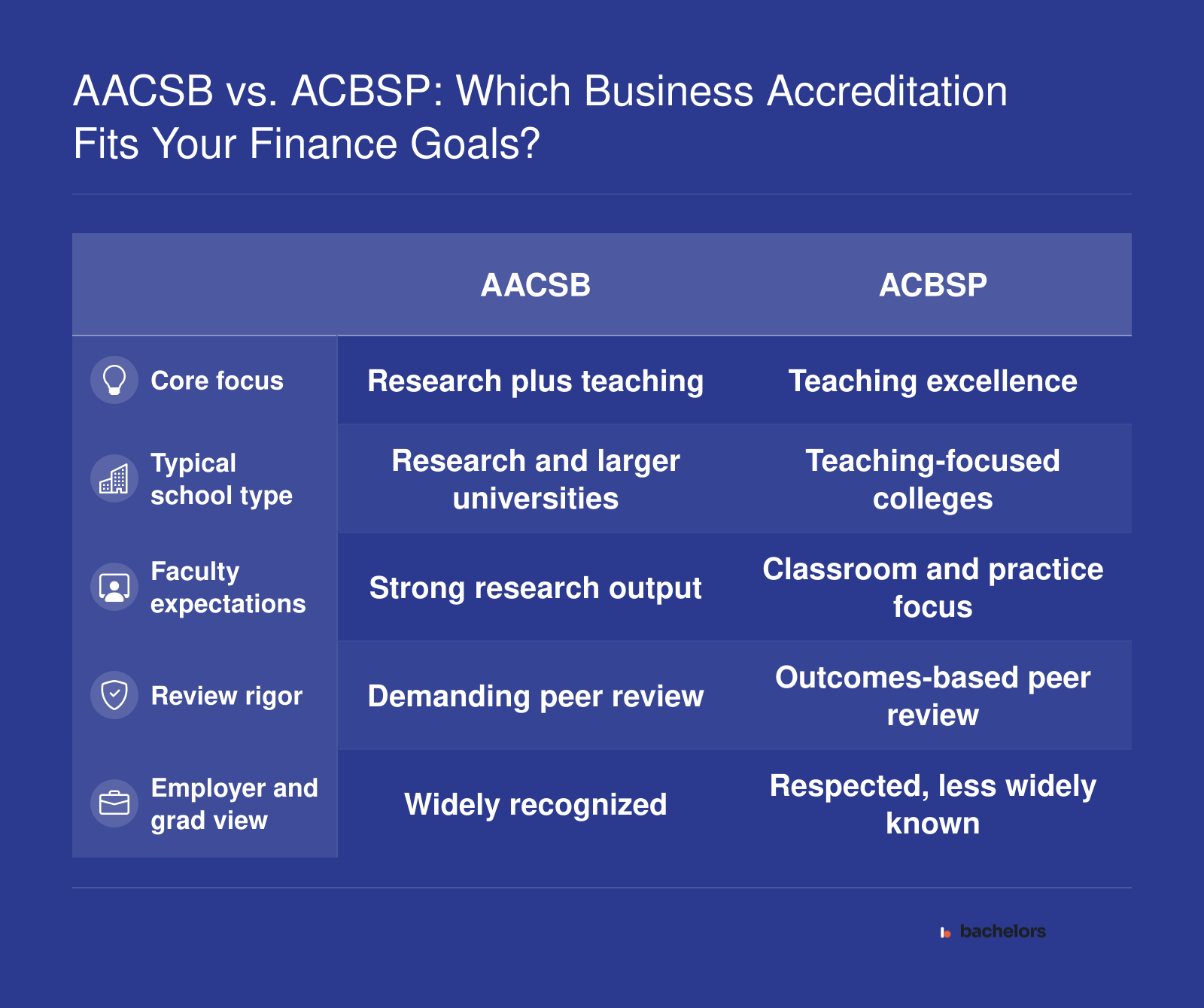
AACSB vs. ACBSP: Which Business Accreditation Fits Your Finance Goals?
Business accreditation tells you an outside body has reviewed a school's finance curriculum, faculty and outcomes. AACSB and ACBSP are both respected, but they emphasize different strengths. Check each school's business program page to confirm which accreditation it holds before you apply.
Online and Hybrid Bachelor's in Finance Options at New Jersey Schools
Most New Jersey finance programs are still taught on campus, so online students have fewer choices than the school list suggests.
Where online and hybrid formats exist
William Paterson University offers a 100% online Bachelor of Science in Finance in an accelerated format with multiple start dates each year.1 Georgian Court University delivers its 120-credit B.S. in Finance in hybrid, on-campus and online formats. Saint Peter's University offers its finance bachelor's online through its School of Professional Studies.
Campus-only programs
Rutgers University-Camden lists its finance degree as fully face-to-face. Rutgers University, Rutgers University-Newark, Ramapo College, Stockton, Rowan, Centenary, Seton Hall and Fairleigh Dickinson University are all listed as campus programs. Do not assume an online option at these schools. Rowan's page, for instance, describes a 48-month, 120-credit degree with no online or hybrid track.2
Combined bachelor's and MBA pathways
- William Paterson: a 4+1 route from the finance B.S. to the MBA.
- Georgian Court: a B.S./M.B.A. pathway. Advanced admission opens after 75 undergraduate credits with a 3.5 GPA, and no GMAT is required.
- Ramapo and Stockton: a 4+1 Flex MBA pathway and an accelerated dual B.S./MBA, respectively, both on campus.
- Rider: a 4+1 program. Its page says transfer students can finish in two years.
We could not verify a dedicated online degree-completion format for transfer students at these schools. Ask each admissions office directly.
Who benefits most
Working adults gain the most from William Paterson's start dates and Saint Peter's online delivery. Commuters can use Georgian Court's hybrid mix. Transfer students should look first at Rider's two-year timeline.
Admission Requirements for NJ Bachelor's in Finance Programs
Rutgers University-New Brunswick admitted about 58 percent of applicants in the latest federal data, making it the most selective school here for a bachelor's degree in finance. Finance is also offered at Rutgers's Newark and Camden campuses, and the New Brunswick program has Wall Street recruiting ties.
Rutgers Business School Requirements
Rutgers publishes no fixed minimum GPA for first-year applicants. Its recent business school profile shows a middle 50 percent of enrolled students with GPAs of 3.5 to 4.0, SAT scores of 1300 to 1470 and ACT scores of 28 to 34.1 Those are profile ranges, not cutoffs, and SAT/ACT submission is optional.1
Transfer rules are more specific. For Fall 2026 at New Brunswick, applicants need Precalculus (01:640:115) plus at least two of four foundation courses (Microeconomics, Macroeconomics, Calculus I, Business Statistics) with a C or better, and about 24 Rutgers credits.2 A 3.0 or higher is recommended, though the GPA needed can vary by cycle.2 Newark accepts 15 to 90 credits from four-year colleges with a minimum 2.8 GPA.3 Two-year transfers should finish an AA or AS with 60 to 65 credits, and Rutgers has articulation agreements with New Jersey community colleges.3
Selectivity Elsewhere
Admit rates run from about 66 percent at Rutgers-Camden and 71 percent at Rutgers-Newark and Ramapo, to roughly 77 to 78 percent at Rowan and Seton Hall, and above 83 percent at Centenary, Stockton, Saint Peter's and Fairleigh Dickinson. We could not confirm published GPA, test-policy or transfer-credit rules for Seton Hall, Rowan, Rider or NJIT, so check each admissions page directly.
Practical Tips
- Plan for the finance gate: Rutgers requires a B or higher in 33:390:300 to declare the finance major, so admission to the university is not the last hurdle.4
- Ask about direct entry: Confirm whether you apply to the business school directly or declare later, since that affects course sequencing.
- Verify transfer credits first: Rutgers advises checking transferability before you take foundation courses elsewhere.
Cost of a Bachelor's Degree in Finance in New Jersey
Sticker price at New Jersey's public universities is the in-state rate. Rutgers-New Brunswick's School of Arts and Sciences estimates $15,381 in tuition and $4,008 in mandatory fees for 2026-2027.1 NJIT lists $22,426 in tuition and fees for a full-time in-state undergraduate year, with student health insurance extra at $2,028.2 Ramapo's in-state tuition is a flat $9,160 per semester for 12 to 18 credits in 2026-2027.3
Sticker Price vs. Net Price
Net price after aid tells a different story. Saint Peter's lists $42,552 in tuition and fees but a net price of $12,199. Fairleigh Dickinson's Metropolitan Campus lists $38,004 against a net price of $15,404. Public options look different: Rutgers-Camden's in-state tuition is $17,764 and its net price $18,745, Ramapo's $16,777 and $18,173, Rutgers-Newark's $14,222 and $19,703. Net price includes living costs, so it can land near or above tuition.
Debt and Outcomes
Rutgers-Camden reports $21,500 in median debt at completion and $74,479 in median earnings ten years after entry. Ramapo reports $21,000 and $67,541. Both pair a net price in the high teens with modest borrowing and solid earnings. Saint Peter's posts the lowest net price among the ranked schools here, which makes it worth a serious look if aid is your priority. Run each school's net price calculator with your own numbers, then weigh the aid offer against debt and earnings, not the sticker.
Related Articles
Finance Careers and Salaries in New Jersey
New Jersey finance work sits inside the largest analyst labor market in the country, which shapes both hiring and pay for graduates who never cross the Hudson. The New York-Newark-Jersey City metro employed 53,870 financial and investment analysts as of May 2025, more than any other metropolitan area tracked by the Bureau of Labor Statistics.1
What the wage data shows
The New Jersey wage estimates are older than the national figures, so read the two sets separately. The most recent state-level BLS release available for financial and investment analysts in New Jersey reported a mean annual wage of $128,280 across roughly 11,250 workers, with the surrounding metro area averaging $146,450.2 Nationally, in May 2025, financial and investment analysts posted a median of $102,740, personal financial advisors $105,070, and loan officers $76,690.3 Metro wages typically run above national medians, but the state medians for advisors and loan officers are not broken out in the current release.
Where graduates work
Loan officers are concentrated at commercial banks, credit unions, and mortgage companies.4 Analyst and advisory roles cluster around the banking, insurance, and asset management operations that line the Hudson waterfront in Jersey City, the corporate corridor in Newark, and the Princeton area. Program highlights from schools here reflect that pipeline: Rowan University names JP Morgan Chase and Vanguard among recruiters, and Rutgers points graduates toward Wall Street firms.
Early career versus mid career
Federal program data for finance graduates at Rutgers reports median earnings near $68,338 one year after completion, rising to about $101,309 by year five. That gap matters. Occupational medians describe workers at all experience levels; first-job pay for a new bachelor's graduate will start lower and climb with licensure, certification, and experience.
Finance Degree in New Jersey: Common Questions
These answers draw on the rankings, cost figures and program details covered above. Rankings use different methods, so treat them as a guide rather than a final verdict.
What is the best school for finance in New Jersey?
Is Rutgers good for a finance major?
What are the best business schools in NJ for undergrads?
Can you get a bachelor's degree in finance online from a New Jersey school?
Compare Finance programs on the data that matters
Explore more Business & Management majors or browse every field of study.
All Business & Management programs Browse every field of study