Best Health Information Management Degree Programs
Compare 140+ accredited Health Information Management programs, with net price after aid, graduation rates, earnings and debt from IPEDS and the U.S. College Scorecard.

Hospitals, insurers, and analytics vendors now run on structured patient data, and the people who govern it need more than coding skill: they answer for privacy, interoperability, and audit. The credential that marks that responsibility is the RHIA, and AHIMA accepts a bachelor's degree from a CAHIIM-accredited program as the route to it.
Average net price across the programs ranked here runs from roughly $10,400 to $24,400, and delivery splits between fully online, campus, and hybrid formats. The figures come from federal College Scorecard and IPEDS records.
Accreditation is what decides whether the degree leads anywhere.
Key Points
- CAHIIM-accredited bachelor's degrees unlock the RHIA; associate degrees lead to RHIT.
- Health informatics programs aren't currently supported by AHIMA for RHIA eligibility.
- Shasta College lists $1,197 in-state tuition but averages $2,878 after aid.
Best Health Information Management Schools at a Glance
This list ranks health information management bachelor's programs across every delivery format: fully online, campus based, and hybrid. Each card draws on federal College Scorecard and IPEDS data, and every graduation rate shown is school wide rather than program specific. Accreditation status varies by program, so check the accreditation section further down before you apply.
University of Washington-Seattle Campus
#1Seattle, WA · ~$14,000/yr (est.)
Best for: Seattle-area transfer students targeting informatics roles
A large public research university in Seattle with deep health sciences resources and a bachelor's program that blends clinical data work with information technology. Students move through a competitive major admission process, and the curriculum is built around electronic health records, data privacy, and the legal side of health care. Graduates head into hospitals, public health agencies, insurers, software vendors, and consulting firms.
- 180 total credit hours across four years
- One start date per year, in summer quarter
- Prepares graduates for the RHIA credential
- Coursework in data privacy, security, and quality assurance
- Emphasis on electronic health records and health informatics
- Open to transfer applicants; competitive admission to the major
- Median earnings of $49,866 one year after finishing
University of Central Florida
#2Orlando, FL · ~$10,000/yr (est.)
Best for: Online learners wanting a public-university option
One of the largest public universities in the country, UCF runs its health information management bachelor's fully online while keeping in-state tuition low. The Orlando campus sits in a growing health care and simulation corridor, and the program pairs a capstone with a two-semester internship placed at a real health care organization. Coursework spans coding, compliance, health law, finance, and data analytics.
- 60 total credit hours in the major
- Completed fully online, with reduced campus-based fees
- Two-semester internship at a real health care organization
- Internship placements available nationwide
- Capstone required; 2.5 GPA minimum to continue
- Starts in fall, spring, or summer
- Median earnings of $40,347 one year after finishing
Strayer University-Florida
#3Tampa, FL · ~$16,000/yr (est.)
Best for: Working adults with employer tuition benefits
A career-focused university built for working adults, with Florida campuses and a fully online health services administration degree that carries a health information management and analytics concentration. Classes run year round and the school accepts a large block of transfer credit, plus employer tuition reimbursement. Coursework leans practical: electronic health records, data visualization, privacy rules, and the AI tools now shaping U.S. health systems.
- 40 total courses, delivered 100% online
- Concentration in health information management and analytics
- Hands-on electronic health records experience
- Transfer up to 28 classes
- Employer tuition reimbursement supported
- No-cost general education courses
- Coursework explores AI and health information exchange
Ohio State University
#4Columbus, OH · $17,000/yr (est. net price)
A flagship public research university in Columbus with a cohort-based health information management and systems major that pulls together business, IT, and clinical coursework. Undergraduates enter the professional curriculum after prerequisites and finish with a professional practice experience. The wider university adds an undergraduate thesis option and study abroad tied to health care.
- 8-semester program that starts in fall
- Cohort-based structure with individualized faculty attention
- Apply by January 31 each year
- Culminating professional practice experience
- Freshmen are guaranteed junior cohort placement
- Undergraduate research thesis option; study abroad in health care
- Median earnings of $54,301 one year after finishing
University of Illinois Chicago
#5Chicago, IL · ~$11,000/yr (est.)
A public research university in Chicago that offers its health information management bachelor's both on campus and fully online, so students can pick the format that fits their life. The curriculum covers coding and reimbursement, analytics, quality improvement, privacy, and information systems, and everyone completes a professional practice experience in a real care setting. Faculty who have led in health care teach in both formats.
- 123 total credit hours, about two years after prerequisites
- Available on campus in Chicago or fully online
- RHIA exam is a graduation requirement
- Professional practice experience in a real health care setting
- Coursework in coding, reimbursement, analytics, and privacy
- Median earnings of $44,526 one year after finishing
Rutgers University
#6New Brunswick, NJ · $24,000/yr (est. net price)
New Jersey's state university, Rutgers delivers its health information management bachelor's through the School of Health Professions in a hybrid, cohort-based format. Didactic courses run online with live and self-paced sessions, and students finish with a management affiliation in a health care setting. The curriculum integrates medicine, business, technology, and law, and part-time options support working professionals.
- 61 total credit hours; finish in two or three years
- Hybrid format with live and self-paced online sessions
- Full-time and part-time enrollment options
- 75-hour management affiliation in the final semester
- 2.8 GPA minimum; cohort-based structure
- Median earnings of $49,928 one year after finishing
Herzing University-Tampa
#7Tampa, FL · ~$20,000/yr (est.)
A career-oriented private university whose Tampa location supports a fully online health information management bachelor's with a required in-person internship. The program runs on rolling admissions with no application deadlines, which suits adults returning to school or changing careers. Students work with virtual encoders and electronic health records software, and some pursue dual credit toward an MBA.
- 100% online classes plus an in-person internship
- Rolling admissions with no application deadlines
- Up to 93 transfer credits accepted
- Access to virtual encoders and electronic health records
- Dual credit toward an MBA
- Day or evening class times; $0 application fee
- Median earnings of $39,231 one year after finishing
Western Carolina University
#8Cullowhee, NC · ~$13,000/yr (est.)
A regional public university in western North Carolina with a long-running health information management bachelor's. The major requires 56 credit hours on top of roughly two years of prerequisites and includes four supervised clinical practica in acute and non-acute care facilities. A capstone seminar adds a research paper and a national registration exam simulation.
- 56 credit hours in the major
- 59 to 60 hours required before admission; 2.0 GPA minimum
- Four clinical practica in acute and non-acute care facilities
- Instruction in ICD-9-CM and CPT-4 coding
- Capstone seminar with research paper and exam simulation
- C or above required in professional courses
Western Governors University
#9Salt Lake City, UT · ~$13,000/yr (est.)
A nonprofit online university built entirely around competency-based degrees, so students advance as soon as they demonstrate mastery of the material. The health information management bachelor's uses flat-rate six-month terms, monthly starts, and a dedicated program mentor. Many students finish in under three years while continuing to work.
- 36 total courses in a competency-based format
- 12 start dates per year; self-paced coursework
- Flat-rate tuition per six-month term
- 40 clinical hours plus a professional practice experience
- Dedicated program mentor for each student
- Transfer credits accepted; many finish in under three years
- Median earnings of $66,651 one year after finishing
St. Joseph's University-New York
#10Brooklyn, NY · ~$19,000/yr (est.)
A private university in Brooklyn with a healthcare information management program offered at its Brooklyn and Long Island locations. The curriculum pairs health administration coursework such as medical terminology, managed care, and health care delivery with an internship in health administration or computer information technology. Computer IT electives can count toward the major, which gives students room to build technical depth.
- Offered at Brooklyn and Long Island locations
- Core courses include medical terminology and managed care
- Internship in health administration or computer information technology
- Computer IT electives may count toward the major
- Only one internship may count toward the concentration
- Median earnings of $48,232 one year after finishing
Cost & outcomes by school
Federal data for the highest-earning Health Information Management programs, independent of the ranking above. Earnings are this field's bachelor's graduates four years after completing where the Scorecard reports them, else the school's undergraduate median.
| School | Net price / yr | Grad rate | Earnings | Debt | Grads/yr | Format |
|---|---|---|---|---|---|---|
| Massachusetts College of Pharmacy and Health Sciences MA | $39,545 | 62% | $125,557 | $25,000 | 8 | Campus |
| Bryant University RI | $41,219 | 80% | $90,008 | $26,849 | — | Campus |
| Loma Linda University CA | — | — | $89,816 | $20,854 | 8 | Campus |
| University of Pittsburgh-Pittsburgh PA | $30,434 | 86% | $83,516 | $22,662 | — | Campus |
| University of Pittsburgh-Johnstown PA | $18,202 | 56% | $83,516 | $22,662 | 3 | Campus |
| University of Pittsburgh-Greensburg PA | $17,945 | 40% | $83,516 | $22,662 | 4 | Campus |
| Western Governors University UT | $12,548 | 46% | $82,644 | $14,909 | 1,420 | Online |
| Ohio State University OH | $17,339 | 88% | $80,315 | $24,995 | 30 | Campus |
| University of Cincinnati OH | $25,648 | 75% | $77,549 | $25,000 | 31 | Online |
| St. Joseph's University-New York NY | $19,035 | 69% | $76,238 | $24,300 | 36 | Campus |
| University of Arkansas for Medical Sciences AR | — | — | $73,827 | $14,000 | — | Online |
| University of Washington-Seattle Campus WA | $14,091 | 85% | $73,484 | $13,787 | 34 | Campus |
Sources: U.S. Department of Education. Net price, graduation rate, earnings and debt: College Scorecard (earnings and debt for this field's bachelor's graduates where reported, else school-wide); graduates: IPEDS. A dash means no figure is reported.
Cost, debt & payoff
Median earnings of this field's bachelor's graduates (4 yrs after completing, else the school's undergraduate median) vs. their median federal loan debt · U.S. College Scorecard
Across these programs the median graduate earns about $52,296 and finishes with roughly $25,000 in debt — a ratio that clears a common rule of thumb (keep debt below first-year salary). Net price and debt vary widely school to school, so check the per-school figures in the table above before you shortlist.
How We Ranked These HIM Bachelor's Programs
A ranking is only useful if you can see what it measures, and this one rests on federal data rather than reputation surveys. The numbers come from the U.S. Department of Education's College Scorecard and the IPEDS database. Anyone can check them, unlike the unexplained "best of" claims on many ranking pages.
What Went Into the Ranking
- Net price: The average cost after grants and scholarships, not the sticker tuition.
- Graduation and retention: How many students finish and how many return after the first year.
- Earnings and debt: Program-level graduate earnings and federal loan debt, where the government publishes them.
- Delivery format: Whether the degree is fully online, hybrid, or on campus.
Where the Data Falls Short
Three limits matter before you trust any single number.
Graduation and retention rates describe the whole institution, not the health information management program. A school with a strong overall rate may still have a smaller or weaker HIM cohort, and the reverse can be true too.
Net price reflects students who received aid, not everyone enrolled. Your own cost depends on your income, transfer credits, and the aid package you are offered, so treat it as a benchmark and not a quote.
Some programs have no published earnings or debt figures because too few students graduate each year for the government to report them. Those schools are not penalized for the gap, but you will have less outcome data to compare.
How to Use the List
Treat the ranking as a shortlist, not a final verdict. Before you apply, confirm each school's CAHIIM accreditation status directly with the school and the accreditor. Ask how the practicum is arranged, whether the school helps online students find a placement, and what the program's recent RHIA exam results look like.
Health Information Management Degree Cost and Tuition Comparison
These are the lowest-net-price options among the HIM schools ranked here. Sticker price and real cost differ sharply: Shasta College lists $1,197 in in-state tuition and $8,853 out of state but averages $2,878 after aid, and because each school below is public, in-state residents pay far less than nonresidents. Purdue University Global HIM bachelor's graduates carried a median federal debt of $30,556 (about $324 a month on a 10-year plan), so ask any online program whether it charges one rate regardless of residency, and remember that net price is a school-wide average from 2024 U.S. Department of Education data; your own cost depends on aid, transfer credits, and residency.
| School | Location | Format | In-State Tuition | Out-of-State Tuition | Average Net Price | Program Median Federal Debt | Est. Monthly Payment (10-Year) |
|---|---|---|---|---|---|---|---|
| Shasta College | Redding, CA | Online | $1,197 | $8,853 | $2,878 | N/A | N/A |
| Purdue University Global | West Lafayette, IN | Online | $10,101 | $14,412 | $7,770 | $30,556 | $324 |
| Palm Beach State College | Lake Worth, FL | Campus or online | $3,050 | $10,910 | $9,182 | N/A | N/A |
Related Articles
Online vs. Campus HIM Programs: Which Format Fits
Yes, you can earn a health information management bachelor's degree online. Many of the programs here are offered fully online or in both online and campus formats, so location rarely limits your options. Texas State University delivers its BSHIM fully online, on campus, or as a hybrid, while the University of Central Florida offers its BSHIM fully online.
Practicum Still Applies
Online does not mean experience-free. CAHIIM accreditation sets curriculum standards but not one identical practicum-hour total, so requirements differ by school. UCF students complete two professional practice experiences plus a capstone internship in the final senior year at an affiliated healthcare facility. At Texas State, practicum credit is 5 or 6 credits within a 120-credit degree, and the five-credit professional practice course is an eight-week, full-time, supervised management experience.1 Placements of two to five weeks may be on site, with length set by the program director. Plan for time away from work.
Delivery, Proctoring and Authorization
Texas State advertises 24/7 online course access, which suggests largely asynchronous coursework, but confirm whether any courses include scheduled live sessions.2 UCF says the degree may be completed fully online, though not every elective or prerequisite may be offered that way, and the facility internship can fall outside a standard asynchronous format.
Proctoring is set by each institution and often by each course. Ask what exams require, whether a webcam or testing center is involved, and whether proctoring fees apply.
State authorization is separate from CAHIIM accreditation. A school can be accredited and still be unable to enroll students from certain states. Do not assume any program accepts every state, and check each school's current authorization list for where you live.
A Practical Tip
Before you apply, ask admissions two questions: how are practicum sites secured, and is my state authorized? Also ask whether you can propose a facility near home and who approves it.
CAHIIM Accreditation and RHIA Eligibility: What to Verify
The growth of health informatics has made one distinction newly important: AHIMA accepts HIM degrees for the RHIA exam, but it does not currently support health informatics programs for that credential. That distinction changes how applicants should read a program's title and its accreditation page.
Match the credential to the program
AHIMA lists several routes to RHIA eligibility, including completion of the baccalaureate-level academic requirements of a CAHIIM-accredited HIM program, completion of a CAHIIM-accredited master's HIM program, and a CAHIIM-approved HIM postbaccalaureate certificate.1 For a bachelor's student, the first route is the standard one. Enrollment alone is not sufficient; AHIMA's wording points to completing the program's requirements. If you are finishing your final term, ask the program and AHIMA to confirm your eligibility in writing before you register for the exam.
Audit the directory entry
Search the CAHIIM Program Directory by program name, state or region, degree level, or delivery format.2 Confirm the subject area is "Health Information Management," the program level is "Baccalaureate Degree," and the enrollment status is "Active." Open the accreditation status or View Details page, then check CAHIIM's Recent Accreditation Actions for the award type, either Initial or Continuing, and the board meeting date.3 Compare those dates with your expected graduation year, not your application year. A school's marketing page can lag behind the official record, so use the directory and award history as the source of truth.
Treat candidacy as a warning flag
Candidacy is not accreditation. CAHIIM states that candidacy does not denote accreditation or full compliance with its standards, and a candidacy-only listing should not be treated as satisfying AHIMA's RHIA requirement.4 A program whose accreditation lapses or transitions during your enrollment needs the same scrutiny. CAHIIM accreditation also does not guarantee exam eligibility on its own, so keep written confirmation from both the program and AHIMA.5
RHIA vs. RHIT: Which Credential Your Degree Unlocks
Both AHIMA credentials share the same exam structure and fee, so the real difference is the degree behind them. A bachelor's degree from a CAHIIM-accredited program qualifies you for the RHIA, the administrator credential. An associate degree leads to the RHIT. RHIT holders can move up to the RHIA by completing the requirements of a CAHIIM-accredited bachelor's program, and the RHIA then supersedes the RHIT.
| Feature | RHIA | RHIT |
|---|---|---|
| Degree required | Baccalaureate-level requirements of a CAHIIM-accredited HIM program (a master's-level pathway is also listed) | Associate's-degree-level requirements of a CAHIIM-accredited HIM program |
| Typical roles and settings | AHIMA's administrator-level HIM credential; AHIMA's excerpt does not list specific job titles | Hospitals, physician practices, nursing homes, home health agencies, mental health facilities, public health agencies, pharmaceutical companies, law and insurance firms, and health product vendors |
| Exam format | 150 questions (130 scored, 20 pretest) | 150 questions (130 scored, 20 pretest) |
| Exam length | 3 hours 30 minutes | 3 hours 30 minutes |
| Exam fee | $229 for AHIMA members; $299 for non-members | $229 for AHIMA members; $299 for non-members |
| Most recent first-time pass rate | Not reported in the AHIMA sources reviewed | 74% in 2025 (1,630 first-time testers) |
| Continuing education | 30 CEUs every two years | 20 CEUs every two years |
Median Pay for Health Information Leaders
Experienced HIM professionals often move into director and department-head roles, which the Bureau of Labor Statistics groups under medical and health services managers.
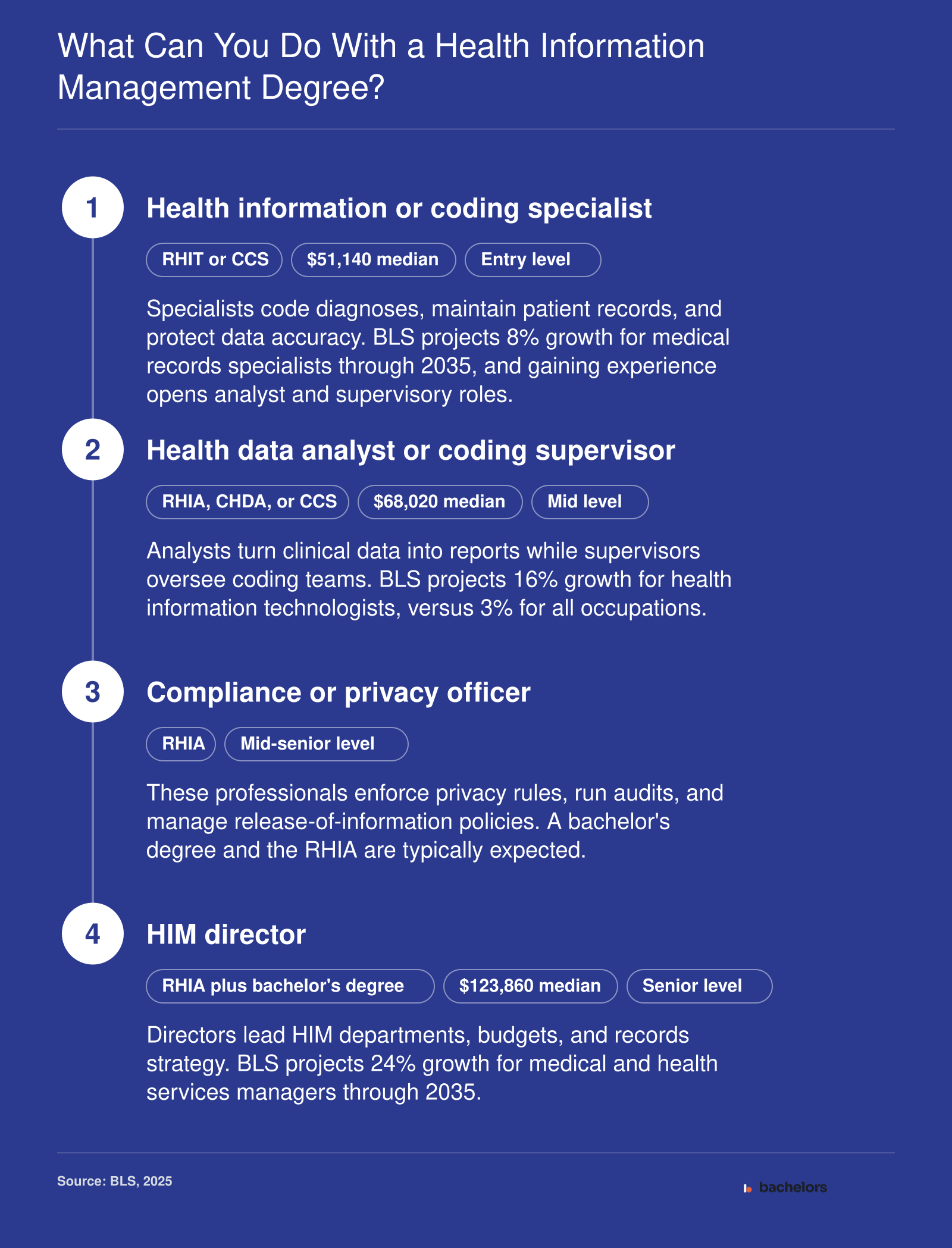
What Can You Do With a Health Information Management Degree?
Entry-level records and coding roles are reachable with an associate degree and the RHIT credential, but compliance, privacy, and director positions typically call for a bachelor's degree and the RHIA. The path below shows how a health information management bachelor's degree moves you from day-to-day data work into leadership, with BLS median wages where a role maps to a federal occupation.
Health Information Management programs by state
Common Questions About HIM Degree Programs
These answers cover the questions prospective students ask most about HIM bachelor's degrees, from value and credentials to coursework. Always confirm details with the specific program you are considering.
Is a health information management degree worth it?
What is the difference between RHIA and RHIT?
Can I sit for the RHIA if my program isn't CAHIIM-accredited?
Do I need strong math or coding skills for an HIM bachelor's degree?
Compare Health Information Management programs on the data that matters
Explore more Business & Management majors or browse every field of study.
All Business & Management programs Browse every field of study