Best Health Informatics Degree Programs
Compare 60+ accredited Health Informatics programs, with net price after aid, graduation rates, earnings and debt from IPEDS and the U.S. College Scorecard.

Does a health informatics bachelor's degree actually qualify you for the RHIA exam?
That single question separates programs more sharply than tuition does. CAHIIM accreditation is what makes a graduate eligible to sit for the Registered Health Information Administrator credential, and a program carries it only after peer review against CAHIIM standards. Two schools with nearly identical course titles can sit on opposite sides of that line.
The consequences show up fast. Hospital IT departments and health systems hiring analysts screen for the credential early, and a graduate without it competes on different terms.
Key Points
- California State University-Stanislaus has the lowest net price here: $6,067 per year.
- At Texas Woman's University, median graduate debt is $18,426 (about $195 monthly).
- Cincinnati's online health informatics bachelor's takes nine semesters, with no campus visits.
Best Health Informatics Schools Ranked for 2027
The top 10 mixes bachelor's programs almost entirely, with a strong tilt toward formats that let working adults finish a degree without relocating. Several schools offer the same curriculum online, on campus, or in a hybrid schedule, and a handful build in credit for prior learning or accelerated paths into a master's.
University of Washington-Seattle Campus
#1Seattle, WA · ~$14,000/yr (est.)
Best for: Public health focused research university seekers
The University of Washington's Seattle campus anchors health informatics in a school of public health, and its bachelor's program is CAHIIM accredited and built around a full four-year sequence. Students take 180 credits covering electronic health records, systems analysis, data privacy, and the legal and regulatory side of health data, then sit for the Registered Health Information Administrator exam. Admission is competitive and opens once a year in summer quarter to current UW students and transfers. For readers who want a research university with a deep health sciences footprint and a accredited, exam-aligned curriculum, this is the strongest option on the list.
- CAHIIM accredited program requiring 180 total credits
- Four-year sequence with one summer start date per year
- Coursework in electronic health records, systems analysis, and data privacy
- Prepares students for the Registered Health Information Administrator exam
- Open to current UW students and transfer applicants
- Competitive admission; administered by the Health Services department
- Hands-on work in database design and clinical data analysis
George Mason University
#2Fairfax, VA · $15,000 – $20,000/yr (est.)
Best for: Northern Virginia students wanting online flexibility
George Mason's health informatics bachelor's sits in the Department of Health Administration and Policy and pulls together health sciences, IT, computer science, data science, and behavioral sciences. The STEM-designated, 120-credit degree offers an internship and an accelerated BS-to-MS path that adds a master's in one more year, and courses run both online and on campus for full- or part-time students. Mason reports unusually strong retention for the program and a curriculum with room for AI and healthcare research. It is a good fit for students in the Washington, D.C. metro who want flexibility without giving up a campus.
- STEM-designated 120-credit bachelor's degree
- Accelerated BS to MS pathway available
- Health informatics internship built into the program
- Courses offered online and on campus, full- or part-time
- Reports 100% one-year retention for the program
- Program holds CAHIIM candidacy status
- Faculty research in AI and healthcare applications
- Average time to degree completion of 3.6 years
Indiana University-Indianapolis
#3Indianapolis, IN · $11,000 – $35,000/yr (est.)
IU Indianapolis offers Indiana's first undergraduate biomedical informatics degree, and it is the rare program that treats health informatics as a specialization inside a computing-focused major. Students work through a 34-credit informatics core in Python, data structures, data mining, and biostatistics, then a 30-credit health informatics block covering health information management, clinical systems, standards and terminologies, and healthcare security and privacy rules. A capstone internship, senior thesis, or system design project closes the degree, and an accelerated path can carry students into a master's in about five years. This is the pick for readers who want more technical depth than a typical health information management track.
- Health Informatics specialization within a biomedical informatics major
- 34-credit informatics core including Python, data structures, and biostatistics
- 30-credit health informatics block on clinical systems and terminologies
- Coursework in healthcare security and privacy regulations
- Capstone internship, senior thesis, or system design project
- Requires a C- or better in every course and a 2.0 GPA to graduate
- 120 total credits including 21 credits of general electives
- Accelerated bachelor's to master's pathway available
University of North Texas
#4Denton, TX · $11,000 – $21,000/yr (est.)
UNT's health informatics bachelor's is a STEM-designated degree delivered face-to-face, fully online, and at the university's Frisco location, which makes it one of the more format-flexible options in this group. Students take 33 hours of required coursework plus 45 hours of electives, covering how healthcare is organized, managing data and technology in healthcare, privacy and security, and analytics tools for improving care delivery. Advising runs through the College of Information, and students maintain a 2.5 GPA in major courses. It suits readers who want a research university name with a true online option and room to shape electives.
- STEM-designated undergraduate degree
- Offered face-to-face, fully online, and at the Frisco campus
- 33 credit hours of required courses plus 45 credit hours of electives
- Coursework in healthcare data, technology, and analytics tools
- Covers privacy and security issues in health information systems
- 2.5 GPA minimum across major courses
- Advisor housed in the College of Information
University of Cincinnati
#5Cincinnati, OH · ~$26,000/yr (est.)
Cincinnati's health informatics bachelor's is delivered entirely online and is built for students who want to finish quickly, with a nine-semester, three-year completion plan and two start dates a year. The curriculum pairs health information systems and data analytics with cybersecurity and leadership, and it includes a professional practicum and a capstone. Students get a dedicated enrollment advisor, credit transfer review, and access to the university's healthcare network for practicum placements. It is a practical choice for working adults who want an established university behind a fully online degree.
- 100% online with no campus visits required
- Nine-semester, three-year completion plan
- Two start dates per year, fall and spring
- Capstone and professional practicum required
- Coursework in health information systems, analytics, and cybersecurity
- Dedicated enrollment services advisor and credit transfer review
- Holds CAHIIM candidacy status
Texas Woman's University
#6Denton, TX · ~$12,000/yr (est.)
Texas Woman's University runs an interdisciplinary health informatics bachelor's that draws on computer science, nursing, health studies, and library science, with hybrid and online coursework and part-time or full-time scheduling. Students choose between a Clinical Applications concentration and a Health Studies concentration, both within a 120-credit, four-year degree. The Denton location puts students in the Dallas-Fort Worth metroplex, with its large healthcare and technology job market, and the university reports a high admit rate and a broad alumni network. It is a strong fit for readers who want a health-focused concentration rather than a purely technical one.
- Clinical Applications concentration
- 120 credit hours across a four-year plan
- Hybrid and online coursework with flexible scheduling
- Full-time and part-time enrollment options
- Interdisciplinary core spanning computer science, nursing, and health studies
- Health Studies concentration
- 120 credit hours across a four-year plan
- Hybrid and online coursework with flexible scheduling
- Interdisciplinary curriculum with a computer science core
Loma Linda University
#7Loma Linda, CA
Loma Linda's health information and informatics bachelor's is CAHIIM accredited through 2029 and prepares students for the Registered Health Information Administrator credential. The curriculum covers health information systems, data analytics, cybersecurity, revenue cycle management, and leadership, with stackable microcredentials in data analytics, cybersecurity, and management baked in. Students can study online or on campus and finish in as few as six terms, and California residents can pursue an EHR business internship with Epic. The 8-to-1 student-to-faculty ratio makes it the smallest-class option on this list.
- CAHIIM accredited through 2029
- Prepares students for the RHIA certification exam
- Stackable microcredentials in data analytics, cybersecurity, and management
- Online or on-campus enrollment with multiple entry points
- EHR business internship with Epic for California residents
- 78 total credit hours; finish in as few as six terms
- 2.5 GPA minimum plus prerequisite coursework
- 8-to-1 student-to-faculty ratio
University of Southern Indiana
#8Evansville, IN · ~$13,000/yr (est.)
Southern Indiana offers a 100% online health informatics and information management degree completion program designed for students who already hold some college credit. The 60-credit curriculum covers clinical informatics, data analytics, electronic health records, and health information systems, and most students finish in one to two years. Credit for prior learning is accepted, and the program includes a partnership with Pollux Systems for career opportunities. It is the clearest fit here for an adult learner who wants to convert existing credits into a bachelor's without ever visiting campus.
- 100% online degree completion format
- 60 total credit hours; most finish in one to two years
- Credit for prior learning accepted
- Coursework in clinical informatics, data analytics, and EHR systems
- Partnership with Pollux Systems for career opportunities
- $40 application fee; financial aid and scholarships available
Minnesota State University-Mankato
#9Mankato, MN · $10,000 – $19,000/yr (est.)
Minnesota State Mankato's health informatics bachelor's is a campus-based program that combines information technology, health sciences, and business, with core courses in database management, information security, health IT systems, programming, and human-computer interaction. The 120-credit degree includes 76 major credits and requires an internship or capstone, and coursework is drawn from computer science, nursing, and geography for a genuinely interdisciplinary base. Students graduate prepared for health informatics specialist, clinical data analyst, and IT project manager roles. It suits readers who want a traditional residential experience with team-based healthcare projects.
- 120 total credits, including 76 major credits
- Campus-based program in Mankato
- Internship or capstone required
- Core topics include database management, information security, and programming
- Interdisciplinary coursework from computer science, nursing, and geography
- Team-oriented healthcare projects and leadership development
The College of Saint Scholastica
#10Duluth, MN · $28,000/yr (est. net price)
The College of Saint Scholastica's health informatics and information management bachelor's blends clinical, technology, and management coursework across a 69-credit major, ending in a professional practice experience. Graduates are eligible for the Registered Health Information Administrator credential, and the program emphasizes critical thinking, ethics, and communication alongside medical terminology, healthcare systems, data analytics, and project management. CAHIIM granted it seven years of continuing accreditation in early 2026, with the next review set for 2033-34, and it is available in both campus and online formats. Small classes and personalized faculty support make it a good fit for students who want close advising.
- CAHIIM continuing accreditation granted for seven years in 2026
- Available in campus-based and online formats
- 69-credit major with a 2.7 GPA minimum
- Eligible for the RHIA credential after graduation
- Professional practice experience required
- Coursework in medical terminology, data analytics, and project management
- Small classes with personalized faculty support
Cost & outcomes by school
Federal data for the highest-earning Health Informatics programs, independent of the ranking above. Earnings are this field's bachelor's graduates four years after completing where the Scorecard reports them, else the school's undergraduate median.
| School | Net price / yr | Grad rate | Earnings | Debt | Grads/yr | Format |
|---|---|---|---|---|---|---|
| Bryant University RI | $41,219 | 80% | $90,008 | $26,849 | 1 | Campus |
| Loma Linda University CA | — | — | $89,816 | $20,854 | — | Online |
| University of Washington-Seattle Campus WA | $14,091 | 85% | $78,466 | $14,615 | — | Campus |
| George Mason University VA | $17,915 | 68% | $76,343 | $19,500 | 15 | Online |
| The University of Texas at Austin TX | $19,857 | 89% | $75,121 | $20,500 | — | Campus |
| Oregon Institute of Technology OR | $15,706 | 54% | $72,273 | $22,500 | — | Online |
| St. John's University-New York NY | $29,999 | 66% | $69,571 | $25,000 | — | Campus |
| University of Pittsburgh-Pittsburgh PA | $30,434 | 86% | $66,125 | $24,250 | — | Campus |
| The College of Saint Scholastica MN | $27,846 | 71% | $65,934 | $20,000 | — | Campus |
| California State University-Stanislaus CA | $6,067 | 54% | $63,188 | $13,540 | — | Hybrid |
| California State University-Channel Islands CA | $9,849 | 51% | $62,152 | $15,000 | — | Campus |
| Illinois State University IL | $19,398 | 65% | $62,117 | $20,482 | — | Campus |
Sources: U.S. Department of Education. Net price, graduation rate, earnings and debt: College Scorecard (earnings and debt for this field's bachelor's graduates where reported, else school-wide); graduates: IPEDS. A dash means no figure is reported.
Cost, debt & payoff
Median earnings of this field's bachelor's graduates (4 yrs after completing, else the school's undergraduate median) vs. their median federal loan debt · U.S. College Scorecard
Across these programs the median graduate earns about $49,379 and finishes with roughly $22,500 in debt — a ratio that clears a common rule of thumb (keep debt below first-year salary). Net price and debt vary widely school to school, so check the per-school figures in the table above before you shortlist.
How We Ranked These Health Informatics Programs
Every figure behind this ranking comes from two federal sources: the U.S. Department of Education's College Scorecard and the Integrated Postsecondary Education Data System (IPEDS). We did not use reader reviews, surveys, or paid placements. Many competing lists lean on opaque review scores or sponsored slots, so you cannot tell why a school sits where it does. Federal data is imperfect, but you can check it yourself.
What We Measured
Each program was compared on the same factors:
- Cost: Net price for undergraduate programs, or graduate tuition where the credential is a master's.
- Earnings: Program-level earnings after completion, where the federal government publishes them.
- Debt: Median federal debt for students who finish the program.
- Completion: Institution-wide graduation and retention rates.
- Format: Whether the program is offered online, on campus, or both.
Where the Data Falls Short
Three limits are worth knowing. Graduation and retention rates describe the whole institution, not the health informatics program alone. Net price is an average after grants and scholarships, so your own bill could land higher or lower. And some programs are too small to have published earnings, so those schools are judged on the remaining measures instead of being penalized.
How to Use the Ranking
Treat the list as a shortlist, not a verdict. Once a few schools stand out, confirm that the program holds the accreditation you need (CAHIIM accreditation matters especially for health information management paths), then run the numbers against your own budget, including transfer credits and the aid you qualify for. A school ranked lower but cheaper for you, or better suited to your schedule, can be the smarter pick.
Health Informatics Degree Cost: Tuition, Net Price, and What You'll Actually Pay
What the Most Affordable Programs Cost
The lowest-cost bachelor's programs here carry an average net price after aid of roughly $6,100 to $12,900 per year. California State University-Stanislaus sits at the bottom, at $6,067. Community College of Denver ($9,450), CSU Channel Islands ($9,849), and the University of Central Florida ($10,411) follow. At the upper end of this group sit the University of Southern Indiana at $12,923 and Florida Gulf Coast University at $12,568.
In-State vs. Out-of-State Tuition
Public schools price residents and nonresidents very differently. Florida Gulf Coast charges $6,118 in-state and $25,162 out-of-state. UCF runs $6,368 against $22,467. Indiana University-Indianapolis shows the widest spread, $10,762 versus $34,891.
Online delivery can shrink that gap, though not everywhere. Louisiana Tech, which offers its health informatics and information management degree online or on campus, lists $10,125 in-state and $16,866 out-of-state, one of the narrower spreads on this list. UCF also offers an online option, yet its sticker gap stays wide. Ask each school whether distance students pay a flat or reduced rate, and whether it depends on where you live.
What Net Price Actually Measures
Average net price after aid blends what students actually paid once grants and scholarships were subtracted. It shifts with family income, residency, enrollment status, and the aid package you qualify for. Your own figure could land well above or below it. Run each school's net price calculator with your real numbers before treating any of these as a budget.
The Practical Takeaway
Sticker price alone is a poor guide. Where a school publishes first-year earnings for its graduates, set that figure beside the program's average net price after aid, then favor the pairing with the smallest gap between what you pay and what you earn. A slightly pricier program with a stronger employment record can beat a low-cost one with thin outcomes.
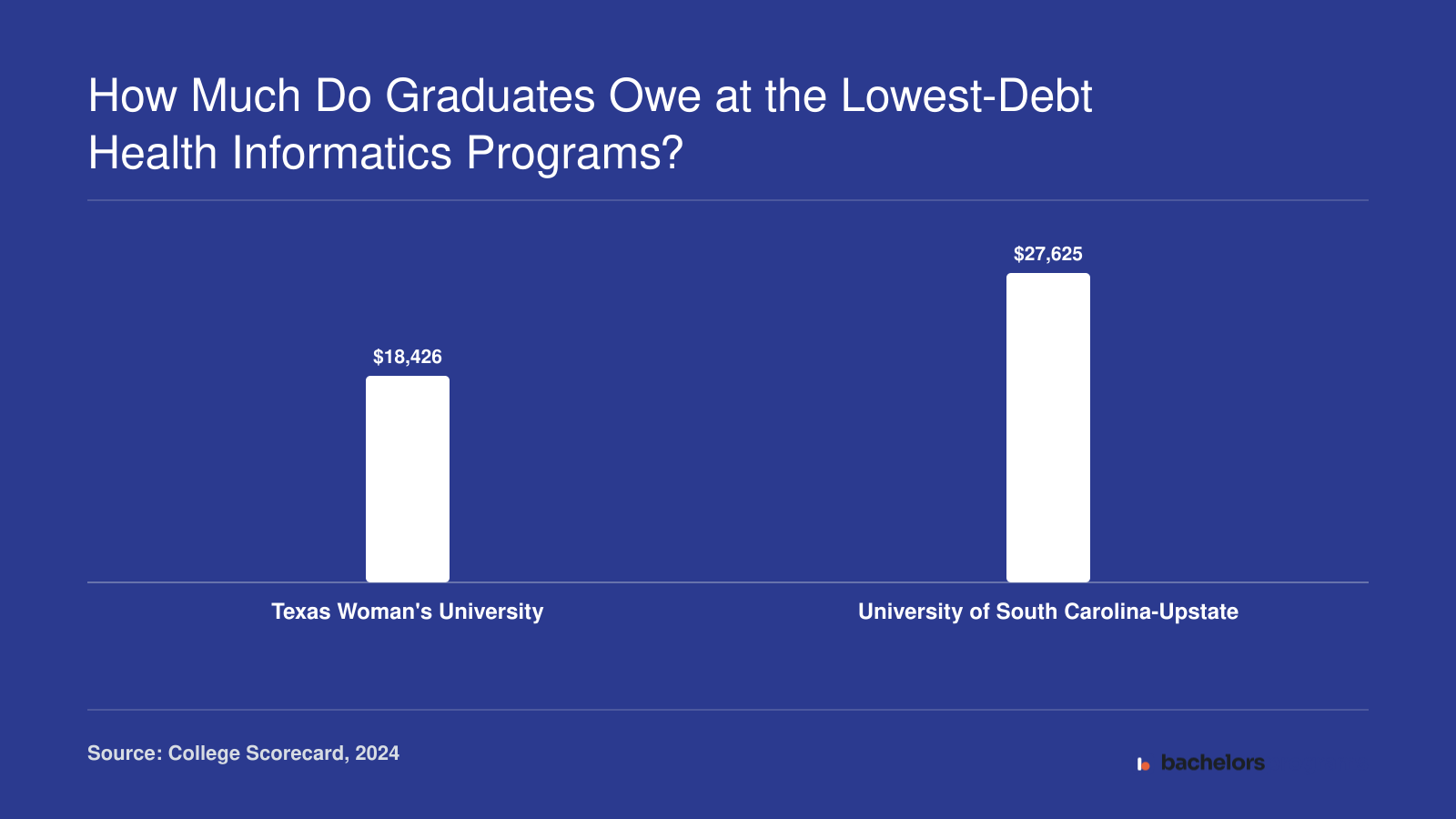
How Much Do Graduates Owe at the Lowest-Debt Health Informatics Programs?
Bachelor's graduates in health informatics at Texas Woman's University finish with median federal loan debt of $18,426 at completion, about $195 a month on a standard 10-year repayment plan. At the University of South Carolina-Upstate, the program median is $27,625, or about $293 a month. Keeping payments under $300 a month makes them easier to absorb on an entry-level health IT salary, especially if you plan for them before graduation.
Related Articles
CAHIIM Accredited Health Informatics and HIM Programs Compared
CAHIIM programmatic accreditation is a voluntary peer review that measures a specific health information or health informatics program against CAHIIM Standards, which is separate from the regional or national accreditation that covers the college or university as a whole. The track matters: CAHIIM accreditation in Health Information Management (HIM) is what opens the path to the RHIA and RHIT credential exams, while accreditation in Health Informatics does not carry that exam pathway. The listings below come from the CAHIIM Program Directory as of late October 2026, but status can change, so confirm each program's current standing in the directory before you apply.
| School | Degree Level | CAHIIM Accreditation Track | Credential Exam Eligibility | Format |
|---|---|---|---|---|
| Loma Linda University | Bachelor's | Health Information Management | RHIA exam pathway | N/A |
| Grand Canyon University | Bachelor's | Health Information Management | RHIA exam pathway | N/A |
| Indiana University Northwest | Bachelor's | Health Information Management | RHIA exam pathway | Campus and online |
| American Public University System | Bachelor's | Health Information Management | RHIA exam pathway | N/A |
| William Carey University | Master's | Health Information Management | RHIA exam pathway | N/A |
| Loma Linda University | Master's | Health Informatics | No RHIA/RHIT exam pathway | N/A |
| Grand Canyon University | Master's | Health Informatics | No RHIA/RHIT exam pathway | N/A |
| Indiana University | Master's | Health Informatics | No RHIA/RHIT exam pathway | Campus and online |
| Adelphi University | Master's | Health Informatics | No RHIA/RHIT exam pathway | Online |
Online vs Campus Health Informatics Degrees: Which Format Fits You?
The University of Cincinnati's online Bachelor of Science in Health Informatics runs nine semesters, and no campus visit is required. That one detail explains why delivery format matters as much as curriculum here: the degree can travel to the student.
Who Each Format Serves
About as many of the programs below are fully online as are campus-based, and a couple offer both formats or a hybrid schedule. Online suits working healthcare staff, including nurses, medical coders, and IT technicians, who need to keep a paycheck while they study. For a nurse on 12-hour rotations, asynchronous coursework is often the only realistic option. Campus suits first-time undergraduates who want in-person labs, standing office hours, and recruiting pipelines into nearby hospitals.
The Practicum Question
Accredited programs include a professional practice experience, and online students still need a local site. Ask before you deposit: does the program find your site or do you, which hospitals and clinics in your metro have hosted students, and who supervises the work when that site sits hundreds of miles from campus. A program with a national preceptor network is far easier to manage than one that leaves you to cold-call a health system.
Same Diploma, Same Accreditation
An online and a campus version of the same program typically share accreditation and award the identical diploma; the transcript does not name the format. Employers ask about the credential and the practicum, not whether you sat in a lecture hall. Verify that the accreditation listing covers the exact program and format you plan to enter, since schools occasionally run an accredited track alongside a separate one.
Questions to Ask Yourself
Do you want to sit for the RHIA credential?
Are you drawn to the clinical side or the data side?
Can the program place you in a professional practice experience near where you live?
Would a bachelor's-to-master's accelerated track save you a year of tuition?
Pay Ceiling for Health Informatics Leaders
Health informatics graduates who move into leadership often land in medical and health services management, where the pay ceiling rises well above entry-level analyst roles.
Health Informatics programs by state
Health Informatics Degree FAQs
These answers cover the questions prospective students ask most often about timelines, value, degree types, and admission requirements. Details vary by school, so confirm specifics with each program before you apply.
How long does it take to complete a health informatics degree?
Is a health informatics degree worth it?
Is health informatics the same as health information management?
Do you need a clinical or IT background to start a health informatics degree?
Compare Health Informatics programs on the data that matters
Explore more Healthcare majors or browse every field of study.
All Healthcare programs Browse every field of study