Best Healthcare Administration Schools in Mississippi
Compare 15 accredited Healthcare Administration programs in Mississippi at 9 colleges, with net price after aid, graduation rates, earnings and debt from IPEDS and the U.S. College Scorecard.

A bachelor's degree in healthcare administration trains you to manage budgets, staffing and compliance at Mississippi hospitals, clinics and long-term care facilities. The Bachelor of Science (B.S.) in Healthcare Administration is the standard award, though some schools grant a business degree, a B.A.S. or an emphasis inside a broader major instead.
Price splits the field sharply. In-state tuition and fees run from $8,492 at Mississippi University for Women to $30,250 at Belhaven University. Rankings weigh published cost, outcomes and delivery format for campus and online programs alike.
Starting pay sits well below manager wages. Belhaven graduates earned a median $39,022 one year after completion.
Key Points
- Mississippi University for Women has the lowest in-state tuition and fees: $8,492.
- Belhaven's BSBA graduates earned a $51,594 median four years out.
- Nursing home administrator licensure in Mississippi requires 1,040 A.I.T. hours.
Best Bachelor's in Healthcare Administration Schools in Mississippi
Nine Mississippi schools award a bachelor's degree in healthcare administration, and they divide into campus programs at Ole Miss, Belhaven, Blue Mountain Christian, and MUW and online degrees built around working adults. Each card pairs the school's programs with institution-wide figures such as tuition, net price, and graduation rate, while the earnings figures, where federal data publishes them, come from graduates of the healthcare administration program itself. Read the program notes closely: the entry rules at William Carey and the applied-science route at Mississippi State assume you already hold a credential or an associate degree.
University of Mississippi
#1University, MS · $10,000 – $15,000/yr (est.)
Best for: Pre-health students planning graduate study
Ole Miss delivers healthcare administration through its B.A. in Allied Health Studies, a four-year interdisciplinary degree organized by the Health Professions Advising Office and listed at Oxford, Booneville, DeSoto, and Tupelo. The Healthcare Management emphasis covers leadership, provider operations, and the business side of a hospital, clinic, or senior care facility. Advising steers students toward the prerequisite coursework needed for graduate health administration study, including the University of Mississippi Medical Center program in Jackson, which students apply to competitively.
- Healthcare Management emphasis with its own checksheet
- Eight concentration options across the allied health studies degree
- Coursework drawn from departments across the university
- Four-year degree that prepares students for allied health professional school admission
- Listed at Oxford, Booneville, DeSoto, and Tupelo
- Prepares students to coordinate business activity in hospitals and clinics
Mississippi State University
#2Mississippi State, MS · ~$18,000/yr (est.)
Best for: Working adults transferring an associate degree
Mississippi State runs two fully online routes into the field: a traditional B.S. in Healthcare Administration for students starting fresh or transferring, and a Bachelor of Applied Science built for people who already hold an Associate of Applied Science. Both are taught through MSU Online at a flat per-credit rate, and the B.S. adds a required internship so coursework gets tested in a real care setting. Graduates move into mid-level roles in hospitals, clinics, long-term care, insurers, and government health agencies.
- 120 credit hours at $452 per credit
- Fully online with an assigned academic advisor
- Required internship in a real healthcare setting
- Covers healthcare finance, law, regulation, policy, and informatics
- Transfer-friendly policies for prior college coursework
- Minimum 2.5 GPA with SAT or ACT scores required
- Built to finish in two years across four semesters
- Requires an AAS degree for admission
- 120 total credit hours across 40 courses
- Two start dates per year, spring and fall
- Focus on patient care, efficiency, and healthcare policy
William Carey University
#3Hattiesburg, MS · ~$14,000/yr (est.)
Best for: Credentialed health workers seeking advancement
William Carey's online health administration degree pairs management coursework with education courses, a combination aimed at people who train, supervise, or teach inside care settings. Admission assumes prior health credentials: an associate degree in a health field, or a certification, registration, or licensure, plus a 2.50 cumulative GPA. Practicum placement requires a clear background check and a negative drug screen, and up to 27 credits can be awarded for a health-related associate degree that led to a credential.
- 120 credit hours with a fully online option
- Combines administration and education coursework
- Up to 27 elective credits for a health-related associate degree or credential
- Associate degree, certification, registration, or licensure required for admission
- Minimum 2.50 cumulative GPA
- Fall and spring start dates only
- Clear background check and negative drug screen before practicum
Delta State University
#4Cleveland, MS · ~$14,000/yr (est.)
Delta State frames healthcare administration as a business degree, so students take a full BBA core alongside healthcare law and regulation, ethics, informatics, economics and finance, and quality management. The program is fully online with part-time scheduling, a required internship, and more than 20 scholarships reserved for management majors. It is one of the state's lower-priced options and is based in Cleveland, in the Mississippi Delta.
- 120 credit hours, completable in four years
- Fully online with part-time scheduling available
- Required internship for hands-on management experience
- Coursework in healthcare law, ethics, informatics, economics, and finance
- Over 20 program-specific scholarships for management majors
- Rolling admissions
Belhaven University
#5Jackson, MS · $15,000 – $20,000/yr (est.)
Belhaven offers the field on two tracks: a campus BSBA with a healthcare administration concentration in Jackson, and a fully online Health Administration degree taught in seven-week terms for working adults. The online version accepts military, veteran, and first responder benefits and hosts a local ACHE student chapter. Federal data for program graduates shows median earnings of about $39,000 one year after completion, rising to roughly $51,600 after four years and $53,500 after five.
- Healthcare Administration concentration within the BSBA
- Combines business fundamentals with healthcare systems and policy
- Campus program in Jackson
- 124 credit hours, fully online and asynchronous
- Seven-week course terms
- $465 per credit
- Military, veteran, and first responder discounts
- Local ACHE student chapter
Jackson State University
#6Jackson, MS · $24,000/yr (est. net price)
Jackson State's online B.S. in Healthcare Administration requires 122 credit hours and builds direct field experience into the degree, positioning graduates for entry-level management in hospitals, nursing homes, managed care organizations, and physician practices. As a historically Black university in the state capital, JSU sits close to the hospitals, insurers, and agencies where students look for internships and first jobs. Program graduates reported median earnings of about $30,900 one year after completion and roughly $45,300 four years out.
- 122 total credit hours
- Fully online option available
- Direct field experience opportunities built into the degree
- Prepares for entry-level management in hospitals and managed care
- Also prepares students for master's and doctoral study
Mississippi University for Women
#7Columbus, MS · ~$12,000/yr (est.)
Mississippi University for Women houses health care management inside its business department, so students take a BBA core plus healthcare economics, quality management, law, information technology, and epidemiology. The junior and senior years can be finished online, which lets students near Columbus stay local while completing upper-division work. An accelerated bachelor's-to-MBA path shortens the route to a graduate degree, and a BAS option is offered alongside the BBA.
- Health Care Management concentration in the Department of Business
- 120 total credit hours
- Junior and senior years can be completed online
- Accelerated bachelor's-to-MBA pathway
- Coursework in health care economics, quality management, law, IT, and epidemiology
- BBA and BAS degree options
Blue Mountain Christian University
#8Blue Mountain, MS · ~$24,000/yr (est.)
Blue Mountain Christian pairs a business core with a healthcare management concentration built in partnership with Rize Education, emphasizing project work and a strategic capstone aimed at real operational problems. Students study healthcare service operations and graduate ready for administrator, practice manager, or operations coordinator roles. The campus sits in the small town of Blue Mountain in north Mississippi and operates in a Christian environment that shapes the general education curriculum.
- Healthcare Management concentration
- Offered in collaboration with Rize Education
- Project-based learning with a strategic capstone
- Coursework in healthcare service operations
- Focus on managing hospitals, clinics, and care settings
Strayer University-Mississippi
#9Jackson, MS · ~$14,000/yr (est.)
Strayer's Mississippi location in Jackson supports an online health services administration degree designed for working adults, with 11-week terms and up to 28 classes accepted in transfer. Students choose between a B.S. in Health Services Administration, which carries tracks in entrepreneurship, human resource management, and management, and a B.B.A. with a health services administration concentration. Academic coaching, financial aid guidance, and career planning are part of the package, and the school accepts military benefits and employer tuition reimbursement.
- 40 courses delivered in 11-week terms
- Tracks in entrepreneurship, HR management, and management
- Covers healthcare policy, finance, and personnel
- Credentialed faculty with real-world experience
- Academic coaching, financial aid help, and career planning
- Military benefits and employer tuition reimbursement accepted
- Health Services Administration concentration
- 40 courses with up to 28 classes accepted in transfer
- Cost per course of $1,555
- No-cost general education courses available
- Employer tuition reimbursement supported
Cost & outcomes by school
Federal data for the highest-earning Healthcare Administration programs, independent of the ranking above. Earnings are this field's bachelor's graduates four years after completing where the Scorecard reports them, else the school's undergraduate median.
| School | Net price / yr | Grad rate | Earnings | Debt | Grads/yr | Format |
|---|---|---|---|---|---|---|
| Belhaven University MS | $15,676 | 49% | $51,594 | $35,416 | 18 | Campus |
| Mississippi State University MS | $17,595 | 67% | $51,513 | $22,142 | 2 | Online |
| University of Mississippi MS | $13,314 | 72% | $50,994 | $20,000 | 4 | Campus |
| Mississippi University for Women MS | $12,411 | 47% | $46,128 | $15,000 | — | Campus |
| Jackson State University MS | $23,836 | 51% | $45,308 | $35,070 | 67 | Online |
| William Carey University MS | $14,258 | 60% | $43,087 | $20,832 | 32 | Online |
| Delta State University MS | $13,540 | 48% | $41,991 | $20,390 | 2 | Campus |
| Blue Mountain Christian University MS | $24,016 | 55% | $40,421 | $18,534 | — | Campus |
| Strayer University-Mississippi MS | — | — | $40,092 | $40,621 | — | Online |
Sources: U.S. Department of Education. Net price, graduation rate, earnings and debt: College Scorecard (earnings and debt for this field's bachelor's graduates where reported, else school-wide); graduates: IPEDS. A dash means no figure is reported.
Cost, debt & payoff
Median earnings of this field's bachelor's graduates (4 yrs after completing, else the school's undergraduate median) vs. their median federal loan debt · U.S. College Scorecard
Across these programs the median graduate earns about $43,087 and finishes with roughly $35,070 in debt — a ratio that clears a common rule of thumb (keep debt below first-year salary). Net price and debt vary widely school to school, so check the per-school figures in the table above before you shortlist.
Online and Hybrid Bachelor's Options at Mississippi Schools
Mississippi's healthcare administration bachelor's programs come in three delivery formats, and format often decides whether a degree fits your life better than curriculum does.
Fully online options
Mississippi State University delivers both its B.S. and its B.A.S. in Healthcare Administration entirely online, 120 credits each. The published rate is $435.75 per credit plus a $25 instructional support fee, which totals $460.75; a separate Mississippi State online page lists $452 plus $25, or $477 per credit, and the university's materials do not reconcile the two. Mississippi State charges every online student the in-state rate regardless of residence, a genuine advantage for out-of-state applicants. Belhaven University's online Bachelor of Healthcare Administration spans 124 credits at $465 per credit for 2026-2027, and Belhaven publishes one undergraduate rate rather than a resident and nonresident split. William Carey and Jackson State also list fully online options, and Strayer University-Mississippi runs its health services administration program online in 11-week terms.
Hybrid and campus formats
Mississippi University for Women keeps its Health Care Management BBA on campus but allows the junior and senior years online, which suits students who want a traditional start and a flexible finish. The University of Mississippi and Blue Mountain Christian University list campus-based programs, and Delta State's Healthcare Administration degree is listed as campus based while also noting online delivery and a required internship.
What still happens in person
Online delivery does not remove field requirements. William Carey requires a cleared criminal background check and a negative drug screen before the practicum, and Delta State lists an internship among its degree requirements. Working adults and transfer students are the natural audience for the fully online tracks; campus programs suit students who want local placements and face-to-face faculty contact.
Admission Requirements for Mississippi Healthcare Administration Programs
Admission to a Mississippi healthcare administration bachelor's program can hinge more on completed college coursework than on a single test score, and Mississippi State University shows how much the rules vary by degree track.
At Mississippi State: B.S. and B.A.S.
Both tracks require a 2.00 GPA for transfer admission and share deadlines: August 1 for fall, December 1 for spring, and May 15 for summer.
The B.S. in Healthcare Administration is test-optional. Applicants with 15 or more transferable hours need a 2.00 college GPA and good standing; with fewer than 15 hours, add a high-school GPA and an ACT or SAT score. Once enrolled, B.S. students must reach a 2.50 overall GPA by the start of junior year.
The B.A.S. is built for Associate of Applied Science holders; it counts regardless of when the degree was earned, as long as it appears on an official transcript. The program states a 2.00 admission GPA. Applicants with fewer than 15 transferable hours submit high-school credentials and an ACT or SAT score, while the university's general online policy allows some non-submitters to be reviewed on other factors.
Transfer Caps
- B.S.: up to 60 community-college and 90 four-year hours; final 30 at Mississippi State
- B.A.S.: 60 community-college hours (45 of them technical), 86 four-year, 86 combined; 30 upper-level hours at the university
Delta State, Belhaven, Jackson State and William Carey set their own GPA, test and transfer rules; read each admissions page for the current policy rather than assuming the Mississippi State numbers carry over.
A Tip for Community College Transfers
General education credits transfer most reliably. English composition, college algebra, lab sciences and introductory psychology or sociology usually satisfy bachelor's requirements at any of these schools. Clinical and technical courses are likelier to count toward the B.A.S. than the B.S., so request a transcript evaluation before you commit.
B.S. vs. B.A.S. vs. Health Administration Emphasis: Which Bachelor's Fits You?
All three paths lead to the same occupation. The U.S. Bureau of Labor Statistics lists a bachelor's degree as the typical entry-level education for medical and health services managers, with a May 2025 median salary of $123,860 and projected growth of 24% from 2025 to 2035. The difference is in how each degree is built and who it suits. Details below are general, so confirm specifics with each school's admissions office.
| Factor | B.S. in Healthcare Administration | Bachelor of Applied Science (B.A.S.) | Health Administration Emphasis in a Broader Degree |
|---|---|---|---|
| Typical student | Often a first-time college student or a transfer student who wants a degree built around the field from the start | Often a student with prior technical or applied coursework, or a working professional looking to move into management | A student who wants a wider health foundation and is still deciding on a role, or who may continue to other health studies |
| How transfer credit is handled | Varies by school. Check the published transfer policy and how many credits apply to the major | Often designed to build on prior applied coursework, but acceptance rules differ by school, so confirm before applying | Varies by school. General education and prerequisite credits tend to carry over more easily than major-specific courses |
| Curriculum focus | Healthcare management, operations, finance, policy and the U.S. health system | Applied, practice-oriented management skills, with the exact balance set by the program | Broad health or allied health coursework, with a smaller block of administration courses |
| Best-fit career goal | Management or administrative roles in hospitals, clinics and other health organizations | Moving into supervisory or management roles from a hands-on health or technical background | Keeping options open across health careers, with administration as one possible direction |
| Mississippi example | Mississippi State University offers a B.S. in Healthcare Administration | Mississippi State University also offers a B.A.S. in Healthcare Administration | The University of Mississippi offers a B.A. in Allied Health Studies |
Cost of a Bachelor's Degree in Healthcare Administration in Mississippi
Mississippi University for Women has the lowest in-state tuition and fees here at $8,492, followed by Delta State University ($8,605) and the University of Mississippi ($9,772). The private schools charge more on paper, from $15,480 at William Carey University to $30,250 at Belhaven University. Average net price comes from the U.S. Department of Education's IPEDS and College Scorecard data (2024). It is an institution-wide average for aided students that adds housing, books and other costs to tuition and then subtracts grants, so treat it as a benchmark rather than a quote for your own bill. That is why the public schools' net prices sit above their tuition while Belhaven's drops to $15,676. The public versus private gap narrows sharply after aid: only about $3,300 separates the lowest and highest net prices shown. Median debt at graduation ranges from $15,000 at Mississippi University for Women to $26,333 at Belhaven, so the lowest sticker price also comes with the lightest typical loan balance.
| School | Sector | In-State Tuition and Fees | Out-of-State Tuition and Fees | Average Net Price After Aid | Median Debt at Graduation |
|---|---|---|---|---|---|
| Mississippi University for Women | Public | $8,492 | $8,492 | $12,411 | $15,000 |
| University of Mississippi | Public | $9,772 | $28,600 | $13,314 | $20,000 |
| Delta State University | Public | $8,605 | $8,605 | $13,540 | $20,390 |
| William Carey University | Private nonprofit | $15,480 | $15,480 | $14,258 | $20,832 |
| Belhaven University | Private nonprofit | $30,250 | $30,250 | $15,676 | $26,333 |
Mississippi Grants and Scholarships That Can Lower the Bill
Mississippi state aid rules shift between award years, so any dollar figure you find in a search result is a starting point, not a locked price. Confirm each detail on the official page before you build a budget.
Step 1: Match Yourself to a State Program
- MTAG: The state's main merit award for Mississippi residents at in-state colleges. Confirm the current GPA and test-score thresholds on the Mississippi Office of Student Financial Aid (OSFA) site.
- HELP: A need-based grant tied to your FAFSA results. Check OSFA for the current income and enrollment requirements.
- Eminent Scholars: Built for high scorers. Verify the test-score and GPA rules rather than assuming you qualify.
Step 2: File the FAFSA Early
Complete FAFSA.gov before your school's priority deadline. Several state programs and most institutional awards read directly from it, and a late filing can cost you an award you would otherwise have received.
Step 3: Layer On School Awards
The Mississippi State University and University of Mississippi financial aid offices each publish their own scholarship deadlines, applications, and residency rules. Check both if you are applying to either, and ask specifically about awards open to healthcare administration majors, since departmental scholarships often sit apart from general ones.
Where to Verify
- OSFA program pages for MTAG, HELP, and Eminent Scholars
- FAFSA.gov
- Each school's financial aid website and scholarship portal
Confirm deadline, GPA, test score, residency, and need requirements on the official page before applying.
Accreditation for Mississippi Healthcare Administration Schools
Institutional accreditation is the baseline every Mississippi bachelor's degree needs, and program-level credentials are a bonus, not a requirement. Check the first before you compare anything else.
Two Kinds of Accreditation
Institutional accreditation covers the whole school. In Mississippi, that means SACSCOC, the regional accreditor for the Southeast. Specialized accreditation covers a single program. In this field, the names to know are CAHME, which accredits graduate programs, and AUPHA, whose membership and certification recognize undergraduate healthcare management programs.
What Is Confirmed
SACSCOC accreditation is confirmed for Mississippi State University (reaffirmed 2024)1, the University of Mississippi (reaffirmed 2019)2, and Belhaven University (reaffirmed 2017, with a 2026 advisory visit)3. The state's 2026-2027 approved-college list also covers these three.4 No confirmed CAHME accreditation or AUPHA membership surfaced for their undergraduate programs. That is not proof none exists, so check the directories directly. Program-level accreditation status for the other schools here was not verified.
Why It Matters
- Financial aid: Federal aid generally requires an accredited institution.
- Transfer credit: Accredited schools usually accept each other's credits. Mississippi State's online B.S. asks for 60 hours from an accredited four-year university.
- Employers: Hiring managers and graduate programs look for recognized accreditation.
Quick Verification
Search the school's name in the SACSCOC institution directory, then check the CAHME and AUPHA program directories. Ask the admissions office to confirm in writing.
What Do Mississippi Healthcare Administration Graduates Earn After Completion?
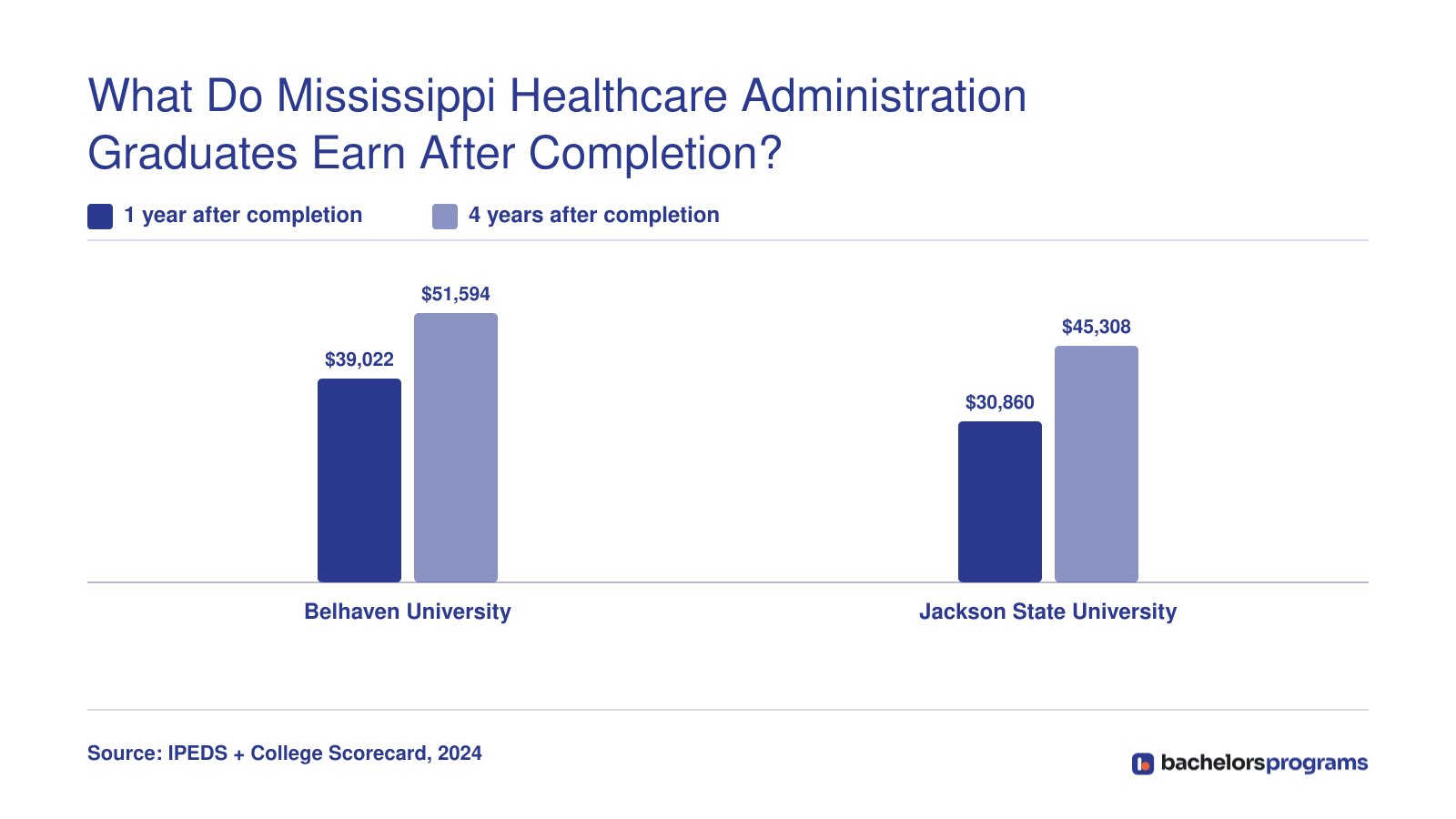
Belhaven University's BSBA in Healthcare Administration posts the strongest program-level outcomes in federal data: a median of $39,022 one year after completion, rising to $51,594 four years out. Jackson State University's B.S. graduates earned $30,860 after one year and $45,308 after four, and Jackson State's program reported 55 completions against Belhaven's 25. Program-level earnings are not reported for Mississippi State, Ole Miss or Mississippi University for Women, so the chart compares only these two programs.
Healthcare Administration Careers and Salaries in Mississippi
The wages below are May 2025 estimates for medical and health services managers from the U.S. Bureau of Labor Statistics and the Mississippi Department of Employment Security. They show what people already working as managers earn, not starting pay for new bachelor's graduates, so read them separately from the graduate earnings figures above. Statewide, the median is $109,680 across 4,280 jobs. The Gulfport-Biloxi area pays more at $114,500, and the Jackson area sits lower at $95,960. Most graduates start in roles such as department coordinator, practice or office manager, or patient services supervisor at employers like the University of Mississippi Medical Center, Baptist Memorial and Singing River Health System, then move into management as they gain experience.
| Area | Median Annual Wage | Employment |
|---|---|---|
| Mississippi (statewide) | $109,680 | 4,280 |
| Gulfport-Biloxi metro area | $114,500 | 520 |
| Jackson metro area | $95,960 | N/A |
Related Articles
Nursing Home Administrator Licensure in Mississippi
The Mississippi State Board of Nursing Home Administrators licenses nursing home administrators, and licensure runs through 1,040 hours as an administrator-in-training (A.I.T.), two exams and two required courses.1
Education and the A.I.T.
A bachelor's in healthcare administration from an institution accredited by an agency recognized by CHEA or the U.S. Department of Education meets the education requirement. The Board also accepts a bachelor's in any field, an associate degree, or 64 semester hours plus two consecutive years of full-time supervisory work in a Mississippi-licensed nursing home.1 The A.I.T. must be served at an approved facility, Monday through Friday during normal business hours, at least 40 hours a week.2 Applicants then complete a Board-approved A.I.T. course and a two-day Mississippi State Department of Health training course, and pass both the NAB examination and the Mississippi State Board examination, which requires at least 75%.3 An academic route with NAB Program Approval may satisfy part of the training, subject to Board approval.4
Most Management Roles Are Not Licensed
Nursing home administration is the exception. Practice manager, department director and hospital operations roles in Mississippi carry no state license requirement.
Choosing a Program for Long-Term Care
If long-term care leadership is the goal, confirm a program's accreditation before enrolling, since the Board's education route depends on it.
Compare Healthcare Administration programs on the data that matters
Explore more Business & Management majors or browse every field of study.
All Business & Management programs Browse every field of study