Best Information Technology Schools in Mississippi
Compare 5 accredited Information Technology programs in Mississippi, with net price after aid, graduation rates, earnings and debt from IPEDS and the U.S. College Scorecard.

Mississippi students weighing a campus degree against an online one are also weighing price. At Mississippi's public universities, a bachelor's degree in information technology, usually a Bachelor of Science (B.S.) in Information Technology, carries in-state tuition and fees from $8,785 at Alcorn State University to $10,202 at Mississippi State University.
The ranked list compares net price, graduation rates, program earnings, and campus versus online format. Cost and state aid, online delivery, admission standards, accreditation, and Mississippi career paths all shape that comparison.
Four years out, graduates of the strongest programs here earn in the low $80,000s.
Key Points
- Alcorn State University has the lowest in-state tuition, at $8,785.
- Mississippi State IT graduates earned a median $82,852 four years out.
- Mississippi State and USM offer test-free admission at a 3.20 GPA.
Best Bachelor's Degree in Information Technology Programs in Mississippi, Ranked
Mississippi's bachelor's degree in information technology options sit at a handful of institutions, and they differ sharply in structure: a College of Education program built around technology support, a networking degree inside an applied-technologies department, a 120-credit program tied to a Cisco academy, a small private degree with a frozen tuition rate, and a 40-course career-focused track in Jackson. Each card below covers what the school is known for, which students it tends to suit, and, where the data supports it, what graduates earn four years after finishing.
Mississippi State University
#1Mississippi State, MS · ~$18,000/yr (est.)
Best for: Aspiring school and business tech-support specialists
Mississippi State University is the largest public research university in the state, and its information technology degree is a non-teaching Bachelor of Science in Information Technology Services housed in the College of Education rather than an engineering department. That setting shapes the curriculum around computer-based information systems, hardware and software, and the design of technology user support for schools, colleges, industry and business. The program requires 124 semester hours, and about 67% of the university's students complete a degree, an institution-wide figure rather than a program rate. Graduates of the IT program report median earnings of about $82,900 four years after finishing.
- 124 total credit hours
- Non-teaching bachelor's program
- Training in computer-based information systems
- Coursework in software applications and hardware
- Preparation for technology user support roles
- Career paths in K-12, higher education, industry and business
Alcorn State University
#2Alcorn State, MS · ~$13,000/yr (est.)
Best for: Networking-focused students wanting an HBCU setting
Alcorn State University is a historically Black land-grant university in southwest Mississippi, and it awards a Bachelor of Science in Computer Networking and Information Technology through the Department of Advanced Technologies in the College of Agriculture and Applied Sciences. IT students share that department with robotics, geospatial and engineering technology majors, which puts networking coursework in an applied-science setting rather than a standalone computer science department. The department combines engineering, technology and applied sciences under one STEM umbrella, so options for switching focus within the college are broad. Roughly 57% of the university's students complete a degree overall, an institution-wide measure rather than a program rate.
- Housed in the Advanced Technologies department
- One of four departments in the College of Agriculture and Applied Sciences
- Prepares students for high-demand technical fields
University of Southern Mississippi
#3Hattiesburg, MS · ~$22,000/yr (est.)
Best for: Working adults needing a fully online route
The University of Southern Mississippi offers a 120-credit Bachelor of Science in Information Technology that is part of the Cisco Networking Academy, giving students a route to CCNA and IT foundations certification alongside the degree. Coursework covers local and wide-area networking, network security, network management, network design, application development and virtualization, with Microsoft and VMware software access and Fortinet Academy firewall training built in. The program runs on the Hattiesburg campus and fully online, which makes it the most format-flexible public option on this list. About 49% of the university's students complete a degree overall, and IT graduates report median earnings of about $81,700 four years after finishing.
- 120 total credit hours
- Fully online option available
- Part of the Cisco Networking Academy Program
- Can lead to CCNA industry certification
- Microsoft and VMware software subscriptions
- Fortinet Academy firewall security training
- Coursework in networking, security and network design
- Graduates work as systems analysts, network administrators and web masters
Blue Mountain Christian University
#4Blue Mountain, MS · ~$24,000/yr (est.)
Blue Mountain Christian University is a small private institution in northeast Mississippi that offers a B.S. in Information Technology covering the development, implementation, support and management of software and systems. It is one of the few private, faith-based options in the state for this field, and the university has announced a tuition freeze for the 2026-2027 academic year, with online programs priced per credit hour rather than by semester. The program is accredited through SACSCOC, and the school markets the degree on field growth, citing 15% job growth by 2031. About 55% of the university's students complete a degree, an institution-wide figure rather than a program rate.
- Covers development, implementation, support and management of software
- Accredited by SACSCOC to award baccalaureate and master's degrees
- Cites 15% job growth in the field by 2031
- Offered through the university's online program track
Strayer University-Mississippi
#5Jackson, MS · ~$14,000/yr (est.)
Strayer University's Mississippi campus in Jackson runs the Bachelor of Science in Information Technology on a 40-course calendar with each course lasting 11 weeks, which lets students start and finish courses quickly rather than waiting on a semester schedule. Students take 58.5 credit hours in the major plus a concentration of 18 credit hours, choosing from eight tracks that include cybersecurity, data analytics, cloud computing, artificial intelligence, networking and IT project management. Up to 28 classes can transfer in, tuition runs $1,555 per course with a $65 technology fee each term, and Middle States accreditation was reaffirmed in March 2026. IT graduates report median earnings of about $82,300 four years after finishing.
- 40 total courses, each running 11 weeks
- 8 concentration options including cybersecurity and cloud computing
- 58.5 credit hours in major courses plus 18 in a concentration
- Transfer up to 28 classes
- $1,555 per course plus a $65 technology fee each term
- Accredited by the Middle States Commission on Higher Education
- 500+ employer tuition assistance partners
- No-cost general education options available
Cost & outcomes by school
Federal data for the highest-earning Information Technology programs, independent of the ranking above. Earnings are this field's bachelor's graduates four years after completing where the Scorecard reports them, else the school's undergraduate median.
| School | Net price / yr | Grad rate | Earnings | Debt | Grads/yr | Format |
|---|---|---|---|---|---|---|
| Mississippi State University MS | $17,595 | 67% | $82,852 | $24,250 | 106 | Campus |
| Strayer University-Mississippi MS | — | — | $82,304 | $37,500 | 1 | Online or campus |
| University of Southern Mississippi MS | $21,708 | 49% | $81,740 | $22,500 | 73 | Online or campus |
| Blue Mountain Christian University MS | $24,016 | 55% | $40,421 | $18,534 | — | Online |
| Alcorn State University MS | $13,265 | 57% | $36,421 | $27,000 | 13 | Campus |
Sources: U.S. Department of Education. Net price, graduation rate, earnings and debt: College Scorecard (earnings and debt for this field's bachelor's graduates where reported, else school-wide); graduates: IPEDS. A dash means no figure is reported.
Cost, debt & payoff
Median earnings of this field's bachelor's graduates (4 yrs after completing, else the school's undergraduate median) vs. their median federal loan debt · U.S. College Scorecard
Across these programs the median graduate earns about $81,740 and finishes with roughly $24,250 in debt — a ratio that clears a common rule of thumb (keep debt below first-year salary). Net price and debt vary widely school to school, so check the per-school figures in the table above before you shortlist.
How We Ranked Mississippi Bachelor's in IT Programs
What We Compared
Four factors carry the most weight: cost and net price, student outcomes, the number of completers, and delivery format. Cost starts with published tuition but does not stop there; net price after grants and scholarships is the figure that shapes a real budget, and a low sticker price can still hide fees and a slow path to graduation. Outcomes cover graduation and retention, plus median earnings for former students. Completer counts show whether a program has enough enrollment depth to keep its course schedule stable. Format matters too, because a hybrid or fully online schedule can change total cost of attendance.
Where the Numbers Come From
Figures come from the U.S. Department of Education's College Scorecard and IPEDS. Three limits apply to these figures:
- Net price is a schoolwide average across all undergraduates, not an IT-specific figure.
- Graduation rates describe the whole institution, not a single major.
- Earnings are medians for former students and blend graduates from every field.
What Counts as Eligible
Only bachelor's programs at schools based in Mississippi are ranked, whether you would study on campus or online. Each program below awards a bachelor's degree in information technology or a closely related computing field. The schools ranked here are Mississippi State University, Alcorn State University, the University of Southern Mississippi, Blue Mountain Christian University, and Strayer University-Mississippi. Graduate degrees and programs from institutions based elsewhere fall outside this list.
What a Bachelor's Degree in Information Technology Costs in Mississippi
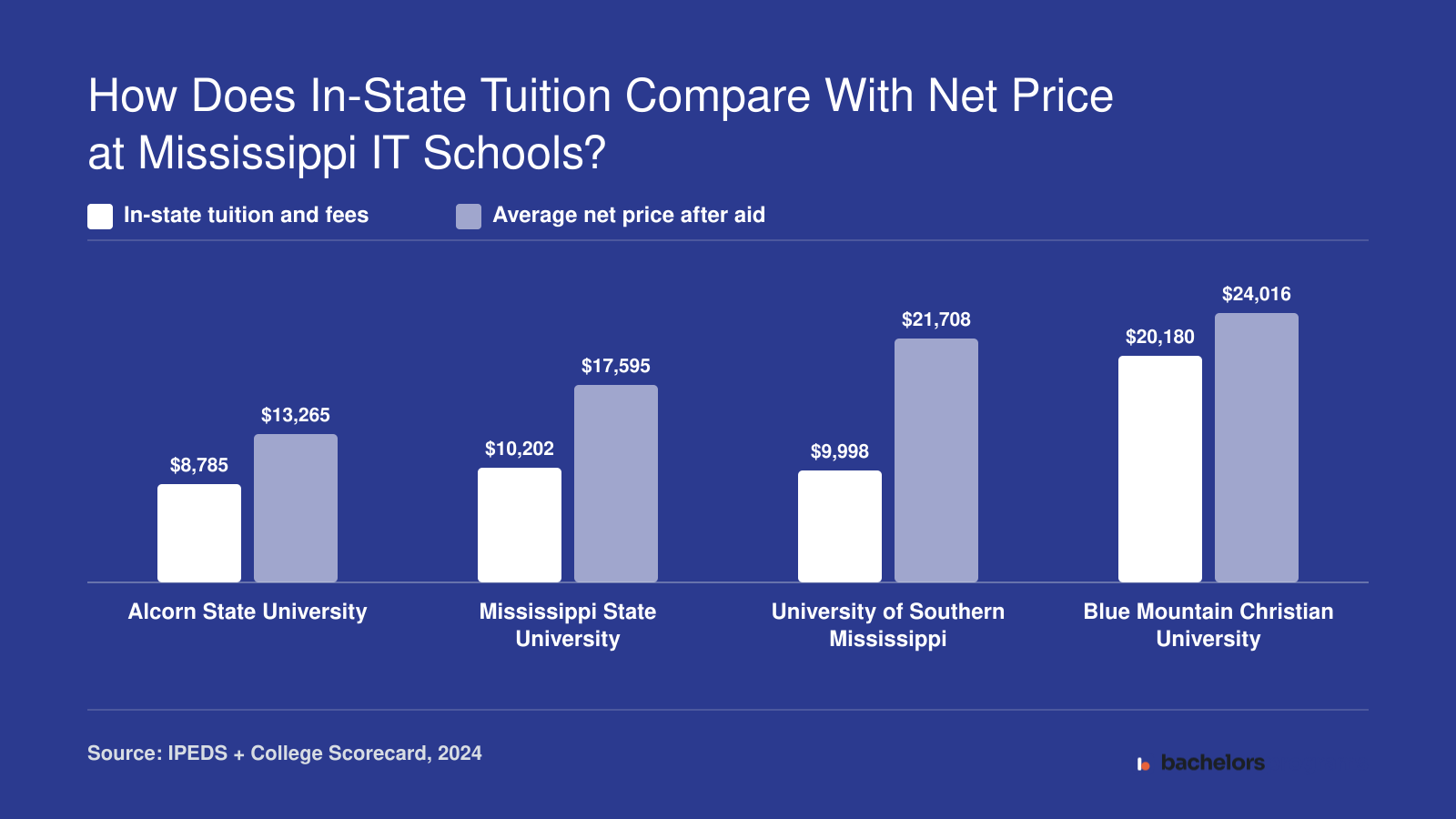
In-state tuition and fees at Mississippi State University run $10,202 a year, with the University of Southern Mississippi close behind at $9,998 and Alcorn State University the lowest sticker price among the public options at $8,785. Blue Mountain Christian University, a private institution, charges $20,180.
Sticker Price vs. What Students Actually Pay
Published tuition is the starting number, not the bill. Net price is what a typical aided student pays after grants and scholarships are subtracted, and it includes housing, books, and living costs that tuition alone leaves out. That is why net price can land above the tuition figure: Alcorn State averages $13,265, Mississippi State $17,595, Southern Miss $21,708, and Blue Mountain Christian $24,016. Measured this way, Alcorn State is the lowest-cost route to a bachelor's degree in information technology among these schools, and the private option narrows its gap considerably once institutional aid is applied.
Mississippi State Aid Programs
The state's three principal undergraduate grants all require full-time enrollment each term, which current materials define as 12 credit hours per semester2:
- HELP Grant: Need-based, covering full tuition for up to eight semesters. Requires a 2.5 GPA, a 20 ACT, and Mississippi residency, with FAFSA-based need criteria.2 The 2026-27 application deadline is March 31, with documents due April 30.3
- MTAG: Residency-based, paying $500 a year for freshmen and sophomores and $1,000 a year for juniors and seniors, for up to eight semesters.1 Requires a 2.5 GPA, a 15 ACT, and one year of residency.2 Deadline: September 15.
- MESG (Eminent Scholars): Merit-based at $2,500 a year for up to eight semesters, requiring a 3.5 GPA and a 29 ACT.2 Deadline: September 15.
Stacking Aid Effectively
File the FAFSA before you touch the state application. HELP requires Pell eligibility to be established, and MTAG specifically excludes students receiving the maximum Pell award4, so your federal result determines which state grant you should pursue. Missing the March 31 HELP deadline cannot be repaired later in the year.
How Does In-State Tuition Compare With Net Price at Mississippi IT Schools?
Alcorn State University has the lowest sticker price here, at $8,785 in in-state tuition and fees, and the lowest average net price, at $13,265. Net price runs higher than tuition at every school shown because it covers the full cost of attendance (housing, books and other expenses) minus average grant aid. Net price is an average for public or private schools, so what you pay will depend on your income and the aid you receive.
Online and Hybrid Bachelor's in IT Options at Mississippi Schools
Delivery format splits Mississippi's bachelor's in information technology programs in two: some are built around a campus, others can be completed entirely online.
Campus, online, and both
- University of Southern Mississippi: The B.S. in Information Technology is offered in Hattiesburg and online.1 The program page does not indicate a hybrid requirement for the online route.
- Blue Mountain Christian University: Listed as an online information technology program.
- Strayer University-Mississippi: A Jackson campus plus a fully online option, with eight concentration choices.
- Mississippi State University and Alcorn State University: Both list campus-based programs. Mississippi State's is Information Technology Services2; Alcorn's is Computer Networking and Information Technology.
The formats listed are campus, online, or a choice between them. None of the program pages reviewed describes a hybrid schedule that requires splitting time between both.
What online study costs
USM does not publish an online per-credit rate or a distance-learning fee on the pages reviewed, so it is not established whether online students pay a different rate than Hattiesburg students. Its published tuition is $9,998 in state and $11,998 out of state.
Blue Mountain lists $20,180 for in-state and out-of-state students, and Strayer lists $13,920 for both. Neither school lists a separate online rate. Strayer does charge a $65 technology fee each term and a one-time $150 degree conferral fee, without stating whether those apply differently online.
Before you enroll remotely
Strayer and Blue Mountain charge the same tuition to nonresidents, which makes their totals predictable. USM's out-of-state campus rate is higher, and its online rate is unpublished, so a nonresident should get the online rate in writing first.
The pages reviewed do not state whether online courses run synchronously or asynchronously, or list any in-person requirements beyond the format itself. Ask each program directly about live class times, proctored exams, and transfer credit.
Admission Requirements for Mississippi Bachelor's in IT Programs
A 3.20 cumulative GPA with no ACT or SAT score is enough for full admission to an information technology bachelor's degree at both Mississippi State University and the University of Southern Mississippi. Both also require completion of the College Preparatory Curriculum (CPC) or its equivalent.1 These requirements come from the schools' published admissions standards and the state university system's freshman requirements.
First-Year and Transfer Policies by School
- Mississippi State University: Full admission requires one of three combinations: a 3.20 GPA with no test, a 2.50 GPA (or top-50% class rank) with an ACT composite of 16, or a 2.00 GPA with an ACT composite of 18.1 Equivalent SAT scores may be submitted. Transfer credit follows the statewide community-college framework described below.
- University of Southern Mississippi: The same three pathways apply, on a 4.0 scale, with the same CPC requirement and the same optional SAT equivalents. Transfer credit follows the same statewide framework.
- Alcorn State University: Minimum GPA: No policy published. ACT/SAT policy: No policy published. Transfer credit: No policy published.
- Blue Mountain Christian University: Minimum GPA: No policy published. ACT/SAT policy: No policy published. Transfer credit: No policy published.
- Strayer University-Mississippi: Minimum GPA: No policy published. ACT/SAT policy: No policy published. Transfer credit: No policy published.
Where nothing is published, contact the admissions office directly before you apply. Do not assume the standards of another school carry over.
Transferring From a Community College
Mississippi's community-college articulation framework generally lets about one-half of the hours required for a bachelor's degree transfer and apply at a four-year university.2 That makes a two-year start a practical way to lower the cost of the first half of a degree. Mississippi State and Southern Miss both fall under this framework.2
The framework is a general rule, not a guarantee. Requirements vary by institution and by program, so an IT major may require specific math or programming courses that a general associate degree does not cover. Ask the IT department for a course-by-course transfer evaluation before you enroll at the community college, and choose classes that match the degree plan you intend to finish.
Questions to Ask Yourself
Do you need to keep working or stay near family while you earn your degree?
Are you bringing community college credits into your bachelor's degree?
Which weighs more for you: the lowest net price or stronger earnings for graduates?
Related Articles
Accreditation, Specializations, and Certification Prep for Mississippi IT Programs
Accreditation is the quickest way to separate a solid IT degree from a risky one, and it works in two layers.
Two Layers of Accreditation
The first layer is institutional. Regional accreditation from SACSCOC affects federal financial aid and whether credits transfer. The second is programmatic: ABET's Computing Accreditation Commission reviews the curriculum of the IT degree itself. Among the schools ranked here, the University of Southern Mississippi states that its B.S. in Information Technology is ABET-accredited.1 For Mississippi State University, Alcorn State University, Blue Mountain Christian University, and Strayer University-Mississippi, ABET status for the IT program is not confirmed in the materials reviewed, so check before you apply. The same goes for SACSCOC status at every school.
How to Verify It Yourself
- Institution: Search the school's name in the SACSCOC institution directory.
- Program: Use ABET's accredited program search, filter by Mississippi, and look for the exact program title and degree level.
- Dates: Confirm that accreditation covers the year you would graduate.
Tracks and Specializations
USM's degree is broad-based rather than split into separately titled concentrations. Its coursework covers networking, network security, virtualization, and application development. Suggested pathways include network management, cybersecurity analysis, and software application development. USM also lists certificates in Computer Networking, Cybersecurity, and Software Engineering, plus minors in Information Security and Computer Science, though these are not formal tracks inside the B.S. Alcorn State's program title points to a networking emphasis. Track details for the other schools are best confirmed with their advisors.
Certification Prep
USM hosts a Cisco Networking Academy that supports CCNA and IT Foundations preparation, and a Fortinet Academy for firewall security training. It names RedHat, Cisco, and Fortinet as industry partners and advertises four industry-recognized certifications, though it does not list all four. Microsoft and VMware are software-access subscriptions only, not guaranteed certifications. No school here publishes a CompTIA partnership or exam-prep alignment. Ask admissions whether exam vouchers are included, since that can change your out-of-pocket cost.
IT Careers and Salaries in Mississippi for Bachelor's Graduates
What Graduates of These Programs Earn
Four years after finishing, Mississippi State University's information technology bachelor's graduates earned a median of $82,852. Strayer University-Mississippi was close behind at $82,304, and the University of Southern Mississippi was at $81,740. These are medians for each school's IT bachelor's program specifically, not campus-wide figures. Pay starts lower: one year out, Mississippi State IT graduates earned a median of $58,755 and Strayer graduates $67,315.
So what does a bachelor's in IT realistically pay? Based on these programs, expect roughly the high $50,000s to the high $60,000s in your first year, climbing into the low $80,000s by year four.
National Wages for Core IT Jobs
Bureau of Labor Statistics figures from May 2025 show a wide spread across the roles these degrees feed:
- Information security analysts: $129,180 median, with 21% projected growth from 2025 to 2035.
- Network and computer systems administrators: $99,130 median, with a projected 4% decline over the same period.
- Computer user support specialists: $61,860 median. The broader computer support specialist category is projected to decline 3%.
Security is the clear growth area. Support and administration roles face shrinking headcounts nationally, so a specialization makes a difference. Software development is another path, and both USM and Strayer include application development or programming coursework.
The Mississippi Picture
In the Hattiesburg metro, computer and mathematical occupations made up 3.4% of employment in May 2025.1 They paid a mean of $57.73 per hour, compared with $23.79 for all occupations locally and $33.54 for all occupations nationally.1 Mississippi wages run below national levels overall, but tech work pays far above the local average.
The schools describe their own career paths:
- Mississippi State: points graduates toward K-12 schools, higher education and industry.
- USM: names systems analyst, network administrator and web roles.
Certifications Instead of a License
Mississippi does not require a state license to work in IT, so industry certifications serve as your professional credential. USM is part of the Cisco Networking Academy, with coursework that can lead to CCNA certification, plus Fortinet Academy firewall security training. Strayer's program focuses on networking, security and programming, which are areas where certifications carry weight with employers.
What IT Bachelor's Graduates Earn After Finishing
Strayer University-Mississippi posts the highest program-level median earnings in our data for the schools on this page.
Compare Information Technology programs on the data that matters
Explore more Computers & IT majors or browse every field of study.
All Computers & IT programs Browse every field of study