Best Healthcare Administration Schools in New Jersey
Compare 16 accredited Healthcare Administration programs in New Jersey at 14 colleges, with net price after aid, graduation rates, earnings and debt from IPEDS and the U.S. College Scorecard.

Healthcare administration is shifting from a generalist business track toward a data-literate, compliance-heavy profession, and employers increasingly expect a bachelor's degree in healthcare administration as the entry credential. The common version is the Bachelor of Science (B.S.) in Healthcare Administration, though some New Jersey schools label it health services management or health leadership.
New Jersey is a strong place to study it. Dense hospital systems, a large nursing home sector and regional health networks keep demand for administrators steady, and the state's medical and health services managers earn well above the national pattern.
The harder question is cost and fit. Net price varies widely across these schools, and the licensed path to running a nursing home adds requirements that most other administration roles never face.
Key Points
- Rutgers University-Camden posts the lowest annual net price: $18,745.
- Rutgers health administration graduates earn a median $76,528 five years out.
- New Jersey health services managers earned a $145,650 median in May 2025.
Best Bachelor's in Healthcare Administration Schools in New Jersey: Our Ranked List
Every school below offers a bachelor's degree in healthcare administration or a closely related major in New Jersey. Each card shows net price after aid, the institution-wide graduation rate, and whether the program runs on campus, online or both. Treat the net price figure as a sector-conditional average for first-time, full-time students who receive aid, not an exact quote for your situation.
Rutgers University
#1New Brunswick, NJ · $24,000/yr (est. net price)
Best for: In-state students wanting a research campus
Rutgers University's New Brunswick campus is the largest public research university in New Jersey, and its health administration major sits inside the Edward J. Bloustein School of Planning and Public Policy. Undergraduates complete 51 credits in the major plus a required professional practice internship, and they study alongside a health administration faculty that also runs the school's graduate programs and hosts New Jersey healthcare leadership events. The institution-wide graduation rate is 84%.
- 51 credits in the major, including a required professional practice internship
- 2.5 GPA minimum plus prerequisite coursework for admission
- Coursework in healthcare finance, economics, operations, information systems and law
- Bloustein School major open to SAS, SEBS, transfer and adult learners
- Program cites 32% projected employment growth through 2030
- Financial aid and scholarships available
Rutgers University-Newark
#2Newark, NJ · $20,000/yr (est. net price)
Best for: City-based students seeking clinical internships
Rutgers University-Newark is the urban campus of the state's public research university, set in downtown Newark. Its health administration bachelor's carries the same Bloustein School curriculum as New Brunswick and adds a required professional practice internship that places students in hospitals, long-term care organizations and consulting firms. The institution-wide graduation rate is 64%.
- 51-credit Bloustein School major with a required professional practice internship
- 2.5 GPA minimum and prerequisite courses required
- Emphasis on ethics, health law, population health data and medical care economics
- Internships in hospitals, long-term care facilities and consulting firms
- Prepares for roles in managed care, insurance, pharmaceuticals and group practices
- Financial aid and scholarships available
Rowan University
#3Glassboro, NJ · $22,000/yr (est. net price)
Best for: Community college transfers needing flexible pacing
Rowan University is a public research university in Glassboro whose healthcare management and administration bachelor's is delivered on its Camden campus. The 120-credit degree sets aside 60 semester hours for 20 major courses, runs full-time or part-time, and pairs two healthcare administration internships with work in informatics, finance and health law. The institution-wide graduation rate is 67%.
- 120 credits total, with 60 semester hours (20 courses) in the major
- 2.0 GPA minimum for transfer applicants holding 12 or more credits
- Two healthcare administration internships built into the degree
- No thesis or capstone required
- $0 application fee
- Full-time and part-time enrollment on the Camden campus
- Coursework in informatics, health law and ethics, finance and strategic management
Seton Hall University
#4South Orange, NJ · $31,000/yr (est. net price)
Seton Hall University is a private Catholic university in South Orange with a long-standing health sciences presence. Its undergraduate pathway into health administration runs through the Bachelor of Science in Interprofessional Health Sciences, where students add a health sciences administration and management concentration, a capstone and a professional internship. Seton Hall also hosted a 2026 healthcare administration case study challenge that drew teams from other New Jersey programs. The institution-wide graduation rate is 69%.
- Health Sciences Administration and Management concentration available
- Capstone and professional internship required
- 27 elective credits for a minor, study abroad or pre-medical coursework
- Students learn alongside exercise science and pharmaceutical marketing majors
- All classes on the South Orange campus
- Prepares for entry-level roles in hospitals, clinics and healthcare organizations
Caldwell University
#5Caldwell, NJ · ~$25,000/yr (est.)
Caldwell University is a small private Catholic university in Caldwell, roughly 22 miles from New York City, and its healthcare administration major blends business and social science coursework. The ACBSP-accredited program closes with a capstone leadership course and an internship, and a five-year B.S./MBA track lets students continue straight into graduate study. The institution-wide graduation rate is 57%.
- 120-credit program with prerequisite coursework required
- Capstone leadership course and practical internship required
- Coursework in healthcare law, finance, marketing and quality improvement
- Five-year B.S./MBA track available
- Internships across the New York City metro region
- International study trips offered
Berkeley College-Woodland Park
#6Woodland Park, NJ · ~$27,000/yr (est.)
Berkeley College is a career-focused institution based in Woodland Park, with additional New Jersey campuses in Woodbridge and Newark. Its health services management major sits inside an IACBE-accredited business school, uses rolling admissions, and lets students carry an associate degree into the bachelor's without losing ground. The institution-wide graduation rate is 44%.
- IACBE-accredited business school
- Rolling admissions with SAT or ACT entrance exam required
- Internship or job-related assignment available
- Seamless transition from associate to bachelor's degree
- Coursework in healthcare law, funding and quality improvement
- Faculty with professional healthcare administration experience
- Prepares for roles such as practice office manager and nursing home administrator
Felician University
#7Lodi, NJ · ~$40,000/yr (est.)
Felician University is a small private Catholic university in Lodi, about 10 miles outside Manhattan, and its healthcare administration bachelor's is IACBE-accredited. Classes average roughly 12 students, faculty are practicing healthcare administrators, and students build a professional portfolio while working internships that often turn into job offers. The institution-wide graduation rate is 47%.
- 120-credit IACBE-accredited program
- Average class size of 12 students
- Faculty are practicing healthcare administrators
- Rolling admissions
- Professional portfolio developed across the program
- Internships near New York City that often lead to job offers
- Coursework in healthcare policy, human resources, ethics, economics and law
Eastern International College-Jersey City
#8Jersey City, NJ · $21,000/yr (est. net price)
Eastern International College is a small career-focused college in Jersey City with a 30-year history in allied health education. Its health leadership completion program is built for students who already hold an associate degree and at least 60 credits, then layers on management, quality and patient safety, finance and informatics coursework. The institution-wide graduation rate is 34%.
- Completion program for students holding an associate degree and 60 or more credits
- Coursework in quality management and patient safety
- Includes healthcare finance and budgeting, health policy and human resources
- Also covers health informatics, organizational theory and leadership
- Built for students who are working full time
- College cites 30 years of allied health education
Rutgers University-Camden
#9Camden, NJ · $15,000 – $20,000/yr (est.)
Rutgers University-Camden is the South Jersey campus of the state university, and its health administration degree runs through the Edward J. Bloustein School of Planning and Public Policy. The program is structured as a transfer pathway: students arrive with an associate degree and prerequisites from a regionally accredited community college, and no minimum GPA is required to apply. The institution-wide graduation rate is 67%.
- Bloustein School curriculum in healthcare management, operations and finance
- No minimum GPA required to apply; 2.5 GPA recommended to stay competitive
- Designed for students transferring from regionally accredited community colleges
- Prerequisite courses required before entering the major
- Prepares for roles in hospital administration, insurance, pharmaceuticals and long-term care
DeVry University-New Jersey
#10Iselin, NJ · ~$27,000/yr (est.)
DeVry University's New Jersey site in Iselin serves students who want career-focused business and technology study with accelerated pacing. Its healthcare administration bachelor's spans 121 credits across three concentration options, starts classes every eight weeks, and can be finished in as little as two years and four months on an accelerated schedule. The institution-wide graduation rate is 71%.
- 121 credits across 35 to 36 classes and 7 full-time semesters
- Concentrations in Healthcare Management, Healthcare Analytics or a general option
- Accelerated schedule can finish in as little as 2 years and 4 months
- Classes start every 8 weeks
- Prepares students for the CPB certification exam
- Access to the ACHE Higher Education Network and Upsilon Phi Delta honor society
- Digital Health Core curriculum with McGraw Hill Connect patient simulations
- Military benefits and employer tuition reimbursement supported
Cost & outcomes by school
Federal data for the highest-earning Healthcare Administration programs, independent of the ranking above. Earnings are this field's bachelor's graduates four years after completing where the Scorecard reports them, else the school's undergraduate median.
| School | Net price / yr | Grad rate | Earnings | Debt | Grads/yr | Format |
|---|---|---|---|---|---|---|
| Rutgers University-Camden NJ | $18,745 | 67% | $74,479 | $21,500 | — | Campus |
| Seton Hall University NJ | $31,446 | 70% | $70,196 | $22,750 | — | Campus |
| Thomas Edison State University NJ | — | — | $69,331 | $12,500 | — | Online |
| Rider University NJ | $24,792 | 61% | $62,208 | $26,130 | — | Campus |
| Rowan University NJ | $22,408 | 67% | $59,988 | $20,500 | 7 | Campus |
| Rutgers University NJ | $24,406 | 84% | $59,921 | $20,375 | 24 | Campus |
| Rutgers University-Newark NJ | $19,703 | 64% | $59,921 | $20,375 | 1 | Campus |
| Berkeley College-Woodland Park NJ | $27,100 | 44% | $55,481 | $38,897 | 31 | Online |
| Caldwell University NJ | $24,691 | 58% | $53,843 | $25,000 | 1 | Campus |
| Saint Elizabeth University NJ | $23,125 | 51% | $53,038 | $24,934 | — | Campus |
| Felician University NJ | $40,045 | 47% | $49,389 | $31,000 | 12 | Campus |
| DeVry University-New Jersey NJ | $26,565 | 71% | $45,987 | $24,807 | — | Online |
Sources: U.S. Department of Education. Net price, graduation rate, earnings and debt: College Scorecard (earnings and debt for this field's bachelor's graduates where reported, else school-wide); graduates: IPEDS. A dash means no figure is reported.
Cost, debt & payoff
Median earnings of this field's bachelor's graduates (4 yrs after completing, else the school's undergraduate median) vs. their median federal loan debt · U.S. College Scorecard
Across these programs the median graduate earns about $54,662 and finishes with roughly $24,871 in debt — a ratio that clears a common rule of thumb (keep debt below first-year salary). Net price and debt vary widely school to school, so check the per-school figures in the table above before you shortlist.
Most Affordable Bachelor's in Healthcare Administration Schools in New Jersey
These New Jersey options are ordered by average annual net price, the cost after grants and scholarships, drawn from 2024 IPEDS and College Scorecard data from the U.S. Department of Education. Rutgers University-Camden comes in lowest at $18,745, and Rowan University posts the lowest in-state tuition and fees at $16,574. Saint Elizabeth University appears from our directory: its sticker price is higher, but aid brings its net price close to the others.
| School | City | Average Net Price (per year) | In-State Tuition and Fees | Program Format |
|---|---|---|---|---|
| Rutgers University-Camden | Camden | $18,745 | $17,764 | Campus |
| Rutgers University-Newark | Newark | $19,703 | $17,250 | Campus |
| Eastern International College-Jersey City | Jersey City | $21,111 | $18,383 | Online |
| Rowan University | Glassboro | $22,408 | $16,574 | Campus |
| Saint Elizabeth University | Morristown | $23,125 | $36,741 | Campus |
How We Ranked These New Jersey Schools
A ranking is only as useful as the evidence behind it. For this list, that evidence comes from the U.S.
What Comes From Where
Two measures describe the school as a whole: its graduation rate and its net price after federal, state and institutional aid. Earnings work differently. Those figures belong to a specific program and a defined window, showing what graduates of that field were earning one, two and four years after finishing, not what every alumnus of the university makes.
What Counts as Eligible
Only bachelor's programs are in scope. That includes campus degrees and online programs offered by New Jersey-based schools, so a student who never sets foot on a New Jersey campus can still compare options on equal footing. Master's degrees and graduate certificates sit outside this list.
Why the Numbers Are Visible
Plenty of pages promise the "top ranked" schools in the state and never say what put them there. Here the underlying figures are the point: you can see what a school charges after aid and what its graduates in this field went on to earn, then judge which trade-off fits your budget and plans.
What a Bachelor's Degree in Healthcare Administration Covers
Breadth versus specialization is the first tradeoff in this field. A bachelor's degree in healthcare administration prepares you to run the business side of care, so the coursework stays broad rather than clinical.
Typical Coursework
Programs in New Jersey generally build around a handful of themes:
- Health policy: how laws, insurers and public programs shape care.
- Healthcare finance: budgeting, reimbursement and cost control.
- Health law and ethics: compliance, patient rights and sound decision-making.
- Operations: staffing, quality improvement and running facilities.
- Health informatics: electronic records and data systems.
Course titles vary by school. Felician describes coverage of policy, HR and law, while DeVry highlights a digital health core.
Internships and Who the Degree Suits
Hands-on experience is common. The Rutgers health administration programs in New Brunswick and Newark list a professional internship as required, Seton Hall's program includes one, and Berkeley College offers an internship or job-related assignment. Confirm each school's requirement before you apply.
Because the skills are managerial, you do not need a healthcare background. The degree fits career changers, transfer students and working adults, including associate degree holders finishing up through a completion program like Eastern International College's.
Accreditation in Plain Terms
New Jersey colleges are typically accredited regionally by the Middle States Commission on Higher Education, which you can verify on each school's website. Some programs add business accreditation: Caldwell lists ACBSP, and Berkeley and Felician list IACBE.
AUPHA membership is a separate distinction. It is an association for undergraduate health management programs at regionally accredited universities.1 Associate membership does not require AUPHA certification, while full membership does.1 Certification is a peer review of curriculum, faculty and educational outcomes, with no site visit, and it is distinct from accreditation.2 We could not confirm which New Jersey programs hold AUPHA membership or certification, so check AUPHA's program directory for the schools you like.
CAHME, the accreditor you may see mentioned online, applies to graduate programs only. It is not a benchmark for a bachelor's degree.
Online and Hybrid Bachelor's Options at New Jersey Schools
Can you earn a bachelor's in healthcare administration from a New Jersey school without sitting in a classroom? For some programs, yes. Others are firmly on campus, and a few pages leave the format unclear.
Fully Online Options
- Rowan University: The Bachelor of Science in Healthcare Management and Administration is described as 100% online and requires 120 credits, 30 of them at Rowan.1 It is also flagged as a campus program, and the page mentions Rowan Camden, so confirm the format you want before applying.
- DeVry University-New Jersey: The Healthcare Administration bachelor's has a fully online option, with classes starting every eight weeks.
- Eastern International College-Jersey City: The Health Leadership Completion Program has a fully online option and is built for associate degree holders.
- Berkeley College-Woodland Park: Health Services Management is listed as online and is offered in New Jersey and New York. Whether it can be completed entirely online is not clear from the page.
On-Campus and Mixed Formats
Felician University lists an on-campus format. Seton Hall University says all classes for its Interprofessional Health Sciences degree meet on the South Orange campus. Rutgers University (New Brunswick), Rutgers University-Newark and Rutgers University-Camden are flagged as campus programs. Rutgers describes flexible in-person and online course options for health administration, and its School of Health Related Professions lists Health Care Management among its online undergraduate programs.3 That falls short of confirming a fully online or hybrid bachelor's, so check with the program. Caldwell University confirms 120 credits but does not make its delivery format clear.2 We did not find a clear format statement for Saint Elizabeth University.
Evening and Part-Time Study
Rowan is the clearest case: its page lists full-time and part-time options.1 Eastern International College describes study while working full-time, though it does not publish evening scheduling. The other schools do not state evening or part-time availability on the pages we reviewed, so ask admissions directly.
Access for Out-of-State Students
Rowan, DeVry, Berkeley College and Eastern International College are New Jersey-based schools with online routes. Whether you can enroll from another state depends on each school's state authorization rules, so confirm that before you apply.
Admission Requirements: GPA, Test Policy and Transfer Credit
Transfer applicants are usually judged on their college GPA rather than SAT or ACT scores, and the schools below do not publish a standardized test policy on their health administration transfer pages, so check the main admissions page for each school's current test-optional status before you send scores. If you start at a New Jersey county college, finishing the full associate degree before transferring matters: under the State-Wide Transfer Agreement, a completed associate degree transfers as a whole to New Jersey public universities, including courses passed with a D, and Rutgers encourages county college students to finish their prerequisites and associate degree for exactly that reason. GPA minimums, credit limits and deadlines change from year to year, so treat the figures below as a 2026 starting point and confirm each one on the school's admissions page before you apply.
| School | Minimum GPA | Test Policy | Transfer Credit | Deadline |
|---|---|---|---|---|
| Rutgers University (New Brunswick) | Overall GPA of at least 2.50 for the Health Administration B.S.; 2.5 or higher recommended on the statewide transfer pathway | Not published | Up to 60 credits from New Jersey county colleges; up to 90 credits may be accepted from a four-year institution | Not published |
| Rowan University | Minimum cumulative GPA of 2.0 on a 4.0 scale (online B.S.) | Not published | 30 to 60 transfer credits, with 30 credits completed at Rowan; a degree-completion pathway serves applicants with an associate degree or at least 60 semester hours from a partner county college | Online modules for 2026: Summer A, April 28; Fall A, August 18; Fall B, October 13; Spring A, January 5; Spring B, March 2 |
| Rutgers University-Camden | Minimum cumulative GPA of 2.5 recommended | Not published | Up to 60 credits from a New Jersey community college; courses must be completed with a C or better | Not published |
New Jersey Grants and Scholarships That Lower the Bill
Some New Jersey aid follows you from the first semester, while other programs wait until your junior year. Knowing which is which shapes your planning, because the gap between sticker tuition and net price often comes down to these four programs.
Aid Available From Year One
- Tuition Aid Grant (TAG): A need-based grant for eligible students at participating two- and four-year colleges. Dependent students generally must have lived in New Jersey with a parent for 12 consecutive months before the aid period.3 Award size depends on need, the state eligibility index, school charges and available funding.
- Educational Opportunity Fund (EOF): Designed for students from educationally and economically disadvantaged backgrounds.5 Awards vary by enrollment status and need, with one HESAA presentation listing $200 to $2,750 depending on institution type.4 It is renewable each year while you remain eligible.
- NJ STARS: For residents in the top 15.0% of their high school class.5 It covers tuition only, up to 18 credits a semester for five semesters, and requires full-time enrollment and a 3.0 GPA before the third semester. Enrollment must begin no later than the fifth semester after graduation.
Help for County-College Transfers
NJ STARS is the program built for a county-college start, since it pays for the early years of study. Garden State Guarantee then picks up in the third and fourth years of a first bachelor's at a New Jersey public four-year school. Full-time students (12 or more credits a semester) with adjusted gross income from $0 to $65,000 pay a $0 net price for tuition and fees after other aid, capped at four semesters or 128 credits.
Before You Apply
File the FAFSA or the NJ Alternative Financial Aid Application (NJFAMS) by state deadlines every year.3 Rules and award tables change with appropriations, so confirm current terms with HESAA before you budget.
Related Articles
What New Jersey Medical and Health Services Managers Earn
New Jersey's medical and health services managers earned a median of $145,650 a year as of May 2025, or $70.02 an hour, across roughly 16,900 workers statewide.
Which New Jersey Programs Lead on Graduate Earnings?
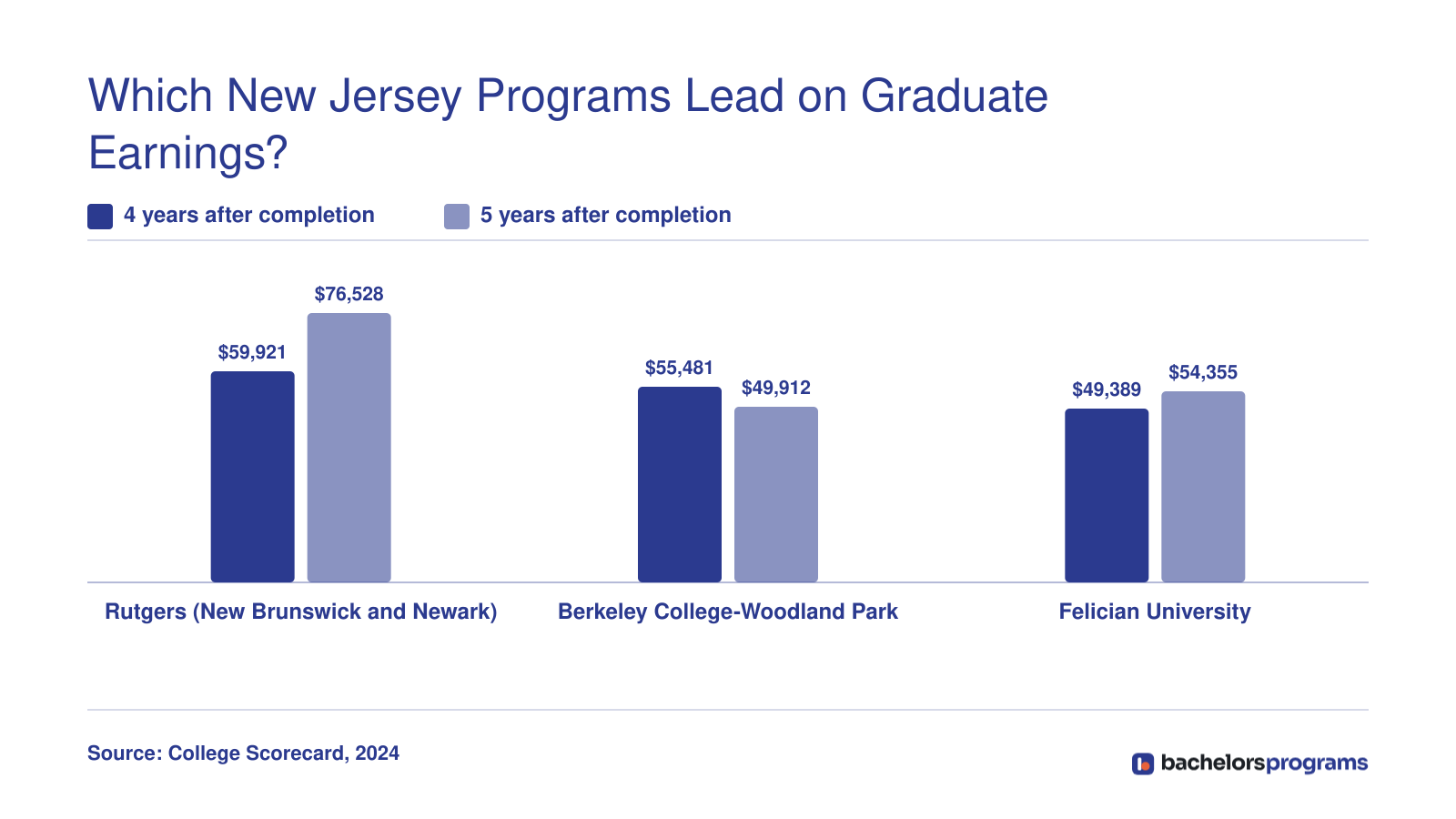
Rutgers health administration graduates earn a median $76,528 five years after completion and $59,921 after four years, a figure the federal data reports for both the New Brunswick and Newark campuses. Berkeley College-Woodland Park follows at $55,481 four years out and $49,912 at five years, and Felician University posts $49,389 at four years and $54,355 at five. These are medians for each school's healthcare administration bachelor's completers, not campus-wide pay, and they say nothing about what any individual graduate will earn.
New Jersey Nursing Home Administrator Licensure at a Glance
Frequently Asked Questions
These answers cover the questions prospective students ask most about studying healthcare administration at a bachelor's level in New Jersey. Policies change, so confirm details with each school's admissions office before you apply.
Are New Jersey healthcare administration programs accredited?
How long does it take to earn a bachelor's in healthcare administration in New Jersey?
Can I transfer county college credits into a New Jersey healthcare administration bachelor's program?
Can international students enroll in New Jersey healthcare administration bachelor's programs?
Can I study healthcare administration part-time or in the evening?
Compare Healthcare Administration programs on the data that matters
Explore more Business & Management majors or browse every field of study.
All Business & Management programs Browse every field of study