Best Healthcare Administration Schools in Virginia
Compare 24 accredited Healthcare Administration programs in Virginia at 18 colleges, with net price after aid, graduation rates, earnings and debt from IPEDS and the U.S. College Scorecard.

Hospitals increasingly want managers who can read cost and quality data, not just run a unit, and bachelor's programs have followed. For Virginia health systems, the usual entry credential is a Bachelor of Science in Healthcare Administration.
Every school ranked here is a Virginia school, on campus or online. Published in-state tuition runs from $9,450 at University of Management and Technology to $36,950 at Shenandoah University. Cost, earnings, admissions and career outcomes are scored on one method, and the aid details are Virginia-specific.
Licensure is the hard limit: leading a nursing home requires a state license that no degree confers on its own.
Key Points
- James Madison University ranks first with an AUPHA-accredited health services degree.
- Lowest net price after aid: Bryant & Stratton College-Virginia Beach, $12,038.
- A state board licenses Virginia nursing home and assisted living administrators.
Best Bachelor's in Healthcare Administration Schools in Virginia, Ranked
James Madison University takes the top spot for a bachelor's degree in healthcare administration in Virginia, pairing an AUPHA-accredited B.S. in Health Services Administration with an internship, a senior capstone, and the lowest in-state tuition of the top three. George Mason and Virginia Commonwealth follow, and between them they cover the state's two biggest advantages: a Northern Virginia campus with fully online options and a Richmond program anchored on the MCV medical campus. Each card below gives the credential, the city, the format, tuition, the approximate average net price after aid, and the institution-wide graduation rate.
James Madison University
#1Harrisonburg, VA · ~$23,000/yr (est.)
Best for: Traditional-age students wanting a full campus experience
James Madison University in Harrisonburg runs an AUPHA-accredited B.S. in Health Services Administration that pairs business fundamentals with healthcare coursework, then adds an internship in a health organization and a senior capstone. The 120-credit degree is aimed at entry-level managerial roles in hospitals, health systems, managed care, and long-term care. Virginia students pay about $14,250 in tuition, the average net price after aid is roughly $23,322, and the institution-wide graduation rate is 79.7%.
- AUPHA accredited Health Services Administration B.S.
- 120 total credit hours; fall and spring start dates
- Internship in a health organization plus senior capstone required
- Coursework in healthcare finance, quality management, health law, and policy
- Professional development seminar woven through the degree
- Built for entry-level managerial roles in hospitals and managed care
- Prerequisite courses required before upper-level major work
- Admits new first-year and transfer students twice a year
George Mason University
#2Fairfax, VA · $15,000 – $20,000/yr (est.)
Best for: Working adults needing fully online flexibility
George Mason University in Fairfax offers an AUPHA-accredited B.S. in Health Administration with three concentrations, and students can study on campus or fully online from anywhere in Virginia. The university sits in the Northern Virginia healthcare and federal health policy corridor, and an accelerated pathway leads into George Mason's Master of Health Administration. In-state tuition is about $14,220, the average net price after aid is near $17,915, and the institution-wide graduation rate is 67.8%.
- AUPHA accredited; offered online and on campus
- Health Systems Management concentration
- Internship course in the final semester
- Accelerated pathway to a Master of Health Administration
- Prepares for entry-level management in clinics and physician practices
- Curriculum covers healthcare systems, community health, and management
- Supervised senior housing internship during the final 15 credits
- Two aging-focused electives required
- Background check required before the internship
- Coursework covers finance, law, ethics, and human resources
- Connects students with industry leaders in senior housing
- Prepares for entry-level assisted living and senior housing roles
- AUPHA accredited, 100% online
- Health Informatics concentration
- 120 total credit hours; full-time and part-time options
- SAT or ACT scores required for admission
- Taught by practitioner faculty from the field
- Prepares for roles in health IT organizations
Virginia Commonwealth University
#3Richmond, VA · ~$23,000/yr (est.)
Best for: Richmond-area students blending classroom and online
Virginia Commonwealth University in Richmond teaches its B.S. in Health Services on the MCV campus, next to one of the state's largest academic medical centers, and lets students complete the final two years entirely online. Coursework covers U.S. health care delivery, health disparities, leadership and change management, and evidence-based practice, with open and restricted electives that shape a focus area. In-state tuition is about $16,945, the average net price after aid is near $23,433, and the institution-wide graduation rate is 63.2%.
- In-person classes on the MCV campus in Richmond
- Complete the whole degree in person or the last two years online
- Courses offered in person or asynchronously online
- Open and restricted electives let students shape a focus area
- Covers U.S. health care delivery, health disparities, and change management
- Evidence-based practice emphasized throughout
- Prepares for hospitals, clinical departments, and practice groups
Liberty University
#4Lynchburg, VA · ~$29,000/yr (est.)
Liberty University in Lynchburg awards its healthcare management credential as a B.S. in Business Administration and Data Analysis with a Healthcare Management cognate, available residentially and online. The ACBSP-accredited School of Business lets students transfer up to 75% of the degree and positions the program as a stepping stone to an MBA or an M.S. in Healthcare Administration. Tuition runs about $15,297, the average net price after aid is near $29,357, and the institution-wide graduation rate is 65.3%.
- B.S. in Business Administration and Data Analysis with a Healthcare Management cognate
- ACBSP accredited School of Business
- 120 credit hours; the same degree is offered online
- Transfer up to 75% of the degree total
- Coursework in healthcare law and ethics, informatics, and grantsmanship
- Stepping stone to an MBA or an M.S. in Healthcare Administration
- Career paths include healthcare administrator and HR manager
Shenandoah University
#5Winchester, VA · $30,000/yr (est. net price)
Shenandoah University in Winchester awards a BBA with a concentration in Healthcare Management, combining a business core with biological sciences so students also pick up a biology minor. The AACSB-accredited School of Business keeps the program small and offers a 4+1 fast track to an MBA, with internship support from Career Development. Tuition is about $35,460, the average net price after aid is roughly $30,298, and the institution-wide graduation rate is 66.8%.
- BBA with a concentration in Healthcare Management
- AACSB accredited School of Business
- Blends biological sciences with a business core; biology minor included
- Rolling admissions, so students can apply year round
- Small program with individual attention from faculty
- 4+1 fast track option to an MBA
- Internship support through Career Development
Regent University
#6Virginia Beach, VA · ~$20,000/yr (est.)
Regent University in Virginia Beach delivers its healthcare management degrees entirely online, with full-time and part-time pacing and eight-week courses. Students can choose the general B.S. in Healthcare Management or a B.S. in Professional Studies route that accepts prior college and military credit. Tuition is about $19,950, the average net price after aid is near $19,923, and the institution-wide graduation rate is 56.9%.
- Delivered fully online in eight-week courses
- Full-time and part-time study options
- Coursework covers operations, informatics, marketing, accounting, and law
- Emphasis on healthcare legislation, informed consent, and patients' rights
- Scholarships, federal aid, and military benefits accepted
- $415 per credit
- 120 total credit hours in an online eight-week format
- Apply existing college and military credit toward the degree
- Military benefits accepted
- Online and on-campus formats available
- Careers in healthcare administration and healthcare management
- Prepares students to pursue nursing home administrator licensure
- 120 total credit hours, fully online
- Christian principles anchor the curriculum
- Faculty hold terminal degrees in their field
- Career paths: nursing home administrator and healthcare supervisor
Radford University
#7Radford, VA · $15,000/yr (est. net price)
Radford University runs a hybrid B.S. in Healthcare Administration whose major classes can all be taken online, with on-campus experiences at Radford University Carilion in Roanoke. Instructors come from Carilion Clinic and other health systems, and students pick a learning track along with a specialized internship in their chosen area. In-state tuition is about $8,528, the average net price after aid is near $14,578, and the institution-wide graduation rate is 48.7%. Radford has also announced plans for a Center for Rural Health focused on Southwest and Southern Virginia.
- Hybrid format; all major classes can be taken online
- On-campus experiences at Radford University Carilion in Roanoke
- Instructors drawn from Carilion Clinic and other health systems
- Learning tracks in long-term care and medical practice management
- Specialized internship in the student's chosen area
- Express path into the M.H.A. program
- Member of AUPHA
Old Dominion University
#8Norfolk, VA · $13,000 – $34,000/yr (est.)
Old Dominion University in Norfolk offers health services administration three ways: an on-campus B.S. in Public Health with a major in the field, a fully online AUPHA-certified degree, and a professional track for licensed clinicians. The 2024 merger with Eastern Virginia Medical School deepened ODU's ties to Hampton Roads clinical and public health organizations. In-state tuition is about $7,800, the average net price after aid is near $14,638, and the institution-wide graduation rate is 46.3%.
- B.S. in Public Health with a major in Health Services Administration
- Earn a minor in management alongside the major
- Coursework in health care finance, epidemiology, and health policy
- Rolling admissions; 2.0 GPA minimum for current ODU students
- Prepares students for medical and health services manager roles
- Reduced per-credit rate for active-duty military
- AUPHA certified; asynchronous online classes
- $443 per credit; 120 total credit hours
- Start in fall, spring, or summer
- Transfer up to 90 credits
- Internship included in the program
- Up to $3,000 Monarch Rise Scholarship available
- Joint program with Norfolk State University
- Military tuition discount available
- Built for practicing health professionals with current clinical licensure
- Work experience required for admission
- Rolling admissions; 2.0 GPA minimum
- Earn a minor in management
- Integrates finance, research, epidemiology, and policy
- Prepares for leadership in public, private, and military healthcare
University of Management and Technology
#9Arlington, VA · $5,000 – $10,000/yr (est.)
The University of Management and Technology in Arlington offers a Bachelor of Health Administration entirely online, built around a 27-credit health administration core inside a 120-credit degree. A capstone in health politics and policy ties the coursework together, and electives let students tailor the degree toward their own interests. Tuition is about $9,360, and the institution-wide graduation rate is 33.3%.
- 120 credit hours with a 27-credit health administration core
- Capstone in health politics and policy
- Coursework in healthcare law and ethics, epidemiology, and long-term care
- Offered online
- Electives fill the remaining credit hours
- Statistics and health information search skills built into the core
American National University
#10Salem, VA · ~$18,000/yr (est.)
American National University in Salem offers a bachelor's in Medical and Health Services Management built for people who already hold an allied health associate degree. The online program mixes synchronous video sessions with asynchronous coursework and runs 180 credit hours including transfer credit, with classes in healthcare law, ethics, policy, economics, and revenue management. Tuition is about $10,716, and the institution-wide graduation rate is 33.3%.
- 180 credit hours including transfer credit from an allied health associate degree
- Online with synchronous video and asynchronous coursework
- Courses in healthcare law, ethics, policy, and economics
- Healthcare Data Analytics and Revenue Management courses
- Quality improvement, project management, and budgeting skills
- All courses carry 4 credit hours
Cost & outcomes by school
Federal data for the highest-earning Healthcare Administration programs, independent of the ranking above. Earnings are this field's bachelor's graduates four years after completing where the Scorecard reports them, else the school's undergraduate median.
| School | Net price / yr | Grad rate | Earnings | Debt | Grads/yr | Format |
|---|---|---|---|---|---|---|
| James Madison University VA | $23,322 | 80% | $77,393 | $19,500 | 63 | Campus |
| George Mason University VA | $17,915 | 68% | $76,343 | $19,500 | — | Online |
| University of Management and Technology VA | — | 33% | $68,530 | — | 4 | Online |
| Liberty University VA | $29,357 | 65% | $58,969 | $29,164 | 71 | Hybrid |
| Mary Baldwin University VA | $12,756 | 39% | $58,714 | $26,586 | 8 | Online |
| Shenandoah University VA | $30,298 | 67% | $58,433 | $25,000 | — | Campus |
| Virginia Commonwealth University VA | $23,433 | 63% | $58,128 | $21,500 | 63 | Hybrid |
| Roanoke College VA | $24,503 | 67% | $58,047 | $27,000 | — | Campus |
| Old Dominion University VA | $14,638 | 46% | $54,914 | $24,000 | — | Campus |
| ECPI University VA | $22,965 | 43% | $51,316 | $37,557 | 76 | Online |
| Radford University VA | $14,578 | 49% | $51,144 | $26,075 | 15 | Hybrid |
| Emory & Henry University VA | $19,061 | 56% | $47,385 | $26,332 | — | Online |
Sources: U.S. Department of Education. Net price, graduation rate, earnings and debt: College Scorecard (earnings and debt for this field's bachelor's graduates where reported, else school-wide); graduates: IPEDS. A dash means no figure is reported.
Cost, debt & payoff
Median earnings of this field's bachelor's graduates (4 yrs after completing, else the school's undergraduate median) vs. their median federal loan debt · U.S. College Scorecard
Across these programs the median graduate earns about $54,914 and finishes with roughly $24,534 in debt — a ratio that clears a common rule of thumb (keep debt below first-year salary). Net price and debt vary widely school to school, so check the per-school figures in the table above before you shortlist.
Most Affordable Healthcare Administration Bachelor's Schools in Virginia
Sorted by average net price after aid, Bryant & Stratton College-Virginia Beach ($12,038) and Mary Baldwin University ($12,756) come in lowest, even though their published tuition and fees ($18,489 and $34,152) run well above the in-state rates at public Radford University, Old Dominion University and Norfolk State University. The public schools charge Virginia residents $10,180 to $12,750 in tuition and fees, yet their net prices land between $14,578 and $15,282, which shows how institutional aid at private schools can offset much of a higher sticker price. Net price is a federal average for full-time students who receive aid, reported separately for public and private schools in 2024 IPEDS and College Scorecard data, so treat it as a benchmark for comparison rather than a quote for your own bill.
| School | Program | In-State Tuition & Fees | Avg. Net Price After Aid | Format | School Type |
|---|---|---|---|---|---|
| Bryant & Stratton College-Virginia Beach | Health Services Administration | $18,489 | $12,038 | Online | Private |
| Mary Baldwin University | Healthcare Administration | $34,152 | $12,756 | Online | Private |
| Radford University | Healthcare Administration | $12,548 | $14,578 | Hybrid (major courses online) | Public |
| Old Dominion University | Health Services Administration | $12,750 | $14,638 | On campus | Public |
| Norfolk State University | Bachelor of Science in Health Services Management | $10,180 | $15,282 | Online | Public (HBCU) |
Related Articles
Online and Hybrid Bachelor's Options at Virginia Schools
Choosing a format means weighing flexibility against access. Online study fits around a job, while campus study puts you near hospitals, internship sites and classmates who become your first professional network.
How Virginia Schools Deliver the Degree
- Fully online: Regent University offers its B.S. in Healthcare Management exclusively online, with full-time and part-time options. University of Management and Technology and American National University also deliver online, and George Mason University's Health Administration B.S. is 100% online.
- Hybrid: Radford University runs major classes 100% online. Virginia Commonwealth University lets students finish the final two years fully online. Liberty University's healthcare management track has a fully online option.
- Campus-based: James Madison University, Shenandoah University and Old Dominion University teach on campus.
American National University's program works as a degree-completion track. It requires an allied health associate degree and mixes live video with self-paced coursework. Liberty accepts transfer credit for up to 75% of the degree.
Who Each Format Serves
Online and hybrid programs suit working adults already employed in clinics or billing offices, plus transfer students who want to finish without relocating. Campus programs make more sense if you want face-to-face access to internship sites, faculty mentors and local recruiters, since many first jobs in this field come through placements.
Accreditation Signals to Check
Start with institutional accreditation from a recognized regional accreditor, which affects financial aid and credit transfer. Next, look for ties to the Association of University Programs in Health Administration (AUPHA): James Madison and George Mason cite AUPHA on their program pages, and Radford lists AUPHA membership. CAHME accreditation applies to graduate programs, so don't expect it on a bachelor's degree.
Questions to Ask Yourself
Would you rather pay in-state public tuition or take on a higher private sticker price for a smaller class size?
Do you need an online or degree-completion format to keep working while you study?
Are you aiming for nursing home administrator licensure in Virginia?
How much transfer credit will your previous coursework actually cover?
Admission Requirements: GPA, Test Policy, and Transfer Credit
Three things decide admission to a Virginia healthcare administration program: a minimum GPA, a test policy, and how many transfer credits the school will accept. Published details vary a lot, and several schools state nothing on some items. Confirm everything on the school's admissions page before you apply.
GPA and Test Policy
- Radford University: 2.5 cumulative GPA required, 2.8 preferred. Recent high school graduates should submit SAT or ACT scores, and no test-optional policy is stated.
- George Mason University: Transfer applicants need a 2.5 GPA and 24 earned college credits. SAT or ACT is required unless you qualify for Mason's score-optional process.
- Old Dominion University: 2.0 GPA before declaring the major. SAT or ACT is optional for traditional first-year applicants. Admission is rolling.
- Liberty University: 2.0 GPA for admission in good standing. No standardized test is required.
- Emory & Henry University: 2.0 GPA for transfer students. It publishes no SAT, ACT or test-optional policy.
- Virginia Commonwealth University: No minimum GPA or test policy was found for the health services pathway.
For James Madison University, Shenandoah University, Regent University and University of Management and Technology, we did not confirm a published GPA or test policy. American National University lists an allied health associate degree as a requirement for its program.
Transfer Credit and Deadlines
Old Dominion accepts up to 90 transfer credits, but you must complete at least 30 there toward the 120 needed to graduate. Some health-field tracks also ask for 12 prerequisite credit hours before you apply to the major. Liberty advertises transfer of up to 75 percent of the degree total. Emory & Henry asks for an A.S. or A.A., or at least 36 transferable credits with grades of C or better, and applicants who fall short can appeal to the provost.
Radford, George Mason, Emory & Henry, Liberty and Virginia Commonwealth publish no maximum transfer limit or 2026 deadline that we could find. Treat those as open questions to ask an admissions office.
Practical Takeaway for Transfer Students
If you are starting at a community college, finish an associate degree first. Radford supports a 2+2 pathway, and Emory & Henry's A.S. or A.A. route gets you in without counting credits. Ask each school for a written course-by-course credit evaluation before you commit.
Cost of a Bachelor's Degree in Healthcare Administration in Virginia
Sticker price and net price are two different numbers at Virginia's healthcare administration programs. Public universities charge Virginia residents less than half what they charge everyone else, but once grant aid is counted, the average net price at these schools still lands above the in-state rate.
What the Ranked Schools Publish
At Radford University, in-state tuition is $12,548 against $25,633 for out-of-state students, with an average net price near $14,578. Old Dominion University follows the same pattern: $12,750 in-state, $33,780 out-of-state, about $14,638 net. George Mason University publishes $14,220 and $38,688, with a net price around $17,915. Private options quote one rate for everyone, but their aid often closes the gap. Regent University lists $21,650 with a net price near $19,923, and American National University lists $10,961 with a net near $18,036. Among the ranked schools that report it, net price clusters between roughly $14,500 and $20,000.
Aid That Cuts the Bill
The federal Pell Grant tops out at $7,395 for 2026-27, and the actual award depends on your Student Aid Index, the school's cost of attendance, your enrollment status, program length, and remaining lifetime eligibility.1 Pell is for undergraduates without a prior bachelor's degree.2 Virginia's Commonwealth Award covers remaining need up to tuition and required fees and scales with that need.3 The state also funds the Virginia Tuition Assistance Grant for residents at private colleges and a set of state scholarships with rules that differ by program, and the General Assembly set aside $65 million in need-based aid for 2026-28.4 Pell participation runs high at several of these schools: about 74% of Regent undergraduates, 64% at Old Dominion, and 54% at Radford.
One Move That Pays
File the FAFSA as soon as it opens, then confirm each Virginia school's state-grant deadline separately, since some aid is awarded until funds run out.
Healthcare Administration Salary in Virginia by Metro Area
Statewide Wages and Employment
The clearest federal wage data for this field is at the state level. In its May 2023 Occupational Employment and Wage Statistics release, the Bureau of Labor Statistics counted about 9,380 medical and health services managers working in Virginia and put their median hourly wage at $58.47.1 Treat that as a broad reference point, not a starting offer. It covers managers at every career stage, from clinic supervisors to hospital executives.
That is why it differs from the graduate earnings shown in the ranking above. Those figures track what a school's own bachelor's graduates earned in their first years after finishing. The BLS number describes everyone who holds the job title. Many new graduates start in coordinator, analyst or practice-support roles and move into management after gaining experience.
How Metro Areas Compare
The data behind this ranking reports no metro-level medians for Northern Virginia, Richmond, Hampton Roads, Roanoke or Charlottesville. If you look them up on the BLS site, keep two geographic quirks in mind:
- Washington-Arlington-Alexandria: This area also includes D.C., Maryland and West Virginia, so its figures blend wages from several jurisdictions.
- Virginia Beach-Chesapeake-Norfolk: This area extends into North Carolina.
In general, larger metros with major health systems tend to pay more than smaller markets, though housing and living costs usually rise with them.
Job Outlook
Demand for healthcare managers is shaped by an aging population, the growth of outpatient and home-based care, and the administrative work that comes with billing, compliance and health data. Check the BLS Occupational Outlook Handbook for the latest projection before you commit, and weigh it alongside openings at the health systems near where you plan to live.
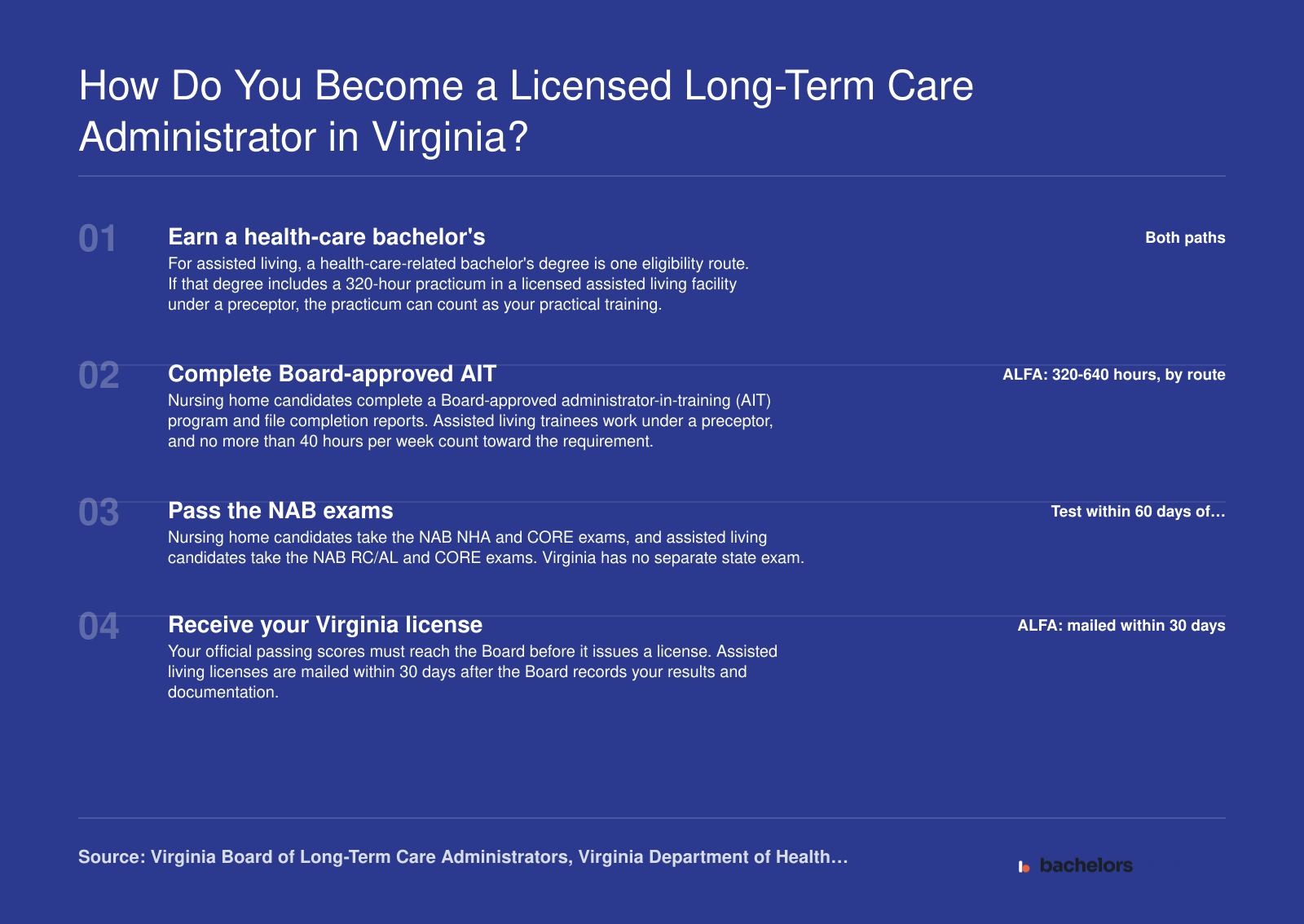
How Do You Become a Licensed Long-Term Care Administrator in Virginia?
Virginia licenses nursing home administrators (NHA) and assisted living facility administrators (ALFA) through the Board of Long-Term Care Administrators. Both paths include supervised training and national exams, but the training rules differ.
Healthcare Administration Programs in Virginia: Common Questions
These answers draw on the program, admissions, cost and licensure details covered above. Policies, prices and start dates can change, so confirm specifics with each school or licensing board before you apply.
Which Virginia schools offer an online bachelor's degree in healthcare administration?
Do you need a license to work in healthcare administration in Virginia?
Is a bachelor's degree in healthcare administration worth it in Virginia?
Can I transfer community college credits into a Virginia bachelor's in healthcare administration?
Compare Healthcare Administration programs on the data that matters
Explore more Business & Management majors or browse every field of study.
All Business & Management programs Browse every field of study