Best Healthcare Administration Schools in West Virginia
Compare 7 accredited Healthcare Administration programs in West Virginia, with net price after aid, graduation rates, earnings and debt from IPEDS and the U.S. College Scorecard.

Published annual tuition for a bachelor's degree in healthcare administration in West Virginia runs from $8,400 to $33,800. The common credential is the Bachelor of Science (B.S.) in Healthcare Administration, though schools also label it health services administration, healthcare management, or a business degree with a healthcare concentration.
Students can attend on campus in Morgantown, Fairmont or Bluefield, in a hybrid format, or fully online. Programs differ on accreditation and on how directly they feed the state's hospitals, clinics and long-term care facilities.
A bachelor's qualifies you for entry-level administrative work. Senior management, and nursing home administration in particular, add experience and licensing requirements.
Key Points
- Annual tuition runs from $8,400 (APUS) to $33,800 (University of Charleston).
- West Virginia University graduates earned a $39,229 median one year out.
- West Virginia nursing home administrators need a bachelor's plus 1,000 experience hours.
Best Bachelor's in Healthcare Administration Schools in West Virginia
Seven West Virginia institutions award a bachelor's degree in healthcare administration or a closely related field, and they range from the flagship research university in Morgantown to small private colleges built around working adults. Each entry below notes the credential the school actually confers, how the program is delivered, and the details that set it apart from the next school on the list.
American Public University System
#1Charles Town, WV · $5,000 – $10,000/yr (est.)
Best for: Military-affiliated adults studying online
American Public University System is an online institution based in Charles Town whose Bachelor of Science in Healthcare Administration blends business, public health, and health information management. Courses run in 8- to 16-week terms with monthly starts, and students can transfer up to 90 credits, a structure built for adults who already have college coursework behind them. Concentrations include Emergency Management, Leadership, and Mental Healthcare Facility Management.
- $360 per credit for 120 total credit hours
- Transfer up to 90 credits
- 12 start dates per year
- 5 concentration options, including Emergency Management and Leadership
- Courses run 8 to 16 weeks
- Senior seminar capstone
- $0 application fee; military benefits accepted
West Virginia University
#2Morgantown, WV · ~$16,000/yr (est.)
Best for: Future graduate students in health administration
West Virginia University is the state's flagship public research university, and its health services administration major sits inside the School of Public Health. Students complete 120 credit hours, a 6-credit internship, and a capstone, and the program is designed to lead both to immediate administrative roles and to graduate study in health administration or public health. An accelerated pathway lets strong students begin master's-level coursework during the senior year.
- 120 total credit hours, including a 6-credit health management internship
- 3.0 GPA required overall and in major coursework
- 2-credit capstone plus required field experience
- Accelerated BS to MHA pathway for students with a 3.5 GPA
- Coursework in health data management, policy, and quality improvement
- Program aims for AUPHA certification
- Prepares for Master of Public Health and Master of Health Administration study
Valley College-Martinsburg
#3Martinsburg, WV · ~$26,000/yr (est.)
Best for: Medical office staff moving into management
Valley College in Martinsburg is a small private institution whose online bachelor's in health services administration aims at medical office and clinic management rather than executive hospital tracks. The roughly 34-month program covers finance, human resources, compliance, and health IT, and the college is an approved National Healthcareer Association testing site. Online success coaches and job placement assistance round out the support.
- Fully online, roughly 34 months to finish
- Approved National Healthcareer Association testing site
- Prepares students for Certified Medical Manager (CMM) certification
- Coursework in healthcare finance, human resources, compliance, and health IT
- Online success coaches and job placement assistance
- Financial aid available for students who qualify
Fairmont State University
#4Fairmont, WV · ~$9,000/yr (est.)
Fairmont State University is a public regional university in north-central West Virginia whose healthcare management program runs in a hybrid format built for working professionals. Four concentrations let students shape the degree around health information technology, marketing, nonprofit agency management, or wellness leadership. A 4+1 pathway lets business students begin graduate coursework during the senior year.
- Four concentrations including Health Information Technology and Healthcare Marketing
- Also offers Nonprofit Agency Management and Wellness Leadership tracks
- Hybrid format that balances in-person and online coursework
- 4+1 pathway lets business students begin graduate work as seniors
- Minor in Healthcare Management available
- Coursework in management, finance, problem-solving, and interpersonal skills
Bluefield State University
#5Bluefield, WV · $11,000 – $18,000/yr (est.)
Bluefield State University is a small public institution in southern West Virginia offering a Bachelor of Science in Health Services Management built on a business core plus a healthcare-specific core. The structure suits allied health practitioners who already work in clinics or hospitals and want to move into management. Students must earn at least a C in every business and health services management course.
- 120 total credit hours
- 30-credit business core plus a 33-credit health services management core
- C or better required in every business and major course
- Open to employed allied health practitioners advancing into management
- Prepares students for master's study in health care administration
University of Charleston
#6Charleston, WV · $20,000 – $25,000/yr (est.)
The University of Charleston is a private university in the state capital that offers its healthcare administration and management bachelor's both in seat and online. The four-year program pairs health science with business fundamentals and includes internship experience, with direct entry available to eligible freshmen and transfer students. Graduates move into hospital administration, practice management, and human resources roles.
- In-seat in Charleston or fully online
- Full-time and part-time enrollment
- Four-year program with real-world internships
- Direct entry for eligible freshmen and transfer students
- Business and health science curriculum
- Roles include hospital administrator, practice manager, human resource manager
Salem University
#7Salem, WV · ~$12,000/yr (est.)
Salem University is a small private institution offering healthcare management as a concentration within its Bachelor of Science in Business Administration. The program runs on a one-course-a-month schedule with rolling monthly starts, and most full-time students finish in about 40 months. Business foundations in accounting, finance, marketing, and law are paired with healthcare regulation and economics coursework.
- ACBSP accredited business program
- One-course-a-month schedule
- About 40 months for most full-time students
- Rolling monthly admissions and starts
- Online or on-campus enrollment
- Senior capstone applying learning to real-world challenges
- Concentration covers healthcare law, regulations, economics, and finance
Cost & outcomes by school
Federal data for the highest-earning Healthcare Administration programs, independent of the ranking above. Earnings are this field's bachelor's graduates four years after completing where the Scorecard reports them, else the school's undergraduate median.
| School | Net price / yr | Grad rate | Earnings | Debt | Grads/yr | Format |
|---|---|---|---|---|---|---|
| Fairmont State University WV | $9,032 | 44% | $56,376 | $21,000 | 9 | Hybrid |
| West Virginia University WV | $15,634 | 65% | $55,939 | $26,000 | 25 | Campus |
| University of Charleston WV | $22,107 | 46% | $55,774 | $19,500 | — | Online |
| American Public University System WV | $9,597 | 57% | $44,409 | $21,743 | 142 | Online |
| Bluefield State University WV | $13,684 | 37% | $38,217 | $18,250 | 5 | Campus |
| Salem University WV | $12,303 | 20% | $34,642 | $24,694 | — | Online |
| Valley College-Martinsburg WV | $25,751 | 66% | $24,900 | $9,500 | 19 | Online |
Sources: U.S. Department of Education. Net price, graduation rate, earnings and debt: College Scorecard (earnings and debt for this field's bachelor's graduates where reported, else school-wide); graduates: IPEDS. A dash means no figure is reported.
Cost, debt & payoff
Median earnings of this field's bachelor's graduates (4 yrs after completing, else the school's undergraduate median) vs. their median federal loan debt · U.S. College Scorecard
Across these programs the median graduate earns about $44,409 and finishes with roughly $21,000 in debt — a ratio that clears a common rule of thumb (keep debt below first-year salary). Net price and debt vary widely school to school, so check the per-school figures in the table above before you shortlist.
How We Ranked West Virginia Healthcare Administration Schools
What actually separates one West Virginia healthcare administration bachelor's program from another?
Each school is judged on what shapes what you pay and what you earn afterward: College Scorecard outcomes, published tuition and net price after aid, delivery format, and program-level earnings and debt where a school reports them. A program that can be finished online without relocating looks different from one that requires weekday labs on campus, and the ranking reflects that.
Two numbers that are school-wide, not program-wide
Both figures cover every undergraduate at the school, not just the healthcare administration major. Read them as statements about the school offering the program, not as a forecast for your own four years. Program-level earnings and debt carry more weight where they exist.
What is included
Every entry is a bachelor's program at a West Virginia school, whether taught on campus, fully online, or in a hybrid mix. Graduate degrees are out of scope.
Treat rank as a starting point. Weigh format against your work and family schedule, and confirm the accreditation your target employer or licensure path expects before you commit.
Online and Hybrid Healthcare Administration Options at West Virginia Schools
The choice between a fully online program and a campus-based one in West Virginia usually comes down to how much structure you want versus how much flexibility you need. A working adult with a full-time job will weigh start dates and part-time pacing; a recent high school graduate may want the internship and peer network that come with being on campus. Delivery format is the first filter.
Fully Online: Frequent Starts, Flexible Pacing
American Public University System lists its Bachelor of Science in Healthcare Administration as online, with 12 start dates a year and courses running 8 to 16 weeks. Salem University's online business administration degree with a healthcare management concentration uses a one-course-a-month schedule, rolling admissions and a 40-month timeline. Valley College-Martinsburg runs its health services administration program fully online over 34 months. The University of Charleston offers its healthcare administration and management degree in Charleston or completely online, full-time or part-time; the standard timeline is four years, with an accelerated finish in three to three-and-a-half years. The program pages do not establish a separate residency requirement for online students, though the course sequence may differ slightly.
Hybrid and In-Seat: More Structure, Less Scheduling Freedom
Fairmont State University lists its healthcare management program as hybrid. West Virginia University's health services administration program is campus-based and includes a required field experience and a capstone; it also lists an accelerated BS-to-MHA pathway. Bluefield State University's health services management program is campus-based. For Fairmont State, WVU and Bluefield State, the sources reviewed do not spell out part-time availability, residency requirements or accelerated bachelor's options, so confirm those details with an admissions office before applying.
Which Format Fits
- Working adults: online programs with frequent starts and part-time pacing fit around a job.
- Recent high school graduates: campus or hybrid formats offer more structure and in-person contact.
- Career changers in a hurry: the University of Charleston's accelerated option shortens the timeline, but requires a heavier course load.
Related Articles
Admission Requirements for West Virginia Healthcare Administration Bachelor's Programs
Applying as a first-time freshman and applying as a transfer student are two different processes, and in West Virginia most of the published detail covers the transfer side. A student coming straight from high school is read against general university standards; a student arriving with college credit is read against a grade point average and a credit count.
What West Virginia University Publishes
WVU, home to the Health Services Administration, B.S., does not publish a universal minimum high school grade point average for first-time freshmen, and some majors are more competitive than others, carrying their own grade or score expectations. Freshman admission is test optional. The university still encourages applicants to send SAT or ACT scores under a no-harm approach: scores are considered only when they work in the applicant's favor, including for automatically awarded merit scholarships.
Transfer Rules at West Virginia University
Transfer policy is the most concrete piece on the page. Applicants with at least 24 transferable credits need a 2.0 grade point average across all college coursework attempted. Anyone arriving with fewer than 24 credits must also satisfy freshman admission standards, though they may still apply test optional. Credit is evaluated after a student is admitted and all final official transcripts are in hand. Every accepted college-level credit and grade counts toward the cumulative grade point average and attempted hours, and the academic department decides which of those credits actually satisfy degree requirements once the student enrolls. Individual majors may set a higher bar than 2.0.
Where to Ask Directly
American Public University System, Valley College-Martinsburg, Fairmont State University, Bluefield State University, University of Charleston and Salem University do not have comparable admissions detail confirmed here, so treat their grade, testing and transfer-credit rules as something to verify with the admissions office before you build an application plan.
Four Practical Takeaways
- Test scores: WVU freshman admission does not require them, and sending them cannot hurt you.
- Community college path: Reach 24 transferable credits with a 2.0 average and WVU's freshman standards fall away.
- Timing: Expect a credit evaluation after admission, not before.
- Verify: Call each admissions office for anything you cannot find in writing.
Accreditation and Program Quality: AUPHA, CAHME, CEPH and Regional
A specialty badge looks impressive, but the accreditation that affects your financial aid and your transcript is the one held by the whole school. Start there, then treat program-level credentials as a bonus.
What each accreditor means for you
Regional accreditation covers the institution. It determines federal financial aid eligibility and whether other colleges accept your credits. AUPHA is the main association for undergraduate healthcare management, and full bachelor's members are AUPHA certified. CEPH reviews public health schools and programs. CAHME mainly accredits graduate programs, so it matters little for a bachelor's search.
Where the schools stand
- Fairmont State University: Accredited by the Higher Learning Commission (HLC) for associate, bachelor's, master's and certificate levels. Its B.S. in Healthcare Management is also accredited by the Accreditation Council for Business Schools and Programs (ACBSP). An AUPHA listing was not established.
- West Virginia University: The School of Public Health is CEPH accredited through December 2027. WVU says it is the only West Virginia AUPHA member, but that membership is tied to its graduate program. Its B.S. in Health Services Management and Leadership is still seeking AUPHA certification. The master's program's CAHME candidacy is not accreditation and does not apply to the bachelor's.
- University of Charleston and the other schools here: A current specialty status was not established for University of Charleston, American Public University System, Valley College-Martinsburg, Bluefield State University or Salem University. Confirm each one directly.
How to verify it yourself
Search the school's accreditation page for its regional accreditor, then confirm it in that accreditor's online directory, such as HLC's. Check AUPHA's program directory for membership and certification. Check CEPH's list of accredited schools and programs. Ask admissions in writing which credential covers your specific bachelor's program.
What a Bachelor's Degree in Healthcare Administration Costs in West Virginia
How much does a healthcare administration bachelor's degree cost in West Virginia? Published annual tuition and fees at the schools ranked here start at $8,400 at American Public University System and reach $33,800 at the University of Charleston. Net price, what students pay on average once grants and scholarships are applied, matters more. It runs from $9,032 at Fairmont State University to $25,751 at Valley College-Martinsburg. Net price is a school-wide average for all undergraduates, not a healthcare administration figure, and it includes housing and books as well as tuition.
Public vs. Private: Sticker Price and Net Price
At public universities, residency drives the bill. In-state tuition and fees are $8,708 at Fairmont State, $10,104 at West Virginia University and $10,648 at Bluefield State University. Out-of-state students pay $18,924, $28,608 and $18,376, respectively. Because net price counts living costs, it can sit above in-state tuition: $9,032 at Fairmont State, $13,684 at Bluefield State and $15,634 at WVU.
Private schools look different. The University of Charleston lists $33,800, but its average net price falls to $22,107, so aid closes much of the gap. American Public University System ($8,400) and Salem University ($11,900) charge one rate regardless of residence, with net prices of $9,597 and $12,303.
West Virginia Aid Programs
The PROMISE Scholarship is the state's merit award. College for West Virginia lists these basics:1
- Apply within two years of high school graduation and enroll full time as a first-year student
- Live in West Virginia for 12 consecutive months before the deadline
- Graduate from a West Virginia public or private high school, earning at least half your credits there
- Hold at least a 3.0 GPA in core and required coursework
- Meet test minimums, such as an ACT composite of 21 (including 19 in English) or an SAT Math score of 510
Renewal requires a 3.0 cumulative GPA, and dual credit counts toward it.1 The WV Higher Education Grant is need-based and draws on your FAFSA. Award amounts and deadlines for both programs change, so confirm current figures with College for West Virginia before budgeting around them.
Ways to Lower Your Cost
- File the FAFSA early: State grants and most school aid start with it.
- Confirm in-state status: At public universities, residency can save thousands per year.
- Use transfer and dual credit: Credits you already hold shorten the degree and the bill.
What Do West Virginia Healthcare Administration Graduates Earn After Finishing?
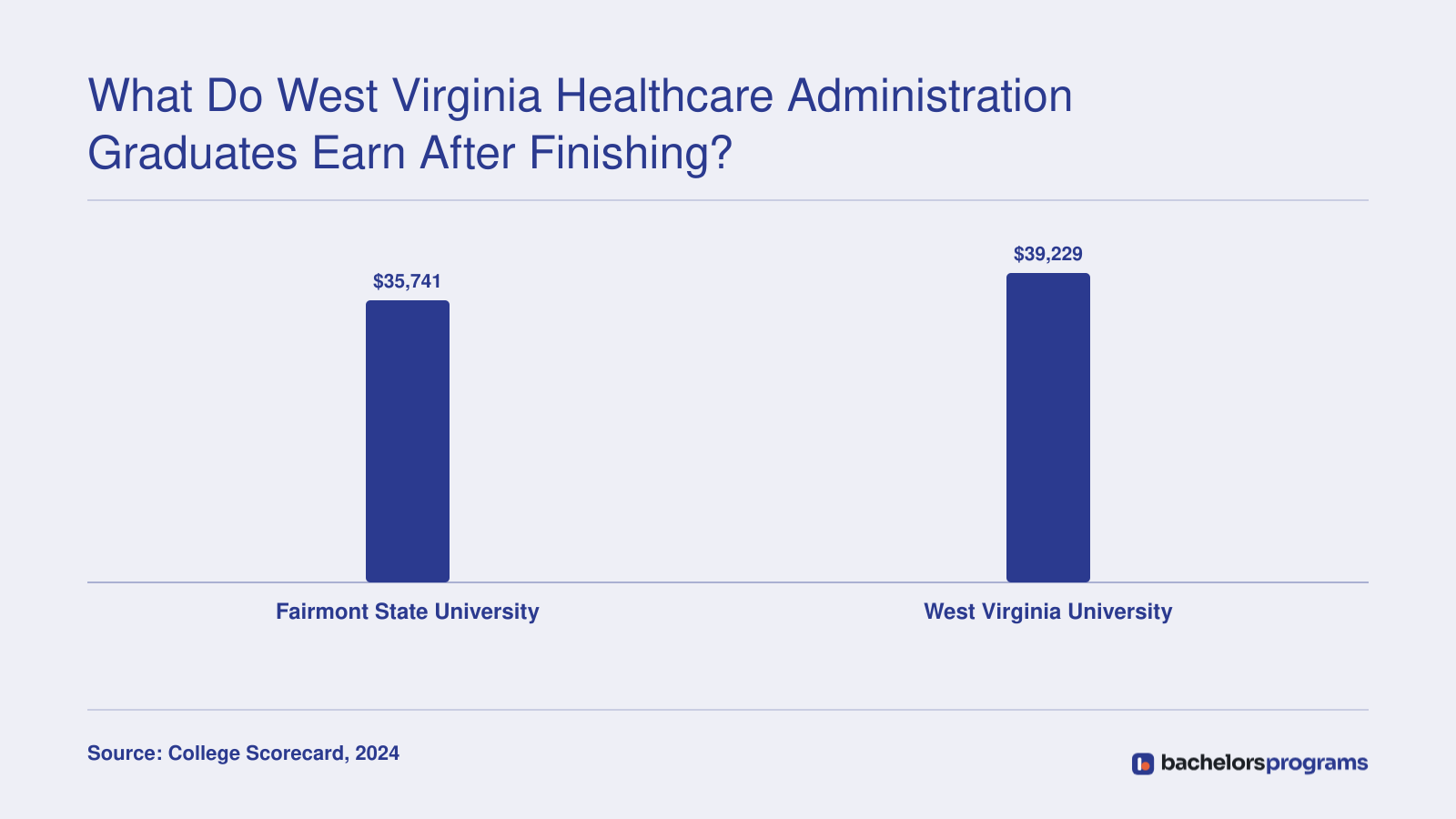
These figures track graduates of each school's healthcare administration bachelor's program, not the university as a whole. One year after completion, West Virginia University graduates earned a median of $39,229, compared with $35,741 at Fairmont State University, whose graduates reached a median of $56,376 four years after completion. The other schools here have no program-level earnings reported yet, and the early gap between these two is small enough that net price, format and fit may matter more than school name.
Healthcare Administration Careers and Salaries in West Virginia
A bachelor's degree gets you into healthcare administration quickly, but the larger management salaries usually come after years on the job. Plan for both stages.
Where Graduates Work
West Virginia's health care and social assistance sector employs more than 138,000 workers, about 20% of statewide jobs and the second-largest industry in the state.1 Graduates typically move into these roles:
- Practice management: physician offices, clinics and outpatient centers.
- Health information: records, coding oversight and compliance support in hospitals.
- Long-term care: administrative positions in nursing and assisted living facilities.
- Hospital administration: department coordination, patient access and operations.
Large employers include WVU Medicine, which reports more than 39,000 employees across 25 hospitals, and Vandalia Health, with 17 hospitals, 220-plus outpatient locations and more than 14,500 employees.2 Their counting methods differ, so compare the figures loosely.
What the Numbers Show
The most recent BLS state data for medical and health services managers (SOC 11-9111) is from May 2022. It counted 1,980 jobs in West Virginia, a mean annual wage of $115,060, and a mean hourly wage of $55.32.3 That is up from 1,460 jobs and $106,940 in May 2017.4 These figures describe the management occupation as a whole. They are not what a new bachelor's graduate should expect to earn.
Takeaways
- Entry versus management: Most new graduates start in coordinator, specialist or assistant roles, and the manager-level wage generally reflects added experience.
- Demand: West Virginia reports about 12,662 annual health care openings against 3,779 qualified graduates, a gap of roughly 8,883 workers a year.5
- Concentration: Management jobs are a small slice of state employment (2.4% in 2022, location quotient 0.90)3, so the largest systems matter for advancement.
- Licensure: Nursing home administrator roles carry a separate state license, covered below.
- Next step: Compare each school's internship and employer ties, since those often lead to first jobs.
West Virginia Nursing Home Administrator Licensure at a Glance
Common Questions About Healthcare Administration Degrees in West Virginia
These answers cover the questions prospective students ask most often. Policies and prices change, so confirm details with each school's admissions and financial aid offices before you apply.
Can you get a bachelor's degree in healthcare administration online in West Virginia?
How much does a healthcare administration degree cost in West Virginia?
Do I need a license to work in healthcare administration in West Virginia?
Can I transfer community college credits into a West Virginia healthcare administration bachelor's program?
Compare Healthcare Administration programs on the data that matters
Explore more Business & Management majors or browse every field of study.
All Business & Management programs Browse every field of study