Best Online Hospitality Management Degree Programs
Compare 50+ accredited online Hospitality Management programs, with net price after aid, graduation rates, earnings and debt from IPEDS and the U.S. College Scorecard.

Front-desk supervisors, banquet captains, and assistant food and beverage managers often work the hours nobody else wants, so the degree that moves them into management has to bend around a rotating schedule.
Delivery is 100% online for every program listed; hybrid formats were excluded. Net price after aid runs from roughly $8,750 to $22,420 a year across the schools listed.
What separates them comes down to cost after aid and online fees, transfer credit for prior coursework and documented work hours, and four-year earnings for graduates. Delivery format is the easy part.
Key Points
- Ohio University-Eastern Campus has the lowest average net price here: $3,925 yearly.
- East Carolina accepts up to 90 transfer credits toward its 120-credit degree.
- Graduates' median federal loan payments range from $159 to $232 monthly.
Best Fully Online Hospitality Management Degree Programs for 2027
Every program below can be finished entirely online, with no in-person or hybrid attendance required at any point. Programs that ask students to come to campus, even occasionally, were left off this list. The order reflects a mix of measures rather than sticker price alone or name recognition alone.
Florida Atlantic University
#1Boca Raton, FL · $4,900 – $17,000/yr (est.)
Best for: Career changers eyeing revenue management roles
Florida Atlantic University runs its hospitality and tourism management bachelor's through the AACSB-accredited College of Business, so online students take the same marketing, finance, accounting and revenue management core as campus business majors. Declaring the major requires a 2.5 GPA in the pre-business foundation courses plus foreign language and civic literacy prerequisites, which keeps the cohort focused. An in-industry internship is required before graduation, so the school has a graduation rate of 63%.
- AACSB-accredited business degree from the College of Business
- 2.5 GPA required in Pre-Business Foundation courses to declare
- FLENT foreign language and Civic Literacy requirements for the major
- Revenue management software training built into the curriculum
- In-industry internship required before graduation
- Applications accepted in any term
- Graduates pursue roles such as guest services or special events manager
Arizona State University
#2Tempe, AZ · ~$15,000/yr (est.)
Best for: Working adults preferring short accelerated terms
Arizona State University delivers tourism, hospitality and event management through the Watts College of Public Service and Community Solutions in 7.5-week online classes, with 40 courses spread across 120 credits and no entrance exam required. Applicants who fall short of direct admission can enter through Earned Admission by completing online courses at a 2.75 GPA. Focus areas include meetings and events, resort and hotel leadership, and sustainable tourism, and the school has a graduation rate of 68%.
- 120 credit hours across 40 courses, each class running 7.5 weeks
- No entrance exam required and test scores are optional
- Earned Admission pathway available with a 2.75 GPA
- Focus areas include meetings and events, resort leadership and sustainable tourism
- Coursework covers hotel operations, event planning and revenue optimization
- Housed in the Watts College of Public Service and Community Solutions
- Full-time and part-time enrollment options
American Public University System
#3Charles Town, WV · $5,000 – $10,000/yr (est.)
Best for: Military students bringing large credit transfers
American Public University System built its hospitality bachelor's for adults who arrive with credits already in hand, accepting up to 90 transfer credits and running 8-week asynchronous courses that start every month. The degree carries ACBSP business accreditation, and tuition is a flat per-credit rate with a lower military rate for active duty, Guard, Reserve and military family members. Students may take up to 10 years to finish, and the school has a graduation rate of 57%.
- Asynchronous classes with 8-week terms starting every month
- Up to 90 transfer credits accepted toward the degree
- ACBSP-accredited business program
- $360 per credit, with a $250 rate for military members and families
- Up to 10 years allowed to finish the degree
- 8- to 10-week internship, or a research paper alternative
- No-cost ebooks and free transfer credit evaluation
University of Nevada-Las Vegas
#4Las Vegas, NV · ~$10,000/yr (est.)
UNLV anchors its hospitality management bachelor's in the William F. Harrah College of Hospitality, and the full degree can be completed online. Students choose from six concentrations, from event design and gaming management to PGA Golf Management, and everyone logs 1,000 hours of hospitality work experience plus 36 upper-division credits in residence. Senior culminating experience courses close out the program, and the school has a graduation rate of 51%.
- Six concentrations, including event design, gaming and beverage management
- PGA Golf Management track requires a handicap of 12 or less
- 1,000 hours of hospitality work experience required
- 36 upper-division hospitality credits must be taken in residence
- Degree can be completed fully online through the Harrah College
- Senior culminating experience courses required for graduation
New Mexico State University
#5Las Cruces, NM · $8,000 – $25,000/yr (est.)
New Mexico State University pairs a 120-credit hotel, restaurant and tourism management degree with 800 hours of real work: 400 hours of hospitality experience and a 400-hour paid internship taken for academic credit. Admission runs without fixed deadlines, which suits working students applying mid-year. The New Mexico Opportunity Scholarship can cover up to 100% of tuition for eligible residents, and the school has a graduation rate of 55%.
- 120 credit hours, including 48 credits at the 300 level or above
- 400 hours of work experience plus a 400-hour paid internship
- No fixed admission deadlines
- Senior electives cover resort management, event planning and revenue
- Opportunity Scholarship can cover up to 100% of tuition for residents
- Marriott Hospitality Futures Center and a student and alumni job board
University of North Carolina at Greensboro
#6Greensboro, NC · $11,000/yr (est. net price)
UNC Greensboro wraps a full business core around hospitality and tourism coursework and offers an unusual Esports Management concentration alongside hotel, event, revenue management and wine electives. Online students earn the same degree as campus students, with dedicated career advising, optional AHLEI certifications and internship pipelines through partners such as Disney and Marriott. An accelerated master's pathway is available, and the school has a graduation rate of 56%.
- Business core paired with hospitality and tourism coursework
- Esports Management concentration for gaming and entertainment careers
- Optional AHLEI certifications alongside the degree
- Internships with partners including Disney and Marriott
- Accelerated master's pathway with no GRE or GMAT required
- Study abroad options and dedicated career advising
East Carolina University
#7Greenville, NC · ~$16,000/yr (est.)
East Carolina University centers its hospitality management bachelor's on a Convention and Special Events Management concentration, with a required internship and coursework in hospitality law, food production and lodging operations. It is one of the largest hospitality programs in North Carolina and leans on industry ties to Disney, ARAMARK, Darden and the Biltmore Estate. Graduates head into convention centers, private clubs and hotel operations, and the school has a graduation rate of 63%.
- Concentration in Convention and Special Events Management
- 120 credit hours with a required event planning internship
- One of the largest hospitality programs in North Carolina
- Industry ties to Disney, ARAMARK, Darden and the Biltmore Estate
- Prepares students for convention center and private club roles
- Degree can be completed fully online
The University of Alabama
#8Tuscaloosa, AL · ~$22,000/yr (est.)
The University of Alabama lets online students choose between a Hotel, Food and Beverage track and a Meetings and Events track, both built on a core of hospitality marketing, law, accounting and industry computer systems. Students finish a pre-approved internship and can prepare for certifications such as MFP, CHIA, CSTEP and Cvent, while strong performers can apply to an Accelerated Master's Program. The school has a graduation rate of 73%.
- Hotel, Food and Beverage track covers lodging and bar management
- Meetings and Events track covers corporate events and convention management
- Certification prep for MFP, CHIA, CSTEP and Cvent
- Pre-approved internship in a hospitality organization required
- Accelerated Master's Program available for high-achieving students
- Entirely online degree completion option
University of North Alabama
#9Florence, AL · $12,000 – $22,000/yr (est.)
The University of North Alabama keeps its hospitality and events management degree practical: 121 to 122 credits, no minor required, two internships and a senior project. Coursework reaches into gaming and casino operations, club management and food and beverage cost control, and past placements include Walt Disney Parks and Resorts, Marriott and Omni. The school has a graduation rate of 55%.
- 121 to 122 credit hours with no minor required
- Two internships plus a hospitality senior project
- Coursework includes gaming and casino operations and club management
- Placements include Walt Disney Parks and Resorts, Marriott and Omni
- Study abroad courses, guest speakers and field trips
- Prepares students for hotel manager and event planner roles
Eastern Kentucky University
#10Richmond, KY · $11,000/yr (est. net price)
Eastern Kentucky University's global hospitality and tourism degree runs entirely through EKU Online and asks students to choose between two 15-hour concentrations, Gastronomic Tourism or Sustainable Hospitality. A practicum is required of every student, and the 120-credit plan leaves room for 24 hours of free electives, which helps transfer students carry in outside coursework. The school has a graduation rate of 50%.
- Two 15-hour concentrations: Gastronomic Tourism or Sustainable Hospitality
- 120 credit hours, including 39 upper-division credits
- Practicum required for every student in the major
- 24 hours of free electives built into the degree
- C or 2.0 minimum in every core and concentration course
- Core includes global hospitality law and tourism analysis
Cost & outcomes by school
Federal data for the highest-earning Hospitality Management programs, independent of the ranking above. Earnings are this field's bachelor's graduates four years after completing where the Scorecard reports them, else the school's undergraduate median.
| School | Net price / yr | Grad rate | Earnings | Debt | Grads/yr | Format |
|---|---|---|---|---|---|---|
| University of Florida FL | $4,815 | 85% | $71,588 | $15,000 | — | Online |
| West Virginia University WV | $15,634 | 65% | $68,473 | $25,300 | 17 | Hybrid |
| California State University-East Bay CA | $9,320 | 48% | $65,655 | $18,579 | 28 | Hybrid |
| Arizona State University AZ | $14,967 | 68% | $64,315 | $15,000 | 38 | Online |
| Oregon State University OR | $19,604 | 70% | $64,010 | $21,221 | 1 | Hybrid |
| University of Nevada-Las Vegas NV | $10,359 | 51% | $58,719 | $18,750 | 347 | Hybrid |
| University of Central Florida FL | $10,411 | 78% | $54,921 | $18,250 | 523 | Hybrid |
| Florida Atlantic University FL | $8,752 | 63% | $54,635 | $20,000 | 34 | Online |
| DeVry University-New Jersey NJ | $26,565 | 71% | $45,987 | $24,807 | — | Online |
Sources: U.S. Department of Education. Net price, graduation rate, earnings and debt: College Scorecard (earnings and debt for this field's bachelor's graduates where reported, else school-wide); graduates: IPEDS. A dash means no figure is reported.
Cost, debt & payoff
Median earnings of this field's bachelor's graduates (4 yrs after completing, else the school's undergraduate median) vs. their median federal loan debt · U.S. College Scorecard
Across these programs the median graduate earns about $53,539 and finishes with roughly $22,200 in debt — a ratio that clears a common rule of thumb (keep debt below first-year salary). Net price and debt vary widely school to school, so check the per-school figures in the table above before you shortlist.
Behind the List: What Earned These Online Hospitality Programs Their Spots
The right online hospitality program is the one that clears three filters at once: fully online delivery, a net price a working adult can carry, and graduates who finish with earnings to match their debt.
What the List Reflects
Every program below delivers its coursework 100 percent online; hybrid formats were set aside because they solve a different scheduling problem. From there, the comparison leans on net price after federal aid, school-wide graduation and retention rates, and the earnings and debt figures the College Scorecard publishes for graduates. Where a school reports its own outcome data, that is read alongside the federal numbers.
Where the Numbers Stop
Treat the figures as signals, not quotes. Net price averages the school's whole student body after aid; it is not a tuition rate you can count on. The graduation and retention figures cover the whole school, not the hospitality department. Program-level earnings are not published for every school, so a gap reflects reporting, not necessarily weak outcomes.
None of this rests on paid placements or reputation surveys. The inputs are federal: enrollment and completion data reported through IPEDS, plus the cost, debt, and earnings figures in the College Scorecard. That keeps the comparison anchored to what graduates actually pay and earn.
Online Hospitality Management Degree Cost: Tuition, Online Fees, and Net Price
Ohio University-Eastern Campus posts the lowest average net price here at $3,925 a year, while private American Public University System is the highest at $9,597, so every option below costs under $10,000 a year on average after aid. For sticker math, multiply the per-credit rate by the credits required: Southeastern Oklahoma State's fee-inclusive $343 rate across its 124 credits comes to about $42,532, Oregon State Ecampus charges residents and nonresidents the same $438 per credit (about $52,560 for 120 credits, before materials and associated fees), and Johnson & Wales lists $495 per credit for 2026-27 (about $59,400 for 120 credits, before a 20% Career Catalyst Scholarship for eligible bachelor's students starting Fall 2026). Net price is an institution-wide average after grants and scholarships, not a quote for your program, and residency matters: American Public University System charges the same $8,400 in annual tuition and fees to everyone, while publics such as New Mexico State charge out-of-state students roughly three times the in-state rate.
| School | In-State Tuition and Fees (per year) | Out-of-State Tuition and Fees (per year) | Average Net Price (per year) | Median Monthly Loan Payment |
|---|---|---|---|---|
| Ohio University-Eastern Campus | $6,362 | $9,444 | $3,925 | N/A |
| University of Florida | $3,876 | $16,579 | $4,815 | N/A |
| Ohio University-Zanesville | $6,362 | $9,444 | $5,746 | N/A |
| Ohio University-Chillicothe Campus | $6,362 | $9,444 | $5,755 | N/A |
| Ohio University-Southern Campus | $6,362 | $9,444 | $5,993 | N/A |
| South Seattle College | $5,238 | $5,796 | $6,004 | N/A |
| Southeastern Oklahoma State University | $7,530 | $16,740 | $8,039 | N/A |
| Florida Atlantic University | $4,879 | $17,324 | $8,752 | $212 |
| New Mexico State University | $8,183 | $25,307 | $8,889 | $222 |
| American Public University System | $8,400 | $8,400 | $9,597 | $332 |
Transfer Credits and Work Experience: Finishing Your Hospitality Degree Faster
East Carolina University will accept up to 90 transfer credits toward its 120-credit online hospitality management bachelor's degree, and American Military University advertises the same 90-credit ceiling. That headroom is real, but it comes with conditions worth understanding before you apply.
Ceilings, Minimums, and Residency Rules
ECU wants at least 24 transferable credits from your most recent institution, each graded C- or better. AMU reserves the right to accept or deny credits under its own policies, so a 90-credit maximum is not a promise that every credit lands in your degree plan. Bellevue University takes transfer work only from regionally accredited colleges and requires 60 transfer credits or an associate's degree before you start. Oregon State applies a residency rule: at least 45 of your final 75 credits must be completed at Oregon State, online or on campus. Johnson & Wales limits transfer credit for similar residency and curriculum-plan reasons.
Prior Learning and Work Experience
Industry professionals often ask whether certifications such as ServSafe or AHLEI credentials, CLEP or DSST exams, military training, or a portfolio of work experience translate into academic credit. At these programs those decisions are typically made case by case during an evaluation, and published policies rarely guarantee an award in advance. Ask a transfer specialist in writing which items they will review, then keep the reply.
How Long It Takes
A 120-credit bachelor's is a four-year baseline at a standard pace. Students arriving with a completed associate's degree often finish in roughly two years, and 7- or 8-week terms can compress the calendar further by letting you carry fewer courses at once without stretching the timeline.
Start With an Unofficial Evaluation
Send transcripts for an informal read before you apply. Johnson & Wales says its Express Transfer Credit Evaluation usually completes within 48 hours of receiving transcripts, and a preliminary answer tells you whether the program is genuinely a two-year finish or closer to three.
Related Articles
Is a Hospitality Management Degree Worth It? Graduate Earnings, Debt, and ROI
The value question is no longer whether hospitality pays enough; it is whether a given program's price matches what its graduates earn in the first four years after finishing.
Four-year earnings and federal debt
Median earnings four years after finishing, alongside median federal debt at completion:
- Arizona State: $64,315 in earnings, $15,000 in debt.
- UNLV: $58,719 and $18,750.
- Alabama: $53,180 and $22,662.
- Southern Maine: $47,748 and $18,455.
Arizona State shows the widest spread between early pay and borrowing, which is what a strong return looks like on paper. Its net price of $14,967 sits below Penn State's $19,550 and Alabama's $22,420, and it completes 68% of its students.
Debt against first-year pay
One year out, the gap narrows. UNLV graduates reported a median $35,277, Arizona State $33,869, Alabama $32,178, Southern Maine $29,924. Alabama's $22,662 debt equals roughly 70% of that first-year figure; Arizona State's $15,000 comes in near 44%. Finding work is not the constraint: 99% of Arizona State graduates and 98% of Alabama's were employed a year after finishing.
The verdict
Value is strongest where net price stays low and students actually finish. Florida Atlantic pairs an $8,752 net price with a 63% completion rate, and its graduates report $54,635 four years out. Borrowing in the low $20,000s against a first-year salary near $30,000 is where the math gets uncomfortable. A hospitality management degree is worth it as a modestly priced, high-completion purchase, and a weaker bet when borrowing runs ahead of first-year pay. Comparing schools at that level beats shopping by national averages.
One more number to read carefully: South Seattle reports $44,486 in median earnings ten years after entry across all its graduates, an institution-wide figure, not a hospitality-program result.
What Will Hospitality Graduates Pay Each Month on Their Student Loans?
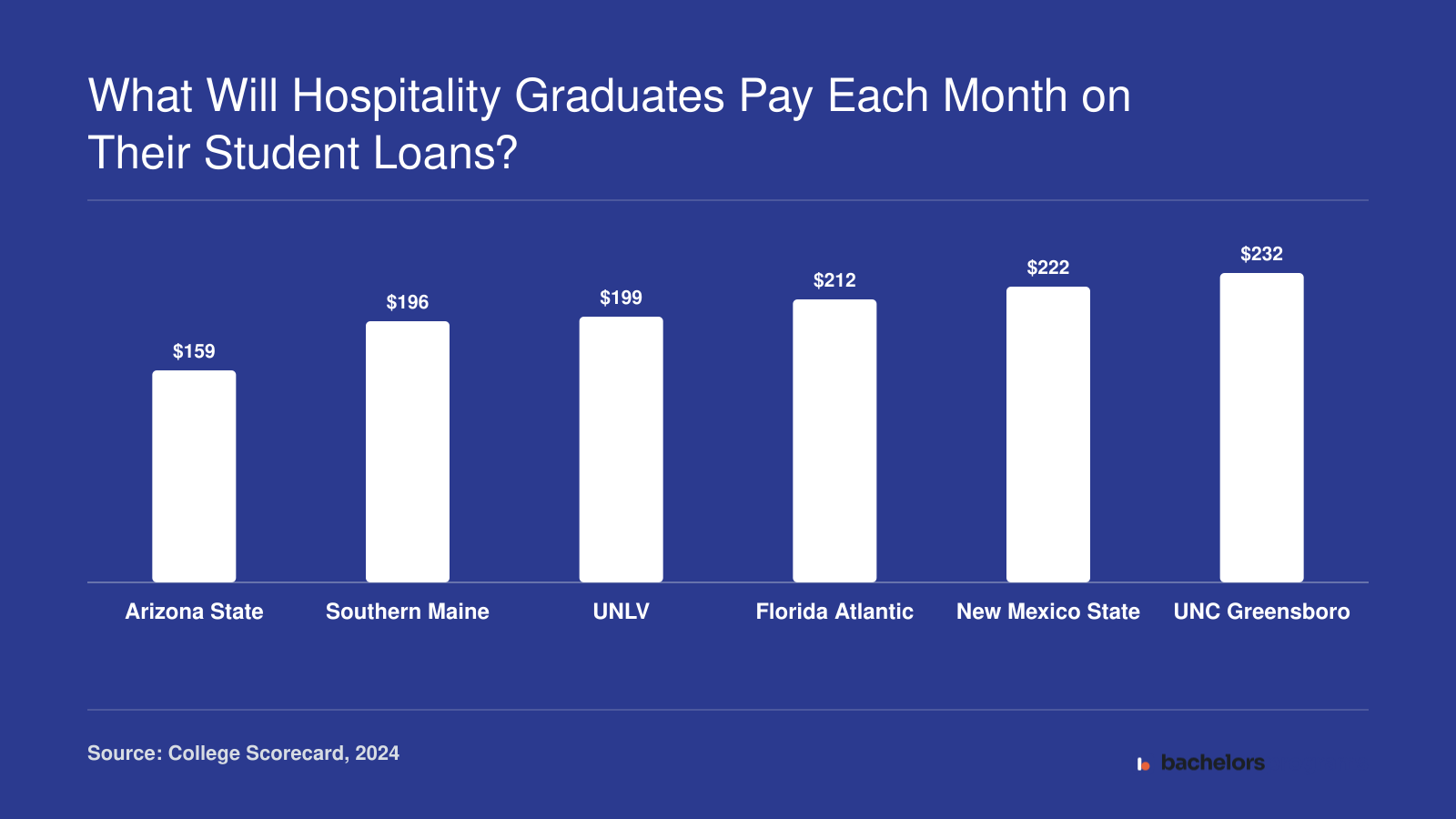
Federal data on recent completers of these online hospitality bachelor's programs shows median monthly payments on a standard 10-year plan from $159 to $232, based on median debt of $15,000 to $21,875. Compared with median earnings one year after graduation, that payment takes about 5.6% of gross monthly pay at Arizona State and close to 9% at New Mexico State and UNC Greensboro. Lower debt and stronger early earnings together keep the monthly burden lighter.
Concentrations and Hospitality Accreditation: Hotel, Event, Tourism, and Culinary Tracks
A hospitality degree housed in a business school approaches the industry through finance, marketing, and revenue management; one housed in a human sciences or applied studies college starts from operations, service delivery, and guest experience. Your concentration and your program's accreditation letters usually tell you which one you are signing up for.
Tracks Offered Online
- Hotel and lodging: The University of Alabama runs a hotel concentration, UNLV offers several concentration options including PGA Golf Management, and New Mexico State frames its degree around hotel, restaurant, and tourism management. These feed front office, rooms division, and property management roles.
- Events and conventions: East Carolina's Convention and Special Events Management concentration and Arizona State's tourism, hospitality, and event management degree point toward convention centers, venues, and meeting planning.
- Food and beverage: Alabama's food and beverage track is the clearest culinary-adjacent option here, aimed at restaurant and multi-unit management rather than cooking.
- Tourism and sustainability: Eastern Kentucky's Sustainable Hospitality concentration and Florida Atlantic's hospitality and tourism major lean toward destinations, ecotourism, and visitor bureaus.
ACPHA and AACSB Are Not Interchangeable
ACPHA, the hospitality-specific programmatic accreditor, is the narrower credential. Published information confirms it at the University of Wisconsin-Stout's online hotel, restaurant and tourism management degree, SIU Carbondale's hospitality, tourism and event management program, and North Carolina Central's hospitality and tourism administration degree. AACSB signals business-school quality instead: Florida Atlantic and UNC Greensboro list it with their hospitality majors, and Oregon State's College of Business holds it at the college level.1 American Public University cites ACBSP. Few online hospitality programs carry ACPHA, so its absence is not a disqualifier.
Certifications and the Baseline
Alabama's coursework references MFP, CHIA, CSTEP, and Cvent credentials, and UNC Greensboro lists optional AHLEI certifications. Formal CMP exam prep is rarely embedded, partly because CMP requires documented work experience. Whatever else a program claims, confirm institutional accreditation first: East Carolina's SACSCOC status, for example, is what makes federal aid and credit transfer possible.
Lodging Manager Median Pay
Hotel and lodging management is the most direct career path for graduates of an online hospitality management bachelor's degree.
Asynchronous vs. Live Online Classes: Internships, Term Starts, and Scheduling
Fully online means no campus attendance is required, but it does not always mean zero scheduled commitments. Some programs are purely asynchronous, while others pair asynchronous coursework with required internships or practicums that carry set hours. The comparison below shows how each format handles the practical details.
| Factor | Fully asynchronous coursework | Asynchronous with field or practicum components |
|---|---|---|
| Class scheduling | Bellevue uses asynchronous participation instead of scheduled class meetings. West Virginia University defines its format as having no required live meeting times, such as Zoom. | Coursework is still asynchronous, but required internships or practicums add outside hours. Monroe expects 10 to 15 hours per week in each internship. |
| Term starts and length | Monroe runs a three-semester calendar and says the BBA can be finished in eight semesters. | Southeastern Oklahoma State lists multiple starts, including Fall II (October 12, 2026), Spring I (January 11, 2027), and Spring II (March 8, 2027). |
| Internship handling | Georgia State says asynchronous courses let students pursue an internship or full-time job alongside the degree. | Oregon State requires three community internships. Monroe requires at least two, totaling 220 hours. Carson-Newman offers HTM 465 as a 3 to 6 credit, pre-approved internship. |
| Current employer and approval | Flexible pacing makes it easier to keep a job while arranging experience on your own schedule. | A Johnson & Wales student completed his internship at his Marriott workplace after his boss agreed, so he kept working full-time. Oregon State advisors help students choose suitable placements, locally or internationally. |
| Campus visits | No campus attendance required. | No campus visit requirement turned up in the research. West Virginia University's HTOR 480 practicum works with real-world clients on live events. |
| Proctoring and technology | Needs reliable internet and access to the learning platform. Confirm each school's exam policy before enrolling. | Same platform needs, plus coordination with an approved internship site and any required documentation. |
| Best fit | Working adults with unpredictable shifts who want maximum control over when they study. | Students who can commit weekly hours to a site, especially those already working in hospitality who can use their employer. |
Hospitality Management programs by state
Compare Hospitality Management programs on the data that matters
Explore more Business & Management majors or browse every field of study.
All Business & Management programs Browse every field of study