Best Hospitality Management Degree Programs
Compare 230+ accredited Hospitality Management programs, with net price after aid, graduation rates, earnings and debt from IPEDS and the U.S. College Scorecard.

A hospitality degree can cost under $7,000 a year in tuition at a Florida public university or more than $69,000 at Cornell, and both routes place graduates into hotel operations. The gap between them is not quality so much as what you pay to get the same job title.
The question worth asking is which program delivers a workable mix of price, early earnings, and access to the companies that hire. Median first-year pay among the programs ranked here runs from roughly $33,000 to $78,000, a spread wider than most prospective students expect.
Required internship hours, not coursework, tend to decide which end of that range a graduate lands in.
Key Points
- Cornell's Hotel Administration graduates earn the highest first-year pay on this list.
- Per 2024 federal data, in-state tuition at top-value publics starts at $4,879.
- Career changers benefit most from campus programs' internships and recruiter access.
The 10 Best Hospitality Management Degree Programs for 2027
A spot on this list came down to three things a reader can act on: an average net price after aid that leaves room to finish without heavy debt, a school-wide completion rate that suggests students actually graduate, and program-level outcomes that show where graduates land. Brand name alone did not carry a school, which is why several large public universities with deep industry pipelines sit alongside the country's most established hotel school. Every entry below names the city and state, the format offered, available concentrations, the average net price after aid, the school-wide graduation rate and the admission rate, with program earnings shown only where published.
University of Central Florida
#1Orlando, FL · ~$10,000/yr (est.)
Best for: Theme park and attractions hopefuls
UCF's Rosen College sits in the middle of the Orlando tourism market, and the hospitality bachelor's is offered both on campus and fully online. Students choose from four concentration options and build budgeting, scheduling, inventory control and service leadership skills through industry internships.
- Four concentration options across lodging, tourism and foodservice
- Fully online option available
- Industry internship opportunities built into the degree
- Coursework in budgeting, scheduling and inventory control
- Orlando location draws 74 million visitors a year
- Median earnings of $33,624 one year after finishing
University of Illinois Urbana-Champaign
#2Champaign, IL · ~$14,000/yr (est.)
Best for: Tourism planning and development focus
The Champaign campus houses a Recreation, Sport and Tourism department that dates to 1940 and offers a Tourism Management concentration inside its Bachelor of Science. The 128-credit degree layers 39 hours of core coursework in financial resource management, marketing, facility management and event management with a 12-hour internship and a third semester of a language other than English. The department describes itself as ranking among the top three nationally in the field, which suits students who want planning and policy depth rather than a pure hotel-operations track.
- 128 total credit hours
- Tourism Management concentration (9 hours)
- 12-hour required internship plus orientation
- 39 hours of core RST coursework
- Third-semester language requirement
- Three concentration options within the major
Florida International University
#3Miami, FL · ~$9,000/yr (est.)
Best for: Event and cruise line career starters
FIU's Chaplin School runs a BS in Hospitality Management in Miami with seven concentration options, from hotel and lodging to beverage, events, and travel and tourism. Students log 500 hours of industry experience plus a 300-hour advanced internship, and the school offers a Hospitality at Sea program and a partnership with the Bacardi Center of Excellence. Tuition is among the lowest of the ranked programs, which makes it a strong value for students who want a large hospitality market without a large price tag.
- Seven concentration options, including events and beverage
- 500 hours of industry experience required
- 300-hour advanced internship
- Hospitality at Sea program and Bacardi Center of Excellence
- Dedicated career development office
- Median earnings of $33,364 one year after finishing
Florida State University
#4Tallahassee, FL · ~$11,000/yr (est.)
Florida State has taught hospitality since 1947, and its BS in Hospitality and Tourism Management requires 120 credit hours split between a 12-hour college core and 31 hours of major coursework. Students complete a 3-credit internship and at least 1,000 hours of hospitality work experience before graduating, and the program reports an almost 100 percent placement rate. Representative job titles include hotel or restaurant general manager, director of operations, meeting planner and events manager, with employers spanning hotels, resorts, casinos, cruise ships and theme parks.
- 120 total credit hours
- 31 hours of major coursework plus a 12-hour college core
- 1,000 hours of hospitality work experience required
- 3-credit internship required
- Offered continuously since 1947
- Median earnings of $37,330 one year after finishing
Purdue University
#5West Lafayette, IN · ~$15,000/yr (est.)
Purdue's Hospitality and Tourism Management major pairs accounting, marketing, lodging, food service and law coursework with a 320-hour paid internship, a capstone that builds a hospitality business, and shifts at the student-run Union Club Hotel. Optional concentrations cover environmental sustainability, facilities design, marketing and sales, and finance. The program reports a 98% job placement rate and lists Disney, Hilton and Marriott among the employers that hire its graduates.
- 320-hour paid internship required
- Capstone builds a hospitality business plan
- Students train at the student-run Union Club Hotel
- Four concentration options, including finance and facilities design
- 98% job placement rate reported
- Median earnings of $41,099 one year after finishing
University of Georgia
#6Athens, GA · ~$14,000/yr (est.)
Georgia's Hospitality and Food Industry Management major sits in the department of agricultural and applied economics and prepares students for hotels, resorts, restaurants, country clubs, event management and agritourism. Students log 400 to 600 hours of industry experience, often at the university-owned hotel, and can add practicum work at the campus golf course, botanical garden, dining services and athletic hospitality. Certificates in entrepreneurship or sustainability and a Double Dawgs pathway to a graduate degree add flexibility.
- 400 to 600 hours of industry experience required
- Training at a university-owned hotel
- Practicum options in campus dining and athletic hospitality
- Certificates in entrepreneurship or sustainability
- Double Dawgs pathway to a graduate degree
- Approved pre-law major
Cornell University
#7Ithaca, NY · $29,000/yr (est. net price)
Cornell's School of Hotel Administration is among the most recognized hospitality business schools in the country, and its BS in Hotel Administration requires 120 credits, 18 core business courses and 800 hours of paid field work. Students train at the Statler Hotel, run a student restaurant, plan the Hotel Ezra Cornell conference, and take coursework in real estate and finance. Graduates move into hospitality management, operations, financial analysis, development and consulting, and the program posts the strongest early-career earnings on this list.
- 120 total credit hours with 18 core business courses
- 800 hours of paid field work required
- Train at The Statler Hotel on campus
- Coursework in real estate, finance and strategic management
- Student-run restaurant and Hotel Ezra Cornell conference
- Median earnings of $77,803 one year after finishing
University of Delaware
#8Newark, DE · $15,000 – $20,000/yr (est.)
Delaware's BS in Hospitality Industry Management is housed in the Alfred Lerner College of Business and Economics, so hospitality coursework sits alongside the full business core in accounting, economics, finance, operations and business computing. Students complete at least 120 credits, 6 credits of hospitality electives and 400 hours of paid hospitality-related work experience, plus a capstone and a Discovery Learning Experience. A published four-year plan makes the path easy to map for students who want business depth with an industry focus.
- 120 credit hours minimum
- 400 hours of paid hospitality work experience
- Business core in accounting, finance and operations
- 6 credits of hospitality electives
- Capstone and Discovery Learning Experience required
- Median earnings of $37,563 one year after finishing
Ohio State University
#9Columbus, OH · $17,000/yr (est. net price)
Ohio State's BS in Hospitality Management runs through the College of Education and Human Ecology on the Columbus campus, with coursework in service management, hospitality marketing, branding, social media, beverage management and event planning. Students enter as a pre-major and need 15 semester hours, a 2.0 cumulative GPA and College Algebra with a C- or better before advancing. Three field experiences, including part-time restaurant and lodging work plus an advanced senior internship, are required, and an Indonesia study abroad option is available.
- Enter as a pre-major, advance after 15 semester hours
- Three required field experiences, including a senior internship
- Coursework in beverage management and event planning
- Study abroad program in Indonesia
- Internships sourced through an industry advisory board
- Median earnings of $36,986 one year after finishing
University of South Florida
#10Tampa, FL · ~$10,000/yr (est.)
USF's hospitality bachelor's lives in the School of Hospitality and Sport Management inside the Muma College of Business in Tampa. The 120-credit degree includes 39 credits of major core work in food production, restaurant management, lodging, cost control, marketing and strategic management, plus 15 elective credits with a hospitality prefix. Students complete 1,000 hours of industry experience, including 300 hours in the advanced internship, and undergraduate research is available for those considering graduate study.
- 120 unduplicated credit hours
- 39 credits of major core coursework
- 1,000 industry experience hours, including a 300-hour internship
- 15 elective credits in hospitality coursework
- 2.0 GPA and a C- in each prerequisite to progress
- Undergraduate research available
Cost & outcomes by school
Federal data for the highest-earning Hospitality Management programs, independent of the ranking above. Earnings are this field's bachelor's graduates four years after completing where the Scorecard reports them, else the school's undergraduate median.
| School | Net price / yr | Grad rate | Earnings | Debt | Grads/yr | Format |
|---|---|---|---|---|---|---|
| Cornell University NY | $28,690 | 95% | $112,289 | $13,086 | 221 | Campus |
| New York University NY | $37,050 | 88% | $84,375 | $17,905 | 50 | Campus |
| Boston University MA | $24,402 | 89% | $82,302 | $23,250 | 50 | Campus |
| University of Illinois Urbana-Champaign IL | $14,355 | 85% | $81,054 | $19,500 | 7 | Campus |
| San Jose State University CA | $13,760 | 69% | $78,988 | $15,000 | 3 | Campus |
| University of Denver CO | $36,131 | 76% | $75,118 | $21,923 | 23 | Campus |
| Rutgers University-Camden NJ | $18,745 | 67% | $74,479 | $21,500 | — | Campus |
| Virginia Polytechnic Institute and State University VA | $24,953 | 86% | $72,817 | $24,500 | 46 | Campus |
| University of Florida FL | $4,815 | 85% | $71,588 | $15,000 | — | Online |
| DePaul University IL | $30,902 | 68% | $71,556 | $16,500 | 10 | Campus |
| Fairleigh Dickinson University NJ | $22,829 | 67% | $71,188 | $25,000 | 7 | Campus |
| University of Delaware DE | $17,799 | 81% | $71,102 | $22,850 | 38 | Campus |
Sources: U.S. Department of Education. Net price, graduation rate, earnings and debt: College Scorecard (earnings and debt for this field's bachelor's graduates where reported, else school-wide); graduates: IPEDS. A dash means no figure is reported.
Cost, debt & payoff
Median earnings of this field's bachelor's graduates (4 yrs after completing, else the school's undergraduate median) vs. their median federal loan debt · U.S. College Scorecard
Across these programs the median graduate earns about $53,539 and finishes with roughly $22,200 in debt — a ratio that clears a common rule of thumb (keep debt below first-year salary). Net price and debt vary widely school to school, so check the per-school figures in the table above before you shortlist.
Behind the List: Outcomes, Price, and Completion Over Brand Name
Hotel and restaurant companies hire on demonstrated experience, and what a hospitality degree costs matters as much as the name above the door.
Each entry draws on federal College Scorecard data: what graduates of a specific bachelor's program earn and borrow, net price after aid, completion and retention rates, and whether the format is campus, online, or hybrid. A program that sends graduates out with heavy debt and modest first-year pay reads very differently from one with a similar sticker price and stronger early earnings.
Why the Degree Level Matters
Competitor lists often blend certificates, associate degrees, and graduate programs into a single hospitality ranking, which makes a two-year certificate look comparable to a four-year business degree. The schools here are weighed on bachelor's-level outcomes, the credential most readers are actually choosing between.
What Outside Rankings Confirm
Brand placement is not settled. In the QS 2026 subject table, UNLV sits at No. 6 worldwide and Penn State at No. 20, with FIU at No. 23 and UCF at No. 27. CEOWorld's 2026 list of 116 hospitality schools puts UNLV first, UCF second, Michigan State third, Penn State fourth, and Cornell sixth. Niche's most recent list places Cornell, Arizona State, and Texas Tech in its top 20. Several schools here show up across those lists, which makes for a useful cross-check rather than a substitute for earnings and debt.
Where the Numbers Stop
Graduation rates are reported school-wide, not by major, so a strong hospitality program sits inside a university-wide figure. Earnings cover graduates who received federal aid and are working, which describes a slice of a class rather than all of it. Read the dollar figures as a starting point for comparing programs, not a promise about any one graduate.
Hospitality Management Degree Cost per Year: The Lowest Net Prices
These three public universities post the lowest average net prices among the programs ranked here, according to 2024 IPEDS and College Scorecard data from the U.S. Department of Education. Sticker tuition ranges from $4,879 for in-state students to $20,058 for out-of-state students, while average net price, which counts housing and other costs minus grants, falls between $7,021 and $9,288. Private schools often show a much wider gap between published price and what families actually pay. Median debt for graduates of these specific programs runs from $15,000 to $20,000, or roughly $159 to $212 a month on a standard 10-year plan. Net price is an institution-wide average, not a personal quote, so check each school's own estimate before comparing offers.
| School | Location | In-State Tuition | Out-of-State Tuition | Average Net Price | Median Program Debt | Median Monthly Payment (10-Year Plan) |
|---|---|---|---|---|---|---|
| California State University-Northridge | Northridge, CA | $7,458 | $20,058 | $7,021 | $15,000 | $159 |
| Florida Atlantic University | Boca Raton, FL | $4,879 | $17,324 | $8,752 | $20,000 | $212 |
| Florida International University | Miami, FL | $6,565 | $18,964 | $9,288 | $16,398 | $174 |
Top Early-Career Earnings Among Ranked Programs
Cornell's Hotel Administration graduates post the strongest first-year paychecks of any program on this list.
Related Articles
Internships, Co-Ops, and Employer Pipelines at Leading Hotel Schools
Required work experience separates hospitality programs more sharply than any other feature, because it decides whether you graduate with a résumé or only a transcript. The hours and the employer relationships behind them vary widely from school to school.
What the Leading Schools Require
- Cornell Nolan: Students must log 800 hours of practical experience. No academic credit is awarded for it.1 The hours can be paid or unpaid, and can come from internships, summer jobs, or experiential learning such as Hotel Ezra Cornell.
- UNLV Harrah: The requirement is 1,000 hours at a verifiable hospitality job, paired with a 3-credit online course. Students choose their own segment (hotels, restaurants, convention spaces, or arenas) and can work anywhere in the world. About 600 students take part in internships each year.3
- UCF Rosen: The Loews Hotels at Universal Progressive Internship Program is a competitive, multi-semester rotation through hotel departments at Universal Orlando Resort.4
School materials for Penn State, Purdue, Michigan State, and Houston Hilton College do not spell out hour requirements or named partners, so ask those programs directly.
How Employer Ties Become Job Offers
Recruiting relationships matter because employers use internships as a screening tool. Cornell lists Hilton, Marriott, Four Seasons, and Wyndham among its recruiting organizations.2 UNLV routes students to industry partners through its Handshake career platform. A rotational program like UCF's lets a company watch you perform across departments before it decides whether to offer you a management-training slot. The strongest pipelines often produce those offers before senior year ends.
What to Ask Admissions
- How many practicum hours are required, and do they earn credit?
- Are placements paid, unpaid, or a mix?
- Which employers recruit on campus each semester, and how many students do they hire?
- Does the school help you find placements, or are you on your own?
Online vs. Campus Hospitality Management Degrees Compared
Online programs buy flexibility; campus programs buy proximity to labs, recruiters, and the classmates who become your industry network. Neither format is better in general. The right one depends on how much of your career edge you expect to come from the classroom schedule and how much from the room you are standing in.
Same Degree, Different Delivery
The curriculum is often identical. The University of Central Florida lists 120 credit hours for both its online and on-campus Hospitality Management BS1, and the same 120-hour total applies to its Lodging and Restaurant Management BS in both formats2. That pairing shows up at several schools here, so you can often compare formats within one institution without changing schools.
Where the Formats Diverge
- Flexibility and pace: Online students typically study around work and family obligations. Campus students follow a fixed class calendar. Term length and typical completion time vary by school, so confirm both before you enroll.
- Transfer credit: Online programs tend to attract students with prior coursework, but each school sets its own cap. Penn State World Campus, for example, requires official college or university transcripts, and official military transcripts where applicable, for every transfer-credit review.3
- Hands-on access: Campus programs usually offer on-site labs, student-run venues, and easier access to practicum placements. Online students generally complete experience through an internship arranged locally.
- Recruiters and networking: Career fairs and employer visits are easiest to use in person. Online students need to seek out virtual events and alumni contacts deliberately.
- Cost and fees: Online delivery can cut housing and commuting costs, but fees and per-credit rates differ. Internships can also change the bill. At Penn State World Campus, Recreation, Park, and Tourism Management students enroll in RPTM 495A and pay full tuition for 12 credits in the semester of the internship.4
How to Choose
If you already work in a hotel, restaurant, or events role, online study lets you build credentials without leaving that experience. If you are starting from scratch, a campus setting usually gives you faster entry into employer pipelines.
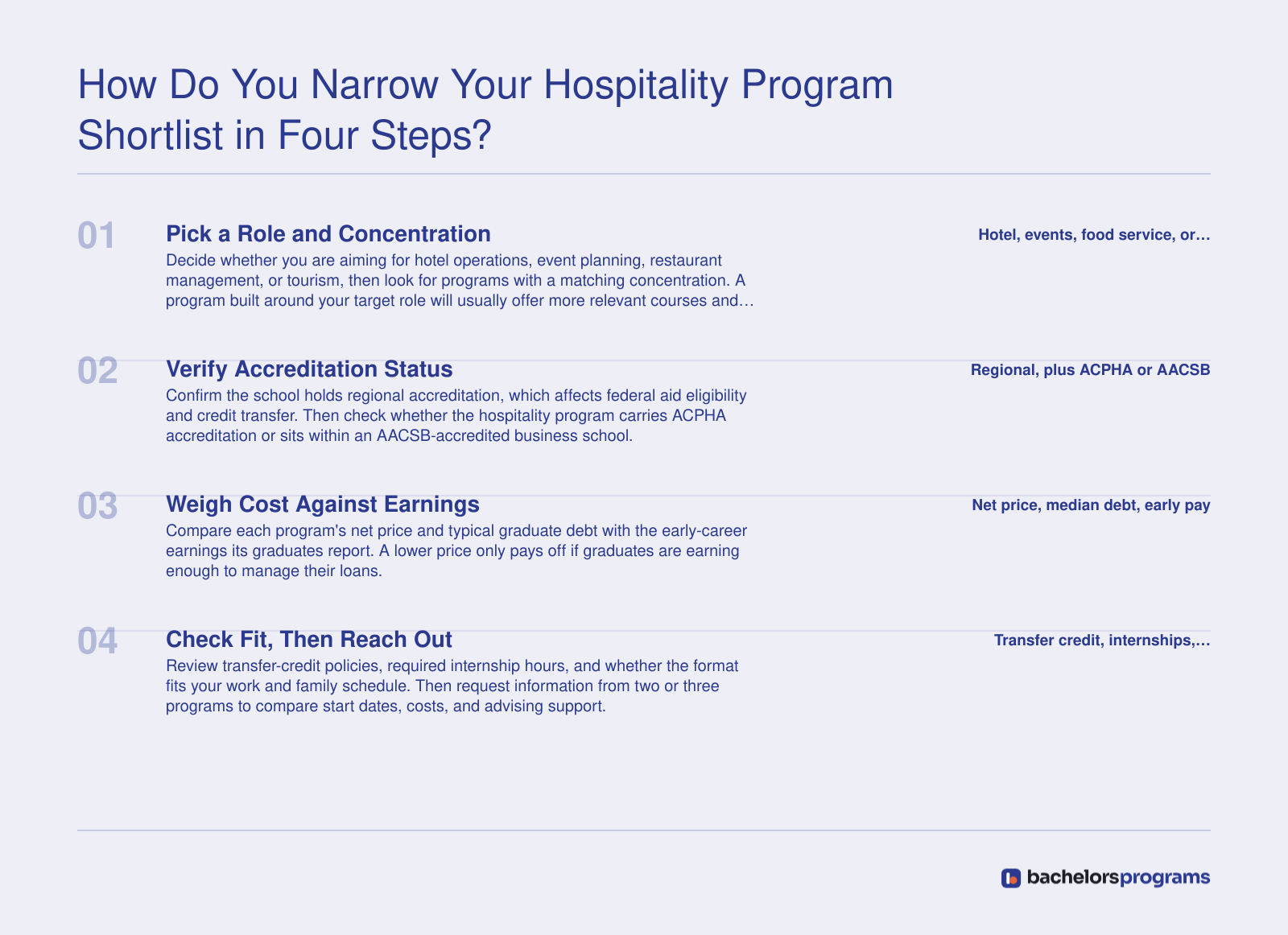
How Do You Narrow Your Hospitality Program Shortlist in Four Steps?
A strong shortlist starts with the job you want, not the school's name. Work through these steps in order so each one filters the programs below before you spend time on applications. Finish by requesting information from your top two or three choices.
Hospitality Management programs by state
Quick Answers for Prospective Hospitality Students
Is a hospitality management degree worth the cost?
Which school is best for hospitality management?
Do you need a degree to become a hotel general manager?
Compare Hospitality Management programs on the data that matters
Explore more Business & Management majors or browse every field of study.
All Business & Management programs Browse every field of study