Best Online Supply Chain Management Degree Programs
Compare 190+ accredited online Logistics & Supply Chain Management programs, with net price after aid, graduation rates, earnings and debt from IPEDS and the U.S. College Scorecard.

No state licensure exam stands between a supply chain graduate and an entry-level analyst or buyer job. The bachelor's degree in logistics and supply chain management does the screening instead, most often as a Bachelor of Science (B.S.) in Supply Chain Management.
Every program below can be finished 100% online, with no hybrid or on-campus residency.
Cost is the harder variable: net price after aid swings widely across online business degrees, and the cheapest option is not always the one with the deepest employer recruiting.
Key Points
- BLS projects logistician jobs to grow 18% from 2025 to 2035.
- A 120-credit B.S. takes about four years full-time, less with transfer credit.
- Every ranked program is fully online, with no required campus visits.
Best Fully Online Supply Chain Management Degree Programs, Ranked
Every school below lets you complete its supply chain coursework entirely online; programs that require any campus visit were excluded. The order reflects a blend of cost after aid, completion and program-level outcomes rather than a single metric, so a cheaper school does not automatically outrank a stronger one.
Strayer University-Florida
#1Tampa, FL · ~$16,000/yr (est.)
Best for: Working adults transferring prior credits
A national online university with a Tampa campus, Strayer runs 11-week terms and accepts up to 28 transfer classes. The school's overall graduation rate is 80%, and supply chain graduates earned a median of about $63,200 five years after finishing.
- 40 courses with 11-week terms; $1,555 per course
- Concentration spans inventory, transportation, global supply chain and innovation
- Transfer up to 28 classes
- CPIM, CLTD and CSCP certifications can earn course credit
- No-cost general education courses through Sophia Learning
- $65 quarterly technology fee; $150 one-time conferral fee
- Middle States Commission on Higher Education accredited
American Public University System
#2Charles Town, WV · $5,000 – $10,000/yr (est.)
Best for: Active-duty military and veterans
Built for military and adult learners, APU offers monthly starts and 8- to 16-week terms across its business degrees. The school's overall graduation rate is 57%, and supply chain graduates earned a median of about $75,700 four years after finishing.
- ACBSP accredited; 120 credits at $360 per credit
- Concentrations in general supply chain, government contracting, reverse logistics, transportation
- 12 start dates a year; 8- to 16-week course terms
- Transfer up to 90 credits with free credit evaluation
- Senior capstone analyzes real supply chain problems
- No-cost textbooks and ebooks; $0 application fee
- ACBSP accredited; 120 credits; no entrance exam required
- Three concentration options
- Covers RFID technology and global air and maritime transport
- Group case studies build teamwork skills
- 12 start dates a year; transfer up to 90 credits
Arizona State University
#3Tempe, AZ · ~$15,000/yr (est.)
Best for: Career changers wanting analytics-heavy coursework
A large public research university, ASU delivers its W. P. Carey business degrees online with heavy coursework in forecasting and optimization. The school's overall graduation rate is 68%, and supply chain graduates earned a median of about $82,500 four years after finishing.
- Tracks: Logistics
- 120 credits with full-time and part-time options
- Coursework in forecasting, statistical modeling, optimization and operations research
- Accelerated bachelor's plus master's option
- STEM-OPT extension eligible
- Logistics track requires a 3.4 GPA and SAT or ACT scores
California State University-East Bay
#4Hayward, CA · $8,000 – $20,000/yr (est.)
A public university in Hayward, Cal State East Bay runs its AACSB-accredited business degrees through self-support online completion. The school's overall graduation rate is 48%, and supply chain graduates earned a median of about $77,600 four years after finishing.
- AACSB accredited; 120 units
- Concentration in operations and supply chain management
- Courses in lean management, global and sustainable supply chains, enterprise planning
- Electives include machine learning forecasting and healthcare analytics
- Capstone required
- Self-support online degree completion through Continuing Education
Miami Dade College
#5Miami, FL · $2,800 – $10,000/yr (est.)
Miami Dade pairs an applied bachelor's with an analytics concentration and a field study course built around real supply chain decisions. The school's overall graduation rate is 46%, and supply chain graduates earned a median of about $57,200 four years after finishing.
- 120 credits with a Supply Chain Analytics concentration
- Covers operations, logistics, purchasing, inventory and warehouse management
- Business intelligence and digital supply chain coursework
- Field study and research course
- Prerequisite courses required
Utah Valley University
#6Orem, UT · $5,000 – $10,000/yr (est.)
Utah Valley requires every supply chain graduate to sit for an industry certification exam and complete an internship or independent study. The school's overall graduation rate is 45%, and supply chain graduates earned a median of about $86,600 four years after finishing.
- 120 credits: 30 general education and 42 discipline core
- Every graduate sits for a Lean, Six Sigma, Domo or project management exam
- Internship or independent study required
- Admission needs a 2.0 overall and 2.5 business GPA
- Courses in scheduling, forecasting, inventory and operations simulation
- Industry leaders advise course content
Daytona State College
#7Daytona Beach, FL · $7,000/yr (est. net price)
Daytona State runs a 2+2 applied bachelor's for associate degree holders, with certification preparation built into the coursework. The school's overall graduation rate is 43%, and supply chain graduates earned a median of about $52,500 four years after finishing.
- 2+2 model for students holding an associate degree
- Admission requires an earned associate degree and 2.0 GPA
- Transfer students need at least 60 college credits
- Seven concentration options including project management
- Internationally recognized certification preparation
- Community-based service-learning projects
University of Maine at Presque Isle
#8Presque Isle, ME · ~$7,000/yr (est.)
Maine's Presque Isle campus folds a compact supply chain concentration into a broad business administration major delivered through YourPace. The school's overall graduation rate is 52%, and supply chain graduates earned a median of about $50,400 four years after finishing.
- 120 credits: 60-credit business major plus 12-credit concentration
- Concentration covers inventory, quality and supplier relationship management
- Offered through the YourPace undergraduate format
- 2.75 GPA required across major and concentration
- Business analytics and strategy capstone
- Accounting, marketing, finance and business law in the core
Utah State University
#9Logan, UT · $9,000 – $25,000/yr (est.)
Utah State's Huntsman School pairs hands-on business teaching with assigned career coaches and a semester-by-semester plan. The school's overall graduation rate is 59%, and supply chain graduates earned a median of about $79,900 four years after finishing.
- Emphasis in process improvement, logistics and supply chain strategy
- Three concentration options
- Personalized semester-by-semester advising plan
- Professional career coaches for networking and interviews
- Hands-on teaching at the Huntsman School of Business
University of Wyoming
#10Laramie, WY · $14,000/yr (est. net price)
Wyoming's AACSB-accredited College of Business builds a 12-credit supply chain focus into its management degree alongside corporate consulting projects. The school's overall graduation rate is 59%, and supply chain graduates earned a median of about $57,100 four years after finishing.
- 12-credit focus: three core courses plus one elective
- Covers logistics, sourcing, supplier relationships, quality and risk
- AACSB-accredited College of Business
- Corporate-sponsored consulting projects and case competitions
- Data-driven decision making and enterprise resource systems
- Supply Chain & Logistics Club
Cost & outcomes by school
Federal data for the highest-earning Logistics & Supply Chain Management programs, independent of the ranking above. Earnings are this field's bachelor's graduates four years after completing where the Scorecard reports them, else the school's undergraduate median.
| School | Net price / yr | Grad rate | Earnings | Debt | Grads/yr | Format |
|---|---|---|---|---|---|---|
| Utah Valley University UT | $6,376 | 45% | $86,602 | $15,375 | 312 | Online or campus |
| Arizona State University AZ | $14,967 | 68% | $82,535 | $20,490 | 284 | Online |
| American Public University System WV | $9,597 | 57% | $75,722 | $22,988 | 2,134 | Online |
Sources: U.S. Department of Education. Net price, graduation rate, earnings and debt: College Scorecard (earnings and debt for this field's bachelor's graduates where reported, else school-wide); graduates: IPEDS. A dash means no figure is reported.
Cost, debt & payoff
Median earnings of this field's bachelor's graduates (4 yrs after completing, else the school's undergraduate median) vs. their median federal loan debt · U.S. College Scorecard
Across these programs the median graduate earns about $66,149 and finishes with roughly $22,247 in debt — a ratio that clears a common rule of thumb (keep debt below first-year salary). Net price and debt vary widely school to school, so check the per-school figures in the table above before you shortlist.
Choosing a Bachelor's Degree in Logistics and Supply Chain Management Online
Should you pick a dedicated supply chain major or a business degree with a supply chain concentration? It depends on how deep you want to go.
Dedicated Major or Business Concentration?
A B.S. in Supply Chain Management builds most of its upper-division coursework around procurement, logistics, operations, and analytics. A business administration degree with a supply chain concentration keeps a broad business core and adds a shorter block of specialty courses. At the University of Maine at Presque Isle, for example, that concentration is 12 credits. Choose the major for depth. Choose the concentration if you want flexibility across business roles.
Concentrations and the Jobs They Lead To
- Procurement and purchasing: buyer, purchasing agent, sourcing specialist.
- Logistics and transportation: logistician, transportation or distribution coordinator.
- Supply chain analytics: supply chain analyst, operations analyst.
Accreditation and Certification Fit
Institutional (regional) accreditation is the baseline. It affects financial aid eligibility and credit transfer. Business accreditation from AACSB, ACBSP, or IACBE is an added quality signal. Arizona State's W. P. Carey School and Cal State East Bay hold AACSB accreditation, and American Public University lists ACBSP.1 Verify any claim in the accreditor's own online directory before you apply.
Some programs align coursework with industry credentials such as ASCM's CPIM (internal operations), CSCP (the extended supply chain), CSCMP SCPro, or Lean Six Sigma. Strayer notes that CPIM certification can earn course credit, and Utah Valley requires a professional certification exam. Treat alignment as preparation, not a credential. A capstone, internship, or independent study, required at schools such as Utah Valley and Cal State East Bay, gives you applied work to show employers.
Most Affordable Online Supply Chain Management Degrees by Net Price
These are the three lowest-cost fully online programs here, ranked by average annual net price after grants and aid. That figure is a school-wide average from the U.S. Department of Education's College Scorecard (2024), not a personal quote. Median federal debt and the estimated 10-year monthly payment show what each program's graduates actually borrowed. Pricing models differ: Penn State World Campus charges $644 to $692 per credit in 2026-27 for students taking 11 or fewer credits per semester in its online BS in Project and Supply Chain Management, roughly $77,000 to $83,000 for 120 credits, while 12 to 19 credits per semester bills at a flat $7,833 to $8,455, and Purdue Global cuts per-credit tuition 55% for current servicemembers and 38% for veterans. Prices change every year, so confirm current rates on each school's bursar page.
| School | Program | Avg. Annual Net Price | In-State Tuition and Fees | Out-of-State Tuition and Fees | Median Program Debt | Est. Monthly Payment (10 Years) |
|---|---|---|---|---|---|---|
| Florida State College at Jacksonville (Jacksonville, FL) | Logistics (B.A.S.) | $4,128 | $2,878 | $9,992 | $23,203 | $246 |
| Miami Dade College (Miami, FL) | Supply Chain Management | $5,463 | $2,838 | $9,661 | $12,140 | $129 |
| Utah Valley University (Orem, UT) | Operations and Supply Chain Management (B.S.) | $6,376 | $6,507 | $18,489 | $15,375 | $163 |
Related Articles
How Long an Online Supply Chain Management Bachelor's Takes, and How to Finish Faster
A student starting with no college credit and one who already holds an associate degree follow very different timelines, even in the same online supply chain management degree. A standard 120-credit bachelor's takes about four years of full-time study. Part-time students take longer, often five years or more when work limits them to one or two courses at a time.
Formats That Speed Things Up
Shorter terms and year-round calendars keep you moving without long breaks:
- Short terms: SNHU runs 8-week terms1, and Purdue Global uses 10-week terms with a standard load of two courses.
- Competency-based pacing: WGU's 6-month terms let you finish courses as soon as you show mastery. WGU says its supply chain and operations degree takes about four years with minimal acceleration and typically under three for students who push ahead.2
Transfer Credit Is the Biggest Lever
SNHU accepts up to 90 transfer credits, provided you complete at least 30 at SNHU.1 Purdue Global evaluates previous coursework and other prior learning, though transfer is not guaranteed. Its program materials put the average at four years, dropping to just over two for students who arrive with transfer credit and prior experience. WGU accepts fewer course-by-course transfers, but associate degree holders usually enter with upper-division standing.2
In practice, 60 credits transferred from an associate degree cover roughly half the degree, so a full-time student could finish in about two years. Request a transcript evaluation before you enroll.
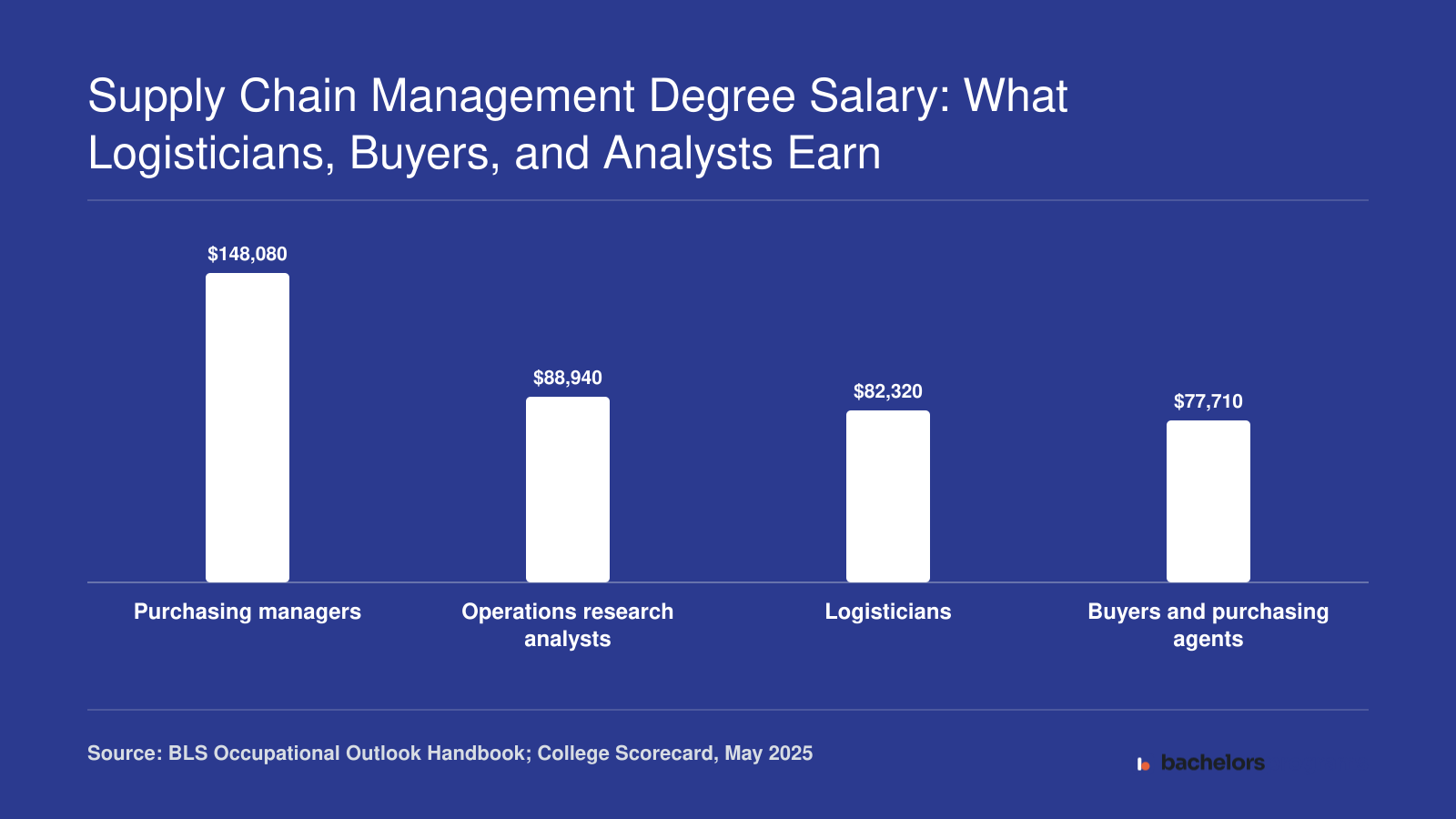
Supply Chain Management Degree Salary: What Logisticians, Buyers, and Analysts Earn
The chart shows Bureau of Labor Statistics median annual wages for May 2025 across four common supply chain occupations. BLS projects logistician jobs to grow 18% from 2025 to 2035, much faster than average. Graduate earnings are a separate measure from these occupation-wide wages: one year after completion, bachelor's graduates of the top-earning programs ranked here posted medians of $51,549-$69,147 (highest at Thomas Edison State University), rising to $77,879-$81,429 five years out. Median graduate debt at those programs ran $14,238-$20,490, well under a single year of early-career pay, so the degree pays off quickly for most completers.
Questions to Ask Yourself
Do you need fully asynchronous courses, or do you want live sessions?
Which role are you aiming for: procurement, logistics, or analytics?
Will you pursue ASCM or Six Sigma certification?
How many credits can you transfer, and does that make acceleration realistic?
Logistics & Supply Chain Management programs by state
Compare Logistics & Supply Chain Management programs on the data that matters
Explore more Business & Management majors or browse every field of study.
All Business & Management programs Browse every field of study