Best Supply Chain Management Degree Programs
Compare 670+ accredited Logistics & Supply Chain Management programs at 500+ colleges, with net price after aid, graduation rates, earnings and debt from IPEDS and the U.S. College Scorecard.

One-year median earnings for supply chain graduates on this list range from $43,213 to $73,557, even though the degrees carry nearly identical titles. A bachelor's degree in logistics and supply chain management, most often a Bachelor of Science (B.S.) in Supply Chain Management, may be a full major, a business concentration, or a short track inside a general business degree.
Cost and format vary just as widely. College Scorecard data lets you compare net price, debt, delivery method, and early pay side by side.
Employers hire for sourcing, planning, and analytics skills, so internship access and the actual curriculum count for more than the name on the diploma.
Key Points
- Texas A&M University-Central Texas averages just $1,300 a year after aid.
- Georgia Tech graduates post the highest early-career pay among ranked programs.
- AACSB accredits the business school, not the supply chain major itself.
The 10 Best Schools for a Bachelor's Degree in Logistics and Supply Chain Management
Each card below covers the same ground so you can compare without hunting: how the program is delivered, the supply chain major or concentration it awards, the average net price after aid, and the outcomes the school reports, including first-year earnings. If cost is your first filter, read the net price line first; if return matters more, start with graduation rate and earnings. Read the concentration line carefully, because at several of these schools supply chain study sits inside a broader business degree rather than standing on its own.
Georgia Institute of Technology
#1Atlanta, GA · ~$12,000/yr (est.)
Best for: Aspiring operations analysts wanting quantitative coursework
Georgia Tech is a public research university in Atlanta whose business school pairs a 122-credit Bachelor of Science in Business Administration with a 12-credit operations and supply chain concentration. The Supply Chain and Logistics Institute runs Supply Chain Day career fairs twice a year, and the Matson Foundation funds a $5,000 scholarship for full-time undergraduates headed into supply chain, transportation, or logistics work. U.S. News places the supply chain and logistics specialty at No. 6 nationally among business specialties in its 2027 rankings.
- 122 total credit hours, with 12 in the supply chain concentration
- Concentration courses require a minimum grade of C
- Options include operations strategy, global operations, and supply chain modeling
- Major requirements include Operations Management and Management Statistics
- Internships capped at 3 credits; undergraduate research up to 9
- Pass-fail grading allowed only for free electives
University of Washington-Seattle Campus
#2Seattle, WA · ~$14,000/yr (est.)
Best for: Students hunting scholarships and honors options
The University of Washington's Seattle campus puts its supply chain work inside the Foster School's Bachelor of Arts in Business Administration, so majors take accounting, finance, and marketing alongside operations and logistics courses. Honors tracks and internships add depth, and roughly 90 undergraduate scholarships support Foster students. The major is a campus program with fall and winter entry points.
- 180 total credit hours with fall and winter start dates
- 2.0 GPA minimum plus prerequisite coursework
- Operations research, database and project management coursework
- Production and inventory modeling plus logistics systems
- Honors options and internships supplement classroom work
- About 90 undergraduate scholarships awarded
University of Georgia
#3Athens, GA · ~$14,000/yr (est.)
Best for: Management majors adding a supply chain specialty
At the University of Georgia, supply chain study lives inside the Management major at the Terry College of Business, where operations and supply chain management is one of two areas of emphasis. Students cover operations strategy, quality management, global sourcing, and logistics, and the emphasis is noted on the official transcript. Graduates move into demand and supply planning, procurement, warehousing, and logistics management roles.
- Operations and supply chain management is one of two emphasis areas
- Covers operations strategy, quality management, and product development
- Global sourcing, supplier management and development, and logistics
- Emphasis is noted on the official transcript
- Prepares students for demand planning, procurement, and logistics roles
- Employers include Delta Air Lines
California Polytechnic State University-San Luis Obispo
#4San Luis Obispo, CA · ~$17,000/yr (est.)
Cal Poly is a public polytechnic in San Luis Obispo where the supply chain concentration sits inside a 120-unit Business Administration degree. The Learn by Doing approach shows up in a Lean Six Sigma Green Belt course, a senior project, and industry collaboration on applied problems. Coursework reaches into port and intermodal transportation, strategic sourcing, and supply chain analytics.
- 120-unit degree; 2.0 GPA and 40 upper-division units required
- Lean Six Sigma Green Belt course included
- Shipping and port management plus intermodal transportation
- Strategic sourcing, procurement, and operations planning and control
- Supply chain data analytics coursework
- Senior project applies skills to real problems
- Learn by Doing approach with hands-on industry collaboration
University of Wisconsin-Madison
#5Madison, WI · ~$17,000/yr (est.)
The University of Wisconsin-Madison houses its supply chain BBA inside a 120-credit degree with a capstone and 18 credits in the major. The Grainger Center supplies academic coaching, speaker events, site visits, a dedicated supply chain career fair, and an annual global trip. Graduates have taken roles at Amazon, Target, PepsiCo, and Deloitte.
- 120 total credit hours with a required capstone
- 18 credits in the major; program starts in fall
- 3.0 GPA minimum
- Tracks: Fundamentals of Supply Chain Management, Logistics Management
- Grainger Center adds coaching, speaker events, and site visits
- Annual global trip and a dedicated supply chain career fair
- Recruiters include Amazon, Target, PepsiCo, and Deloitte
North Carolina State University at Raleigh
#6Raleigh, NC · $9,000 – $33,000/yr (est.)
NC State's Poole College runs a 120-credit Bachelor of Science in Business Administration with 46 credits in the operations and supply chain concentration. The Supply Chain Resource Cooperative connects students to industry partners, and practicum teams solve real company problems and present findings to executives. Faculty bring decades of industry experience, and advisors help students map a study plan.
- 120 total credit hours, 46 in the operations and supply chain concentration
- Capstone business strategy course required
- Practicum teams solve real company problems for sponsoring firms
- Supply Chain Resource Cooperative industry connections
- 82 to 85 percent job placement within three months
- Small-team projects presented to sponsoring company executives
California State University-Fullerton
#7Fullerton, CA · $7,000 – $20,000/yr (est.)
Cal State Fullerton is a large public university in Orange County whose Business Administration degree carries an 18-unit operations and supply chain concentration. Core courses cover purchasing, quality management, and project management, with electives in logistics management and operations planning. A business practicum and a capstone seminar close out the concentration, and the 120-unit degree includes a global business requirement.
- 120 total units including a global business requirement
- 18-unit concentration with a required capstone seminar
- Core courses in purchasing, quality management, and project management
- Electives include logistics management and operations planning
- Business practicum required; 30 units in residence
- 2.0 GPA minimum and prerequisite courses required
University of Minnesota-Twin Cities
#8Minneapolis, MN · ~$17,000/yr (est.)
The University of Minnesota's Carlson School offers a 26-credit Supply Chain and Operations Management major inside its Bachelor of Science in Business. Students can join the Supply Chain and Operations Club and compete in a national undergraduate case competition. Coursework runs from purchasing and inventory control to plant operations and sourcing.
- 26-credit major inside the Bachelor of Science in Business
- Covers purchasing, logistics, inventory and quality control
- Also covers plant operations and sourcing strategy
- National undergraduate case competition
- Supply Chain and Operations Club for majors
- Minor available with 16 credits
University of California-Riverside
#9Riverside, CA · ~$14,000/yr (est.)
UC Riverside's School of Business lets Business Administration majors concentrate in operations and supply chain management through five upper-level courses chosen with a faculty advisor. The coursework blends operations management, management science, and quantitative models drawn from operations research. An OSCM seminar series rounds out the concentration.
- Concentration requires five operations and supply chain courses
- Faculty advisor helps students choose courses
- Covers operations management and management science
- Supply chain integration across suppliers, vendors, and distributors
- Quantitative decision-making tools drawn from operations research
- OSCM seminar series
Brigham Young University
#10Provo, UT · $15,000 – $20,000/yr (est.)
BYU's Marriott School runs a 64-credit Bachelor of Science in Global Supply Chain Management that students must apply into. Core courses begin in the first fall semester and cover operations, quality, purchasing, and logistics, with a winter elective block that includes AI in business operations and advanced operations analytics. A 2026-2027 academic plan is published for planning purposes.
- 64 total credit hours
- Formal application and acceptance required
- Core courses begin in the first fall semester
- Covers operations, quality, purchasing, and logistics
- Winter elective block includes AI in business operations and analytics
- 2026-2027 academic plan published
Cost & outcomes by school
Federal data for the highest-earning Logistics & Supply Chain Management programs, independent of the ranking above. Earnings are this field's bachelor's graduates four years after completing where the Scorecard reports them, else the school's undergraduate median.
| School | Net price / yr | Grad rate | Earnings | Debt | Grads/yr | Format |
|---|---|---|---|---|---|---|
| Maine Maritime Academy ME | $23,414 | 58% | $123,155 | $27,000 | — | Campus |
| California Polytechnic State University-San Luis Obispo CA | $16,665 | 86% | $110,902 | $16,633 | 777 | Campus |
| University of Illinois Urbana-Champaign IL | $14,355 | 85% | $107,904 | $19,087 | 81 | Campus |
| Babson College MA | $40,514 | 93% | $107,520 | $22,766 | 762 | Campus |
| Southern Methodist University TX | $40,892 | 84% | $106,799 | $19,500 | 55 | Campus |
| Texas Christian University TX | $36,660 | 86% | $106,765 | $24,251 | 157 | Campus |
| Georgia Institute of Technology GA | $12,116 | 94% | $106,155 | $21,500 | 416 | Campus |
| Brigham Young University UT | $15,564 | 81% | $105,544 | $11,000 | 167 | Campus |
| University of Wisconsin-Madison WI | $17,354 | 90% | $100,005 | $20,000 | 226 | Campus |
| Bentley University MA | $37,930 | 87% | $99,514 | $25,000 | 139 | Campus |
| Lehigh University PA | $36,931 | 88% | $98,481 | $20,500 | 15 | Campus |
| University of Pittsburgh-Pittsburgh PA | $30,434 | 86% | $95,917 | $20,500 | 106 | Campus |
Sources: U.S. Department of Education. Net price, graduation rate, earnings and debt: College Scorecard (earnings and debt for this field's bachelor's graduates where reported, else school-wide); graduates: IPEDS. A dash means no figure is reported.
Cost, debt & payoff
Median earnings of this field's bachelor's graduates (4 yrs after completing, else the school's undergraduate median) vs. their median federal loan debt · U.S. College Scorecard
Across these programs the median graduate earns about $66,149 and finishes with roughly $22,247 in debt — a ratio that clears a common rule of thumb (keep debt below first-year salary). Net price and debt vary widely school to school, so check the per-school figures in the table above before you shortlist.
How We Scored and Sorted These Supply Chain Programs
Students at Cal State Fullerton pay $6,555 a year on average after aid; at the University of Minnesota-Twin Cities, the figure is $16,778. That spread is why this list favors value over prestige. It rewards schools where students pay less, finish, and earn more after graduating.
What Went Into the Sort
Four inputs shaped the order:
- Net price: the average cost after grants and scholarships, not the sticker tuition.
- Earnings and debt: program-level College Scorecard earnings and median federal debt for graduates of the supply chain credential.
- Graduation rate: the share of students who finish at the institution as a whole.
- Format flexibility: whether the program is offered online, on campus, or both, which matters for working adults and transfer students.
No single input decides a placement, and we do not publish percentage weights.
Program Data Versus School Data
Earnings and debt are tied to the supply chain program itself, so they reflect what graduates of this major experienced. Graduation rates work differently. They describe the whole school, every major included, so a high rate points to a campus that keeps students on track rather than to one department. A low net price paired with a weak finish rate can still leave you paying for credits that never become a degree, so read the two kinds of figures together.
Two Caveats
AACSB accreditation was checked separately against AACSB's public directory. A later section covers the results and shows you how to verify it yourself.
Net price averages what students who received aid actually paid, so it is not a quote for you. Your own figure depends on family income, residency, and scholarships, so check each school's net price calculator before you compare.
Most Affordable Supply Chain Management Degree Programs by Net Price and Debt
The lowest-cost ranked programs are all public universities, and Texas A&M University-Central Texas stands out with an average annual net price of $1,300 against a published in-state tuition of $7,363. Net price is what the typical aided student actually pays for a year of attendance after grants, while published tuition is the sticker price before aid, so a school like Florida International University can show a net price above its tuition once housing and books are counted. Private and online-focused schools often price by the credit, which makes the total for a 120-credit degree easy to project: Arkansas State University's online rate of $302 per credit comes to about $36,240 in tuition, Oregon State University's $438 per credit (no added charge for nonresidents) comes to about $52,560 before fees, and private National University's $640 per unit carries an estimated total of $69,000. Because aid packages vary by income, residency and transfer credit, run each school's net price calculator before comparing final costs.
| School | Location | Sector | Average Annual Net Price After Aid | Published In-State Tuition and Fees | Median Federal Debt at Completion | Median Monthly Payment (10-Year Plan) |
|---|---|---|---|---|---|---|
| Texas A&M University-Central Texas | Killeen, TX | Public | $1,300 | $7,363 | $15,875 | $168 |
| California State University-Fullerton | Fullerton, CA | Public | $6,555 | $7,470 | $13,982 | $148 |
| Florida International University | Miami, FL | Public | $9,288 | $6,565 | $16,952 | $180 |
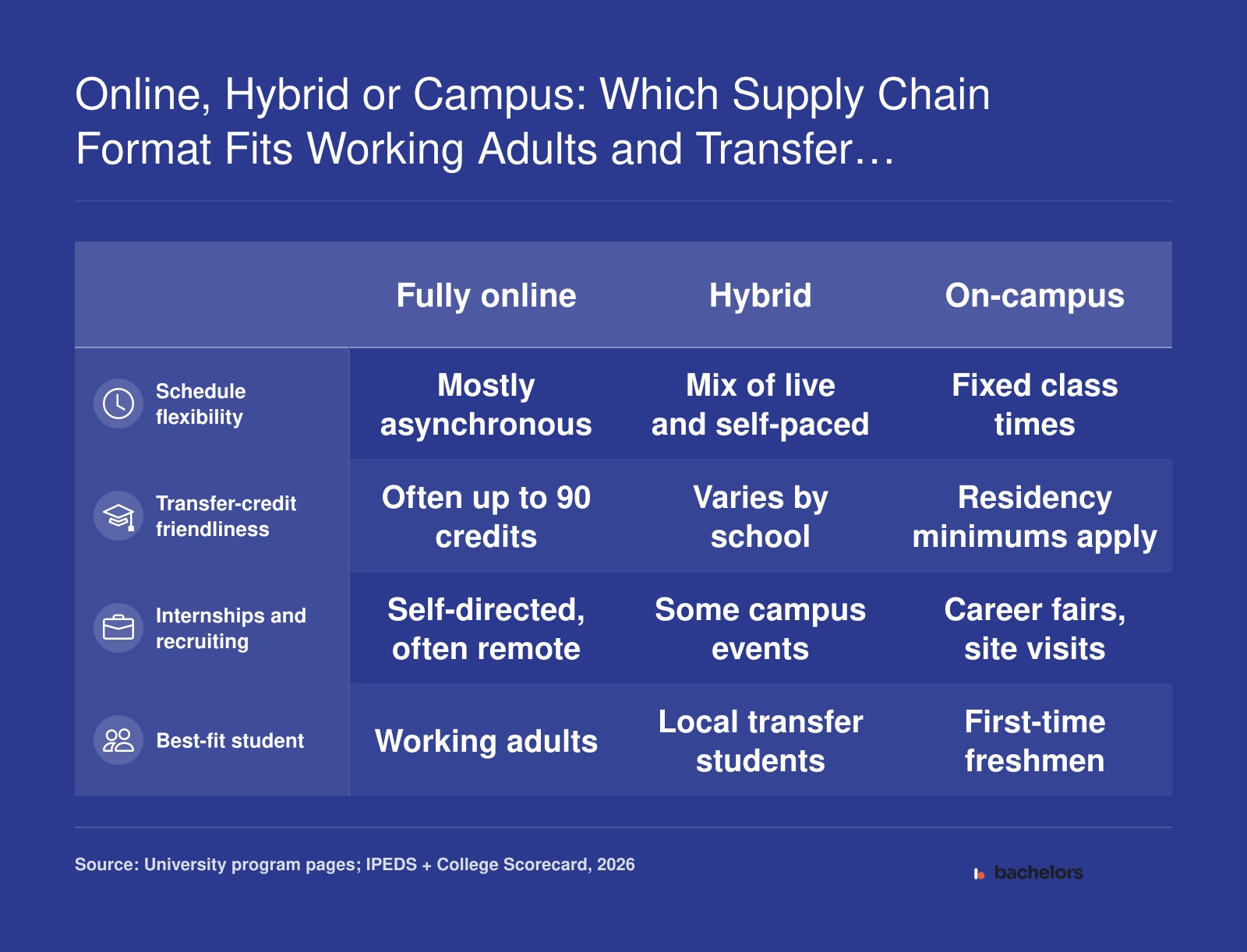
Online, Hybrid or Campus: Which Supply Chain Format Fits Working Adults and Transfer Students?
The schools ranked here deliver their supply chain degrees on campus, so working adults who need flexibility should also look at online programs that publish clear transfer rules. Franklin University accepts up to 94 transfer credits but requires 30 earned at Franklin, while the University of New Hampshire and USC Upstate each apply up to 90 credits toward a 120-credit degree. Rasmussen University applies a conferred associate degree as a 90 quarter-credit block toward its 180-credit program, and full-time students with that block can finish in as little as 18 months, depending on accepted credit and course load.
Related Articles
AACSB Accredited Supply Chain Management Programs: How to Check Before You Enroll
A famous campus name and a verified business-school credential are not the same thing, and only the second takes five minutes to check. AACSB accredits the business school, not each major on its own. A supply chain major inherits that status when it sits inside an accredited college of business.
What the Directory Confirms
AACSB's directory shows current business-school accreditation for these universities, each with a supply chain-related undergraduate offering:
- University of South Dakota: Bachelor of Business Administration in Supply Chain/Transport/Logistics.
- Grand Valley State University: Bachelor of Business Administration in Supply Chain/Transport/Logistics.
- University of South Carolina: Bachelor of Science in Business Administration, Supply Chain/Transport/Logistics.
- Saint Xavier University: Bachelor of Business Administration in Supply Chain Management.
- Clarkson University: Bachelor of Science in Supply Chain/Transport/Logistics.
- University of Hartford: Supply Chain & Logistics Management.
- Georgia College & State University: AACSB describes its undergraduate programs as accredited, though the exact supply chain major name is not established.
The University of Wisconsin-Madison's program listing also notes AACSB accreditation. For any other school you are considering, treat status as unconfirmed until you check it yourself.
How to Verify It Yourself
1. Open AACSB's online directory of accredited schools. 2. Search by the university's name and confirm the business school appears with current accreditation. 3. Check whether accreditation covers the whole institution or a single business unit, since that scope determines which majors are included. 4. Confirm your major is a business degree. Bachelor's programs with at least 25% business content (30 business credits in a 120-credit degree) are normally included unless AACSB approved an exclusion.
Why It Matters
Employers that recruit on campus often screen for accredited business schools. Accreditation can also smooth credit transfer if you change schools. Down the road, an AACSB-accredited bachelor's degree is a recognized credential when admissions committees review your background. Ask the school directly if the directory leaves any doubt about your specific major.
Top First-Year Earnings Among Ranked Programs
Among the ranked supply chain bachelor's programs, Georgia Tech's graduates post the highest early-career pay.
Questions to Ask Yourself
Do you prefer analytics-heavy work or negotiation-driven roles?
How many of your prior credits will the program accept?
Does the business school hold AACSB accreditation, and do your target employers recruit there?
Will you need asynchronous classes to keep working?
Logistics & Supply Chain Management programs by state
Quick Answers for Future Supply Chain Majors
These answers draw on the schools ranked on this page and on 2026 cost and earnings data. Costs and outcomes vary by school, residency and format, so use the figures as starting points for your own comparison.
What is the best degree for supply chain management?
Which university is best for a supply chain management bachelor's degree?
How much do supply chain management majors make?
Can you get a supply chain management degree online?
Is a supply chain management degree worth it?
Compare Logistics & Supply Chain Management programs on the data that matters
Explore more Business & Management majors or browse every field of study.
All Business & Management programs Browse every field of study