Best Online Organizational Leadership Degree Programs
Compare 300+ accredited online Organizational Leadership programs, with net price after aid, graduation rates, earnings and debt from IPEDS and the U.S. College Scorecard.

Leaving a job to finish a degree and finishing one while working are different bets, and for someone already supervising a team, only the second one keeps the paycheck coming. Each program on the list is 100% online, with no hybrid sessions or residency weekends to schedule around a shift.
Cost is where the list splits most. Average annual net price runs from $1,471 at St. Petersburg College to $21,786 at Washington University in St. Louis, a gap of more than $20,000 for the same general credential.
Several of the lowest-cost options are Bachelor of Applied Science completions that expect an associate degree on arrival.
Key Points
- Average annual net price starts at just $1,471 at St. Petersburg College.
- Northern Kentucky University's $11,088 in-state tuition drops to $8,191 average net price.
- Candidate or probation status in the federal DAPIP database isn't full accreditation.
The 10 Best 100% Online Organizational Leadership Bachelor's Programs
Every program below can be finished entirely online, with no campus visits and no hybrid requirements anywhere in the sequence. They range from a 60-credit degree-completion track finished in about two years to a full 120-credit bachelor's at a major public research university, and they include dedicated leadership majors as well as interdisciplinary degrees with a leadership concentration. Tuition, approximate average net price after aid, and institution-wide graduation rates sit alongside each entry so you can compare the numbers that shape the total bill.
University of Central Florida
#1Orlando, FL · ~$10,000/yr (est.)
Best for: Working adults with prior college credits
UCF's online operation is large and well established, and its Leadership BA/BS is built for students who want to shape the degree themselves, with nine concentration tracks stretching from commerce and healthcare to the arts and environmental sustainability. A Student Success Coach helps map the path, and a service-learning project puts the coursework to work in the student's own community. Partnerships with a long list of Florida state and community colleges make it one of the smoother transfers in the state for students arriving with an associate degree.
- Nine concentration tracks, from commerce and healthcare to the arts
- Coursework in organizational behavior, conflict resolution, and change management
- Prior college credit can count toward the 120-hour degree
- Service-learning project places students with a local organization
- Student Success Coach helps tailor the degree plan
- Starts in fall, spring, and summer
- Median earnings of $69,111 four years after finishing
- Commerce track built around corporate, retail, service, and entrepreneurial settings
- Up to 60 credits of electives and up to 30 internship credits
- Prepares students for HR manager and financial advisor career paths
- Emphasis on ethical, values-driven decision making
North Carolina State University at Raleigh
#2Raleigh, NC · $9,000 – $33,000/yr (est.)
Best for: Community college graduates entering public service
NC State's Leadership in the Public Sector degree is a completion program for students who already hold an associate degree or roughly 60 credits, aimed squarely at people heading into government and nonprofit work. Transfer agreements with 15 North Carolina community colleges, including a 45-credit direct-entry route for selected public safety programs, make it unusually friendly to working adults coming out of the state's two-year system. The program has been a fixture in national online rankings and draws heavily from military and public-service backgrounds.
- Degree-completion program for students with an associate degree or about 60 credits
- 30 credit hours of leadership in the public sector coursework
- Specializations in leadership security, nonprofit leadership, and public affairs
- Transfer up to 70 credit hours
- Agreements with 15 North Carolina community colleges
- Selected public safety programs transfer in with 45 credits
- 3.0 GPA minimum plus prerequisite courses
- Median earnings of $84,349 four years after finishing
Lake-Sumter State College
#3Leesburg, FL · ~$6,000/yr (est.)
Best for: Associate degree holders moving into management
Lake-Sumter State College sits in central Florida's lake country and specializes in applied bachelor's degrees that build directly on an associate degree. The Bachelor of Applied Science in Leadership runs 60 credit hours beyond the associate level, split between a core and an Organizational Management concentration, and it is aimed at people already working who want a credential that translates into supervisory responsibility. The concentration leans on entrepreneurial leadership and organizational change rather than abstract case studies.
- Organizational Management concentration
- 60 credit hours after the associate degree, about five semesters
- 30 hours of online core coursework plus 30 in the concentration
- $122.25 per credit
- Coursework in entrepreneurial leadership and organizational change
- 2.0 GPA minimum to enter
- Built for students who already hold an associate degree
Saint Johns River State College
#4Palatka, FL · ~$6,000/yr (est.)
Saint Johns River State College is a Florida state college whose applied bachelor's degrees are designed around adults who are already employed. The Organizational Management degree concentrates on supervision, with a health care option alongside the general management track, and it offers three start dates a year so students can enter without waiting for a single annual intake. Admission processing is quick, and the curriculum stays on practical department-level management: staffing, budgets, and operations.
- Supervision and Management concentration
- Two tracks: health care or supervision
- Three start dates a year, fall, spring, and summer
- Full-time and part-time options
- Application processing takes about two weeks
- Prepares students for mid-management roles in public, private, and nonprofit organizations
Washington University in St Louis
#5St. Louis, MO · ~$22,000/yr (est.)
Washington University in St. Louis is the most selective institution on this list, and its online bachelor's for adult learners is a Bachelor of Science in Integrated Studies with a leadership and management focus rather than a stand-alone business degree. Students assemble the degree from foundational, distribution, leadership management, and elective requirements, which suits people who want a rigorous credential they can shape around an existing career. Coursework covers group and organizational cultures, strategic planning, and finance.
- Leadership theory paired with strategy, finance, and organizational culture
- Students plan, implement, and evaluate initiatives and engage stakeholders
- Built from foundational, distribution, leadership management, and elective requirements
- Suits working adults balancing study with a full-time career
University of Oklahoma
#6Norman, OK · $15,000 – $20,000/yr (est.)
The University of Oklahoma runs its online leadership degrees through a dedicated online arm built for returning adult learners, with asynchronous eight-week sessions that let students keep working full time. Two routes are available: an interdisciplinary studies degree in organizational leadership and a stand-alone Bachelor of Arts in Organizational Leadership, and both accept substantial transfer credit from earlier college work. Faculty bring senior leadership experience, and a capstone pulls the coursework into a single finished project.
- $515 per credit with no application fee
- Asynchronous eight-week sessions
- Requires at least 60 transferable college credits and a 2.0 GPA
- Transfer up to 90 credit hours
- Capstone ePortfolio pulls the coursework together
- Rolling admissions with decisions inside two weeks
- $550 per credit and a $50 application fee
- Asynchronous eight-week course format
- Transfer in as few as 24 credits
- Capstone required to finish the degree
- Alumni network of more than 250,000
- Median earnings of $88,953 four years after finishing
Santa Fe College
#7Gainesville, FL · ~$11,000/yr (est.)
Santa Fe College pairs an associate-level foundation with applied bachelor's degrees, and its Organizational Management program adds a 24-credit professional core on top of a management concentration. The senior capstone asks students to research a real business process and pitch improvements to a sponsor, which gives graduates a work sample rather than just a transcript. Admission is built around transfer: an A.A., A.S., or equivalent plus a 2.5 GPA gets you in, and full-time students can finish in four terms.
- Management concentration with a 24-credit professional core and 15 management credits
- $126 per credit, about $7,579 total program tuition
- 60 total credit hours; full-time students finish in four terms
- Senior capstone researches a real business process for a sponsor
- Requires an A.A., A.S., or equivalent and a 2.5 GPA
- Six concentration options
- Military benefits accepted
California State University-San Marcos
#8San Marcos, CA · $10,000/yr (est. net price)
California State University San Marcos offers a two-year, 60-unit degree-completion program taught asynchronously, so students in the cohort move through the material together without fixed class times. The curriculum deliberately mixes business, education, and social science courses, which gives graduates a broader frame than a pure management degree. Credit for prior learning can shorten the runway for students arriving with substantial college work behind them, and the campus holds a Military Friendly Gold Award.
- $430 per credit
- Two-year, 60-unit degree-completion program
- Asynchronous, cohort-based format
- Five-unit capstone project
- Requires 60 transferable units
- Credit for prior learning can shorten the program
- Military Friendly Gold Award recipient
- Rolling admissions
St Petersburg College
#9St. Petersburg, FL · ~$1,500/yr (est.)
St. Petersburg College offers its Management and Organizational Leadership degree with five career-focused sub-plans, from digital marketing management to entrepreneurship, and coursework built around budgets, project delivery, and leading diverse teams. The program is designed with input from business and industry leaders and prepares students for the Project Management Institute certification exam alongside the degree. Every course requires a minimum grade of C, which keeps the credential consistent for employers who screen on it.
- Five career-focused sub-plans, including digital marketing and entrepreneurship
- Estimated total program cost of $10,814.64
- Prepares students for the Project Management Institute certification exam
- Coursework in developing fiscal plans and delivering projects within budget
- Curriculum built with input from business and industry leaders
- Minimum grade of C required in every course
- Median earnings of $62,040 four years after finishing
Southern Utah University
#10Cedar City, UT · $7,000 – $21,000/yr (est.)
Southern Utah University's Bachelor of General Studies is a build-your-own degree, and the organizational leadership track is one of five specialty areas students can choose. Because general studies programs tend to be generous about older credit, it is a realistic option for people returning to college after a long gap who want leadership coursework without committing to a single narrow major. A capstone course closes the program, and electives are chosen with an advisor rather than fixed in advance.
- Organizational Leadership track within the 120-credit Bachelor of General Studies
- Leadership track requires 15 credits
- Credit earned more than 20 years ago may count toward the major
- Capstone course required
- 2.0 cumulative GPA minimum
- One of five specialty tracks
- Not intended for Utah teacher certification
Cost & outcomes by school
Federal data for the highest-earning Organizational Leadership programs, independent of the ranking above. Earnings are this field's bachelor's graduates four years after completing where the Scorecard reports them, else the school's undergraduate median.
| School | Net price / yr | Grad rate | Earnings | Debt | Grads/yr | Format |
|---|---|---|---|---|---|---|
| University of Pennsylvania PA | $28,699 | 97% | $136,806 | $20,348 | 86 | Online |
| University of Massachusetts-Amherst MA | $22,383 | 83% | $92,623 | $20,500 | 361 | Online or campus |
| Syracuse University NY | $38,793 | 84% | $91,472 | $27,000 | 123 | Online |
| University of Oklahoma OK | $15,300 | 75% | $88,953 | $16,679 | 19 | Online |
| Washington University in St Louis MO | $21,786 | 94% | $86,182 | $17,500 | 25 | Online |
| North Carolina State University at Raleigh NC | $17,303 | 85% | $84,349 | $19,500 | 921 | Online |
| New York University NY | $37,050 | 88% | $82,509 | $20,500 | — | Online |
| Charter Oak State College CT | $15,815 | 67% | $82,069 | $20,497 | 79 | Online |
| Lipscomb University TN | $24,739 | 72% | $80,751 | $21,082 | 53 | Online |
| Grand Valley State University MI | $16,317 | 67% | $79,324 | $25,000 | 109 | Hybrid |
| University of the Pacific CA | $25,447 | 69% | $76,025 | $19,500 | 95 | Hybrid |
| Texas Tech University TX | $19,070 | 69% | $75,702 | $19,812 | 584 | Online |
Sources: U.S. Department of Education. Net price, graduation rate, earnings and debt: College Scorecard (earnings and debt for this field's bachelor's graduates where reported, else school-wide); graduates: IPEDS. A dash means no figure is reported.
Cost, debt & payoff
Median earnings of this field's bachelor's graduates (4 yrs after completing, else the school's undergraduate median) vs. their median federal loan debt · U.S. College Scorecard
Across these programs the median graduate earns about $63,247 and finishes with roughly $22,000 in debt — a ratio that clears a common rule of thumb (keep debt below first-year salary). Net price and debt vary widely school to school, so check the per-school figures in the table above before you shortlist.
Inside Our Scoring: Online-Only, Accredited, and Outcome-Tested
In online leadership education, "fully online" has become a meaningful filter rather than a marketing phrase. In 2026, a program that requires even one campus residency sits in a different category from one you can finish from anywhere, and the ranking below treats it that way.
The Online-Only Filter
Only bachelor's-level organizational leadership programs that can be completed entirely online made the cut. Hybrid programs were excluded outright, even when the online portion was substantial, because a required campus visit changes the math for a working adult.
What the Composite Captures
Scoring blends net price after aid, averaged across the institution, with the school's graduation rate and, where the College Scorecard reports them, program-level earnings and debt. The inputs come from the College Scorecard and IPEDS, using the latest available snapshot. Two caveats matter: the graduation rate and the net price describe the whole school rather than your program, so treat them as institutional context, not a promise about your major.
What It Does Not Measure
The ranking cannot tell you whether faculty answer emails, whether course design suits working adults, or how employers in your region view a given degree. It also says nothing about the quality of advising or the strength of the alumni network you would join. Those judgments take a conversation. Confirm transfer credit rules, course format, and any residency requirement directly with each school before you apply.
Online Organizational Leadership Degree Tuition and Cost: Sticker Price vs. What You Actually Pay
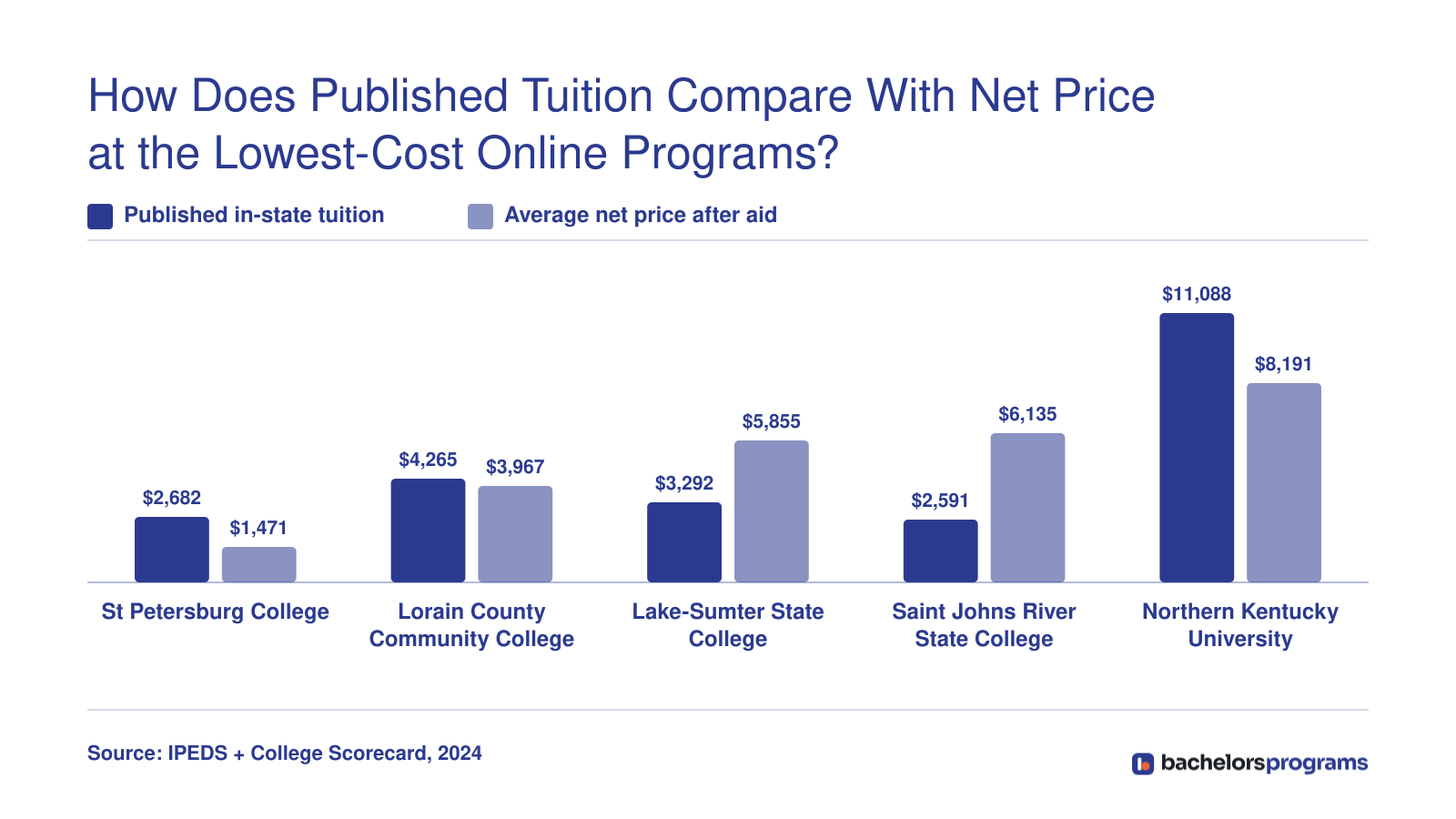
Net price, not published tuition, is the number that predicts your bill. Twenty-six of the 29 schools ranked here are public, and the gaps are wide. Average annual net price runs from $1,471 at St. Petersburg College to $10,462 at Southern Utah University. Published in-state tuition spans roughly $2,591 (Saint Johns River State College) to $11,088 (Northern Kentucky University). Out-of-state sticker prices climb as high as $22,467 at the University of Central Florida. Net price is the better yardstick because it subtracts grants and scholarships. It is a school-wide average, though, so adult online learners may see different results.
Estimating Your Total
Multiply annual net price by the years you will be enrolled, then subtract what transfers. As a rough illustration, two years at about $5,855 (Lake-Sumter State College) lands near $11,700. Transferring 60 or more credits can shrink the bill dramatically. Lorain County Community College and Northern Kentucky University both allow up to 90 transfer credits.
Aid Levers Worth Pulling
- FAFSA and Pell: File the FAFSA every year.1 Online students at eligible schools can qualify for Pell, generally if they have exceptional need and no prior bachelor's degree.1 Workforce Pell begins July 1, 2026, with age and school-determined limits.2
- Employer assistance: Section 127 lets employers pay up to $5,250 per employee per calendar year tax-free. Ask HR whether your plan covers online bachelor's coursework.
- Military benefits: Tuition Assistance is capped at $250 per credit hour across the major service branches3, and Liberty University and American Military University match that rate. Purdue Global advertises a 55% discount for active duty, Guard and Reserve members, veterans, and spouses. GI Bill benefits are a separate option. Confirm approval rules with your education office before enrolling.
- Discounts: Ask each school about adult-learner, alumni, and military rates.
Where Budget Readers Should Start
The lowest net prices here belong to St. Petersburg College ($1,471), Lorain County Community College ($3,967), Lake-Sumter State College ($5,855), Saint Johns River State College ($6,135), and Northern Kentucky University ($8,191). St. Petersburg College lists an estimated total program cost of $10,814.64. Treat these as starting points and request a personalized estimate before you commit.
How Does Published Tuition Compare With Net Price at the Lowest-Cost Online Programs?
Sticker price and what students actually pay can differ sharply. At Northern Kentucky University, published in-state tuition of $11,088 drops to an average net price of $8,191, a gap of nearly $2,900, while St Petersburg College falls from $2,682 to $1,471. At Lake-Sumter State College and Saint Johns River State College, net price runs higher than tuition because it counts housing, books, and other living costs before subtracting grant aid. Treat each net price as a schoolwide average for aided students, not a quote for the organizational leadership program, and run each school's net price calculator for your own figure.
Organizational Leadership Program Accreditation Online: The Checks to Run Before You Enroll
DAPIP, the U.S. Department of Education's Database of Accredited Postsecondary Institutions and Programs, sorts schools into statuses such as accredited, candidate, applicant, pre-accredited, and probation, and only "accredited" means the school currently holds full accreditation.
Start With Institutional Accreditation
Institutional accreditation covers the entire college or university. It is what makes your credits transferable, qualifies you for federal financial aid, and tells employers the degree is legitimate. The agencies once called regional accreditors are now known as institutional accreditors, so you may see either term.
Business Accreditation Is a Bonus, Not a Substitute
Some organizational leadership degrees sit inside a business school and may carry programmatic accreditation from AACSB International, ACBSP, or IACBE. AACSB's review generally extends to all of a school's business degrees unless some are expressly excluded. ACBSP accredits business and business-related programs from the associate to doctoral level, while IACBE uses an outcomes-based review often suited to smaller, teaching-oriented institutions. Many leadership programs, though, are housed in education, psychology, public administration, or organizational studies units and won't hold any of these seals. None of them replaces institutional accreditation.
Verify in Two Steps
- Search the databases: Look up the school's exact legal name in both the CHEA database and DAPIP. Confirm the listing is the degree-granting institution (not just a partner or online brand), the accreditor is recognized, and the status reads "accredited."
- Check the accreditor's directory: If a program advertises AACSB, ACBSP, or IACBE status, confirm in that accreditor's directory that your specific degree falls within scope.
Note the date you checked, since status can change.
Red Flags
Walk away if the accreditor isn't recognized by CHEA or the Department of Education, or if a marketing page is the only proof. Be cautious with nationally accredited schools too: regionally accredited colleges may refuse those credits if you transfer or apply to graduate school.
Related Articles
Concentrations, Transfer Credit, and Course Format: Where Online Programs Really Differ
Concentrations
Online organizational leadership degrees now share a similar leadership core, so the real differences show up in specializations, credit policies, and how classes meet. UCF offers nine concentration options in its Leadership BA/BS. Santa Fe College lists six, and St. Petersburg College and Southern Utah University list five each. St. Petersburg's tracks include Digital Marketing Management, and its coursework prepares you for a Project Management Institute certification exam. Southern Utah requires 15 credits per track. NC State's Leadership in the Public Sector program points toward public service, nonprofits, and law. Several Florida options, including Lake-Sumter State College (Organizational Management) and Saint Johns River State College (Supervision and Management), are 60-credit applied bachelor's programs built for associate degree holders.
Transfer Credit and Prior Learning
Many programs cap transfer credit at 90, but the fine print varies. Tiffin University accepts up to 90 credits but requires at least 48 to enroll.1 Appalachian State pairs its 90-credit ceiling with a 24-credit minimum. Louisville separates the sources, allowing up to 60 credits from community colleges and 90 from four-year schools.3 At UMass Global, 90 credits equal 75 percent of the degree.2 NC State accepts up to 70. Louisville's prior learning assessment can award up to 48 credits for work and military experience, though many students earn fewer.4 Cal State San Marcos also offers credit for prior learning. Ask each school whether exam credit such as CLEP counts.
Timeline and Format
Starting from scratch, 120 credits takes about four years. Transfer students on accelerated terms can often finish in 18 to 24 months. Terms run seven weeks at Tiffin, eight at Oklahoma and Louisville, and 7.5 at Buena Vista, which has six start dates a year.5 Penn State World Campus uses longer 12- to 15-week semesters.6
Tiffin, Oklahoma, Louisville, Appalachian State, and Cal State San Marcos use asynchronous courses, which suit shift workers and parents. Buena Vista adds live virtual classes, a better fit if you want real-time discussion. Expect a capstone at the end. Oklahoma, Santa Fe, Cal State San Marcos, and Southern Utah all require one.
Training and Development Managers: A Standout Leadership Salary
Organizational Leadership vs. Business Administration: Which Degree Fits You?
Both degrees prepare you to manage, but they start from different places: organizational leadership from people and behavior, business administration from the functional disciplines of business. Organizational leadership suits people managers and career-changers in non-corporate sectors such as nonprofits, government, and healthcare. Business administration suits readers aiming at finance, marketing, or a future MBA that expects quantitative prerequisites.
| Factor | Organizational Leadership | Business Administration |
|---|---|---|
| Core focus | The human side of leadership: communication, conflict management, team dynamics, and organizational change | Broad business functions: finance, marketing, operations, and data-driven decision-making |
| Typical coursework | Behavioral Dynamics in Organizations; Theory and Practice of Leadership; Organizational Ethics; Diversity and Organizations | Fundamentals of Financial Accounting; Statistics; Survey of Marketing; Operations Management |
| Quantitative load | Lighter. The program descriptions reviewed stress behavior and strategy over accounting or finance and do not specify a required statistics course | Heavier. Expect accounting, statistics, and required business analytics and spreadsheet modeling courses |
| Applied learning | Two-course capstone: strategic analysis of a real organization, then a personal career plan | Three career-development courses, from exploring options to implementing a career plan |
| Typical career paths | Organizational development consultant, director of training, diversity and inclusion specialist, operations supervisor, talent manager | Financial analyst, marketing manager, business consultant, operations manager, sales manager |
| Best-fit student | Someone who wants people-centered leadership skills that transfer across industries | Someone who wants broad business grounding and stronger analytical exposure |
| Programmatic business accreditation | Often housed outside a business school, so it may not fall under business accreditors. Confirm with each school | Typically eligible for business accreditors such as AACSB or ACBSP when offered through an accredited business school |
Questions to Ask Yourself
Do I want to lead people and change, or run budgets and functional departments?
How many credits am I bringing, and will each school accept enough of them?
Will my employer's tuition benefit limit which schools qualify?
Can I commit to scheduled live sessions, or do I need fully asynchronous courses?
Organizational Leadership programs by state
Compare Organizational Leadership programs on the data that matters
Explore more Business & Management majors or browse every field of study.
All Business & Management programs Browse every field of study