Best Organizational Leadership Degree Programs
Compare 450+ accredited Organizational Leadership programs at 340+ colleges, with net price after aid, graduation rates, earnings and debt from IPEDS and the U.S. College Scorecard.

An organizational leadership bachelor's degree teaches the management side of work: staffing, change management, budgets, and accountability, usually without the full quantitative core of a business degree. Working adults and newly promoted supervisors are the typical students, and many pay their own way.
Net price after aid among the schools ranked here runs from about $10,400 a year to roughly $40,500, a spread that rarely tracks what graduates later earn. Delivery ranges from fully online to traditional campus.
Accreditation is easy to miss: leadership programs often sit outside the business school, so AACSB, ACBSP, or IACBE stamps do not automatically apply.
Key Points
- Online public in-state tuition averages about $356 per credit nationally.
- UNC-Chapel Hill graduates report the highest program-level earnings among ranked schools.
- Penn, UCF, WashU, and NC State deliver their leadership programs online.
The 10 Best Organizational Leadership Degree Programs for 2027
This list rewards what a degree actually costs, how reliably students finish it, and what graduates earn afterward, not the size of the campus name. Public flagships, a technical institute, and a handful of private universities sit side by side here because the numbers put them there.
Georgia Institute of Technology
#1Atlanta, GA · ~$12,000/yr (est.)
Best for: Business-minded students in technical fields
Georgia Tech's bachelor's in business administration lets students lock in the Leadership and Organizational Change concentration by the end of sophomore year, and the school graduates 94% of students. Median earnings for graduates of this program reached $106,155 four years after completion. Ambitious students can add the International Plan or double count up to six credits toward a master's degree.
- Leadership and Organizational Change concentration, chosen by sophomore year
- 8 concentration options across the business school
- International Plan available for business students
- Double count up to 6 credits toward the BSMS master's option
- Elective hours tailor the degree toward marketing, finance, or strategy
University of Pennsylvania
#2Philadelphia, PA · $29,000/yr (est. net price)
Best for: Working adults drawn to public policy
Penn's Bachelor of Applied Arts and Sciences lets students concentrate in Leadership and Communication or in Organizational Studies, and both build leadership theory alongside practical communication and analytics. The school graduates 97% of students, and graduates of these programs earned a median of $136,806 four years after completion. The Leadership and Communication concentration was co-designed with Civic, a Washington, DC organization, so coursework connects to real policy and public work.
- 12 courses total, with prerequisite courses required
- Curriculum co-designed with Civic, a Washington, DC organization
- Admission requires two prior leadership courses and a B average
- Dual certificates available in Leadership and Communication and Applied Positive Psychology
- No transfer credits accepted for the concentration
- Students build a five-year leadership plan
University of Central Florida
#3Orlando, FL · ~$10,000/yr (est.)
Best for: Career changers exploring several industry tracks
UCF's Leadership BA and BS gives students nine concentration options, from commerce and healthcare to technology, education, and nonprofit work. The school graduates 78% of students, and graduates earned a median of $69,111 four years after completion. Coursework covers organizational behavior, team dynamics, conflict resolution, change management, and strategic planning, with a Student Success Coach helping shape the plan.
- 9 concentration options, from commerce and healthcare to nonprofit and the arts
- $179 per credit; 120 total credit hours
- Prior college credits can count toward the degree
- Starts in fall, spring, and summer
- Student Success Coach support throughout
- Service-learning project in your own community
University of North Carolina at Chapel Hill
#4Chapel Hill, NC · ~$12,000/yr (est.)
Carolina's Human and Organizational Leadership Development major blends leadership theory with organizational and community development, research methods, and data-informed decision making. The school graduates 91% of students, and graduates earned a median of $135,874 four years after completion. The 45-credit major takes at least three semesters after admission and closes with a capstone applied to a real organization.
- 45 credit hours over at least three semesters
- 2.5 GPA recommended for admission, with entry offered every semester
- Capstone project with a real organization
- Quantitative and qualitative research methods coursework
- Electives drawn from business, communication, sociology, public policy, and education
- Honors thesis option for students with a 3.3 GPA
- Study abroad advising available
Washington University in St Louis
#5St. Louis, MO · ~$22,000/yr (est.)
Washington University's Bachelor of Science in Integrated Studies with a Leadership and Management focus teaches how groups, teams, and organizations actually work, from strategic planning and finance to stakeholder engagement. The school graduates 94% of students. Foundational, distribution, leadership management, and elective requirements let students shape the degree around their own goals while balancing study with a career.
- Foundation in leadership and strategic planning
- Study of group and organizational cultures
- Coursework in planning, implementing, and evaluating initiatives
- Practice engaging stakeholders and drawing on community resources
- Prepares leaders for business, government, and nonprofit organizations
- Format built for working adults balancing study with a career
North Carolina State University at Raleigh
#6Raleigh, NC · $9,000 – $33,000/yr (est.)
NC State's Bachelor of Arts in Leadership in the Public Sector is a degree-completion program for students who already hold an associate degree or about 60 college credits. The school graduates 85% of students, and graduates earned a median of $84,349 four years after completion. Students take 30 credit hours of leadership coursework plus a specialization, with no rigid class schedule and no commute.
- Degree-completion format with no rigid class schedule
- 30 credit hours of core and elective leadership courses
- Specializations in nonprofit leadership, public affairs leadership, and leadership security
- Transfer up to 70 credit hours
- 3.0 GPA minimum; 120 total credit hours
- Pathway to law school and graduate study in public administration
- Pre-application assessment available
California State Polytechnic University-Pomona
#7Pomona, CA · $10,000 – $15,000/yr (est.)
Cal Poly Pomona's Management and Human Resources option, with a Management and Leadership emphasis, covers hiring, employment law, ethics, diversity, training, and organizational strategy through the university's learn-by-doing model. The school graduates 68% of students, and graduates earned a median of $70,954 four years after completion. The HR track aligns with SHRM certification, and the campus PIHRA chapter offers workshops and industry networking.
- Learn-by-doing model built around hands-on projects
- Coursework in employment law, ethics, diversity, training, and strategy
- HR track aligns with SHRM certification
- 3 concentration options within the option
- PIHRA chapter for workshops, networking, and industry experience
- Paths into HR management, corporate recruiting, benefits, and operations
Babson College
#8Wellesley, MA · ~$41,000/yr (est.)
Babson's Leadership, People and Organizations concentration sits inside the bachelor's in business administration and covers negotiations, networking, workplace diversity, strategic decision making, and project management. The school graduates 93% of students, and graduates earned a median of $107,520 four years after completion. A Management Consulting Field Experience places students inside real organizations before they graduate.
- Core coursework in negotiations, networking, and career building
- Electives in strategic decision making, organizational leadership, and project management
- Management Consulting Field Experience with real organizations
- Training in ethical decision making and respectful, inclusive behavior
- Group projects, experiential learning, and presentations
- Pairs with the bachelor's in business administration
University of Washington-Bothell Campus
#9Bothell, WA · ~$12,000/yr (est.)
At UW Bothell, the Business Administration option in Leadership and Strategic Innovation pairs a full business core with a deliberate focus on guiding teams and shaping an organization's future direction. The school graduates 65% of students, and graduates earned a median of $78,771 four years after completion. It sits alongside concentrations in accounting, finance, marketing, and supply chain management, so students can see where leadership fits in the wider business curriculum.
- Offered by the UW Bothell School of Business
- Pairs a business administration core with leadership and innovation
- Sits alongside accounting, finance, marketing, and supply chain options
- Focus on how organizations set strategy and adapt to change
Purdue University
#10West Lafayette, IN · ~$15,000/yr (est.)
Purdue's Organizational Leadership BS, housed in the Department of Technology Leadership and Innovation, builds people skills and business instincts through real projects, internships, and user testing. The school graduates 83% of students, and graduates earned a median of $81,040 four years after completion. The degree is ATMAE accredited, and the Degree in 3 option lets students finish a year early.
- Tracks: project management, business intelligence, organizational design and transformation
- ATMAE accredited
- Degree in 3 option lets students finish a year early
- Hands-on internships, real-world projects, and user testing
- Coursework in ethics, diversity, innovation, and organizational change
- Skills in scoping work, reading financial data, and managing conflict
- Study abroad experiences offered
Cost & outcomes by school
Federal data for the highest-earning Organizational Leadership programs, independent of the ranking above. Earnings are this field's bachelor's graduates four years after completing where the Scorecard reports them, else the school's undergraduate median.
| School | Net price / yr | Grad rate | Earnings | Debt | Grads/yr | Format |
|---|---|---|---|---|---|---|
| University of Pennsylvania PA | $28,699 | 97% | $136,806 | $20,348 | 86 | Online |
| University of North Carolina at Chapel Hill NC | $11,655 | 91% | $135,874 | $14,239 | 435 | Campus |
| University of Illinois Urbana-Champaign IL | $14,355 | 85% | $107,904 | $19,087 | 81 | Campus |
| Babson College MA | $40,514 | 93% | $107,520 | $22,766 | 762 | Campus |
| Georgia Institute of Technology GA | $12,116 | 94% | $106,155 | $21,500 | 416 | Campus |
| University of Wisconsin-Madison WI | $17,354 | 90% | $100,005 | $20,000 | 226 | Campus |
| Miami University OH | $28,384 | 80% | $95,796 | $24,250 | 96 | Campus |
| Loyola University Maryland MD | $30,574 | 79% | $93,753 | $27,000 | 19 | Campus |
| University of Massachusetts-Amherst MA | $22,383 | 83% | $92,623 | $20,500 | 361 | Online or campus |
| Saint Louis University MO | $24,398 | 80% | $91,483 | $34,391 | 20 | Campus |
| Syracuse University NY | $38,793 | 84% | $91,472 | $27,000 | 123 | Online |
| Michigan State University MI | $19,680 | 81% | $91,187 | $21,500 | 427 | Campus |
Sources: U.S. Department of Education. Net price, graduation rate, earnings and debt: College Scorecard (earnings and debt for this field's bachelor's graduates where reported, else school-wide); graduates: IPEDS. A dash means no figure is reported.
Cost, debt & payoff
Median earnings of this field's bachelor's graduates (4 yrs after completing, else the school's undergraduate median) vs. their median federal loan debt · U.S. College Scorecard
Across these programs the median graduate earns about $63,247 and finishes with roughly $22,000 in debt — a ratio that clears a common rule of thumb (keep debt below first-year salary). Net price and debt vary widely school to school, so check the per-school figures in the table above before you shortlist.
What Put These Programs on the List
A leadership degree should lead somewhere you can afford to go, so the scoring started with price and finished with payoff.
What Went Into Each Pick
Five inputs shaped the order of the programs below:
- Net price: the average cost after grants and scholarships, not the sticker tuition.
- Graduation rate: the share of students at the institution who finish a bachelor's degree.
- Earnings and debt: program-level median figures from the College Scorecard, where the federal government publishes them.
- Completions: how many students earn the degree each year, a signal that a program is established.
- Format flexibility: online, hybrid, or evening options that work around a full-time job.
Where the Data Falls Short
None of these measures is perfect, and you should know the limits. Graduation rates describe the whole school, not the leadership major alone. Net price is a sector average, so your own bill depends on your aid package and transfer credits. Where a program publishes no earnings figure, the school was judged on the remaining inputs rather than guessed at.
Why the Criteria Matter
Many competing lists declare a school "top" without saying why. That leaves you unable to tell whether a ranking reflects value or marketing. Stated inputs let you check the logic and reweigh it. If cost matters more to you than completions volume, you can read the list that way.
Organizational Leadership Degree Cost: Tuition, Fees, and What You Actually Pay
Sticker tuition has stopped meaning much in online higher education, and leadership degrees show the gap plainly. National averages for online bachelor's programs run about $356 per credit for public in-state students ($40,536 for the full program), $492 per credit for public out-of-state students ($59,011), and $542 per credit at private colleges ($63,185). Organizational leadership programs tend to land lower, roughly $250 to $500 per credit, or $30,000 to $60,000 for the full degree.
Sticker Rate Versus Net Price
Net price, the figure left after grants and scholarships, is the number worth comparing. The spread runs from about $804 at North Florida College to roughly $15,435 at UNC Charlotte. The public-private split shows up per credit as well: private programs average about $186 more per credit than public in-state ones, and the published total program cost differs by close to $22,650 ($63,185 at private colleges versus $40,536 for public in-state students).
Fees the Per-Credit Rate Hides
Technology fees, online course fees, and graduation or assessment fees rarely appear in the headline rate. USC Upstate pairs its $467 per credit with a $12 per-semester technology fee, a $10.50 per-credit health fee, a $50 per-semester security fee, and a $45 application fee.1 Arkansas State advertises $302 per credit with all fees included, and CSU Global charges $385 per credit with no fees at all.2 Ask for the fee schedule in writing before you commit.
What Borrowing Actually Looks Like
At the ranked schools that report it, median federal debt for graduates who borrowed falls between about $13,700 and $21,500.3 On a standard 10-year repayment plan, that works out to roughly $145 to $228 a month.
One lever outweighs the rest: transfer credits. Arriving with an associate degree can cut the tuition bill nearly in half before any scholarship applies, so check how many credits each program will accept.4
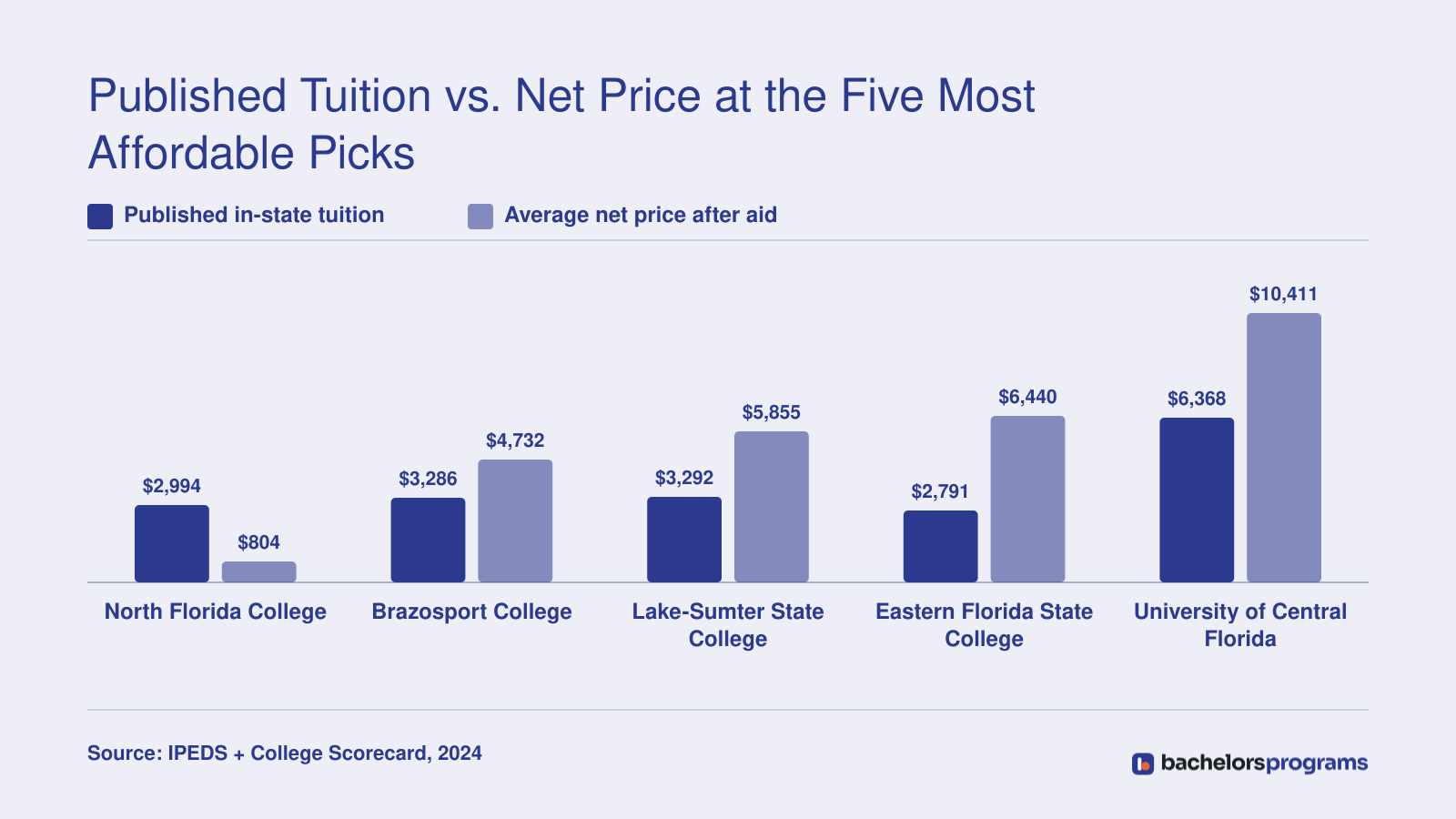
Published Tuition vs. Net Price at the Five Most Affordable Picks
Published tuition is only part of the cost. Average net price is an institution-wide figure: the full cost of attendance, including books, housing and other expenses, minus grants and scholarships. It is not a guaranteed quote, and it can run higher than tuition alone. University of Central Florida shows the widest gap, with $6,368 in published in-state tuition against a $10,411 average net price, while North Florida College is the only school here where net price ($804) falls below tuition ($2,994).
Related Articles
Online, On-Campus, or Both: Matching the Format to Your Workweek
Working adults now expect flexible delivery in leadership programs; it is no longer a side option. The schools here reflect that split. Penn, UCF, Washington University in St. Louis, and NC State deliver their programs online, while Georgia Tech, UNC Chapel Hill, Cal Poly Pomona, Babson, UW Bothell, and Purdue are campus-based. None is listed as a true hybrid.
Where Campus Options Sit
The campus programs are spread out: Georgia, North Carolina, California, Massachusetts, Washington, and Indiana. North Carolina is the one state offering both a campus path (UNC) and an online path (NC State).
What Flexible Delivery Means
- Asynchronous courses: You watch lectures and submit work on your own schedule, with deadlines instead of set login times.
- Accelerated terms: Shorter sessions let you take fewer courses at once and finish them faster.
- Optional campus sessions: Some programs offer in-person events you can attend but don't have to.
Concentrations and Who They Fit
- Leadership and Organizational Change (Georgia Tech): Fits future managers heading into corporate transformation work.
- Leadership and Communication (Penn): Suits people who persuade, present, and coach.
- Management and Leadership (Cal Poly Pomona): Pairs with human resources and startup paths.
- Organizational Leadership (Babson): Works for business majors adding people skills.
- Leadership and Strategic Innovation (UW Bothell): Fits those drawn to strategy.
- Project management (Purdue): Suits technical and operations roles.
- Leadership in the Public Sector (NC State): Targets government and nonprofit careers.
The Practical Trade-Off
Campus programs build local networks of classmates, faculty, and employers in one region. Online programs let you apply Monday's reading to Tuesday's meeting, which makes coursework immediately useful if you already manage people.
Institutional and Business-School Accreditors Compared
Institutional accreditation is the baseline for any bachelor's program. Business accreditors from AACSB, ACBSP, and IACBE add a second layer, but only for programs housed in a business school. Many organizational leadership degrees sit in colleges of arts and sciences, professional studies, or education, so holding institutional accreditation alone is normal and not a warning sign. Business accreditation matters most if you plan to pursue an MBA or expect to apply to employers that screen for it.
| Factor | Institutional (regional) | AACSB | ACBSP | IACBE |
|---|---|---|---|---|
| What it accredits | The whole institution. The U.S. Department of Education lists recognized agencies, including those covering schools that offer the baccalaureate or above. | Business education programs. The Department of Education treats programmatic agencies as a separate category. | Business programs, typically assessed within a business unit (confirm scope on its website). | Business programs, typically assessed within a business unit (confirm scope on its website). |
| Selectivity | Required baseline for most schools. Recognition by the Department of Education is tied to federal student aid eligibility. | Widely viewed as the most selective. It lists 1,104 accredited institutions in 72 countries and territories. | Generally viewed as less selective than AACSB. Check its directory for current totals. | Generally viewed as less selective than AACSB. Check its directory for current totals. |
| What it signals | The school meets institution-wide quality standards and its credits are more likely to transfer and be recognized. | The business school has passed a rigorous program-level review, which some employers and graduate programs value. | Commonly described as emphasizing teaching quality and measured outcomes. | Commonly described as emphasizing mission-driven outcomes assessment. |
| How to verify | Use the Department of Education's Search Institutional Accreditation System or its View Agencies page. | Use the Accredited Schools search on AACSB's website, which offers geographic filters. | Use the accredited-program directory on ACBSP's own website. | Use the accredited-program directory on IACBE's own website. |
| Matters most when | Always. Confirm it before you apply to any program. | You are planning an MBA at a selective school or targeting employers that screen by it. | You want a business-school credential beyond institutional accreditation, or your employer asks for it. | You want a business-school credential beyond institutional accreditation, or your employer asks for it. |
What Can You Do With an Organizational Leadership Degree?
An organizational leadership degree trains you to manage people and processes, so it leads to a range of management roles rather than one job title. The Bureau of Labor Statistics Occupational Outlook Handbook lists several occupations where graduates commonly land.1 The figures below are national medians for each occupation (May 2025) and projected growth for 2025 to 2035. They describe the jobs, not what degree holders earn as a group, and they are not starting salaries.
Common Roles and What They Pay
- Human resources manager: $149,280 median, 6% projected growth.2
- Training and development manager: $133,000 median, 6% projected growth.3
- General and operations manager: $105,770 median.1 The source reviewed here gives no separate 2025 to 2035 growth rate for this role.
- Management analyst: $101,860 median, 10% projected growth.4
- Social and community service manager: $80,390 median, 7% projected growth.5
Most of these roles ask for work experience on top of a bachelor's degree, so the figures reflect established managers more than new graduates.
Where Graduates Get Hired
The skills transfer widely. Healthcare systems, government agencies, nonprofits, logistics companies, and schools all need people who can coordinate teams, manage budgets, and lead change. Nonprofit and public-sector work lines up most closely with social and community service management, while consulting-style analyst roles span every one of these industries.
Is It Worth It?
It depends on where you are starting. The degree pays off most for people who already have work experience and want to move into management. A supervisor, team lead, or specialist gains the credential and the leadership vocabulary that promotion committees look for. As a stand-alone credential for an entry-level candidate with no work history, it is weaker, because employers hiring for the roles above usually want proof you have managed projects or people. If you are early in your career, pair the degree with internships or a technical specialty to strengthen your case.
Top Program-Level Earnings Among Ranked Schools
Graduates of UNC-Chapel Hill's Human and Organizational Leadership Development program report the highest program-level earnings of any school ranked here.
Questions to Ask Yourself
Do you want to manage people and change, or budgets, operations, and data?
Is an MBA in your five-year plan?
Does your employer promote supervisors from within based on a degree in any field?
Organizational Leadership programs by state
Compare Organizational Leadership programs on the data that matters
Explore more Business & Management majors or browse every field of study.
All Business & Management programs Browse every field of study