Best Statistics Degree Programs
Compare 340+ accredited Statistics programs, with net price after aid, graduation rates, earnings and debt from IPEDS and the U.S. College Scorecard.

Statistics is increasingly taught alongside data science rather than as a branch of pure mathematics. UCLA and UC Santa Barbara now award degrees titled "Statistics and Data Science," while Berkeley, Harvard, and Michigan keep the traditional name.
The biggest differences between programs are cost and early pay. Among the top-ranked schools, average net price runs from $6,541 a year at the University of Florida to $21,590 at Columbia. Median earnings one year after graduation span $49,264 at UC Davis to $141,116 at Harvard.
Prestige does not line up neatly with value. Florida's statistics graduates earned a median $59,619 in their first year after finishing, at a net price below $7,000.
Key Points
- CUNY Baruch College leads on cost: $3,033 average net price yearly.
- Four common statistics occupations all paid 2025 median wages above $85,000.
- Our rankings use federal College Scorecard outcomes, not school reputation.
Best Statistics Schools at a Glance: Our Top 10
The ten statistics programs below are compared on net price, institution-wide graduation rates, and, where a school publishes them, program-level earnings and debt for recent graduates. Each card gives you the format, the city and state, and the numbers a prospective student needs before applying.
University of California-Los Angeles
#1Los Angeles, CA · $13,000/yr (est. net price)
Best for: Los Angeles data science aspirants
UCLA is a public research university in Los Angeles, California, and its statistics program is campus-based. Undergraduates face an average net price of $12,548, and the school graduates 93% of students. Median earnings for statistics graduates came in at $59,718 one year after finishing. The department now carries the Statistics and Data Science name, and the coursework leans on the same machine-learning and statistical tools used in industry rather than pure theory alone.
- Department renamed Statistics and Data Science
- Kept separate from UCLA's Data Theory major
- Emphasizes applied statistical and machine-learning tools
- Applications include computational biology and environmental statistics
- Coursework spans probability, inference, and regression modeling
- Hands-on programming in R and Python
- Prepares students for analytics, research, and technology roles
University of California-Berkeley
#2Berkeley, CA · ~$13,000/yr (est.)
Best for: Actuarial and quant-finance track students
UC Berkeley is a public university in Berkeley, California, offering its statistics major in a campus format. The average net price is $13,481 and the school graduates 93% of students. Statistics graduates reported median earnings of $83,227 one year after finishing, among the strongest figures on this list. The major now sits inside the College of Computing, Data Science, and Society, and students build their own applied cluster from departments across campus.
- 14 total courses with a 2.0 GPA minimum
- Design your own applied cluster across campus departments
- Honors thesis with a faculty mentor
- Actuarial career preparation, including VEE-approved courses
- Graduate courses may substitute for undergraduate requirements
- Housed in the College of Computing, Data Science, and Society
- Careers in biotech, finance, genomics, and pharmaceuticals
University of Florida
#3Gainesville, FL · ~$7,000/yr (est.)
Best for: Florida residents seeking the lowest net price
The University of Florida is a public university in Gainesville, Florida, with a campus-based statistics program. It posts the lowest net price in this group at $6,541, and the school graduates 91% of students. Statistics graduates earned median pay of $59,619 one year after finishing. The department runs parallel BA and BS tracks, so students can aim at secondary teaching or at graduate study in statistics.
- 120 total credit hours with a capstone required
- Separate BA and BS tracks in Statistics
- BA requires 42 major credits and suits secondary teaching
- BS emphasizes mathematics for graduate study
- Coursework in regression and design of experiments
- Minor in actuarial science available
- Department advisor consultation required to shape the plan
University of California-Santa Barbara
#4Santa Barbara, CA · $15,000 – $20,000/yr (est.)
UC Santa Barbara is a public university in Santa Barbara, California, and its statistics program is campus-based. The average net price is $16,109 and the school graduates 83% of students. Statistics graduates reported median earnings of $55,110 one year after finishing. Statistics and Data Science is the most popular major on campus, and a capstone pairs students with both a faculty member and a graduate student mentor on real research.
- Most popular major on campus
- Data Science Capstone with a faculty and graduate mentor
- Clubs include the UCSB Data Science Club and Girls Who Code
- Coursework touches machine learning, big data, and analytics
- Common career pathway: consulting and technology
- Prepares students for graduate study in statistics or finance
Harvard University
#5Cambridge, MA · $15,000 – $20,000/yr (est.)
Harvard University is a private university in Cambridge, Massachusetts, and its statistics concentration is campus-based. The average net price is $19,066, and the school graduates 98% of students, the highest rate here. Statistics graduates reported median earnings of $141,116 one year after finishing. Admission is highly selective, with an admit rate near 4%, and the concentration can be combined into an A.B./A.M. path, with a part-time A.L.B. option for working adults.
- A.B. concentration in Statistics at Harvard College
- A.B./A.M. combined degree option
- Focus on principled data collection and analysis
- Modeling randomness across social, natural, and medical sciences
- A.L.B. pathway allows part-time study for working professionals
University of California-Davis
#6Davis, CA · $10,000 – $15,000/yr (est.)
UC Davis is a public university in Davis, California, offering statistics in a campus format. The average net price is $14,741 and the school graduates 86% of students. Statistics graduates reported median earnings of $49,264 one year after finishing. Davis is the most flexible option on this list, with separate A.B. and B.S. degrees and five concentration options that let students tilt toward machine learning, computation, or a general statistics track.
- A.B. and B.S. degrees offered
- Five concentration options, including machine learning
- Applied statistics track available for the A.B.
- Curriculum includes calculus, linear algebra, computer science
- General track prepares students for graduate study
- Prepares graduates for actuarial and consulting roles
Columbia University in the City of New York
#7New York, NY · ~$22,000/yr (est.)
Columbia University is a private university in New York, New York, and its statistics major is campus-based. The average net price is $21,590, and the school graduates 96% of students. Admission is highly selective, with an admit rate around 4%. The major runs 14 courses with a heavy mathematics and probability core, and a BA/MA option lets undergraduates finish both degrees in less time.
- 14 courses including four math prerequisites
- Five core courses in probability and statistics
- Three advanced electives, one at the 4221 to 4291 level
- BA/MA option lets undergraduates finish both degrees sooner
- Summer research internship with housing allowance and stipend
- Joint majors with computer science, economics, and math
- Departmental honors for up to 10% of graduating majors
- Courses graded Pass/D/Fail or D do not count toward the major
University of Chicago
#8Chicago, IL · ~$15,000/yr (est.)
The University of Chicago is a private university in Chicago, Illinois, with a campus-based statistics program. The average net price is $14,860, and the school graduates 96% of students. Statistics graduates reported median earnings of $82,681 one year after finishing. The major is one of the most mathematically demanding here, pairing a 42-credit core with electives in Bayesian analysis and causal inference, plus a joint BA/MS or BS/MS route.
- 42 total credit hours
- Joint BA/MS or BS/MS option
- Honors option with a bachelor's paper
- Electives in Bayesian analysis, causal inference, biostatistics
- Coursework in optimization and machine learning
- Python and Jupyter notebooks used in courses
- Strong training in mathematics and computation
- Prepares students for graduate study in statistics
Rice University
#9Houston, TX · ~$13,000/yr (est.)
Rice University is a private university in Houston, Texas, and its statistics program is campus-based. The average net price is $13,370, and the school graduates 95% of students. Admission is selective at roughly 8%. The BS in Statistics emphasizes probability, inference, and statistical computing, and Rice undergraduates in science and engineering can continue into a fifth-year Master of Statistics.
- 120 total credit hours with a senior capstone
- Probability, statistical inference, and statistical computing
- Electives in machine learning, Bayesian inference, time series
- Fifth-year Master of Statistics option for Rice students
- Transfer credit capped at nine hours
- Summer internships and research encouraged
University of Michigan
#10Ann Arbor, MI · $18,000 – $61,000/yr (est.)
The University of Michigan is a public university in Ann Arbor, Michigan, offering statistics in a campus format. The average net price is $13,138, and the school graduates 93% of students. Statistics graduates reported median earnings of $64,371 one year after finishing. The major requires a 29-credit core plus a capstone, and an honors track at a 3.4 GPA leads to a senior thesis.
- Minimum 29 credits, with 15 on the Ann Arbor campus
- Capstone course required
- Prerequisites include multivariable calculus and linear algebra
- Electives in statistics, mathematics, or computer science
- Honors major with a 3.4 GPA and senior thesis
- Apply statistics to economics, biology, and psychology
- Prerequisites may be taken Pass/Fail
Cost & outcomes by school
Federal data for the highest-earning Statistics programs, independent of the ranking above. Earnings are this field's bachelor's graduates four years after completing where the Scorecard reports them, else the school's undergraduate median.
| School | Net price / yr | Grad rate | Earnings | Debt | Grads/yr | Format |
|---|---|---|---|---|---|---|
| Harvard University MA | $19,066 | 98% | $230,876 | $14,000 | 93 | Campus |
| Carnegie Mellon University PA | $31,944 | 94% | $156,743 | $21,000 | 186 | Campus |
| Duke University NC | $29,612 | 97% | $152,782 | $13,500 | 68 | Campus |
| University of California-Berkeley CA | $13,481 | 93% | $133,986 | $15,400 | 128 | Campus |
| University of Chicago IL | $14,860 | 96% | $130,189 | $15,000 | 62 | Campus |
| Northwestern University IL | $29,167 | 95% | $122,682 | $14,234 | 33 | Campus |
| University of Pennsylvania PA | $28,699 | 97% | $111,371 | $15,715 | 61 | Campus |
| Cornell University NY | $28,690 | 95% | $111,090 | $14,000 | 32 | Campus |
| University of Michigan MI | $13,138 | 93% | $109,466 | $23,150 | 125 | Campus |
| University of California-Los Angeles CA | $12,548 | 93% | $109,017 | $15,811 | 295 | Campus |
| University of Virginia VA | $21,565 | 96% | $108,532 | $16,295 | 172 | Campus |
| University of Illinois Urbana-Champaign IL | $14,355 | 85% | $105,978 | $19,000 | 389 | Campus |
Sources: U.S. Department of Education. Net price, graduation rate, earnings and debt: College Scorecard (earnings and debt for this field's bachelor's graduates where reported, else school-wide); graduates: IPEDS. A dash means no figure is reported.
Cost, debt & payoff
Median earnings of this field's bachelor's graduates (4 yrs after completing, else the school's undergraduate median) vs. their median federal loan debt · U.S. College Scorecard
Across these programs the median graduate earns about $61,244 and finishes with roughly $21,355 in debt — a ratio that clears a common rule of thumb (keep debt below first-year salary). Net price and debt vary widely school to school, so check the per-school figures in the table above before you shortlist.
How We Ranked Statistics Degree Programs
Some ranking pages for statistics degrees rely on reputation and never show their formula. Ours draws entirely on federal outcome data from the U.S. Department of Education's College Scorecard, which you can check yourself.
What We Measured
- Net price after aid: What a student pays for a year once grant and scholarship aid is applied.
- Graduation and retention rates: How many students finish and how many return after their first year, measured across the whole institution.
- Median earnings after completion: What statistics graduates typically earn after finishing the program.
- Median federal debt: The typical federal loan balance statistics completers carry when they leave.
- Completions count: How many students earn a statistics degree at the school, a rough signal of program size.
Program-Level vs. Institution-Wide Figures
These figures describe two different groups of students. Program-level figures, such as earnings, debt and completions, describe only students who finished a statistics degree at that credential level. Institution-wide figures describe all students at the school, measured 10 years after entry. A university can post strong overall outcomes while its statistics department is small, or the reverse, so reading both together gives a fuller picture.
A Note on Net Price
Net price is an average reported for students after aid, not a quote for you. Your actual cost depends on family income, residency and the aid package you receive. Before you compare schools on price, run each one's net price calculator; colleges that take federal aid post them on their websites.
Why We Show Our Work
Most ranking pages on this topic don't disclose their criteria. Before you trust a list with a decision this large, you can check the data behind it yourself.
Top Early-Career Earnings Among Ranked Statistics Programs
Among the schools ranked here, one statistics program stands out for pay right after graduation.
Most Affordable Statistics Degree Programs
The lowest-cost statistics programs here are all public, on-campus programs, led by CUNY Bernard M Baruch College at an average net price of $3,033 a year, according to 2024 IPEDS and College Scorecard data from the U.S. Department of Education. Debt looks manageable next to early pay: University of Florida statistics graduates carry a median federal debt of $13,191 against median earnings of $59,619 one year after graduation (about $140 a month on a 10-year repayment plan), while Florida State University graduates borrow a median $22,350 against $47,347 in first-year earnings (about $237 a month). Residency changes the math at public schools, so nonresidents should compare out-of-state tuition, not net price alone; at UF, for example, tuition rises from $6,381 in-state to $28,659 out-of-state.
| School | Location | Format | Average Annual Net Price | In-State Tuition | Out-of-State Tuition | Program Median Federal Debt | Est. Monthly Payment (10-Year) |
|---|---|---|---|---|---|---|---|
| CUNY Bernard M Baruch College | New York, NY | On campus | $3,033 | $7,464 | $15,414 | N/A | N/A |
| University of Florida | Gainesville, FL | On campus | $6,541 | $6,381 | $28,659 | $13,191 | $140 |
| Florida State University | Tallahassee, FL | On campus | $11,297 | $6,517 | $21,683 | $22,350 | $237 |
Related Articles
Statistics Bachelor's Degree Salary and Career Outcomes
A statistics bachelor's degree is a four-year program in data collection, probability, modeling, and inference: the work of turning uncertain evidence into defensible conclusions. How much statistics majors make depends on two things: the earnings of the specific program and the occupation they enter.
What the Programs Report
The programs ranked here report median earnings at different intervals after completion. The University of Pennsylvania reports $129,732 one year after completion; Cornell reports $111,090 at four years. Five years out, reported medians run from about $105,000 at Michigan to $230,000 at Harvard. The top of that range reflects selective private universities with deep recruiting pipelines, not a guarantee for every graduate.
What the Jobs Pay
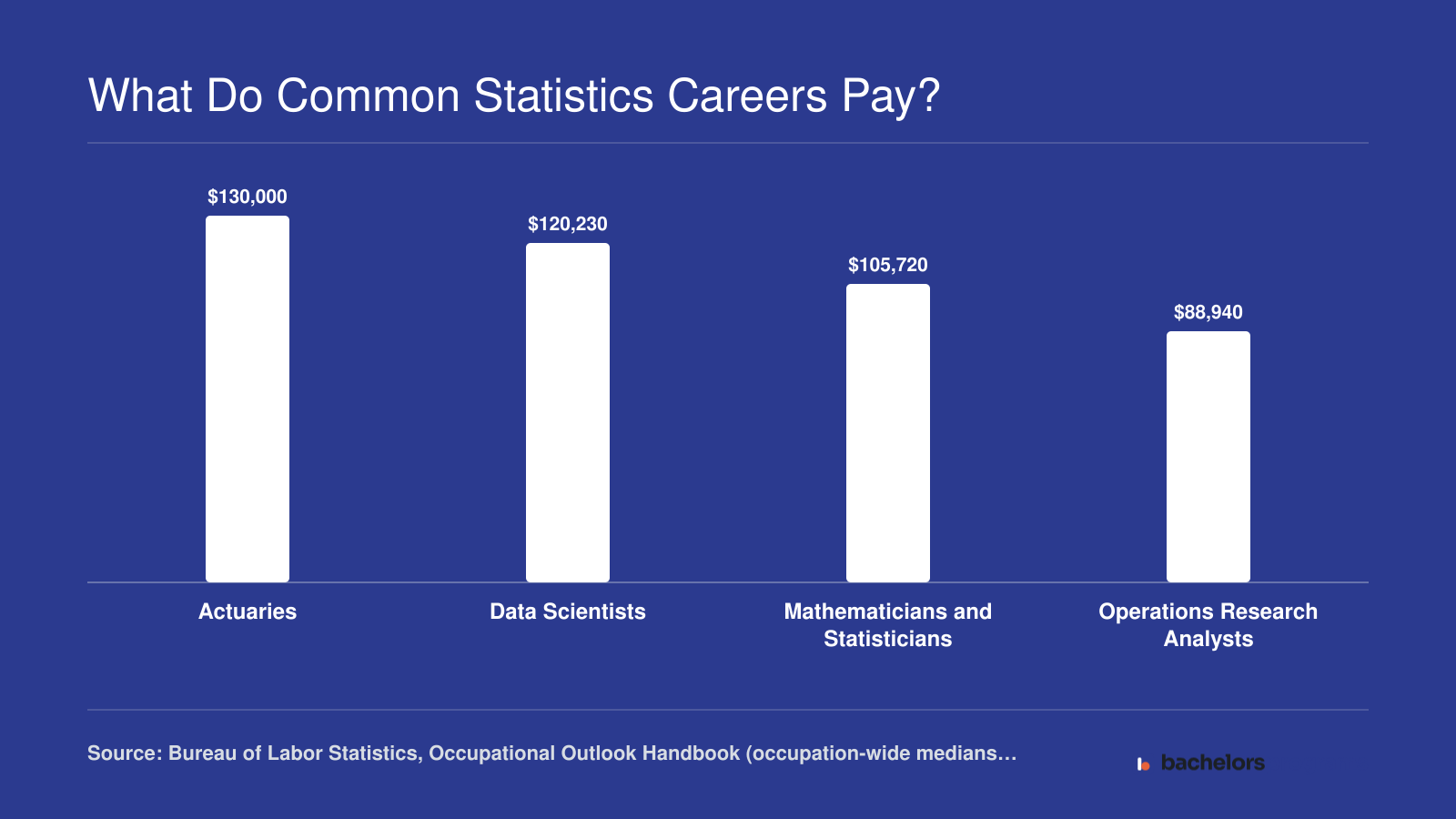
The Bureau of Labor Statistics puts the median annual wage for statisticians at $105,650 as of May 2025.1 Most statistician roles prefer or require a master's degree, though some entry-level jobs accept a bachelor's. Adjacent occupations open to bachelor's graduates pay similarly or more: actuaries at $130,000; data scientists at $120,230, a field projected to grow 35 percent from 2025 to 2035; and operations research analysts at $88,940.2
Routes Open With a Bachelor's
- Data analyst: The most common first job, building dashboards, cleaning data, and running analyses for finance, health care, retail, or government teams.
- Actuarial track: Insurance and consulting roles that require passing a sequence of professional exams, often with employer support.
- Research assistant: University, hospital, and policy labs hiring graduates to manage data and run models.
- Operations research analyst: Roles that optimize schedules, supply chains, and pricing; some employers prefer a master's.
Is the Degree Worth It?
For the programs here, median debt at graduation clusters between about $13,000 and $19,500. Against the early-career earnings reported by the strongest programs, that is a favorable ratio. Outcomes depend heavily on the school, your internship record, and whether you add computing skills. A statistics bachelor's is worth it when you leave with a portfolio, a network, and a plan for analytics work, actuarial exams, or graduate study. It is a weaker bet if you borrow heavily for a program with thin career support.
What Do Common Statistics Careers Pay?
Statistics graduates often move into four related occupations, and all four pay a 2025 median wage well above $85,000. These are occupation-wide medians covering workers at every career stage, so they do not show what new bachelor's graduates earn. The Bureau of Labor Statistics reports statisticians together with mathematicians rather than as a separate category. Among the other three, it projects 35% job growth for data scientists from 2025 to 2035, compared with 12% for operations research analysts and 9% for actuaries.
How to Verify an Online Statistics Program's Accreditation
Accreditation affects financial aid eligibility, credit transfer, and how employers and graduate schools view your degree. Run these checks before you apply to any online statistics program.
- Search DAPIP and CHEALook up the school in the U.S. Department of Education's DAPIP database and the CHEA directory, which covers more than 8,200 institutions. DAPIP data is not audited, so confirm current status on the accreditor's own directory.
- Confirm a recognized institutional accreditorThe accreditor should be one of the recognized institutional agencies formerly called regional accreditors.
- Know what ASA does and doesn't doUndergraduate statistics has no required programmatic accreditation. The American Statistical Association publishes curriculum guidelines, endorsed in 2014, but they are recommendations. They are not program approval. Its PStat and GStat credentials certify individual statisticians, not degrees.
- Check state authorizationMake sure the school is authorized to enroll online students in your state of residence.
- Watch for diploma-mill red flagsAvoid schools that cite accreditors you can't find in DAPIP or CHEA, or that award degrees for life experience.
Statistics vs. Data Science, Applied Math, and Economics
What is the difference between statistics and data science? Statistics emphasizes inference, probability theory, and study design, with a sustained focus on the mathematical principles behind rigorous data analysis. Data science keeps that foundation but adds more computing, databases, and machine learning engineering, and spreads coursework across a broader set of applications. Applied math and economics overlap with both, but each leans toward its own tools and career tracks.
| Factor | Statistics | Data Science | Applied Math | Economics |
|---|---|---|---|---|
| Core focus | Statistical methods and theory, data management, computation, and statistical practice | Breadth across probability, data analysis, computing, and domain applications | Mathematics, statistics, and computer science applied to a specific domain | Economic theory and empirical analysis combined with statistical modeling |
| Signature courses | Regression, time-series analysis and forecasting, study design, machine learning | Computational foundations, ethics, communication, discipline-specific applications | Probability, mathematical statistics, statistical learning, algorithms | Econometrics, quantitative economic analysis, markets and policy modeling |
| Programming emphasis | Fluency in higher-level languages, professional statistical software, and database systems | Introduction to Programming plus computational foundations | May include software development, algorithms, AI or machine learning, and databases | Econometric and data-science methods used in economic analysis (strongest in data-science concentrations) |
| Typical first jobs | Statistician or analyst roles requiring data manipulation and algorithmic problem-solving | Data analyst, data scientist, business analyst, financial analyst, bioinformatics programmer | Roles blending computing and mathematics, such as quantitative or computational analysis | Business economist, or analyst roles in business, finance, government, and healthcare |
| Graduate school pathways | Graduate study in statistics, a common route for those who want to practice as statisticians | Graduate study in data science or AI-related fields | Graduate study in mathematics, statistics, or computational fields | Graduate study in economics or related policy and business fields |
| Choose this if | You want to master inference, modeling, and study design | You want a broad mix of computing, statistics, and applications | You want strong math with computational flexibility | You want to apply quantitative tools to markets and policy |
Statistics programs by state
Statistics Degree FAQs
These answers draw on the 2026 net price data and federal career guidance used elsewhere in this article. Use them as a starting point, then check each school's current details before you apply.
What is the best college for a statistics degree?
Can you get a statistics degree online?
How much does a statistics degree cost?
Can you become a statistician with only a bachelor's degree?
Compare Statistics programs on the data that matters
Explore more Business & Management majors or browse every field of study.
All Business & Management programs Browse every field of study