Best Online Statistics Degree Programs
Compare 9 accredited online Statistics programs, with net price after aid, graduation rates, earnings and debt from IPEDS and the U.S. College Scorecard.

Most lists of online statistics degrees aren't really lists of online statistics degrees. Hybrid programs, master's degrees and data science tracks get mixed in, and the fully online bachelor's is hard to pick out.
Every program here clears one bar, 100% online delivery with no campus residency, and they appear in order of overall quality. Average net price runs from roughly $5,130 to about $29,357 after grants and aid.
Statistics is a small, math-heavy major, and the online bachelor's market is correspondingly thin.
Key Points
- IU Northwest's online applied statistics degree averages about $5,130 yearly net price.
- Every program ranked here is delivered fully online, with no hybrid options.
- Data science fits tech roles; statistics better prepares you for graduate school.
The Best 100% Online Statistics Degree Programs, Ranked
Every program below is delivered fully online, and hybrid or partly residential options were not considered for this list. Because the online-only bar is strict, the field of qualifying statistics bachelor's degrees is smaller than you might expect, so this list runs shorter than a typical top 10. Each entry covers what the program asks of you, how it is taught, and what it prepares you to do next.
Indiana University-Indianapolis
#1Indianapolis, IN · $11,000 – $35,000/yr (est.)
Best for: Career switchers aiming at data analytics roles
IU Indianapolis is the flagship campus behind Indiana University's collaborative online statistics degree, and its Applied Statistics bachelor's carries the resources of a large public research university. The program is built for people who want a quantitative credential without relocating, with rolling admissions that let students start without waiting for a single annual intake. Coursework runs from calculus and linear algebra into applied linear modeling, categorical data analysis and statistical learning in R.
- 120-credit bachelor's delivered 100% online
- Rolling admissions, so applicants can start sooner
- Transfer up to 64 credit hours into the degree
- Core courses in applied linear modeling and categorical data analysis
- Statistical learning and data analysis using R
- Prepares graduates for statistician, data analyst and financial manager roles
- Taught through IU's multi-campus collaborative online structure
Indiana University-Northwest
#2Gary, IN · ~$5,000/yr (est.)
Best for: Busy professionals balancing full-time work
IU Northwest is one of five Indiana University campuses that jointly deliver the online Applied Statistics degree, so students get a broad course catalog with a smaller-campus point of contact. The Gary campus handles general education and administrative requirements while the major curriculum is shared across the IU system. Students build a foundation in calculus, linear algebra and calculus-based probability before moving into statistical modeling and data analytics communication.
- 100% online, delivered through a five-campus IU collaboration
- Curriculum covers calculus, linear algebra and calculus-based probability
- Coursework in statistical methods, theory and exploratory data analysis
- Training in data analytics communication for non-technical audiences
- Prepares students for statistician, data scientist and business analyst roles
- IU Northwest priority dates: July 1 fall, December 1 spring
Indiana University-South Bend
#3South Bend, IN · $9,000/yr (est. net price)
Best for: Asynchronous learners who study at their own pace
IU South Bend delivers the Applied Statistics degree as a formal consortial program taught jointly by five IU campuses, which means the major curriculum is standardized across the state. Classes are asynchronous, and the program is open to students in all 50 states, a useful detail for military families and remote workers. The coursework leans practical, with statistical programming in R and SQL alongside study design and big data analysis.
- 120-credit consortial degree taught by five IU campuses
- Asynchronous online classes with no fixed meeting times
- Open to students in all 50 states
- Statistical programming in R, SQL and SAS
- Aligned with American Statistical Association curriculum guidelines
- Coursework in study design, data collection and big data mining
- Designed for working adults returning to school
Liberty University
#4Lynchburg, VA · ~$29,000/yr (est.)
Liberty University is a large private Christian university in Lynchburg, Virginia, with one of the biggest online enrollments in the country and the advising infrastructure that comes with it. Its online applied statistics major emphasizes probability, statistical programming and experimental design, with ethical data practice taught from a Christian perspective. Students work with widely used statistical software and can move through the material at their own pace.
- Online only program with self-paced study flexibility
- Coursework in probability, statistical programming and experimental design
- Ethical data practice taught from a Christian perspective
- Hands-on use of widely adopted statistical software
- Prepares graduates for statistician, data analyst and market research roles
- Applies statistical methods to real-world business and research problems
Arizona State University
#5Scottsdale, AZ
Arizona State University is a large public research university with a well-established online division and a statistics department that blends mathematics, computing and statistical theory. Online students take the same core curriculum as the West Valley campus cohort, with several enrollment sessions each year. Strong students can pair the bachelor's with a master's in an accelerated track, and the program is STEM-OPT eligible for international students on F-1 visas.
- Offered online and at the West Valley campus
- Multiple enrollment sessions each year
- Blends mathematics, computing and statistical theory
- Accelerated bachelor's plus master's option in five years
- STEM-OPT extension eligible for F-1 international students
- Research and internship opportunities built into the curriculum
- Reduced nonresident tuition for residents of western states
- Concurrent degree options available to high-achieving students
Middle Georgia State University
#6Macon, GA · $12,000/yr (est. net price)
Middle Georgia State University is a public institution in Macon where statistics is taught inside the Department of Mathematics and Statistics, part of the School of Computing. The Applied Statistics concentration sits within the Bachelor of Science in Mathematics, so graduates leave with a heavier pure-math foundation than a stand-alone statistics major provides. The concentration is offered fully online and is one of three options in the department.
- Applied Statistics concentration within the BS in Mathematics
- Offered fully online by the Department of Mathematics and Statistics
- One of three concentration options in the department
- Curriculum grounded in mathematics and quantitative reasoning
- Builds analytical and problem-solving skills for data-driven jobs
- Housed in the School of Computing
Columbia College
#7Columbia, MO · ~$23,000/yr (est.)
Columbia College is a private institution in Columbia, Missouri, that has been running online and evening programs for working adults for decades. Its Bachelor of Science in Statistics takes a flexible approach: students can finish entirely online, take evening classes, or attend the main campus, and they can pair the degree with a minor. The upper-level coursework reaches into machine learning and data visualization for business analytics, which goes further than many traditional statistics majors.
- Complete 100% online, through evening classes, or on campus
- Coursework in multivariate calculus and general linear models
- Machine learning and data visualization for business analytics
- Design of experiments and survey methodology
- Individualized faculty support from the School of Arts and Sciences
- Option to pair the degree with a minor
- Prepares graduates for roles in government, business, healthcare and research
None of the ranked Statistics programs match the online lens yet. The full ranking is at the link above.
Cost, debt & payoff
Median earnings of this field's bachelor's graduates (4 yrs after completing, else the school's undergraduate median) vs. their median federal loan debt · U.S. College Scorecard
Across these programs the median graduate earns about $61,244 and finishes with roughly $21,355 in debt — a ratio that clears a common rule of thumb (keep debt below first-year salary). Net price and debt vary widely school to school, so check the per-school figures in the table above before you shortlist.
Most Affordable Online Statistics Degrees: Net Price and Per-Credit Tuition
The lowest average net prices among the online statistics programs ranked here belong to three Indiana University campuses that offer a 100% online applied statistics bachelor's degree. IU Northwest averages about $5,130 a year after grants and aid, according to federal IPEDS and College Scorecard data. Net price is an average that shifts with family income, so treat these figures as approximate. For context, national 2025-26 averages for online bachelor's programs run about $356 per credit at public schools for in-state students, roughly $492 for out-of-state students and $542 at private schools, or roughly $42,700 to $65,000 for a 120-credit degree. The published tuition below shows a wide in-state versus out-of-state gap, so confirm with each campus whether online students pay one flat rate regardless of residency before you budget.
| School | Location | Average Annual Net Price (After Aid) | Annual In-State Tuition and Fees | Annual Out-of-State Tuition and Fees | Median Debt at Graduation (All Majors) |
|---|---|---|---|---|---|
| Indiana University-Northwest | Gary, IN | $5,130 | $8,424 | $22,811 | $21,710 |
| Indiana University-South Bend | South Bend, IN | $8,653 | $8,424 | $22,811 | $21,355 |
| Indiana University-Indianapolis | Indianapolis, IN | $11,668 | $10,762 | $34,891 | $20,000 |
Is an Online Statistics Degree Worth It?
The real choice is not between an online statistics degree and no degree. It is between a statistics bachelor's and a data science bachelor's, or between stopping at the bachelor's and continuing on to a master's.
For most students, an online statistics degree is worth it if you borrow modestly and finish the program. The occupational math is favorable. The Bureau of Labor Statistics reports a May 2025 median annual wage of $105,650 for statisticians, with projected growth of 10% from 2025 to 2035.1 Data scientists earned a median of $120,230, with 35% projected growth2, and operations research analysts earned $88,940, with 12% growth.3 Those are national occupational benchmarks, not guarantees tied to any single online program.
The Master's Question
Statisticians typically enter the field with a master's degree1, so a bachelor's is not the terminal credential for every statistics job. It is, however, a practical entry point for analyst roles in business, health care, government, and research, and a strong stepping stone to graduate study. Data scientists and operations research analysts typically enter with a bachelor's, though some employers prefer or require a master's for operations research work.
How to Judge the Cost
Do not treat an institution's overall long-term earnings or average debt as what statistics graduates earn or owe. Those figures blend every major on campus. Instead, compare the published tuition for these online statistics programs with entry-level analyst salaries you can verify in your target job market, and keep total student loan debt to a level a first-year analyst salary can comfortably repay. If a program requires heavy borrowing, the answer becomes maybe.
Related Articles
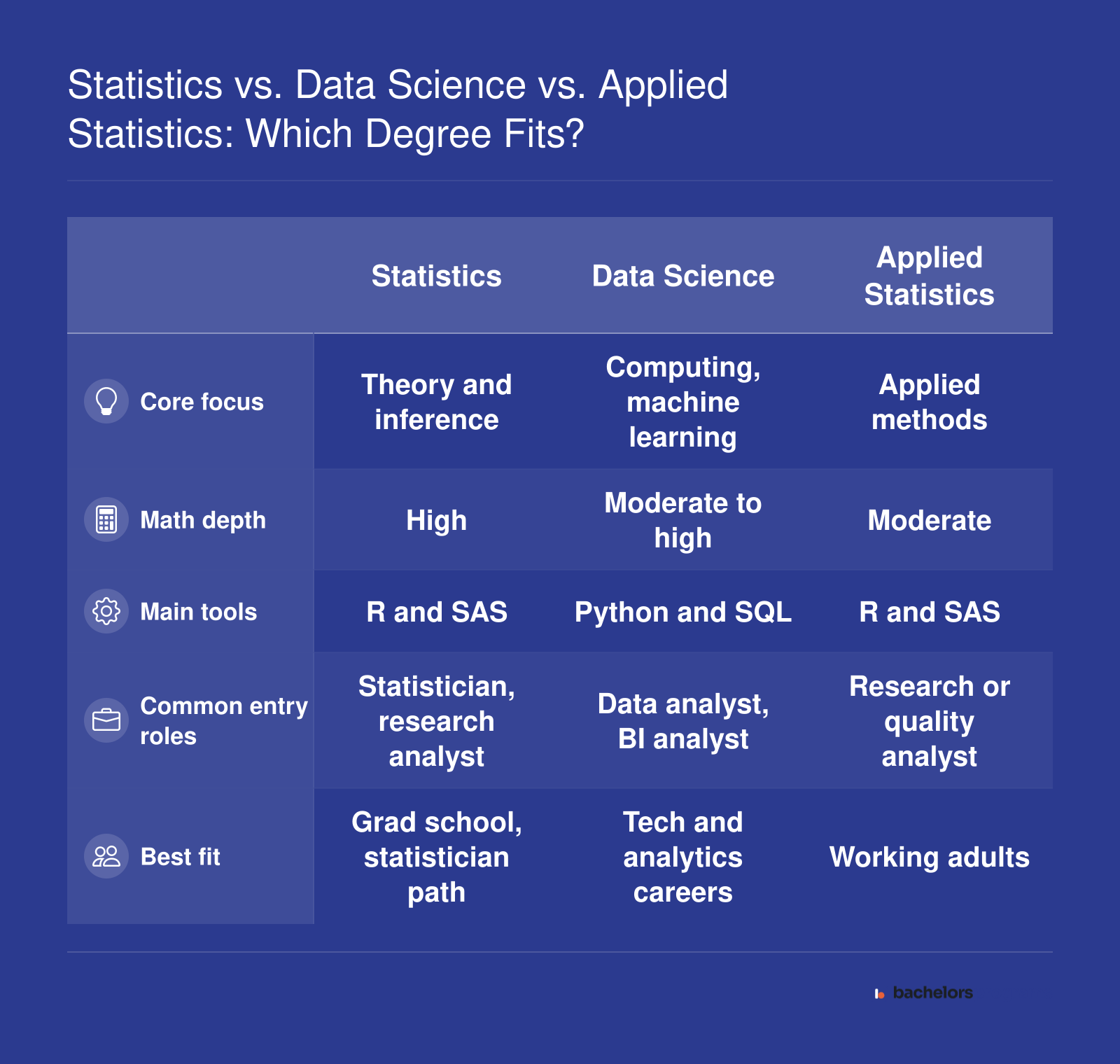
Statistics vs. Data Science vs. Applied Statistics: Which Degree Fits?
A statistics degree suits students headed for graduate school or statistician careers, a data science degree fits tech and analytics roles, and an applied statistics degree serves working adults who want practical skills they can use right away. Many students complete an online BS in statistics first and add a master's later, since many statistician and advanced analytics roles prefer a graduate degree.
Questions to Ask Yourself
Do you plan to pursue a master's in statistics or biostatistics?
Would you rather build models in Python or run analyses in R and SAS?
Can you commit to live online sessions at set times?
How many transferable math credits do you already have?
What to Check Before You Enroll in an Online Statistics Program
Use this checklist to compare programs side by side. Policies change by catalog year, so confirm each point with the school before you apply.
- Institutional accreditationVerify that the school holds regional (institutional) accreditation, either on the school's own site or in the U.S. Department of Education's accreditation database.
- Math prerequisitesIndiana University's online Applied Statistics B.S. includes Calculus I–III. UMass Lowell accepts an ALEKS score of 76–100 or a C- or higher in MATH.1230 for placement. Students there without a precalculus foundation add two courses, which raises the total to 126 credits.
- Transfer creditIndiana accepts up to 64 credits from two-year colleges and 90 from four-year colleges. Grade floors vary by school. Cornell requires a C, not a C-, in key calculus courses, and Texas A&M requires a B or better in required transfer-sheet courses.
- Format fitAsk whether classes meet live or run on your own schedule, and how proctored exams are handled.
- Software and techConfirm which tools you will use, such as R, SAS or Python, and check the laptop specifications the program requires.
Statistics programs by state
Online Statistics Degree FAQs
Can you get a statistics degree fully online?
What math is required for an online statistics degree?
Is there a statistics-specific accreditation for bachelor's programs?
Do you need a master's degree to become a statistician?
Compare Statistics programs on the data that matters
Explore more Business & Management majors or browse every field of study.
All Business & Management programs Browse every field of study