Best Business Degree Programs in Maine
Compare 22 accredited Business programs in Maine at 12 colleges, with net price after aid, graduation rates, earnings and debt from IPEDS and the U.S. College Scorecard.

Maine's business schools compete on price and delivery format more than on prestige. Average annual net price across the programs ranked here runs from $7,035 at the University of Maine at Presque Isle to $38,107 at the University of New England; format splits along the same lines, with Presque Isle's accounting concentration taught online and the University of Southern Maine running a hybrid business administration degree in Portland.
Every program in this ranking is a bachelor's at a Maine-based school, on campus or online. The practical tension is simple: the cheapest option and the highest-earning one are rarely the same.
Key Points
- Lowest net price here: University of Maine at Presque Isle, $7,035.
- Husson University business graduates earn a $63,669 median five years out.
- Maine CPA licensure requires 150 semester hours, including a bachelor's degree.
Best Bachelor's in Business Programs in Maine, Ranked
Maine's ten business bachelor's programs range from a flagship business school with six majors to a self-paced online degree priced for working adults and a tourism-focused B.S. built around sustainability. The list below covers campus, hybrid and fully online options, all based at Maine institutions, so readers can compare delivery, cost and program depth in one place.
University of Maine at Farmington
#1Farmington, ME · $17,000/yr (est. net price)
Best for: Liberal arts learners wanting small-campus business study
UMF's business administration B.A. sits inside a public liberal arts college, so majors pair financial accounting, marketing and strategic management with a broad general education. Classes are small and the Farmington campus keeps the degree workable for students who want a residential four-year experience with room for coursework outside business. Regional tuition discounts are available for qualifying students, and admissions review academic readiness rather than a single formula.
- B.A. in Business Administration taught on the Farmington campus
- Business major built on a liberal arts foundation
- Core includes financial accounting, marketing and strategic management
- Coursework in leadership, team building and decision making
- Statistics and Excel for data analytics in the curriculum
- Regional tuition discount available for qualifying students
University of Maine at Presque Isle
#2Presque Isle, ME · ~$7,000/yr (est.)
Best for: Working adults needing self-paced online coursework
UMPI delivers its business administration B.A. through YourPace, a self-paced online format built for adults who are working while they study. Students complete a 60-credit business major plus a 12-credit accounting concentration covering finance, human resource management, project management and information systems. The result is one of the lowest net prices in this ranking paired with a curriculum that stresses managerial, analytical and quantitative skills.
- B.A. completed online through the YourPace format
- 60 credit hours in the business administration major
- 12 credit hours of accounting concentration coursework
- Covers finance, human resource management and project management
- Includes information systems and production and operations courses
- Built around managerial, analytical and quantitative skill outcomes
University of Maine
#3Orono, ME · $18,000/yr (est. net price)
Best for: Undecided students wanting broad concentration choice
The Maine Business School at the University of Maine is the state's flagship business program, with an AACSB-accredited B.S. built on 120 credits: a broad general foundation, a shared business core and a chosen major. Students pick among accounting, finance, management, marketing, business information systems, sport management and security management, then add concentrations such as International Business or Entrepreneurship. Recent students have taken on applied consulting work for Maine organizations, and the MGT 449 capstone pulls the core together.
- 120 credits: 46-credit foundation, 37-credit business core
- Majors in accounting, finance, management, marketing and information systems
- Also offers sport management and security management majors
- International Business and Entrepreneurship concentrations available
- C- minimum in every business core course; MGT 449 capstone
- At least 36 credits must be earned at the Maine Business School
- 2.0 cumulative GPA required to graduate
Husson University
#4Bangor, ME · $20,000 – $25,000/yr (est.)
Husson University in Bangor runs a 122- to 123-credit business administration B.S. with a broad-based option plus concentrations in entrepreneurship and small business management or financial management. The business core covers accounting, business law, ethics, organizational behavior, strategy and international business, and two internship courses give students applied experience. Small classes lean on simulations and case studies, and the school's long entrepreneurship tradition gives the small business track a distinct character.
- 122 to 123 credit hours for the B.S.
- Broad-based business education or a chosen concentration
- Core includes accounting, business law, ethics and strategy
- Two internship courses, BA 351 and BA 352
- Small classes using simulations and case studies
Saint Joseph's College of Maine
#5Standish, ME · $25,000 – $30,000/yr (est.)
Saint Joseph's College of Maine offers its business administration B.S. both on its Standish campus and fully online, with six specializations that include accounting, finance, management, marketing, human resource management, and business and sport management. More than 80% of students complete internships, many with local employers, and the college offers an accelerated three-year path plus a 4+1 option. The online version adds a banking concentration and accepts a generous amount of transfer credit.
- B.S. with six specializations, including accounting and finance
- Over 80% of students complete an internship
- Accelerated three-year completion option available
- Accelerated 4+1 pathway option for qualified students
- SHRM-aligned human resource management track
Thomas College
#6Waterville, ME · $19,000/yr (est. net price)
Thomas College in Waterville frames its business administration B.S. around career preparation, with a 121-credit curriculum that includes internships, leadership coursework, managerial accounting and business ethics. Students can finish in three years, and the Harold Alfond Institute for Business Innovation adds innovation challenges, workshops and mentorship. It is a small, teaching-focused campus where business is the center of gravity.
- 121 credit hours with a three-year completion option
- Career-focused curriculum that includes internships
- Courses in leadership, managerial accounting and business ethics
- Access to the Harold Alfond Institute for Business Innovation
- Prepares students for executive and nonprofit leadership roles
University of Southern Maine
#7Portland, ME · $11,000 – $28,000/yr (est.)
The University of Southern Maine's AACSB-accredited B.S. in Business Administration offers majors in accounting, business analytics, finance, management, marketing and sport management, with a management major that runs 54 to 73 credits depending on the path a student builds. The Portland-area campus puts internships with regional employers within reach, and students can pursue accelerated graduate pathways, double majors, minors and certificates. Business analytics is available as an online major.
- AACSB-accredited B.S. in Business Administration
- Majors include accounting, finance, management, marketing and sport management
- Business Analytics major offered online
- Management major spans 54 to 73 credits depending on path
- Internships encouraged; accelerated graduate pathways available
- Double majors, minors and certificate programs possible
University of New England
#8Biddeford, ME · $38,000/yr (est. net price)
The University of New England's business administration B.S. requires 120 credits spanning accounting, business law, economics, finance, management and marketing, plus a credit-bearing internship and five College of Business electives. Every business course requires at least a C, which keeps students moving at a common standard, and qualified students can graduate with honors after faculty-guided research. The College of Business also lists Maine-flavored options such as Marine Entrepreneurship, Outdoor Business and Innovation, and Sustainability and Business.
- 120 credits across accounting, business law, economics and finance
- At least one credit-bearing internship required
- Minimum grade of C in every College of Business course
- Five College of Business electives built into the degree
- Honors track available through faculty-guided research
University of Maine at Augusta
#9Augusta, ME · $10,000 – $15,000/yr (est.)
The University of Maine at Augusta offers a business administration B.S. with accounting and management majors and a long list of management concentrations, from small business and financial services to public administration, executive management and data science. Classes run at the Augusta campus, in Bangor, at university centers and online, which makes the degree workable for students who cannot relocate. The curriculum emphasizes financial analysis, the marketing mix, legal concepts and case-based business policy.
- Accounting and Management majors within the B.S.
- Management concentrations include small business and data science
- Also offers executive management and public administration tracks
- Classes at Augusta, Bangor, university centers and online
- Coursework in financial analysis, marketing and business law
Unity Environmental University
#10New Gloucester, ME · ~$19,000/yr (est.)
Unity Environmental University's business administration degree heads in an unusual direction: a B.S. in Regenerative Tourism taught in person at Unity at Pineland in New Gloucester. The 120-credit program pairs a business core in finance, marketing, management and supply chain with regenerative hospitality and sustainable destination management, plus an internship or capstone. Five-week terms and a 2.5- to 5-year completion window give students a focused path into ecotourism and sustainability roles.
- B.S. completed in 2.5 to 5 years at Unity at Pineland
- 120 credits: 44 general education, 42 program core, 34 electives
- 30 credits must be at the 300 level or above
- Includes internships or capstone experiences
- Coursework in regenerative hospitality and sustainable destination management
- 2.0 cumulative GPA required for admission
Cost & outcomes by school
Federal data for the highest-earning Business programs, independent of the ranking above. Earnings are this field's bachelor's graduates four years after completing where the Scorecard reports them, else the school's undergraduate median.
| School | Net price / yr | Grad rate | Earnings | Debt | Grads/yr | Format |
|---|---|---|---|---|---|---|
| Maine Maritime Academy ME | $23,414 | 58% | $89,964 | $27,000 | 402 | Campus |
| Saint Joseph's College of Maine ME | $27,555 | 66% | $59,045 | $27,000 | 508 | Campus |
| University of New England ME | $38,107 | 68% | $55,921 | $25,250 | 976 | Campus |
| University of Southern Maine ME | $13,596 | 40% | $49,958 | $19,060 | 2,090 | Hybrid |
| University of Maine ME | $17,510 | 55% | $48,653 | $25,000 | 3,972 | Campus |
| Husson University ME | $21,005 | 59% | $45,025 | $27,000 | 1,096 | Campus |
| Thomas College ME | $18,885 | 54% | $44,991 | $24,250 | 340 | Campus |
| University of Maine at Farmington ME | $16,857 | 52% | $44,433 | $24,499 | 594 | Campus |
| University of Maine at Presque Isle ME | $7,035 | 52% | $40,956 | $16,000 | 2,814 | Online |
| University of Maine at Augusta ME | $10,924 | 27% | $40,342 | $22,734 | 840 | Hybrid |
| Unity Environmental University ME | $19,104 | 29% | $37,852 | $25,000 | 942 | Campus |
| Beal University ME | $40,109 | 36% | $35,639 | $19,500 | 28 | Online |
Sources: U.S. Department of Education. Net price, graduation rate, earnings and debt: College Scorecard (earnings and debt for this field's bachelor's graduates where reported, else school-wide); graduates: IPEDS. A dash means no figure is reported.
Cost, debt & payoff
Median earnings of this field's bachelor's graduates (4 yrs after completing, else the school's undergraduate median) vs. their median federal loan debt · U.S. College Scorecard
Across these programs the median graduate earns about $45,025 and finishes with roughly $25,000 in debt — a ratio that clears a common rule of thumb (keep debt below first-year salary). Net price and debt vary widely school to school, so check the per-school figures in the table above before you shortlist.
How We Scored Maine's Bachelor's in Business Programs
A business degree is only as good as what it does for you after graduation, so the programs below were scored on outcomes rather than reputation. Only bachelor's-level business programs at Maine-based schools were eligible, and location did not matter: a campus program in Orono, a hybrid in Portland, or a fully online degree taken from your kitchen table out of state all competed on the same terms.
What Went Into Each Score
Five inputs carried the weight:
- Net price after aid: the average a first-year student actually pays once grants and scholarships land, not the sticker tuition.
- Graduation rate: the share of students who finish what they start.
- Earnings: program-level median pay for business graduates.
- Concentrations: accounting, management, marketing, tourism, and other tracks that shape which jobs you can chase.
- Delivery format: whether a working adult can finish the degree without relocating.
A specialized track such as Unity Environmental University's regenerative tourism degree was read the same way as a broad business administration program at Thomas College.
Where the Numbers Get Fuzzy
Two inputs are institution-wide. Both describe the whole college, not the business department, so read them as a signal about the school rather than a promise about your major. Earnings data is narrower, program-level rather than school-wide, and thinner, because some fields report no figure at all.
Figures come from the federal College Scorecard and IPEDS, the databases colleges report into each year.
AACSB, ACBSP, and Candidacy: Which Maine Business Programs Are Accredited
Business accreditation is an outside review that checks whether a school's business curriculum, faculty, and outcomes meet a published standard. AACSB is the more selective of the two major business accreditors and emphasizes research-active faculty and continuous improvement. ACBSP focuses more on teaching quality and learning outcomes, and it accredits many institutions that AACSB does not.
Verified Status by School
- University of Maine: The AACSB directory lists the Maine Business School as accredited. A 2025 AACSB announcement also names it among institutions extending their accreditation. We could not confirm any ACBSP status.
- University of Southern Maine: The AACSB directory lists the School of Business as accredited, and the same 2025 announcement names it. We could not confirm any ACBSP status.
- University of New England: We could not confirm a current AACSB or ACBSP status, including whether it holds candidacy.
- Other schools here: For the University of Maine at Farmington, University of Maine at Presque Isle, Husson University, Saint Joseph's College of Maine, Thomas College, University of Maine at Augusta, and Unity Environmental University, we could not confirm AACSB or ACBSP status. That is not the same as having none. Ask each school directly.
Why It Matters
Employers often recognize AACSB in particular, and it can help when you apply to competitive graduate programs. Transfer offices and graduate admissions committees may also look at program accreditation when weighing your coursework. Federal financial aid eligibility depends mainly on a school's institutional accreditation, not on business-specific accreditation, so an unconfirmed business accreditation does not by itself put your aid at risk.
One Practical Step
Before you apply, search the AACSB and ACBSP online directories for the school's name, and read the accreditation page on the school's own website. Directory listings change, so confirm the current status yourself.
Cheapest Bachelor's in Business Programs in Maine by Net Price
The University of Maine at Presque Isle has the lowest average net price among the schools ranked here at $7,035 a year, well under half of the University of Maine's $17,510, and it delivers its accounting-focused business degree online. Net price is the average yearly amount students pay after grants and scholarships, so it can differ sharply from published tuition: the University of Maine at Augusta has the lowest in-state sticker price at $8,888 but ranks second on net price. Figures come from the U.S. Department of Education's IPEDS and College Scorecard data (2024), with first-year earnings reported for each school's business administration graduates.
| School | City | Format | Average Net Price (per year) | In-State Tuition and Fees | Out-of-State Tuition and Fees | Graduation Rate | Median Earnings 1 Year After Graduation (Business) |
|---|---|---|---|---|---|---|---|
| University of Maine at Presque Isle | Presque Isle | Online | $7,035 | $9,402 | $14,862 | 51.6% | $43,902 |
| University of Maine at Augusta | Augusta | Hybrid | $10,924 | $8,888 | $22,178 | 27.0% | $41,325 |
| University of Southern Maine | Portland | Hybrid | $13,596 | $11,284 | $27,944 | 40.3% | $48,421 |
| University of Maine at Farmington | Farmington | On campus | $16,857 | $11,308 | $23,878 | 51.5% | $29,685 |
| University of Maine | Orono | On campus | $17,510 | $13,326 | $36,756 | 54.9% | $45,950 |
What a Maine Business Bachelor's Really Costs After Aid
The price that matters is what a business bachelor's in Maine costs your family after grants and scholarships, not the sticker figure.
Public Sticker, Private Net Price
Begin with the published price, then subtract aid. University of Maine System tuition and fees run roughly $10,000 to $15,000 a year, according to Finance Authority of Maine materials.5 Private colleges in Maine post higher sticker prices, yet many enrolled students pay less after institutional grants. Treat any published net price as a sector average, not a quote for your household. Your offer depends on income, assets, enrollment level, and how each college packages its aid, so compare written offers side by side rather than sticker prices.
State Aid That Can Reduce Your Bill
The Maine State Grant is the main need-based award for Maine undergraduates.1 For 2026-27 it pays up to $2,500 full time, or up to $1,250 at half- or three-quarter time, at an eligible Maine institution, with a Student Aid Index at or below $10,000.1 You must enroll at least half time, hold no prior bachelor's degree, and stay within 10 full-time-equivalent semesters.2 Maine's community college tuition-free scholarship covers tuition for eligible recent high school graduates and equivalent credential earners from 2022 through 2025 at seven colleges after filing the FAFSA.3 Transfer ME supports community college students continuing into the University of Maine System, but award terms vary by agreement.4 The University of Maine at Augusta also advertises a transfer pathway for in-state, full-time, Pell-eligible students new to the system with at least 30 transferable credits; FAME does not publish the exact discount.5
File Early and Verify Deadlines
Submit the FAFSA as soon as the 2026-27 cycle opens, because Maine uses it for the State Grant. FAME's published deadlines conflict, with one page citing November 13, 2026 and earlier guidance citing May 1, 2026, so confirm the current date directly with FAME.2 Then ask each aid office how outside scholarships affect your package.
Studying Business Online, Hybrid, or on Campus at Maine Schools
You can earn a business bachelor's from a Maine-based school without living near campus, though the options are narrower than the on-campus choices. Within the schools here, the University of Maine at Presque Isle delivers its Business Administration program online, with an Accounting concentration. The University of Southern Maine and the University of Maine at Augusta run hybrid formats. The rest are campus-based: the University of Maine at Farmington, the University of Maine, Husson University, Saint Joseph's College of Maine, Thomas College, the University of New England and Unity Environmental University.
Comparing the Formats
- Flexibility: Online study at Presque Isle suits working adults and students who live far from campus. Hybrid programs at Southern Maine and Augusta mix scheduled campus time with remote coursework. Saint Joseph's also mentions flexible online course options within its on-campus degree.
- Internships and ties: On-campus programs make in-person internships easier. Husson lists internships, simulations and case studies, and Saint Joseph's reports local company partnerships. Southern Maine ties students to the Maine SBDC and its Center for Entrepreneurship.
- Tuition: Published rates are set per school, not per format. In-state tuition is $9,402 at Presque Isle and $8,888 at Augusta. Ask each school whether online students pay the same rate.
Concentrations by Format
Presque Isle's online option centers on accounting. Augusta, a hybrid school, offers accounting and management majors across six concentrations, while Southern Maine's Business Analytics major can be taken online. On campus, the University of Maine offers six concentrations, including International Business and Entrepreneurship. Husson offers two, Saint Joseph's six, and Unity Environmental University focuses on Regenerative Tourism, the closest fit here for an environmental business path.
Online students at Maine-based schools still gain from state employer connections, since advising, alumni networks and internship contacts are rooted in Maine's own business community.
Questions to Ask Yourself
Do you need to stay put in Maine for a job or family, or could you earn your degree online from a Maine school?
Is there a Maine industry you want your business degree to point toward?
Will your employer, graduate plans, or CPA path care about AACSB or ACBSP accreditation?
Are you starting at a Maine community college with plans to transfer?
Getting in: GPA, Test Policies, and Transfer Credit at Maine Business Schools
The University of Maine and the University of Southern Maine publish clear GPA and testing language, while Husson University is quieter on testing. The real gaps appear where a school says nothing at all.
GPA and Test Policies
- University of Maine (Orono): The transfer pages point to a 2.0 GPA for most programs, and the B.S. in Business Administration adds good academic standing. Test-optional is stated for transfer admission. The pages reviewed do not say whether first-year admission works the same way.
- University of Southern Maine (Portland): The general transfer minimum is 2.0, but majors can set higher bars. Accounting and Finance list 2.33 or higher. USM states that test scores are optional and do not affect admission.
- Husson University (Bangor): A 2.0 GPA is a standard business students must maintain, not an admission minimum. No test-optional policy is published.
For the other schools here, we have no verified admissions figures, so confirm GPA and testing rules on each school's admissions page before you plan around them. A missing policy online does not prove none exists.
Transfer Credit Limits
None of the three documented schools publishes a numeric cap on transfer credits. UMaine requires 70% of the business core and major to be completed there, and USM requires 30 of the final 45 credits in residence toward a 120-credit degree. Those are residency rules, not caps, but they set a practical ceiling on what you can bring in. Husson describes its transfer policy as generous and lists college-level credit, military training, CLEP, and DANTES as accepted types.
Two patterns stand out. Where policies are published, a 2.0 is the common baseline, with selective majors like USM's accounting and finance set higher. And residency requirements, not stated caps, are what limit transfer credit.
Advice for Community College Transfers
- Ask each school for a written credit evaluation before you commit, since accepting a course is not the same as applying it to the business core.
- Check whether your business courses count toward major requirements or only as general electives.
- Look at the residency rule early. At UMaine, the 70% core requirement shapes how many upper-level courses you must take on that campus.
- If you are headed into accounting or finance at USM, aim above 2.33 in your community college coursework.
- Ask an admissions advisor about articulation agreements for your specific program, because the pages reviewed here do not detail them.
Related Articles
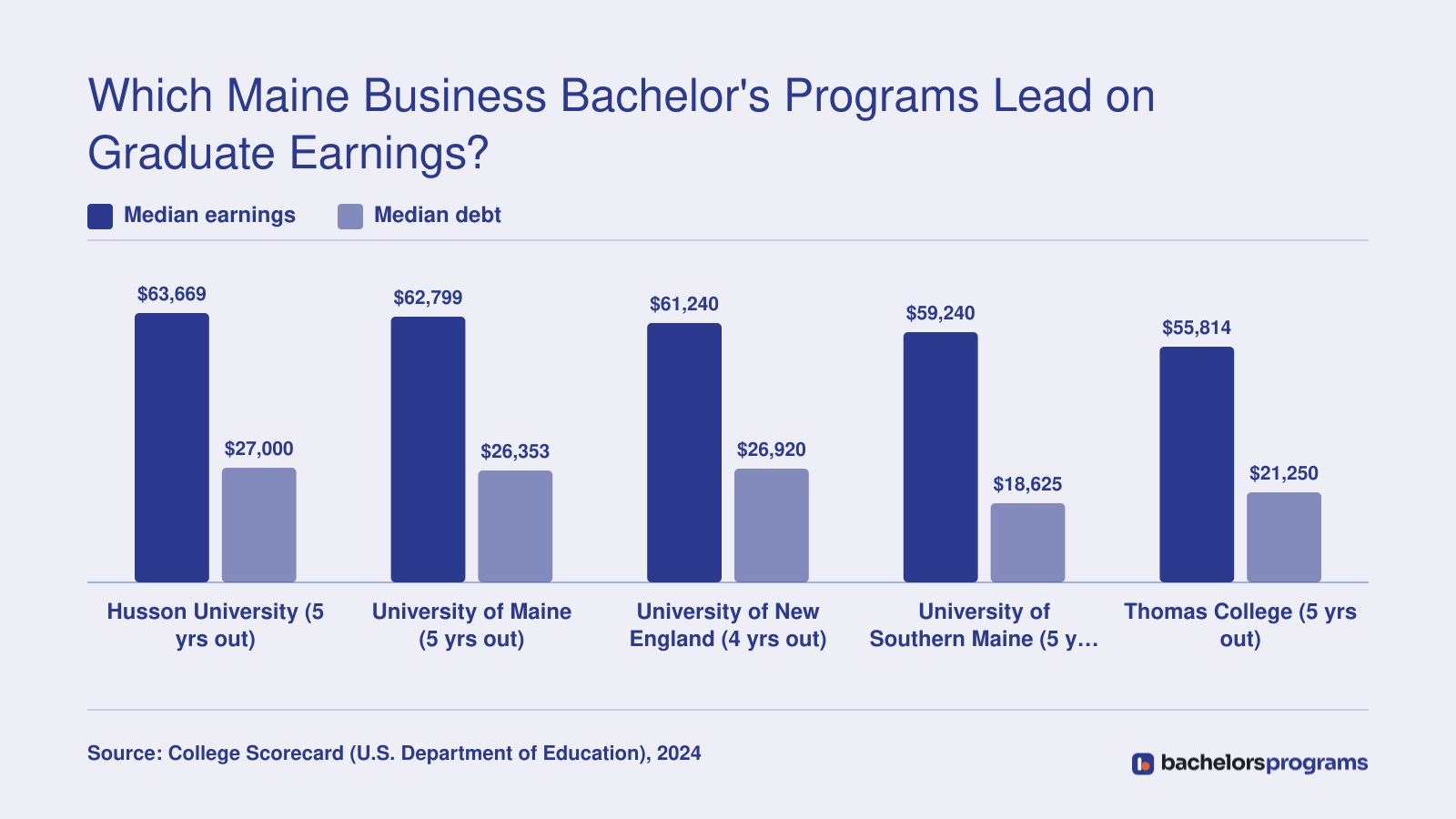
Which Maine Business Bachelor's Programs Lead on Graduate Earnings?
Husson University leads this comparison: its business administration graduates earn a median of $63,669 five years after finishing. University of Maine follows at $62,799 at five years, then University of New England at $61,240 four years out, University of Southern Maine at $59,240 at five years, and Thomas College at $55,814 at five years. Median debt for these programs runs from $18,625 at Southern Maine to $27,000 at Husson. These are College Scorecard medians for each school's business program, not guarantees of what any one graduate will earn.
Maine CPA Licensure for Accounting Majors at a Glance
Compare Business programs on the data that matters
Explore more Business & Management majors or browse every field of study.
All Business & Management programs Browse every field of study