Best Computer Science Schools in Maine
Compare 8 accredited Computer Science programs in Maine at 7 colleges, with net price after aid, graduation rates, earnings and debt from IPEDS and the U.S. College Scorecard.

Maine's lowest-priced computer science degree and its most selective one sit two hours apart, and that spread is the real decision. The credential is a Bachelor of Science (B.S.) or Bachelor of Arts (B.A.) in Computer Science. At the University of Maine at Presque Isle, in-state tuition and fees run $9,402; Bowdoin and Colby charge private rates for far smaller classes.
Campus and online options both exist among Maine-based schools, and cost, admissions policy and median earnings shift sharply between them.
Software developer wages set a local benchmark; the state's thin employer base shapes where graduates land.
Key Points
- UMaine's computer science B.S. carries ABET accreditation, rare among Maine programs.
- University of Maine at Presque Isle posts the lowest net price, $7,035.
- Flexibility seekers: University of Southern Maine offers a blended CS B.S.
Best Computer Science Schools in Maine, Ranked
Maine's computer science bachelor's programs split into two camps: highly selective private colleges with small classes and open-admission public campuses where net price after aid stays low. This list covers both, from Brunswick and Waterville to Orono, Portland, Farmington and Presque Isle. Each entry notes the credential awarded, how the program is delivered, what students pay after aid, and how many undergraduates finish a degree.
Bowdoin College
#1Brunswick, ME · ~$14,000/yr (est.)
Best for: Liberal arts students targeting research careers
Bowdoin's computer science major is a ten-course, campus-based sequence that covers data structures, algorithms and computer systems before students branch into theory, systems or artificial intelligence. Classes are small, roughly 95% of undergraduates finish a degree, and the admit rate sits near 7%. Program graduates reported median earnings of about $137,600 four years after completion. Students aiming at research can pursue honors projects and fellowship-funded summer work, and a joint major with mathematics is available.
- Ten courses total, with prerequisite courses required
- Two entry pathways into the CS curriculum
- Distribution areas in theory, systems and artificial intelligence
- Interdisciplinary major with mathematics offered
- Fellowship-funded summer research and honors projects
- Electives include cybersecurity and deep learning for computer vision
- Introduction uses Python programming
- AP or IB scores determine introductory placement
Colby College
#2Waterville, ME · ~$17,000/yr (est.)
Best for: Interdisciplinary thinkers drawn to AI coursework
Colby awards a bachelor's degree in computer science on its Waterville campus, with core work in computational thinking, data structures, computer organization, programming languages and theory of computation. Students build a two-semester elective sequence ending at the 400 level, and the department lists an artificial intelligence concentration along with five CS+X interdisciplinary majors. The admit rate is about 7% and roughly 89% of students graduate. Net price after aid runs near $17,180.
- Core covers data structures, algorithms and computer organization
- Four CS electives required, two forming a two-semester sequence
- Artificial intelligence concentration available
- Five interdisciplinary CS+X majors offered
- Honors requires a 3.6 GPA in CS courses numbered 200 or higher
- Independent study available
- 200-level mathematics or statistics course required
University of Maine
#3Orono, ME · $18,000/yr (est. net price)
Best for: Maine residents wanting a research university CS track
The University of Maine's Orono campus awards both a B.S. and a B.A. in computer science; the B.S. is ABET-accredited and pairs 53 credits of computer science with mathematics, science and a two-semester capstone. In-state tuition is $13,326 and net price after aid is about $17,510, with an admit rate above 96% and roughly 55% of students graduating. Program graduates reported median earnings of about $99,400 four years after completion. The university has also added a computer science and business bachelor's degree and expanded artificial intelligence coursework across its computing college.
- ABET-accredited since 1995
- 53 credit hours in computer science
- 15 credit hours of mathematics and 14 of science
- Two-semester capstone: COS 397 and COS 497
- Electives in AI, databases and networks
- Internships and undergraduate research available
- Roughly 120 credits total, with model four-year plans
- Ethics and society course required
- 50 credit hours in computer science
- Minor requirement and more room for outside coursework
- 15 credit hours of mathematics and 7 to 8 of science
- Capstone project required across two semesters
- Includes a cybersecurity course
- Flexible route for students pairing CS with another field
University of Maine at Farmington
#4Farmington, ME · $17,000/yr (est. net price)
UMF's Farmington campus offers a B.A. in computer science with coursework in network security, artificial intelligence, web development, computer architecture, databases and networking, plus internships and faculty research projects. Admission is close to open, with an admit rate around 97%, and about 52% of students graduate. In-state tuition is $11,308 and net price after aid is roughly $16,857. Students from certain states may qualify for a regional tuition discount, though program-level eligibility should be confirmed.
- B.A. degree in computer science
- Coursework in network security, AI and web development
- Computer architecture, database and networking courses
- Internships, on-campus jobs and research projects
- Annual programming contest participation
- Prepares for software developer and information security roles
- Tuition discounts for students from certain states
University of Southern Maine
#5Portland, ME · $11,000 – $28,000/yr (est.)
USM's Portland campus offers a B.S. in computer science in blended and in-person formats, with course areas including databases, graphics, artificial intelligence, robotics, operating systems and networks, plus a project-based internship. SAT and ACT scores are optional. In-state tuition is $11,284 and net price after aid is about $13,596, while the admit rate is near 79% and roughly 40% of students graduate. Program graduates reported median earnings of about $68,000 one year after completion, and New England residents may qualify for a regional tuition break.
- Blended and in-person delivery
- Test optional: SAT and ACT scores not required
- Project-based internship experience
- Course areas include AI, robotics, graphics and networks
- Dedicated computer science lab and Maker Innovation Studio
- Automatic merit scholarship consideration by the deadline
- Regional tuition break for eligible New England residents
- Alumni hired at WEX, IDEXX, Unum and TD Bank
Thomas College
#6Waterville, ME · $19,000/yr (est. net price)
Thomas College in Waterville awards a B.S. in computer science built on 121 credit hours, with a three-year accelerated option and required internships. Coursework covers Java, intelligent systems, computer architecture and databases, aligned to IEEE and ACM curriculum standards. The admit rate is about 96%, roughly 54% of students graduate, and net price after aid is near $18,885. Program graduates reported median earnings of about $76,100 four years after completion.
- 121 credit hours required
- Three-year accelerated option available
- Internships and leadership development included
- Java, intelligent systems, architecture and database courses
- Curriculum aligned to IEEE and ACM standards
- Prepares for software development and systems analyst roles
- Cloud computing preparation included
University of Maine at Presque Isle
#7Presque Isle, ME · ~$7,000/yr (est.)
UMPI's Presque Isle campus offers a 120-credit computer science bachelor's with 51 credits of core CS, covering Python, C and C++, Java, algorithms, networking, databases, big data, cloud computing and machine learning, plus a capstone. Admission is effectively open, with an admit rate near 100%, and about 52% of students graduate. In-state tuition is $9,402 and net price after aid is roughly $7,035, the lowest among the Maine schools on this list. Undergraduates can join faculty research in artificial intelligence, machine learning and bioinformatics.
- 120 total credits, including 51 in core computer science
- Instruction in Python, C/C++ and Java
- Big data, cloud computing and machine learning coursework
- Capstone experience required
- Electives in cybersecurity, game development and software testing
- Faculty research in AI, machine learning and bioinformatics
- Instructional lab and Computer Science Club on campus
- Certification opportunities available
Cost & outcomes by school
Federal data for the highest-earning Computer Science programs, independent of the ranking above. Earnings are this field's bachelor's graduates four years after completing where the Scorecard reports them, else the school's undergraduate median.
| School | Net price / yr | Grad rate | Earnings | Debt | Grads/yr | Format |
|---|---|---|---|---|---|---|
| Bowdoin College ME | $14,398 | 95% | $137,611 | $18,500 | 47 | Campus |
| University of Maine ME | $17,510 | 55% | $99,413 | $26,209 | 55 | Campus |
| Colby College ME | $17,180 | 89% | $80,490 | $19,157 | 47 | Campus |
| Thomas College ME | $18,885 | 54% | $76,089 | $24,250 | 7 | Campus |
| University of Southern Maine ME | $13,596 | 40% | $49,958 | $17,500 | 17 | Hybrid |
| University of Maine at Farmington ME | $16,857 | 52% | $44,433 | $24,499 | 3 | Campus |
| University of Maine at Presque Isle ME | $7,035 | 52% | $40,956 | $16,000 | — | Campus |
Sources: U.S. Department of Education. Net price, graduation rate, earnings and debt: College Scorecard (earnings and debt for this field's bachelor's graduates where reported, else school-wide); graduates: IPEDS. A dash means no figure is reported.
Cost, debt & payoff
Median earnings of this field's bachelor's graduates (4 yrs after completing, else the school's undergraduate median) vs. their median federal loan debt · U.S. College Scorecard
Across these programs the median graduate earns about $78,290 and finishes with roughly $21,704 in debt — a ratio that clears a common rule of thumb (keep debt below first-year salary). Net price and debt vary widely school to school, so check the per-school figures in the table above before you shortlist.
How We Ranked Maine's Bachelor's Degree in Computer Science Programs
Ranking a computer science program comes down to two things: what it costs and what its graduates get out of it. The comparison below uses federal College Scorecard signals for Maine programs, read at the program level rather than the campus level.
What Drives the Order
- Earnings after graduation: median pay for graduates of the computer science program, measured a few years out.
- Net price: what students actually pay after grants and scholarships, not sticker tuition.
- Completion: the share of students who finish their degree.
- Retention: the share who return for a second year.
Why This List Looks Different
National outlets like Niche and U.S. News rank whole institutions, folding graduate reputation, faculty research and national name recognition into one score. This is an undergraduate-only comparison built around Maine programs. Bowdoin College and Colby College get judged on the same terms as University of Maine and Thomas College, with no bonus for endowment size or selectivity.
How to Read the Numbers
Net price is a sector-average estimate, so treat it as a starting point rather than a quote for your situation. Graduation rates are school-wide, not specific to the computer science major. Some programs publish no figure for a given measure, and where that happens the other measures carry more of the comparison.
Concentrations, Curriculum and Accreditation: How Maine CS Programs Differ
The University of Maine's Bachelor of Science in Computer Science is accredited by the Computing Accreditation Commission of ABET, and that single credential separates it from most other undergraduate CS options in the state. ABET review signals to employers (especially defense contractors and federal agencies) and to graduate admissions committees that the curriculum meets an external standard for computing content. Programs without it are not weaker by definition, but they forfeit that shorthand. Ask each admissions office directly whether the degree carries ABET status rather than assuming it does.
B.S. versus B.A., and tracks
UMaine offers both a B.S. and a B.A. in Computer Science. The B.S. demands 88 credits in the major against 71 for the B.A., with 120 credits total either way. The extra credits go to math and technical depth, which matters if you are aiming at systems work or graduate study; the B.A. leaves more room for a second field, a language, or business coursework. Published catalog material for UMaine does not list separately named undergraduate tracks in artificial intelligence, cybersecurity, data science, or software engineering, so students typically build those emphases through electives and research rather than a declared concentration. If a formal track matters to you, confirm the current catalog before you apply.
What the coursework looks like
UMaine's B.S. runs through programming languages (COS 301), operating systems, algorithms and data structures, computer architecture, software engineering, and CS theory. The degree finishes with a capstone, met either through COS 397 and COS 497 or through the longer CIS research capstone sequence.
At the University of Southern Maine, the 2026-2027 catalog sets the B.S. at a minimum of 69 credits in the major within a 120-credit degree, with a C- floor in listed major courses.
Online and Hybrid Computer Science Bachelor's Options at Maine Schools
Online computer science degrees are now common nationally, but Maine's bachelor's options remain campus-centered, with flexibility concentrated at one school.
USM: Blended Study in Portland
The University of Southern Maine lists its Computer Science, B.S. as blended and in-person, not fully online. The standard timeline is four years. USM does not publish how many credits are delivered online, so ask the department how much of the major you could complete off campus.
USM's Technology Management, B.S. is a closely related degree listed with blended, in-person and online modes. It is the clearest online route among the schools here, though it is a technology-and-business degree rather than a computer science major. Confirm the online share and any required campus components before applying. USM also lists an Information Technology, B.S., but its delivery format is not clear from the program pages reviewed.
In-Person Programs
The University of Maine (Orono) teaches its B.S. and B.A. in Computer Science as campus programs. Bowdoin, Colby, the University of Maine at Farmington, Thomas College and the University of Maine at Presque Isle also list Computer Science as campus-based study. Check each department for evening sections or remote courses.
Accelerated Options
USM's accelerated pathway is a five-year bachelor's-plus-master's route, not a shortened bachelor's. Students can apply up to 12 graduate credits to both degrees. It suits students already sure they want advanced study. Thomas College is the school to ask about a faster bachelor's schedule, but the pages reviewed do not confirm a three-year computer science track, so verify it with admissions.
Which Format Fits
Working adults should start with USM's blended and online options. Career changers should compare USM's Technology Management with a full computer science major. Traditional students will find the widest choice in campus programs.
Admissions for Maine's Bachelor's Degree in Computer Science Programs: GPA, Test Policy and Transfer Credit
Maine's computer science programs publish fewer firm admission rules than you might expect from a state with this many colleges. Only the University of Maine states a clear, general test policy in the admissions material reviewed; the other schools on this list leave the specifics unstated.
What UMaine States Clearly
UMaine is test-optional for all programs, so SAT or ACT scores are not required for admission to its bachelor's degree in computer science. The university does not publish a general minimum high school GPA or a universal high school math prerequisite for first-year applicants. Transfer applicants are encouraged to apply with a 2.0 cumulative college GPA, and most programs use that threshold. Some set a higher bar: Nursing requires a 3.5, while several Education, Science and Engineering programs ask for 2.3 to 2.5. Engineering transfer applicants need college-level math beyond Algebra II, with Physics preferred. Nursing transfer applicants need Biology, Chemistry and Anatomy and Physiology with at least a B. UMaine awards transfer credit for college-level work from regionally accredited institutions, and completed college courses can replace missing high school requirements. The pages reviewed do not state one universal minimum grade or a maximum number of transferable credits.
Where the Other Schools Are Silent
For Bowdoin College, Colby College, the University of Maine at Farmington, the University of Southern Maine, Thomas College and the University of Maine at Presque Isle, the admissions pages reviewed did not yield a general first-year GPA cutoff, a universal math prerequisite or a single SAT/ACT or transfer-credit rule. Absence is not a policy. Ask each admissions office directly before you assume test scores are optional or that a particular GPA will clear the bar.
Selective vs. Accessible
Bowdoin and Colby are small, highly selective liberal arts colleges, and their review is the most competitive here. The public universities and Thomas College cast a wider net, with more room for transfers, part-time students and applicants who took nontraditional paths. Those differences matter more than any cutoff number. A strong math background, including precalculus or calculus, keeps every option open.
Related Articles
What a Computer Science Bachelor's Costs in Maine: Tuition vs. Net Price
The University of Maine at Presque Isle is the cheapest computer science degree in Maine among the schools here. It has the lowest published in-state tuition and fees ($9,402) and the lowest average net price after aid ($7,035). Bowdoin and Colby list tuition near $70,000 for every student regardless of residency, yet their average net prices come in below those of the University of Maine and Thomas College. Net price is a federal average for first-time, full-time students who receive aid, not a personal quote, so use each school's net price calculator before you compare offers.
| School | Type | Published in-state tuition and fees | Average net price after aid | Students receiving Pell Grants | Median graduate debt |
|---|---|---|---|---|---|
| University of Maine at Presque Isle | Public | $9,402 | $7,035 | 71% | $16,000 |
| University of Southern Maine | Public | $11,284 | $13,596 | 60% | $19,060 |
| Bowdoin College | Private nonprofit | $67,832 | $14,398 | 49% | $18,500 |
| University of Maine at Farmington | Public | $11,308 | $16,857 | 58% | $24,499 |
| Colby College | Private nonprofit | $69,600 | $17,180 | 39% | $19,157 |
| University of Maine | Public | $13,326 | $17,510 | 48% | $25,000 |
| Thomas College | Private nonprofit | $31,824 | $18,885 | 57% | $24,250 |
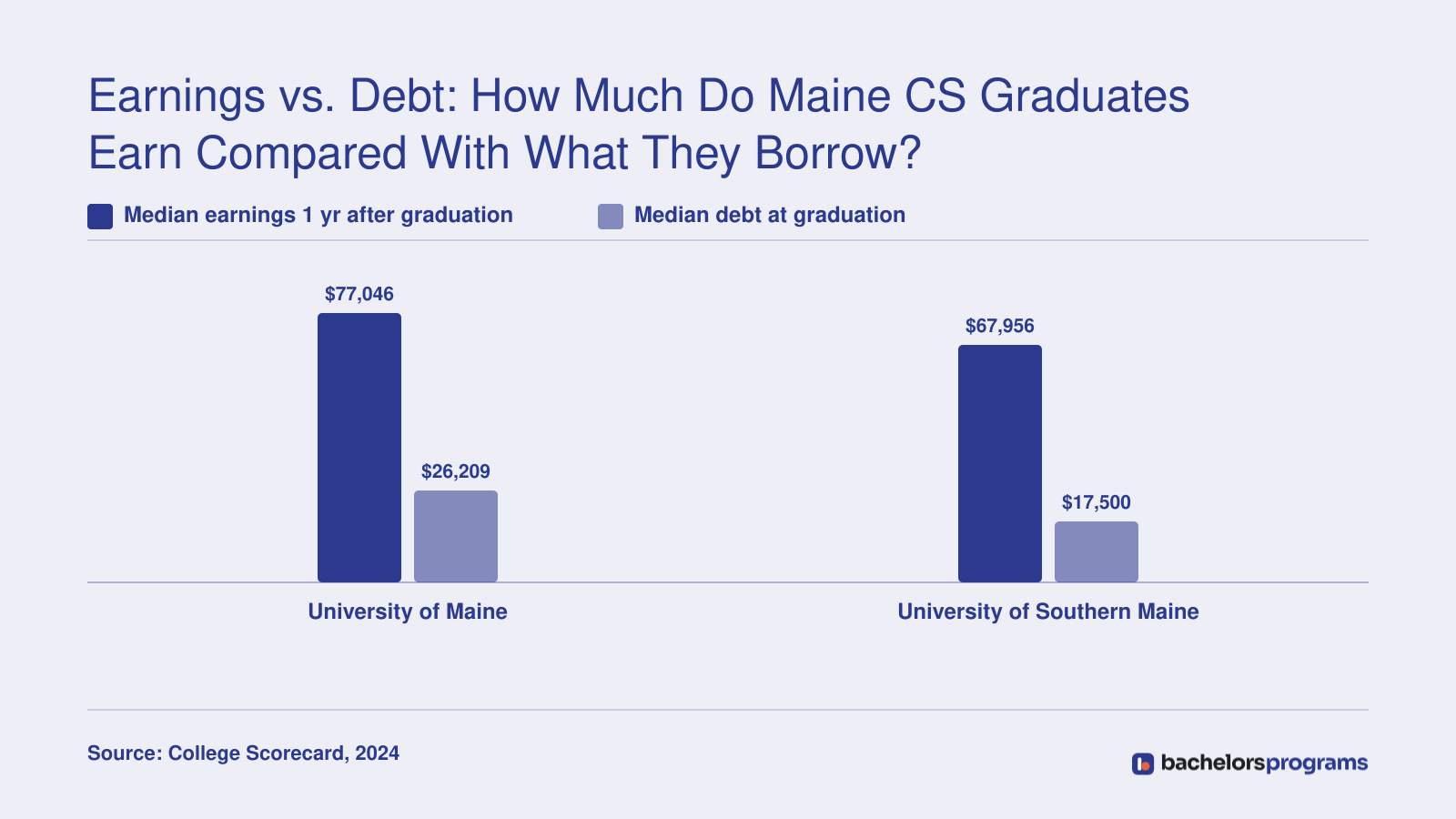
Earnings vs. Debt: How Much Do Maine CS Graduates Earn Compared With What They Borrow?
The University of Maine and the University of Southern Maine both publish program-level median earnings and median debt for their computer science bachelor's graduates, so the chart compares them using pay measured one year after graduation. Graduates of both schools owe less than half of a single year's earnings. USM graduates borrow about $26 for every $100 of first-year pay, compared with about $34 at UMaine, which gives USM the stronger debt-to-earnings balance. UMaine's median pay climbs to $99,413 four years out.
Median Pay for Software Developers in Maine
National wage data gives Maine computer science graduates a useful benchmark for one of the field's most common career paths.
Questions to Ask Yourself
Do you want a small, selective liberal arts college or a larger flagship university with more course choice?
Can you attend in person, or do you need a blended or online format?
Does your target job call for ABET accreditation or a specific concentration such as cybersecurity or data science?
Can you cover the net price without borrowing more than your likely early-career earnings will support?
Compare Computer Science programs on the data that matters
Explore more Computers & IT majors or browse every field of study.
All Computers & IT programs Browse every field of study