Best Business Degree Programs in Oregon
Compare 43 accredited Business programs in Oregon at 18 colleges, with net price after aid, graduation rates, earnings and debt from IPEDS and the U.S. College Scorecard.

Oregon's business schools split along institutional lines: a flagship research campus, regional publics in Monmouth, Ashland, and La Grande, private colleges, and online degrees offered by those same campuses. Price tracks that split loosely. Portland State's average net price after grants comes to $9,552.
The ranking weighs net cost against completion and graduate earnings, then factors in admissions policy, aid, accreditation, and Oregon hiring data. Quick answers: Portland State on cost, George Fox on earnings.
What separates them is less the diploma than the gate: a separate business-major application on some campuses, a credit-heavy accounting track on others.
Key Points
- Portland State University's average net price after aid is just $9,552.
- George Fox University graduates earn a median $85,171 five years out.
- Pacific awards a BA, while Portland State and Eastern Oregon award a BS.
Best Bachelor's in Business Programs at Oregon Schools, Ranked
Each entry below weighs what a degree costs against how many students finish and what graduates go on to earn, so lower-priced programs with strong completion records rise to the top. All ten are bachelor's degrees at Oregon-based schools. Net price figures are approximate sector averages for students who receive aid, not quotes for any single major.
Oregon State University
#1Corvallis, OR · $15,000 – $20,000/yr (est.)
Best for: Online learners who still want a big university
Oregon State teaches business administration in Corvallis, online through Ecampus and at OSU-Cascades in Bend, so a degree can begin on one campus and finish remotely. Students choose a BA, BS, HBA or HBS and can add options such as digital marketing, entrepreneurship, international business or sports business. In-state tuition is about $14,400 and net price around $19,600, and schools offering this program have graduation rates of 70%.
- 180-credit degree with BA, BS, HBA and HBS options
- Tracks: Digital Marketing, Innovation and Entrepreneurship
- Taught in Corvallis, online via Ecampus, and at OSU-Cascades
- Seven concentration options including Sports Business and International Business
- Case analysis and an experiential learning requirement built into the curriculum
- Degree Partnership Program combines OSU courses with community college classes
University of Oregon
#2Eugene, OR · ~$22,000/yr (est.)
Best for: Marketing and sports-business hopefuls
The University of Oregon's Lundquist College of Business awards a BA or BS in business administration on its Eugene campus, after 40 pre-major credits and 76 credits of major coursework. Concentrations in accounting, entrepreneurship, finance, marketing, sports business and operations and business analytics are optional and do not appear on the transcript. In-state tuition is about $16,100 and net price roughly $22,200, and schools offering this program have graduation rates of 72%.
- BA or BS in Business Administration after 40 pre-major credits
- 76 credits of major requirements, including seven upper-division business electives
- Optional concentrations: accounting, entrepreneurship, finance, marketing, operations and business analytics, sports business
- Guaranteed admission with a 3.0 cumulative and 3.00 pre-business core GPA
- 44 upper-division credits must be completed in residence
- Cultural Awareness for Business Decisions course required; study abroad can waive it
University of Portland
#3Portland, OR · $28,000/yr (est. net price)
Best for: Small-cohort learners in Portland
This private Portland university runs a Bachelor of Business Administration on its city campus, built on economics, marketing, finance and accounting plus coursework in ethics and social responsibility. The School of Business is one of five in Oregon accredited by AACSB, and students can join a student-run investment group managing real money. Tuition is about $58,100 and net price around $28,200, and schools offering this program have graduation rates of 80%.
- AACSB-accredited School of Business
- Core coursework in finance, marketing and accounting
- Ethics and social responsibility built into the curriculum
- Student investment group (UPIA) manages a real portfolio
- Electives let students tailor the degree
- Alumni hired at Nike, U.S. Bank and Wieden + Kennedy
Willamette University
#4Salem, OR · $25,000 – $30,000/yr (est.)
Willamette's Salem campus awards a Bachelor of Science in Business Administration that pairs a liberal arts core with a required internship and faculty who also teach in the MBA program. The 124-credit degree admits first-year, transfer and international students, and merit scholarships are awarded with no separate application. Tuition is about $51,200 and net price around $25,100, and schools offering this program have graduation rates of 71%.
- Bachelor of Science, 124 credit hours
- Required internship built into the major
- Taught by faculty who also teach in the MBA program
- Merit scholarships awarded with no separate application
- Study abroad and experiential electives available
- Open to first-year, transfer and international applicants
Portland State University
#5Portland, OR · ~$10,000/yr (est.)
Portland State's business administration BS centers on a Management & Leadership concentration and follows a 180-credit, four-year degree map with 62 upper-division credits. Students complete BA 302 before the concentration and finish with a capstone open to seniors who have cleared the 300-level core. In-state tuition is about $11,700 and net price under $10,000, and schools offering this program have graduation rates of 53%.
- BS in Business Administration with a Management & Leadership concentration
- 180 total credits, including 62 upper-division credits
- BA 302 is the prerequisite for the Management & Leadership concentration
- Capstone BA 495 requires all eight 300-level BA courses and senior standing
- A 4-credit business internship can count as an upper-division MGMT elective
- Optional first-year course MGMT 200: Business School Basics
Western Oregon University
#6Monmouth, OR · ~$17,000/yr (est.)
Western Oregon's Monmouth campus offers a general Bachelor of Science in Business Administration with no required concentration, so electives carry most of the customization. Coursework spans finance, economics, accounting and stakeholder management and points toward general manager and operations manager roles. In-state tuition is about $11,900 and net price around $17,200, and schools offering this program have graduation rates of 47%.
- Bachelor of Science in Business Administration
- No concentration required; business electives tailor the degree
- Coursework in finance, economics, accounting and stakeholder management
- Prepares students for general manager and operations manager roles
- Willamette Promise dual-credit pipeline reaches 46 Oregon school districts
George Fox University
#7Newberg, OR · $30,000 – $35,000/yr (est.)
George Fox pairs a 42-credit business core with a 15-credit concentration in economics, finance, management or marketing on its Newberg campus. Classes are small, mentorship runs through the Ignite program, and ethics plus Christian faith are woven through the curriculum. Tuition is about $42,800 and net price around $31,700, and schools offering this program have graduation rates of 72%.
- Bachelor of Arts with a 42-credit core and a 15-credit concentration
- Tracks: Economics, Finance, Management, Marketing
- Small, student-focused classes with mentorship through the Ignite program
- Business ethics and Christian faith integrated into coursework
- Project-based final course plus internship opportunities
- Accredited by NWCCU
Eastern Oregon University
#8La Grande, OR · $15,000 – $20,000/yr (est.)
Eastern Oregon delivers business administration from La Grande in three formats: on campus, hybrid, and fully online and asynchronous with no campus visits required. The 180-quarter-credit degree comes as a BS, BA or Bachelor of Applied Science, accepts up to 135 transfer credits, and can be finished in about two years by transfer students. In-state tuition is about $11,100 and net price around $17,100, and schools offering this program have graduation rates of 43%.
- BS, BA or Bachelor of Applied Science in Business Administration
- 180 quarter credits; transfer students can finish in about two years
- Up to 135 credits accepted from other institutions
- Fully online, asynchronous option with zero on-campus requirements
- IACBE-accredited College of Business
- Credit for Prior Learning and Sigma Beta Delta honor society available
- 92% of online students receive financial aid or scholarships
Corban University
#9Salem, OR · ~$28,000/yr (est.)
Corban's Salem campus awards a 120-credit business administration degree with five concentrations: accounting, agribusiness, leadership and management, marketing, and sports and recreation management. Every business student joins Corban Consulting Partners, and seniors consult for a real client before presenting results to Salem business leaders. Tuition is about $40,300 and net price around $28,000, and schools offering this program have graduation rates of 61%.
- 120 credits over four years, on campus in Salem
- Five concentrations: accounting, agribusiness, leadership and management, marketing, sports and recreation management
- Senior capstone consulting project presented to Salem business leaders
- All business students join Corban Consulting Partners
- Business majors make up 24% of undergraduates
Pacific University
#10Forest Grove, OR · ~$35,000/yr (est.)
Pacific University's Forest Grove campus offers a BA in Business Administration built on a 42-credit core plus 16 credits of concentration electives in accounting, finance, international business, management, marketing or sports marketing. A team-based senior capstone must be completed in residence, and a 2.0 GPA is required across business courses. Tuition is about $56,400 and net price around $35,300, and schools offering this program have graduation rates of 67%.
- BA in Business Administration, a 63.5-credit major
- 42-credit business core plus 16 credits of concentration electives
- Concentrations: accounting, finance, international business, management, marketing, sports marketing
- 2.0 GPA minimum in all business, accounting and economics courses
- Team-based senior capstone must be completed in residence
- Study abroad and international internship options
Cost & outcomes by school
Federal data for the highest-earning Business programs, independent of the ranking above. Earnings are this field's bachelor's graduates four years after completing where the Scorecard reports them, else the school's undergraduate median.
| School | Net price / yr | Grad rate | Earnings | Debt | Grads/yr | Format |
|---|---|---|---|---|---|---|
| University of Portland OR | $28,210 | 80% | $82,804 | $21,370 | 1,716 | Campus |
| Linfield University OR | $26,536 | 71% | $78,638 | $25,000 | 988 | Hybrid |
| Oregon Institute of Technology OR | $15,706 | 54% | $72,273 | $22,500 | 1,198 | Campus |
| Oregon State University OR | $19,604 | 70% | $64,010 | $21,221 | 13,578 | Online |
| University of Oregon OR | $22,182 | 72% | $61,324 | $20,139 | 9,470 | Campus |
| Pacific University OR | $35,273 | 67% | $60,583 | $23,223 | 820 | Campus |
| George Fox University OR | $31,679 | 72% | $59,761 | $24,250 | 1,370 | Campus |
| Portland State University OR | $9,552 | 53% | $57,906 | $20,500 | 7,306 | Campus |
| Willamette University OR | $25,121 | 71% | $56,911 | $21,500 | 624 | Campus |
| Warner Pacific University OR | $25,629 | 49% | $55,204 | $25,000 | 212 | Campus |
| Warner Pacific University Professional and Graduate Studies OR | — | — | $55,204 | $25,000 | 82 | Online or campus |
| Bushnell University OR | $20,789 | 56% | $53,623 | $23,500 | 340 | Campus |
Sources: U.S. Department of Education. Net price, graduation rate, earnings and debt: College Scorecard (earnings and debt for this field's bachelor's graduates where reported, else school-wide); graduates: IPEDS. A dash means no figure is reported.
Cost, debt & payoff
Median earnings of this field's bachelor's graduates (4 yrs after completing, else the school's undergraduate median) vs. their median federal loan debt · U.S. College Scorecard
Across these programs the median graduate earns about $55,204 and finishes with roughly $22,500 in debt — a ratio that clears a common rule of thumb (keep debt below first-year salary). Net price and debt vary widely school to school, so check the per-school figures in the table above before you shortlist.
Most Affordable Bachelor's in Business Programs at Oregon Schools, Ranked
Portland State University stands out on cost, with an average annual net price of $9,552 after grants and scholarships, roughly half that of the other public universities below. Figures come from the U.S. Department of Education's IPEDS and College Scorecard data (2024), and net price is the better guide to what families actually pay. Southern Oregon University, in our directory, also comes in low at a $16,732 net price for its hybrid business administration bachelor's.
| Rank | School | City | Program | Format | In-State Tuition and Fees | Average Net Price |
|---|---|---|---|---|---|---|
| 1 | Portland State University | Portland | BS in Business Administration: Management & Leadership | Campus | $11,679 | $9,552 |
| 2 | Eastern Oregon University | La Grande | Bachelor of Science in Business Administration | Hybrid (fully online option) | $11,076 | $17,148 |
| 3 | Western Oregon University | Monmouth | Business Administration (BS) | Campus | $11,879 | $17,237 |
| 4 | Oregon State University | Corvallis | Business Administration | Online (also on campus) | $14,400 | $19,604 |
What a Bachelor's in Business Costs in Oregon: Tuition, Net Price, and State Aid
The tuition a business school publishes and the price a student pays are two different numbers, and in Oregon the gap can reach several thousand dollars a year.
The Lowest Published Prices
- Portland State University: $11,679 in-state tuition; $9,552 average net price.
- Southern Oregon University: $12,762 in-state tuition; $16,732 average net price.
- Eastern Oregon University: $11,076 in-state tuition; $17,148 average net price.
- Western Oregon University: $11,879 in-state tuition; $17,237 average net price.
- Oregon State University: $14,400 in-state tuition; $19,604 average net price.
Net price is an institution-wide average after grant aid, not a personal quote.
Sticker Price vs. Net Price
At public universities, in-state tuition is the sticker price; net price is the average undergraduate's cost after grants. Private colleges post higher tuition, but aid often narrows the gap, so compare net prices.
State Aid That Lowers the Bill
The Oregon Opportunity Grant is a need-based state grant. For 2026-27 it requires 12 months of Oregon residency, no prior bachelor's degree, and a Student Aid Index of $8,000 or less. Awards reach $8,352 at four-year institutions and $7,092 in community-college bachelor's programs, with priority by greatest need and filing date. There is no separate application: file the FAFSA or ORSAA. The 2026-27 final filing date was May 15, 2026.
Oregon Promise is a last-dollar grant for recent Oregon high school and GED graduates at Oregon community colleges. It pays $2,280 to $4,716 for a full-time 2026-27 year and covers up to 12 credits per term. It can cut your first two years before transfer, but it does not apply at four-year business schools. The 2026-27 deadline was June 1, 2026 for high school graduates and July 10, 2026 for GED candidates.1
The Western Undergraduate Exchange lets students from participating Western states pay reduced tuition at out-of-state institutions. Eligibility, discount size, and deadlines are set by each institution, so confirm details on the school's WUE page.
One Practical Step
File the FAFSA or ORSAA early. Oregon Opportunity Grant funds go first to students with the greatest need, so an early application puts you ahead of later applicants. If you are ineligible for federal aid, the ORSAA is the state alternative.
Highest-Earning Business Bachelor's Programs in Oregon
On value, Portland State stands out: its average net price of $9,552 is the lowest of any school in this table, and its graduates earn a median of $76,365 five years out with a median debt under $20,000. All earnings and debt figures below are for each school's business bachelor's program, not the institution as a whole.
| School | Program | Format | Median Earnings 1 Year After Completing | Median Earnings 4 Years After Completing | Median Earnings 5 Years After Completing | Median Program Debt | Typical Monthly Loan Payment |
|---|---|---|---|---|---|---|---|
| George Fox University | Business Administration | Campus | $63,331 | $82,212 | $85,171 | $21,687 | $230 |
| Portland State University | Business Administration: Management & Leadership, Bachelor of Science | Campus | $51,358 | $71,621 | $76,365 | $19,901 | $211 |
| Oregon State University | Business Administration | Campus and online | $47,555 | $73,660 | $69,262 | $21,500 | $228 |
| Southern Oregon University | Business Administration | Hybrid | $48,074 | $65,171 | $61,883 | $25,000 | $265 |
| Pacific University | Business Administration, BA | Campus | $44,435 | $61,696 | $61,140 | $26,000 | $276 |
Studying Business Online or Hybrid at Oregon-Based Schools
Flexibility and campus experience pull against each other, and Oregon's business programs split along that line. Format matters more than prestige if you are working or living far from a campus.
Sorting the Schools by Format
- Online: Oregon State University offers its Bachelor of Arts or Science in Business Administration 100% online through Ecampus, alongside Corvallis and OSU-Cascades campus options.
- Both: Eastern Oregon University offers a fully online path and an on-campus path in La Grande. The online classes are asynchronous.
- Campus-based: University of Oregon, University of Portland, Willamette University, Portland State University, Western Oregon University, George Fox University, Corban University and Pacific University are listed as on-campus programs. Check each school's page for any online courses.
Residency, Rates and Fees
OSU sets no in-person requirement for the online degree. It does require at least 45 of your last 75 credits to be completed at Oregon State, online or on campus. The 2026-27 rate is $438 per credit, including a $15 per-credit distance-education fee, and course materials cost extra. Nonresidents pay no additional charge.
EOU's program is 180 credits over four years, and the online version has no on-campus requirement. Online tuition is $338 per credit, or an estimated $60,840 for the full degree if you bring no transfer credits. Add a one-time $250 matriculation fee and $15.10 per credit for accounting, business, economics and marketing courses. EOU's online pages do not say whether the rate differs for out-of-state students, so ask admissions before you apply. EOU also accepts up to 135 transfer credits.
Who Benefits
- Working adults: Asynchronous EOU courses and OSU Ecampus let you study around a job.
- Rural Oregon students: Online study avoids a move or a long commute to Corvallis, Eugene or Portland.
- Out-of-state learners: OSU's no-surcharge policy for online nonresidents makes it the clearest cost fit.
If you want campus life, internships and in-person networking, the campus-based programs fit better.
Getting in: GPA, Test Policy, and Transfer Credit at Oregon Business Schools
Oregon business schools run two different admission models. Some admit you to the university first and then require a separate application to the business major; others fold the two into one review. Which model a school uses tells you more about your odds than its overall acceptance rate does.
The real gate is often inside the university
At the University of Oregon, freshman admission requires 15 core high school units with at least a C- in each, and SAT or ACT scores are optional. The business major is a second step: guaranteed admission calls for a 3.0 combined UO and transfer GPA plus a 3.0 in the pre-business core, with those courses letter-graded at C- or better. Oregon State requires 180 approved credits for the degree, and transfer coursework in business must carry at least a C-.
Acceptance rates only tell part of the story
Most schools here admit the large majority of applicants. Eastern Oregon (98.3%) and Western Oregon (98.1%) sit near open access, followed by Corban (93.9%), George Fox (93.5%), Portland State (90.9%) and Pacific (89.6%); Oregon State (77.3%) and Willamette (77.1%) are the most selective in this group. On the open-access campuses, the GPA bar is rarely what stops a student. Grades in the major's own courses are. Several schools do not publish a general GPA minimum, a test policy, or a transfer-credit cap on their admissions pages, so confirm directly with an advisor. Pacific lists a 2.0 GPA minimum, and Eastern Oregon accepts up to 135 transfer credits.
Transfer credit: grades and guarantees
The statewide Business Major Transfer Map sets a 2.0 cumulative GPA, requires at least a C- in major courses, and does not accept pass/no-pass grades for those courses; a 3.0 earns guaranteed admission. Oregon transfer applicants need a 2.25 GPA as residents and 2.50 as nonresidents, or 2.00 with an AAOT or ASOT in Business regardless of residency. Only 124 community college credits count toward a UO degree, and at least 62 upper-division credits must be taken there. Oregon State publishes no general maximum transfer-credit limit, though a transfer guide notes up to 135 community college credits may apply, and upper-division business courses must come from an AACSB-accredited business school or they count only as electives.
Related Articles
AACSB vs. IACBE: Which Oregon Business Schools Hold Which Accreditation
Does it matter whether an Oregon business bachelor's carries AACSB or IACBE accreditation? Both signal that an outside reviewer has checked the curriculum, but they review different things. That difference can shape how employers and graduate programs read your degree.
What Each Seal Signals
AACSB reviews the business school as a whole. Its principles-based standards cover strategy and innovation, research, teaching, curriculum, and student learning, so the seal speaks to quality across the business unit. IACBE accredits specific business and accounting programs rather than the entire institution.1 Its seal applies only to the programs it lists. For employers and graduate admissions offices, either one is a quick quality signal beyond the diploma itself.
Where Oregon Schools Stand
- AACSB: Oregon State University, University of Oregon, and Portland State University, each accredited for business and accounting. Oregon State notes that design programs within its College of Business fall outside that accreditation.
- IACBE: Eastern Oregon University, for its BA and BS in Business Administration and its MBA, with an approved period running through December 31, 2027.2
For the other schools ranked here, our directory review did not confirm either business accreditation. That gap alone does not prove a school lacks one, so check before you apply.
Institutional Accreditation Is Separate
Regional accreditation from the Northwest Commission on Colleges and Universities (NWCCU) covers the whole institution and underpins federal aid eligibility and credit transfer. Business accreditation is an additional, voluntary layer on top of it.
Verify It Yourself
Search the school's name in the AACSB Accredited Schools Directory and the IACBE member status search.3 If you plan to pursue a CPA license, confirm that accounting is included in the accreditation, not just general business.
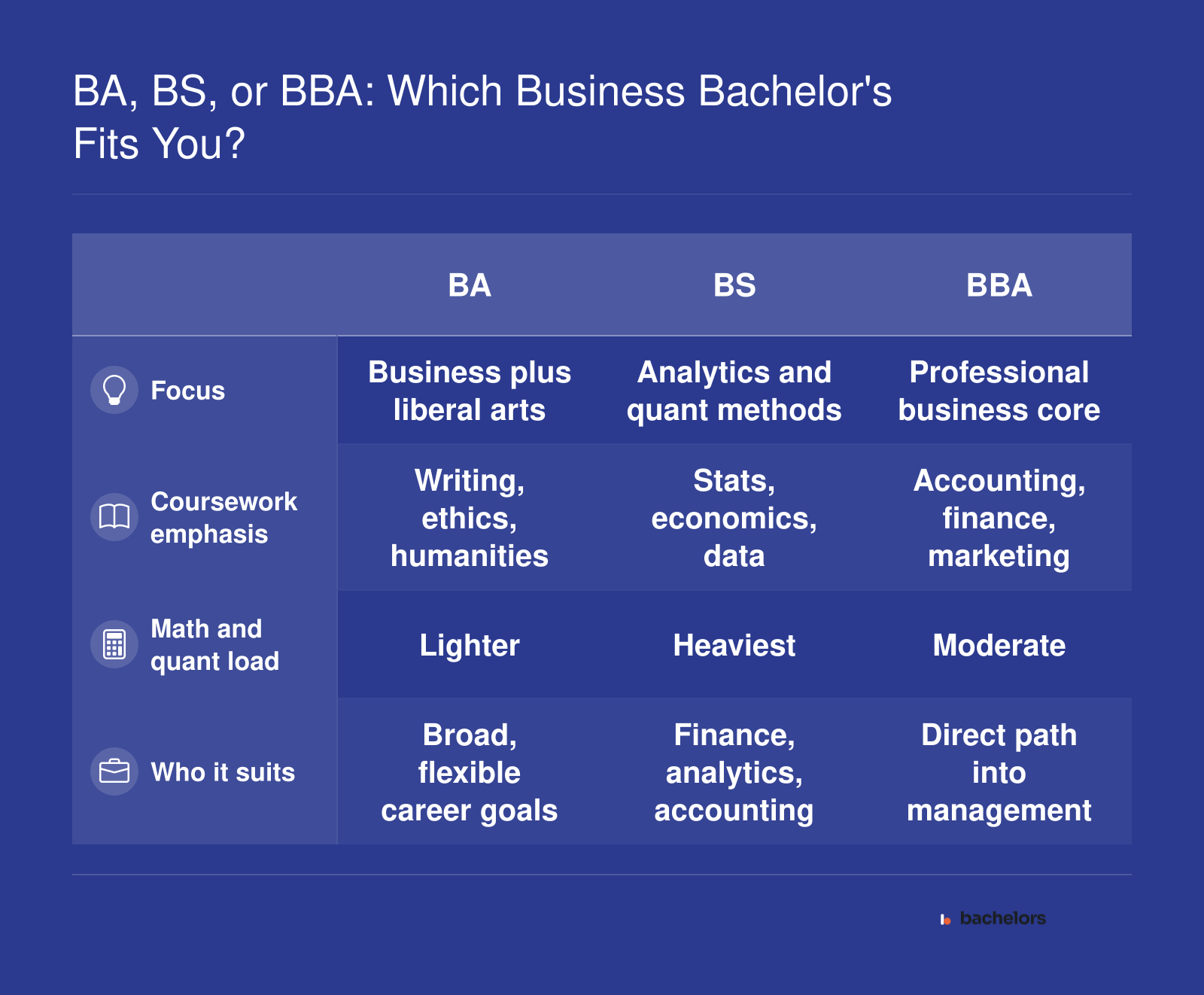
BA, BS, or BBA: Which Business Bachelor's Fits You?
Business bachelor's degrees carry different labels: Pacific University awards a BA, Portland State and Eastern Oregon award a BS, and the University of Portland awards a BBA. A Bachelor of Applied Science (BAS) is a separate degree-completion route for students who already hold an applied or technical associate degree. Labels vary by school, so read the actual curriculum and required math courses before you decide.
Business Careers and Pay in Oregon
A business bachelor's degree in Oregon points toward four broad salaried job families: general management, marketing, accounting, and finance. Each hires across Portland-area employers as well as in Salem, Eugene, Corvallis, and smaller Willamette Valley cities, and the state publishes median pay for most of them.
What the Concentrations Lead To
- Management: Operations and general managers held 47,248 Oregon jobs in 2025, with median pay of $105,227 a year and an average of $133,919. Short-term state projections put annual openings near 8,100.
- Marketing: Marketing managers earned a median $164,258. Market research analysts and marketing specialists, the more typical entry point for new graduates, numbered 11,409 with a median of $79,498 and about 1,227 openings a year.
- Accounting: Accountants and auditors numbered 15,157, with 1,297 annual openings and a median of $80,330.
- Finance: Corporate finance, credit, and banking roles cluster in Portland, and finance coursework feeds the analyst and planning teams inside larger employers.
The Baseline to Beat
Oregon's average annual wage across all private-sector jobs was $71,936 in 2025. The accounting and market research medians sit just above that line, while management pay runs well above it. Program-level earnings figures reflect what graduates of specific programs actually reported, and they are the sharper comparison once you have a shortlist.
No License to Practice
Business administration carries no Oregon state licensure. Employers hire on the degree, internships, and software fluency rather than a state credential. The exception is accounting, where the CPA is a separate credential layered on top of the bachelor's; Oregon's requirements are covered further down.
Oregon CPA Licensure for Accounting Concentrations
Most business majors never need a license, but accounting students face a choice: sit for the CPA exam on a bachelor's degree, or build toward full licensure with more credits. Accounting is the exception here, and the Oregon Board of Accountancy sets the rules.
As of January 1, 2026, exam candidates need a bachelor's degree and at least 120 semester hours. They also need 24 semester hours of upper-division accounting and 24 semester hours of accounting-related coursework, which can span business, economics, finance, and communication.
Licensure itself has three pathways. Pathway 1 requires 150 semester hours, a bachelor's degree, the Uniform CPA Examination, and one year of supervised experience. Pathway 2 skips the 150 hours but requires two years of supervised experience. Pathway 3 requires a master's degree and one year.
Before choosing a concentration at any school here, compare its accounting coursework against the board's current requirements.
Quick Answers on Oregon Business Bachelor's Degrees
What is the cheapest business degree in Oregon?
Are there online business degrees from Oregon schools?
What is the difference between a BA, BS, and BBA in business?
Compare Business programs on the data that matters
Explore more Business & Management majors or browse every field of study.
All Business & Management programs Browse every field of study