Best Computer Science Schools in Oregon
Compare 18 accredited Computer Science programs in Oregon at 13 colleges, with net price after aid, graduation rates, earnings and debt from IPEDS and the U.S. College Scorecard.

A bachelor's degree in computer science, awarded in Oregon as a Bachelor of Science (B.S.) or Bachelor of Arts (B.A.) in Computer Science, averages $9,552 a year after aid at Portland State University and $19,604 at Oregon State University. That is a gap of more than $10,000 a year for the same credential.
Price is one filter among several. Graduate earnings, admissions expectations, ABET accreditation, online delivery and career paths also separate the schools ranked here, from large public universities to small private colleges in Salem, Newberg and Forest Grove.
There is a practical case for staying in-state. The Portland metro is home to the Silicon Forest, a cluster of semiconductor, hardware and software employers centered on Hillsboro, which puts internships and campus recruiting within commuting distance.
Key Points
- Portland State has the lowest net price here at $9,552 a year.
- Oregon State's average net price runs $19,604, over double Portland State's.
- Statewide agreements govern how Oregon community college credits transfer in.
Best Computer Science Schools in Oregon: Top 10 Bachelor's Programs Ranked
What separates the top of this list from the rest is the combination of a rigorous, accredited curriculum and a visible path from the classroom into paid software work. Oregon State anchors the group with statewide delivery options, the University of Portland counters with small classes and a year of hands-on design, and Portland State plugs students straight into the city's tech employer base. The remaining seven schools trade scale for tighter cohorts and, in a few cases, a lower sticker price.
Oregon State University
#1Corvallis, OR · $15,000 – $20,000/yr (est.)
Best for: Students wanting campus or online flexibility
Oregon State is the state's largest public research university and the anchor of this list, running an ABET-accredited computer science major on the Corvallis campus, online through OSU Ecampus, and at OSU-Cascades in Bend. Undergraduates can earn a Bachelor of Science, a Bachelor of Arts, or an honors degree while choosing among options in Computer Systems, Cybersecurity, or Specialized Computer Science. The university is also standing up a council on community college partnerships to strengthen transfer pathways into the major.
- ABET accredited computer science major
- Options in Computer Systems, Cybersecurity, or Specialized Computer Science
- 180 total credit hours, designed for four-year completion
- Available at Corvallis, OSU Ecampus, and OSU-Cascades
- Pairs computer science theory with hands-on software development
- Covers data structures, algorithms, databases, and software engineering
- Includes social and ethical issues in computing
- Four years of high school math, science, and English recommended
University of Portland
#2Portland, OR · $28,000/yr (est. net price)
Best for: Portland-area students wanting small classes and mentorship
The University of Portland is a private Catholic university in North Portland with a small, project-driven Bachelor of Science in Computer Science. Students work through the entire software engineering process, from defining problems to designing solutions, and add electives in artificial intelligence, machine learning, robotics, security, and big data analytics. Small classes, collaborative research with faculty, and a capstone experience feed graduates into employers such as Amazon, Apple, Google, Intel, and Microsoft. A post-baccalaureate option serves career changers, and the Shiley-Marcos Center for Design and Innovation provides prototyping and virtual reality space.
- Capstone project required
- Electives in AI, machine learning, robotics, security, and big data
- Small class sizes that foster collaboration
- Undergraduate research with a faculty advisor
- Shiley-Marcos Center for Design and Innovation prototyping and VR spaces
- Core Curriculum integrates liberal arts and ethics
- Post-baccalaureate option for career changers
- Financial aid and scholarships available
Portland State University
#3Portland, OR · ~$10,000/yr (est.)
Best for: Urban commuters seeking paid industry internships
Portland State sits in the middle of downtown Portland, close to the tech employers that feed its internship pipeline. Its ABET-accredited Bachelor of Science in Computer Science spans 180 credits of programming, systems, and theory, with electives in artificial intelligence, cybersecurity, and web development. Students take paid internships with companies such as Intel and Amazon, and the department reports an 85% job placement rate for graduates. Admission is a two-step process: acceptance to the university first, then meeting upper-division eligibility for the major.
- ABET accredited program
- 180 total credits, delivered in person
- Start any term
- Electives in AI, cybersecurity, and web development
- Paid internships with employers such as Intel and Amazon
- Department reports 85% job placement for graduates
- Upper-division opt-in after university admission
- Housed in the Maseeh College department in the Portland Silicon Forest
Willamette University
#4Salem, OR · $25,000 – $30,000/yr (est.)
Willamette University is a private liberal arts university in Salem that awards both a Bachelor of Arts and a Bachelor of Science in Computer Science, plus a minor. The 124-credit degree includes a 40-semester-hour major built on 28 core hours with additional work in mathematics and data science, and small classes keep students close to faculty. Admitted undergraduates are considered automatically for merit scholarships starting at $30,000 a year, and the NSF-supported STEM Fellows Program adds up to $10,000 annually with mentorship. A dedicated computer science lab and weekly department events round out the experience.
- BA and BS degrees offered, plus a minor
- 124 total credit hours over four years
- Major requires 40 semester hours, including 28 core hours
- 4 semester hours each in mathematics and data science
- Minor requires 20 semester hours, including CS 151 and CS 152
- Merit scholarships start at $30,000 a year
- NSF STEM Fellows Program adds up to $10,000 annually
- Weekly TechBytes department events and a dedicated computer science lab
Linfield University
#5McMinnville, OR · $25,000 – $30,000/yr (est.)
Linfield University is a private university in McMinnville, roughly an hour southwest of Portland, offering computer science as both a major and a minor. Coursework covers data structures, algorithms, software engineering, and network security, with an emphasis on real-world problem solving, teamwork, and project management alongside software development skills. Faculty mentorship and applied projects are the program's calling cards, and graduates move into software engineering, development, and analyst roles.
- Major and minor both available
- Courses in data structures, algorithms, and software engineering
- Network security included in the curriculum
- Focus on real-world problem solving
- Builds skills in software development, teamwork, and project management
- Faculty mentorship in a small department
- Campus-based undergraduate program
Lewis & Clark College
#6Portland, OR · $35,000 – $40,000/yr (est.)
Lewis & Clark College is a private liberal arts college in southwest Portland whose computer science degree comes with an optional cybersecurity concentration. The curriculum pairs computation and complex software construction with courses such as Network Security and Computer Security, and students compete in the National Cyber League and the Pacific Rim Collegiate Cyber Defense Competition. Classes are faculty-taught with no graduate assistants, and the college's four-year graduation guarantee covers tuition for an extra semester if a student needs one. Popular complementary minors include data science, mathematics, and entrepreneurial leadership.
- Optional cybersecurity concentration
- Courses include Network Security and Computer Security
- Teams compete in the National Cyber League and Pacific Rim Cyber Defense
- Four-year graduation guarantee covers an extra semester's tuition
- Paid Rogers Summer Science research opportunities
- Faculty-taught classes with no graduate assistants
- Hackathons, workshops, and game jams
- Popular minors include data science and entrepreneurial leadership
Corban University
#7Salem, OR · ~$28,000/yr (est.)
Corban University is a private Christian university in Salem that awards a bachelor's degree in computer science over four years and 120 credits. Students work in Python, Java, JavaScript, and SQL and take courses in artificial intelligence, data mining, combinatorics and graph theory, and database systems, with coursework that considers technology through an ethics and faith lens. The IT department offers four on-campus internships each year, an unusual built-in work component for a program this size, and mathematics is a common double major. Information technology is also named among Oregon's in-demand workforce sectors in the 2026 state talent assessment.
- 120 total credit hours over four years
- Teaches Python, Java, JavaScript, and SQL
- Courses in AI, data mining, combinatorics and graph theory, and database systems
- Four on-campus internships each year through the Corban IT department
- Integrates ethics, integrity, and faith into computing coursework
- Mathematics is a common double major
- 15% of majors in the program are women
- Information technology listed among Oregon in-demand sectors
Pacific University
#8Forest Grove, OR · ~$35,000/yr (est.)
Pacific University is a private university in Forest Grove, west of Portland, with a 50-credit computer science major built on project work rather than isolated assignments. Students cover software engineering, artificial intelligence, machine learning, data science, cybersecurity, and human-computer interaction, building complete systems in Python, C++, Java, Linux, databases, and web technologies. A year-long senior capstone asks teams to design and present a full software solution, and a 3-year accelerated option lets students enter the workforce sooner. The Boxer Makerspace adds 3D printing and fabrication space.
- 50-credit major with a required capstone
- Year-long senior capstone team project
- Coursework in AI, machine learning, data science, cybersecurity, and human-computer interaction
- Hands-on work with Python, C++, Java, Linux, and databases
- 3-year accelerated bachelor's option available
- Boxer Makerspace with 3D printers
- Small classes with close faculty collaboration
- Accredited by NWCCU
George Fox University
#9Newberg, OR · $30,000 – $35,000/yr (est.)
George Fox University is a private Christian university in Newberg, southwest of Portland, offering a Bachelor of Science in Computer Science with optional concentrations in Cybersecurity and Artificial Intelligence & Data Science. The core runs 51 credit hours plus 9 hours of electives, and concentrations add 22 to 26 more, including courses such as Ethical Hacking, Digital Forensics, and Cyber Defense. Industry mentorship, servant engineering projects, and competitions like the National Collegiate Cyber Defense Competition give students applied experience, backed by a Maker Space with computing labs. Additional course fees apply, and high school algebra is an admission prerequisite.
- Tracks: Cybersecurity, Artificial Intelligence & Data Science
- 51 credit hour core plus 9 credit hours of electives
- Concentrations add 22 to 26 credit hours
- Concentration courses include Ethical Hacking, Digital Forensics, and Cyber Defense
- Industry mentorship and servant engineering projects
- Competes in the National Collegiate Cyber Defense Competition
- Maker Space with computing lab and shops
- Internships at employers such as NASA and Intel
- High school algebra required for admission
Western Oregon University
#10Monmouth, OR · ~$17,000/yr (est.)
Western Oregon University is a public university in Monmouth, about 20 minutes west of Salem, where computer science is bundled with mathematics in a single combined major. The 104-credit program layers core computing courses in programming, data structures, algorithms, and operating systems on a mathematics sequence that runs through calculus, linear algebra, and discrete mathematics. Students must earn at least a C in computer science courses and a C- in mathematics courses, and 16 credits of electives let them steer toward software engineering or deeper theory. BA and BS options and a dual-major path are available, along with research and individual study opportunities.
- Combined computer science and mathematics major
- 104 total credits, including 16 elective credits
- Core courses in programming, data structures, algorithms, and operating systems
- Mathematics sequence includes calculus, linear algebra, and discrete mathematics
- Grade of C or better required in CS courses, C- in math courses
- BA and BS options, plus a dual-major path
- Built around software engineering preparation
- Research and individual study opportunities available
Cost & outcomes by school
Federal data for the highest-earning Computer Science programs, independent of the ranking above. Earnings are this field's bachelor's graduates four years after completing where the Scorecard reports them, else the school's undergraduate median.
| School | Net price / yr | Grad rate | Earnings | Debt | Grads/yr | Format |
|---|---|---|---|---|---|---|
| University of Portland OR | $28,210 | 80% | $125,929 | $22,590 | 31 | Campus |
| Oregon State University OR | $19,604 | 70% | $121,405 | $22,721 | 1,157 | Campus |
| Portland State University OR | $9,552 | 53% | $113,889 | $25,000 | 134 | Campus |
| Pacific University OR | $35,273 | 67% | $105,018 | $23,223 | 7 | Campus |
| Willamette University OR | $25,121 | 71% | $100,650 | $21,500 | 15 | Campus |
| Linfield University OR | $26,536 | 71% | $78,638 | $25,000 | 3 | Campus |
| Lewis & Clark College OR | $36,013 | 75% | $62,205 | $24,000 | 24 | Campus |
| George Fox University OR | $31,679 | 72% | $59,761 | $24,250 | — | Campus |
| Bushnell University OR | $20,789 | 56% | $53,623 | $23,500 | — | Campus |
| Western Oregon University OR | $17,237 | 47% | $51,815 | $20,609 | — | Campus |
| Eastern Oregon University OR | $17,148 | 43% | $50,112 | $20,500 | — | Campus |
| Southern Oregon University OR | $16,732 | 43% | $49,175 | $20,332 | — | Campus |
Sources: U.S. Department of Education. Net price, graduation rate, earnings and debt: College Scorecard (earnings and debt for this field's bachelor's graduates where reported, else school-wide); graduates: IPEDS. A dash means no figure is reported.
Cost, debt & payoff
Median earnings of this field's bachelor's graduates (4 yrs after completing, else the school's undergraduate median) vs. their median federal loan debt · U.S. College Scorecard
Across these programs the median graduate earns about $59,761 and finishes with roughly $22,608 in debt — a ratio that clears a common rule of thumb (keep debt below first-year salary). Net price and debt vary widely school to school, so check the per-school figures in the table above before you shortlist.
How We Ranked Oregon's Bachelor's in Computer Science Programs
How do you compare an Oregon computer science degree at a large public research university against one at a small private college?
What we looked at
Four measures drive the order: graduate earnings, net price after aid, how many students complete the program, and whether the degree runs on campus, online, or both. Earnings and cost come from federal College Scorecard figures, which apply one definition of earnings and one definition of cost no matter how large the campus is. Completion counts show whether a department graduates a steady group of majors or only a few each year. Format matters for transfer students, working adults, and anyone living far from Corvallis, Portland, or Salem.
What counted
Bachelor's programs in computer science at Oregon institutions, campus and online, awarded as a B.S. or a B.A. A school earns a place only when its program publishes outcomes and cost figures solid enough to compare. Graduate study plays no part here.
Where the numbers stop
- Institution-wide averages: Graduation rate and net price describe the whole university, not the computer science department.
- Different earnings windows: Some schools report earnings one year after graduation, others later, so match the spans when you can.
- Format changes the experience: An online or hybrid program can suit a working student and disappoint someone who wants labs and faculty research.
Treat the ranking as a starting point. Before you apply, check department pages for class sizes, internship pipelines, and advising, then weigh those against the published cost figures.
Which Oregon Computer Science Schools Cost the Least After Aid?
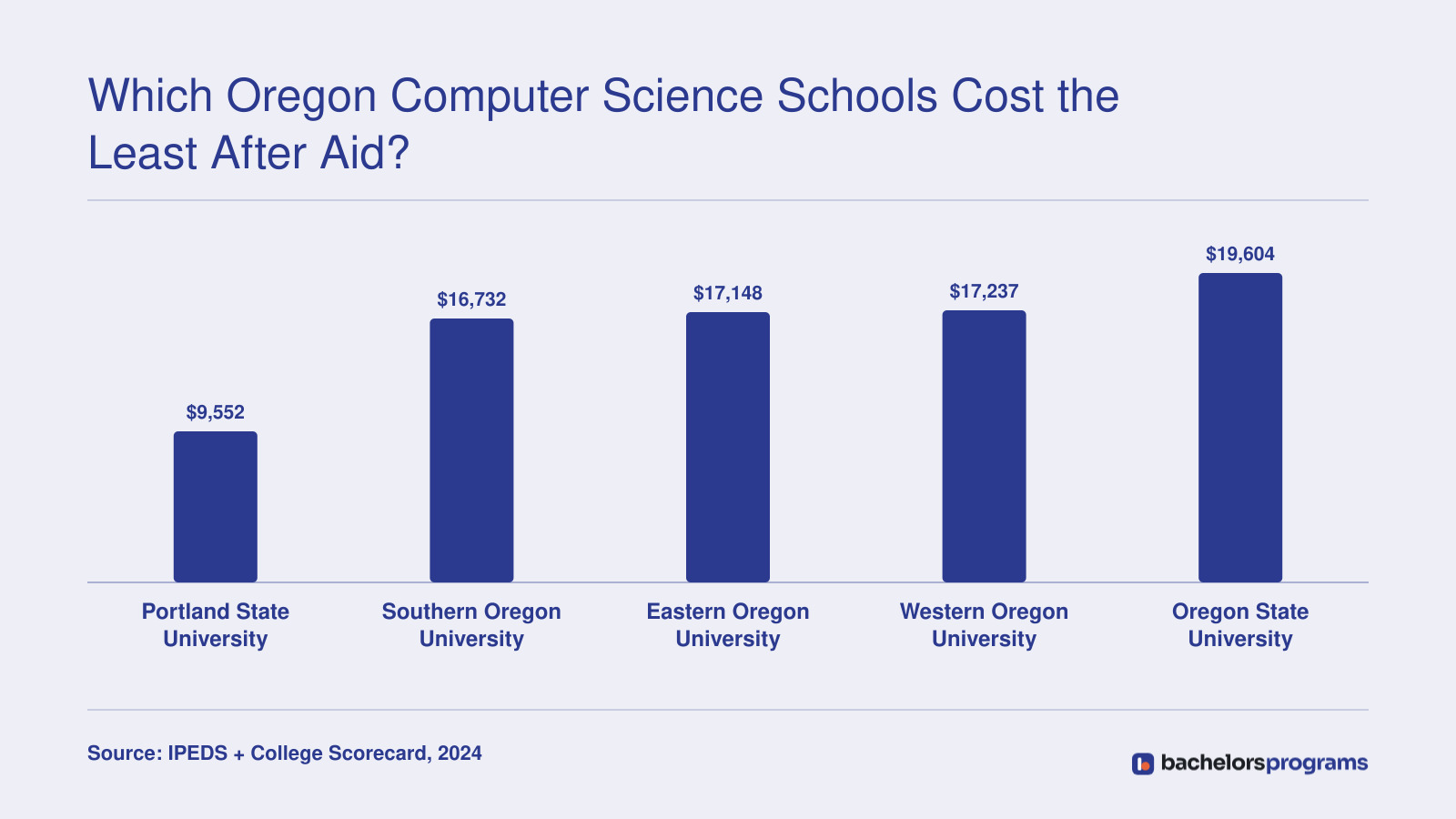
Portland State University has the lowest average net price after aid among these Oregon computer science schools at $9,552 a year. That is less than half of Oregon State University's $19,604, a gap of $10,052 a year. Southern Oregon University, Eastern Oregon University and Western Oregon University fall in a narrow middle band from $16,732 to $17,237. Each figure is a schoolwide average for aided in-state students at a public university, not an exact quote for every student, so use each school's net price calculator to estimate your own cost.
Highest-Earning Oregon Computer Science Programs
For a quick return-on-investment check, compare median debt with first-year pay. At University of Portland, Portland State and Oregon State, median debt runs between roughly a quarter and a third of first-year earnings, while program-level debt is not reported for Pacific or Willamette, whose small graduating classes make their earnings figures more directional.
| School | City | Median Earnings (Latest Window) | Earnings Window | Median Earnings, 1 Year After Graduation | Median Debt at Graduation | Est. Monthly Payment (10-Year Plan) |
|---|---|---|---|---|---|---|
| University of Portland | Portland | $136,265 | 5 years after graduation | $85,637 | $22,590 | $239 |
| Portland State University | Portland | $126,086 | 5 years after graduation | $78,669 | $25,000 | $265 |
| Oregon State University | Corvallis | $109,905 | 5 years after graduation | $85,376 | $22,721 | $241 |
| Pacific University | Forest Grove | $105,018 | 4 years after graduation | N/A | N/A | N/A |
| Willamette University | Salem | $100,650 | 4 years after graduation | $80,077 | N/A | N/A |
Related Articles
Admissions for a Bachelor's Degree in Computer Science in Oregon
Oregon's computer science applicants face a familiar tradeoff: the schools that publish the most detailed admissions guidance are not always the easiest to get into, and the ones that admit nearly everyone often say the least about what they expect. Knowing which is which tells you how much preparation each application actually needs from you.
What Oregon State publishes
Oregon State University is the only school here with a fully documented first-year admissions policy. It recommends a 3.0 unweighted high school GPA for admission consideration,1 which is a guideline rather than a cutoff, and reports an average incoming freshman GPA of 3.67.2 That gap matters: meeting the minimum does not mean matching the typical admit.
OSU is test-optional for first-year applicants.3 No exam is required for any program, and leaving scores off is not held against you in either admission or scholarship review. For 2027 entry, Early Action falls on November 2, 2026; applicants who miss it land on a February 1, 2027 priority date, with supporting documents due February 12.4 Applications after that are reviewed on a space-available basis, and Corvallis decisions may not arrive until mid-March.
Importantly, OSU does not use your intended major in the admission decision, and there is no separate computer science admission requirement for incoming freshmen.5 Your major is used for advising, not gatekeeping.
The OSU acceptance rate question
Federal data puts Oregon State's admission rate at roughly 77 percent. That figure is campus-wide, not computer science specific. OSU does not publish a separate acceptance rate for the CS major, so treat the university-wide number as your reference point and ignore any source claiming a distinct CS figure.
How selective the rest are
Selectivity at these Oregon schools ranges from moderate to nearly open. Willamette University (about 77 percent) and Lewis & Clark College (about 78 percent) sit at the more selective end alongside OSU. Linfield University, Pacific University and University of Portland admit roughly 85 to 89 percent of applicants. Portland State University, George Fox University and Corban University all admit over 90 percent, and Western Oregon University admits about 98 percent, which makes its CS and mathematics degree close to open-access.
Outside Oregon State, these schools publish no verified GPA floors, 2026 deadlines or separate CS major requirements we could confirm. Check each admissions office directly rather than assuming OSU's rules carry over.
Transferring Into an Oregon Computer Science Bachelor's Program
"Do my Oregon community college credits count toward a computer science bachelor's degree in Oregon?" Usually they do, but the guarantee comes from statewide agreements, not from the credits themselves.
What transfers as a block
Oregon separates block-transfer guarantees from course-by-course review. The Associate of Science Oregon Transfer in Computer Science, earned at an Oregon community college with the receiving university's admission requirements met, grants junior registration status and covers lower-division general education at Oregon public universities.1 The Computer Science Major Transfer Map goes further: at least eight classes or 30 credits transfer as a block and count toward core bachelor's requirements.2 Oregon State's AST-Computer Science pathway lands students at junior standing and prepares them for the CS major. Portland State treats 90 quarter credits, or 60 semester credits converted at 1.5, as junior standing.3
Courses to finish first
Calculus and introductory programming are the two sequences transfer students most often wish they had finished before applying. The transfer maps are built around lower-division math and programming, so finishing those at the community college keeps a two-year plan on schedule and cuts the number of prerequisite terms after you arrive.
Check the caps and the equivalencies
Oregon State accepts regionally accredited college-level credit but limits non-OSU coursework to 135 quarter credits and professional-technical credit to 12; its online CS bachelor's requires 45 of the last 75 credits through OSU.4 Portland State accepts nothing below the 100 level, caps vocational-technical credit at 12, and takes up to 124 credits from accredited junior colleges.5 Neither published policy promises that every transfer-map course satisfies a specific CS major requirement, so confirm equivalency with the target school's advisor before you register for the class.
Oregon Computer Science School FAQs
What are the best computer science schools in Oregon for international students?
What is the acceptance rate for computer science at Oregon State University?
Are there ABET-accredited computer science programs in Oregon?
How much do computer science graduates earn in Oregon?
Can you get a bachelor's degree in computer science online from an Oregon school?
Compare Computer Science programs on the data that matters
Explore more Computers & IT majors or browse every field of study.
All Computers & IT programs Browse every field of study