Best Business Degree Programs in Texas
Compare 236 accredited Business programs in Texas at 101 colleges, with net price after aid, graduation rates, earnings and debt from IPEDS and the U.S. College Scorecard.

A Texas resident pays $7,363 in annual tuition and fees at Texas A&M University-Central Texas, and several times that for a business degree at Rice, SMU or TCU. What separates them is recruiting access to Dallas and Houston employers and alumni networks, so price alone misleads.
Format splits the market too: working adults can finish a BBA online at a Texas public university without relocating, while traditional-age students gain more from a campus with an internship pipeline.
Every program on both lists is a bachelor's degree at a Texas-based school.
Texas employers weigh the two paths differently, and the difference shows up in your first job.
Key Points
- Texas A&M University-Central Texas charges residents $7,363 yearly, nonresidents $17,154.
- The University of Texas at Tyler directly admits top-quartile Texas high schoolers.
- One Texas CPA pathway requires 150 semester hours plus a year's work.
Best Business Bachelor's Programs in Texas, Ranked
Ten Texas bachelor's programs in business, ordered by the things that matter most when you are choosing where to enroll: how many students finish on time, what they pay after aid, and what the degree is worth once they are working. Each entry below carries the city, delivery format, and concentrations you need to compare them side by side.
Rice University
#1Houston, TX · ~$13,000/yr (est.)
Best for: High achievers seeking a selective business major
Rice packs a small, selective undergraduate business major into a research university in Houston, and the program has grown quickly since it launched in 2021. The Virani Undergraduate School of Business now anchors that growth, with a dedicated business building expected to open in 2026. Classes stay small, students can change concentrations at any point, and departmental honors is available for those who want a research component.
- 3 concentration options, changeable after declaring
- 120 total credit hours across 16 courses
- Minimum 11 upper-level business courses
- Departmental honors available in business
- Transfer credit capped at 9 credit hours
Texas A&M University-Central Texas
#2Killeen, TX · under $5,000/yr (est.)
Best for: Community college transfers in Central Texas
A public university in Killeen built for students who arrive with credits already in hand. Its BBA in Management is the most affordable route on this list by a wide margin, and short 9-credit micro-credentials let students stack a specialty in analytics, cybersecurity, project management, or supply chain on top of the degree. Small classes and published transfer pathways from partner community colleges and four-year universities make it a practical choice for working adults in Central Texas.
- Focus areas in human resources or entrepreneurship
- Study options in accounting, computer information systems, finance, marketing
- 9-credit micro-credential in Business Analytics and Intelligence
- Micro-credentials in Cybersecurity and Project Management
- Micro-credentials in Financial Management and Supply Chain Management
- Relatively small class sizes
- Transfer pathways from partner community colleges and four-year universities
Texas A&M University-College Station
#3College Station, TX · ~$21,000/yr (est.)
Best for: Full-time students wanting a flagship campus
The flagship campus in College Station runs the state's largest undergraduate business program through Mays Business School, and it is one of the most heavily recruited in Texas. The BBA is a full-time, campus-based degree with a broad foundation across management, finance, marketing, and operations. Sections are large and the course catalog is deep, so students should expect to compete for the most sought-after majors and employers.
- Campus-based BBA through Mays Business School
- Foundation curriculum in management, finance, marketing and operations
- Case study and project-based coursework
- Competitive admission with standardized test scores
The University of Texas at Dallas
#4Richardson, TX · $18,000/yr (est. net price)
UT Dallas sits in Richardson, in the middle of the Dallas-Fort Worth tech and telecom corridor, and its business school builds the degree around that proximity. The BS in Business Administration is a 120-credit campus program with seven concentrations, a required capstone, and a 160-hour practicum that puts students inside a company before they graduate. A community engagement requirement rounds out the degree, which carries a heavy upper-division load.
- 120 semester credit hours, 45 at the upper-division level
- 7 concentration options plus a general business option
- Concentrations include energy management, real estate finance and sales
- Capstone required for all undergraduate business students
- Practicum of at least 160 working hours
- Community engagement experience required
Trinity University
#5San Antonio, TX · $20,000 – $25,000/yr (est.)
Trinity is a small private university in San Antonio, and its business administration degree runs through an AACSB-accredited school with experiential work built into the major. Students take on consulting projects for real businesses and nonprofits and can study abroad in Europe or Asia. Sections are small, and the school's honor society and internship platform give undergraduates an early professional footing.
- AACSB International accreditation
- Consulting projects with real businesses and nonprofits
- Study abroad options in Europe and Asia
- Experiential learning required for the major
- Beta Gamma Sigma honor society chapter
- Handshake internship platform for students
Texas Tech University
#6Lubbock, TX · $15,000 – $20,000/yr (est.)
Texas Tech gives students two routes into the same AACSB-accredited business school in Lubbock: a fully online BBA in General Business built around working adults, and a campus BBA in Management with concentrations in human resources or strategic entrepreneurship. The online version runs in 8-week terms with multiple start dates and includes free industry certificates from partners such as Google and IBM. Either way, the diploma matches the one earned on campus.
- 100% online asynchronous format
- 8-week courses with multiple start dates
- 120 credit hours, typically finished in 2 to 4 years
- AACSB-accredited through the Rawls College of Business
- $415 to $500 per credit hour tuition
- Free industry certificates from partners such as Google and IBM
- Credit for work and life experience
- Same diploma as on-campus students
- Human resources management concentration
- 2.75 minimum GPA required
- On-campus program in Lubbock
- School reports a 92.8% job placement rate
- Strategic entrepreneurship and innovation concentration
- Campus-based program through the Rawls College of Business
- Management core paired with entrepreneurship coursework
Texas Christian University
#7Fort Worth, TX · $35,000 – $40,000/yr (est.)
TCU's Neeley School of Business sits on a private campus in Fort Worth and runs a BBA with career services that are unusually strong for a school of its size. Students get small classes, an internship course, and access to 15 business majors and minors across the school. The trade-off is cost, since private tuition here runs well above the public options on this list.
- Small classes taught by expert faculty
- Real-world curriculum with hands-on learning
- Dedicated career and professional development services
- School reports 97% employment or graduate school placement
- 15 business majors and minors across the Neeley School
- Internship course and study abroad options
- Pathways of distinction programs
Southern Methodist University
#8Dallas, TX · ~$41,000/yr (est.)
SMU's Cox School of Business is in Dallas and awards a BBA in General Business with five specializations, including newer options in artificial intelligence in business and management consulting. The degree requires at least 120 credit hours, and students can also specialize in energy management, entrepreneurship, or real estate. The campus sits minutes from the city's core business district, which shapes the internship and recruiting calendar.
- 120 total credit hours minimum
- 5 specialization options
- Specializations include AI in Business and Management Consulting
- Also energy management, entrepreneurship and real estate
- Awarded through the Cox School of Business
Hallmark University
#9San Antonio, TX · $13,000/yr (est. net price)
Hallmark is a small private university in San Antonio that has built its business degrees around consulting work rather than case competitions. Undergraduates complete a 29-month hybrid program with a concentration in marketing, leadership, healthcare management, or AI for business, and they consult for real San Antonio companies through the Hallmark Consulting Group. Students present their proposals to a board of school and local business leaders before graduating.
- 29-month accelerated bachelor's program
- Hybrid format based in San Antonio
- 4 concentrations: marketing, leadership, healthcare management, AI
- Students consult for real San Antonio companies
- Proposals presented to school and local business leaders
- Dedicated career services department
Parker University
#10Dallas, TX · ~$29,000/yr (est.)
Parker University in Dallas focuses its business degree on the healthcare side of management, pairing accounting, marketing, and general business coursework with healthcare-specific material. The BBA in Health Care Management is delivered in a hybrid format through the College of Business and Technology. It is a narrow fit by design, aimed at students who want to run practices, departments, or health services rather than general commerce.
- Health care management major
- Coursework includes accounting and marketing
- Awarded through the College of Business and Technology
- Hybrid delivery format
Cost & outcomes by school
Federal data for the highest-earning Business programs, independent of the ranking above. Earnings are this field's bachelor's graduates four years after completing where the Scorecard reports them, else the school's undergraduate median.
| School | Net price / yr | Grad rate | Earnings | Debt | Grads/yr | Format |
|---|---|---|---|---|---|---|
| Rice University TX | $13,370 | 95% | $89,718 | $11,000 | 3,286 | Campus |
| Southern Methodist University TX | $40,892 | 84% | $78,354 | $19,500 | 4,266 | Campus |
| The University of Texas at Austin TX | $19,857 | 89% | $75,121 | $20,500 | 21,946 | Campus |
| Texas A&M University-College Station TX | $21,315 | 84% | $72,097 | $17,804 | 28,560 | Campus |
| Trinity University TX | $23,464 | 84% | $71,668 | $22,954 | 1,518 | Campus |
| Texas Christian University TX | $36,660 | 86% | $68,424 | $21,500 | 6,344 | Campus |
| The University of Texas at Dallas TX | $18,267 | 76% | $68,227 | $18,000 | 10,778 | Campus |
| Baylor University TX | $41,104 | 80% | $65,793 | $23,000 | 10,076 | Campus |
| The University of Texas at Arlington TX | $13,951 | 54% | $63,199 | $17,527 | 15,038 | Campus |
| Texas Tech University TX | $19,070 | 69% | $62,454 | $21,500 | 14,706 | Online |
| University of Houston TX | $14,276 | 65% | $62,377 | $18,194 | 18,040 | Campus |
| Austin College TX | $21,107 | 67% | $61,296 | $24,500 | 612 | Campus |
Sources: U.S. Department of Education. Net price, graduation rate, earnings and debt: College Scorecard (earnings and debt for this field's bachelor's graduates where reported, else school-wide); graduates: IPEDS. A dash means no figure is reported.
Cost, debt & payoff
Median earnings of this field's bachelor's graduates (4 yrs after completing, else the school's undergraduate median) vs. their median federal loan debt · U.S. College Scorecard
Across these programs the median graduate earns about $52,788 and finishes with roughly $21,250 in debt — a ratio that clears a common rule of thumb (keep debt below first-year salary). Net price and debt vary widely school to school, so check the per-school figures in the table above before you shortlist.
The Yardsticks Behind This Texas Business Degree List
A lower net price at one Texas business program does not by itself mean it will cost you less.
Understanding why makes the figures easier to use.
Cost and completion are school-wide averages
Net price is what first-time, full-time undergraduates pay on average in a year after grants and scholarships, averaged across the whole institution. It is not a quote for your situation, and it is not specific to the business major. Your residency and aid package can move the final number a lot. Graduation rate works the same way: it tracks how many undergraduates finish within a set window, across every department, so it describes the university rather than its business school alone.
Earnings are program-specific, with a clock attached
The salary figures tied to a named business program come from federal College Scorecard data and reflect median pay for that program's graduates who received federal aid, four years after finishing. Read the window before you compare: pay four years out says more about early-career roles than about a mid-career ceiling.
What the list covers
Every school named here is based in Texas, and the formats run from full campus programs to fully online and hybrid options. Programs based outside the state sit outside this comparison.
Cheapest Bachelor's in Business Programs in Texas
Texas A&M University-Central Texas posts the lowest net price in our data for a Texas business bachelor's, largely because of a very low average net price after aid. The table below lists the most affordable options by net price, using each program's published in-state tuition and the federal net price figure. A few schools appear here for cost comparison even if they are not part of this page's main school list.
| School | City | Program | In-State Tuition | Net Price After Aid |
|---|---|---|---|---|
| Texas A&M University-Central Texas | Killeen | Bachelor of Business Administration in Management | $7,363 | $1,300 |
| The University of Texas at El Paso | El Paso | Bachelor of Business Administration in General Business | $9,544 | $9,403 |
| Texas A&M University-San Antonio | San Antonio | Bachelor of Business Administration | $9,654 | $11,196 |
| Midwestern State University | Wichita Falls | Bachelor of Business Administration | $9,950 | $11,656 |
| East Texas A&M University | Commerce | Bachelor of Business Administration (BBA) in General Business | $10,026 | $11,841 |
Related Articles
Online and Hybrid Business Bachelor's Options at Texas Schools
Online and hybrid business bachelor's degrees in Texas split into two models: a full online BBA built for working adults, and smaller hybrid programs that trade some flexibility for face-to-face time with faculty and employers.
Delivery Formats Vary Widely
Most of the schools ranked here run their bachelor's in business on campus. Texas Tech is the clearest fully online option in the group, offering an online BBA with 8-week courses and multiple start dates. Hallmark University and Parker University list hybrid formats: Hallmark's business bachelor's runs about 29 months and includes face-to-face executive discussions, while Parker's BBA in health care management blends online coursework with campus sessions. Rice, Texas A&M, UT Dallas, Trinity, TCU and SMU list campus-based programs.
Accreditation: Check the Business School, Not Just the University
Texas Tech identifies its business school as AACSB-accredited on its online BBA page, and Trinity lists AACSB accreditation among its program features. For Hallmark and Parker, current program pages do not confirm AACSB business accreditation, so ask admissions directly. AACSB applies to the business school itself, not to every online offering a university sells.
What Online Costs
Texas Tech publishes tuition of roughly $11,852 for in-state students and $24,157 for out-of-state students, and its online page quotes about $415 to $500 per credit hour. Parker lists the same rate near $26,904 whether a student lives in Texas or not. Out-of-state applicants should confirm the online rate in writing before enrolling.
Who Online Fits
Working adults with full schedules and transfer students who already hold college credit get the most from these formats. Accelerated terms, such as Hallmark's compressed schedule, suit students who can carry a heavier course load at once.
Admission Requirements and Transfer Paths for Texas Business Bachelor's Programs
The University of Texas at Tyler admits Texas high school graduates in the top 25% of their class straight into its Bachelor of Business Administration.1 Students ranked in the second through fourth quartiles need at least a 2.75 GPA, according to UT Tyler's BBA page.1 Business admission standards can therefore sit apart from general university admission.
What GPA Do You Need for a Texas Business School?
There is no single statewide cutoff. Direct-admit business programs often set a higher bar than the university as a whole, because business seats are limited and the coursework turns quantitative early. UT Tyler also offers a later route. Students who reach sophomore status and complete 15 UT Tyler credits can apply to the business program.1 Transfer applicants need at least 30 semester hours from an accredited institution and a GPA of 2.0 or higher.1
Test policies shift from one admission cycle to the next. UT Tyler ties automatic business admission to the university's own ACT, SAT and class-rank criteria, so check the current admissions page for the scores that apply to your entry year.1 If a school does not post a separate business GPA or test standard, treat its general admission requirement as the floor and confirm with an admissions counselor.
How Credits Move Between Texas Public Schools
Every Texas public college maintains a core curriculum of general education courses, typically 42 semester credit hours.2 The Texas Higher Education Coordinating Board publishes each school's approved core list by academic year, and a completed core generally transfers as a block to another public institution.2 On top of the core, the board-approved Field of Study Curriculum for business covers lower-division freshman and sophomore coursework.3 Those courses are guaranteed to transfer to any Texas public university and apply toward the corresponding bachelor's degree plan.3
2+2 Agreements: The Lowest-Cost Route
A 2+2 agreement lets you complete two years at a community college, usually at far lower tuition, then move into a partner university's bachelor's program. Some agreements lock in your degree requirements when you sign up. Texas Woman's University reports more than 30 transfer partnerships, including 2+2 plans such as one that carries an Associate of Arts in Business into TWU's BBA in Business Administration.4 Before enrolling anywhere, ask your target school which community colleges it partners with and whether admission is guaranteed.4
What a Business Bachelor's Costs in Texas
Published tuition and the amount Texas families actually pay can sit far apart, and the gap runs in both directions.
Sticker Price vs. Net Price
At the lowest-priced public universities in this ranking, in-state tuition and fees stay under $10,000 a year: $7,363 at Texas A&M University-Central Texas, $8,640 at Texas Woman's University and $9,744 at The University of Texas at El Paso. Rice University lists $64,144. Net price after grants and scholarships changes the picture. Rice's average net price is $13,370, close to Hallmark University's $12,513, while Texas A&M University-Central Texas averages just $1,300. Some publics land above their sticker tuition because net price counts the full cost of attendance, including housing: Texas A&M University-San Antonio averages $11,196 and The University of Texas at Tyler $13,323.
These are averages across aided students. What you pay depends heavily on family income, so run each school's net price calculator before comparing offers.
Texas Aid Programs to Check
- TEXAS Grant: For Texas residents with financial need at public universities, enrolled at least three-quarter time, with no prior bachelor's degree. For 2026-27, priority goes to students with a Student Aid Index of 6,478 or below.1 In 2025-26 the maximum was $5,429 per semester (up to $16,287 across three terms), though state guidelines targeted $2,500 per semester, and schools may award less.2
- Tuition Equalization Grant: For students at private Texas colleges, up to $4,270 a year in 2026-27, or up to $6,405 for exceptional need, capped by your need.3
- Texas Tuition Promise Fund: A prepaid plan that buys tuition units in advance rather than an annual grant.4 Residency, age and income rules apply.
- In-state tuition: Generally requires 12 consecutive months of Texas residence before the semester begins, plus lawful U.S. presence.5 Each school decides using the Core Residency Questions.
File Early
Submit the FAFSA or TASFA as soon as it opens. State grant funds are limited, and students who apply late can miss out even when they qualify.
How Much More Do Out-of-State Students Pay at Texas Business Schools?
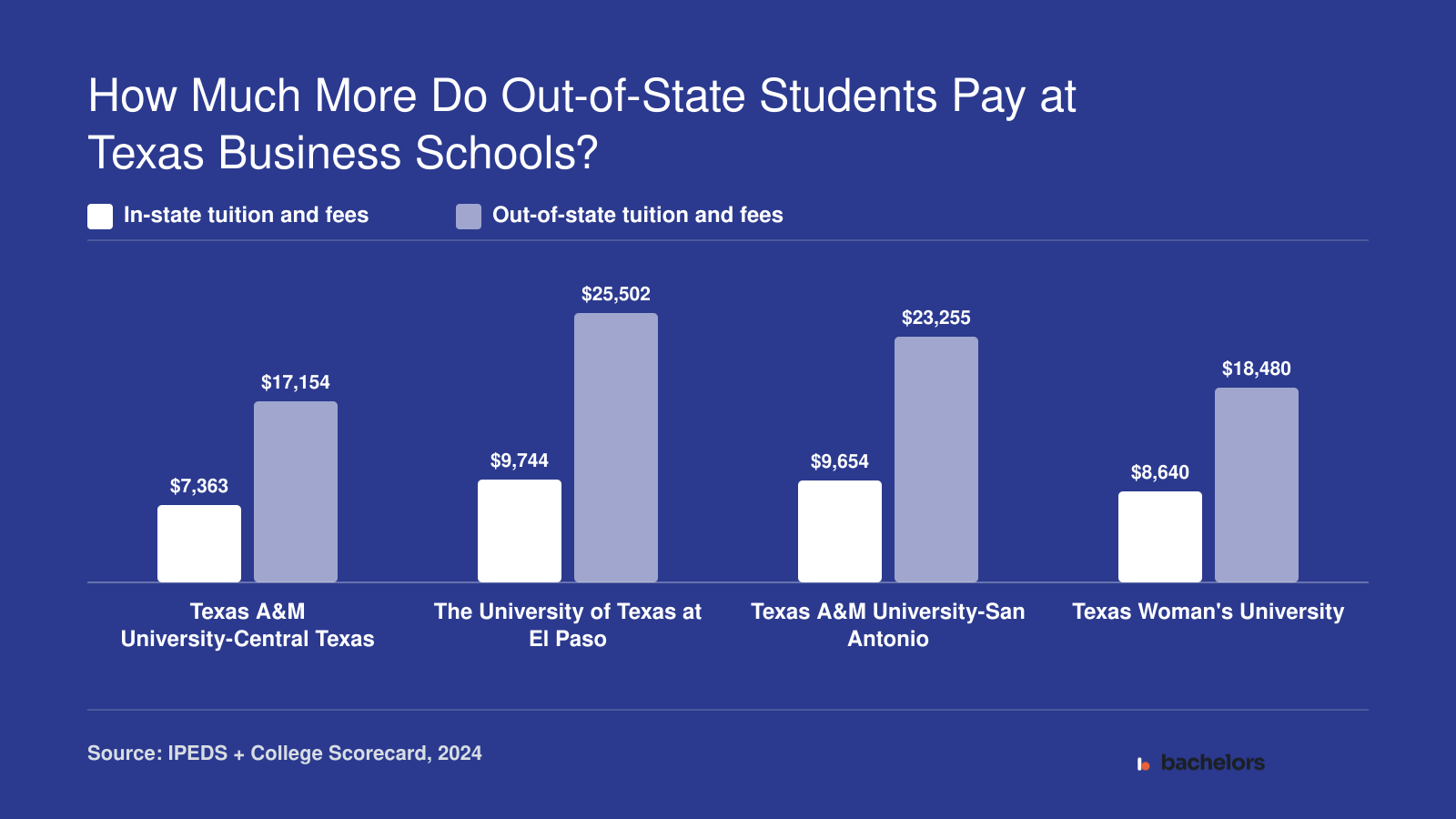
Nonresidents pay more than double the in-state rate at each of these lower-cost Texas public universities. Texas A&M University-Central Texas, a ranked school, charges $7,363 in annual tuition and fees for Texas residents versus $17,154 for out-of-state students. These are published prices before grants and scholarships, so most students pay less. Average net price after aid at A&M-Central Texas was $1,300.
Business Careers in Texas: Wages by Occupation and Metro
Two things move the paycheck for a Texas business job: the occupation and the metro. The clearest benchmark is the Bureau of Labor Statistics' Occupational Employment and Wage Statistics program. Its latest release carries a May 2025 reference date and reports median, 10th, 25th, 75th and 90th percentile annual wages for Texas and for each major metro.
Occupations Worth Looking Up
- Accountants and auditors: the most direct path from an accounting concentration and the starting point for CPA licensure.
- Financial analysts: a common first role for finance majors.
- Management analysts: consulting, operations and process-improvement work.
- Market research analysts and marketing specialists: a fit for marketing and analytics students.
- Human resources specialists: recruiting, benefits and employee relations.
The sources reviewed for this update did not confirm dollar figures for these jobs, so none are given here. The BLS Texas and metro tables for Dallas-Fort Worth-Arlington, Houston-The Woodlands-Sugar Land, Austin-Round Rock-San Marcos and San Antonio-New Braunfels are the place to check current medians.
Where Texas Business Graduates Tend to Land
Dallas-Fort Worth and Houston are the state's largest labor markets, with corporate headquarters, banking and energy firms generating many analyst and accounting roles. Austin leans toward technology employers, where marketing and analytics jobs cluster. San Antonio's mix of financial services, healthcare and military-related employers supports accounting and HR hiring. Accounting, finance, business analytics and supply chain generally draw steady employer interest across all four.
BLS Wages vs. Graduate Earnings
The program earnings in the rankings above follow one school's graduates shortly after they finish. BLS wages cover every wage and salary worker in an occupation, from new hires to veterans, and blend six survey panels collected over three years. They count straight-time gross pay, including commissions and production bonuses, and exclude the self-employed. Expect entry-level pay to sit closer to the lower percentiles.
Texas CPA Licensure for Accounting Graduates
Compare Business programs on the data that matters
Explore more Business & Management majors or browse every field of study.
All Business & Management programs Browse every field of study