Best Business Degree Programs in Vermont
Compare 13 accredited Business programs in Vermont at 5 colleges, with net price after aid, graduation rates, earnings and debt from IPEDS and the U.S. College Scorecard.
A business bachelor's in Vermont comes from a short list of programs. The University of Vermont's Grossman School of Business is the only school on this list with confirmed AACSB accreditation; Saint Michael's, Norwich, Champlain and Vermont State compete on price, format and majors instead. Published tuition spans almost $40,000 a year between the cheapest public option and the priciest private one.
Net price after grant aid narrows that gap without closing it, which is why cost decides more Vermont business choices than reputation does. Hiring here runs on local networks, so a Burlington internship can weigh as much as the diploma's name.
Key Points
- UVM's Grossman School of Business is the only AACSB-accredited option here.
- Vermont State University charges in-state students $11,952 in published tuition.
- Norwich business graduates post median earnings of $79,145.
Best Business Bachelor's Programs in Vermont, Ranked
The University of Vermont is the best business school in Vermont for most students, and its Grossman School of Business sits at the top of this list. What follows are five Vermont institutions whose business bachelor's degrees differ sharply in what students pay after aid, how many finish, and what graduates earn. They span a flagship campus, a small liberal arts college, a fully online university, a hybrid public option, and a career-focused college in Burlington.
University of Vermont
#1Burlington, VT · $19,000 – $46,000/yr (est.)
Best for: In-state students wanting a research campus
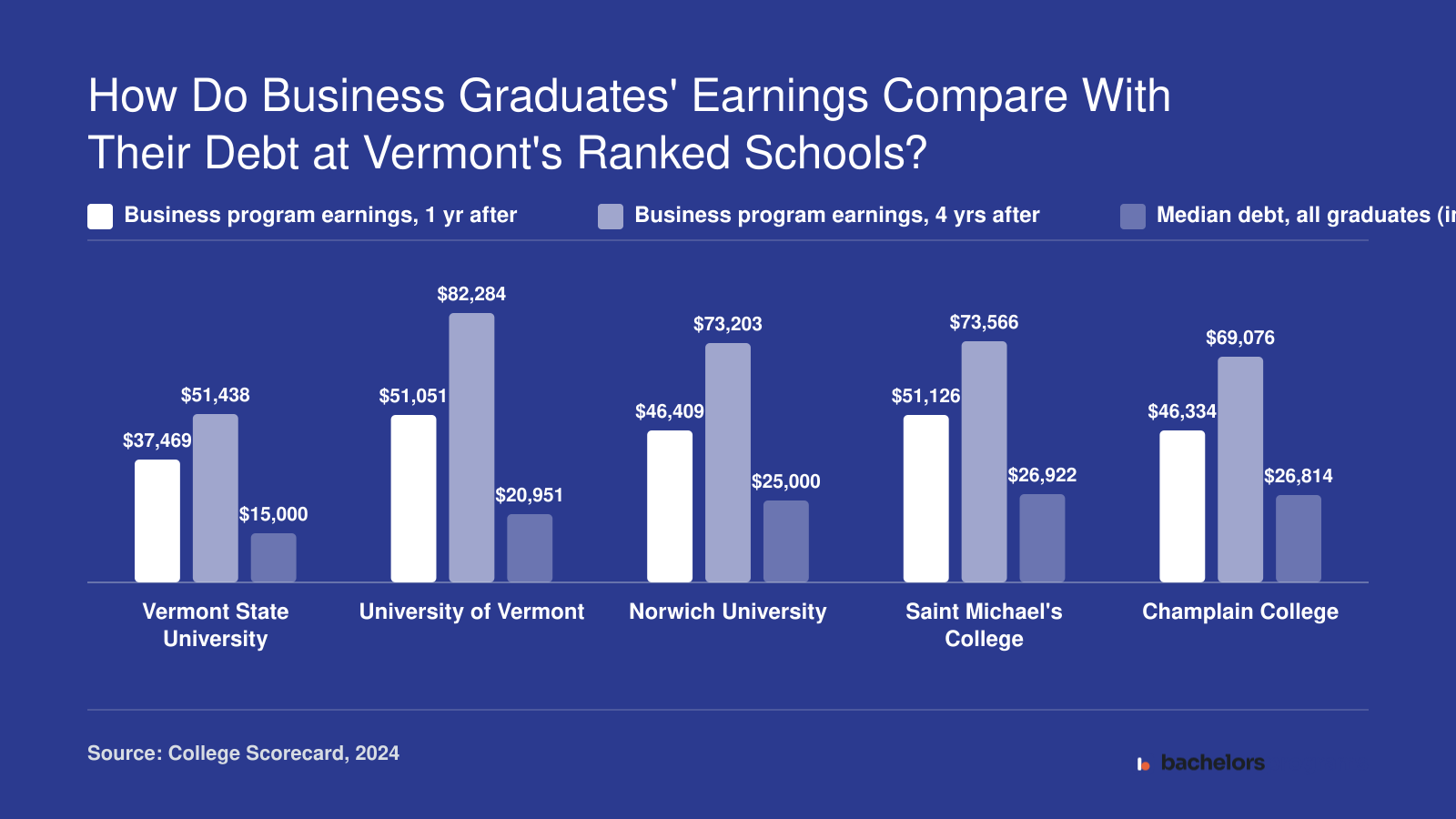
The state's flagship university runs its business degrees through the Grossman School of Business in Burlington, where students complete a required business core, a mandatory Professional Development Series, and a senior capstone. A $15 million Grossman Family Foundation gift is funding a new undergraduate co-op program that pairs students with employers for paid work experience in Vermont and in markets such as Boston and New York. Business graduates reported median earnings of $51,051 one year after finishing and $82,284 four years out. Four concentrations and three interdisciplinary themes give students room to shape the degree around accounting, analytics, finance, marketing, entrepreneurship, global business, or sustainability.
- 120 total credits built on a Basic Business Core and Business Field courses
- Concentrations in Accounting, Business Analytics, Finance and Marketing
- Interdisciplinary themes in Entrepreneurship, Global Business and Sustainable Business
- Professional Development Series required alongside business coursework
- Senior capstone course required for graduation
- At least 40 credits must come from outside the business school
- Real-world experience available in a student-run investment fund
Saint Michael's College
#2Colchester, VT · $25,000 – $30,000/yr (est.)
Best for: Liberal arts-minded students wanting small business classes
Saint Michael's delivers its business degree through the School of Business & Analytics on a Colchester campus just outside Burlington, pairing liberal arts coursework with a major built on seven stated learning outcomes. Ethics and professional responsibility, team leadership, communication, and data-driven decision-making run through the curriculum, and career planning is built in rather than bolted on. Business graduates reported median earnings of $51,126 one year after graduation and $73,566 four years out. Classes are small, and the college's size means business students share ground with the rest of a liberal arts campus.
- Housed in the School of Business & Analytics
- Curriculum built on seven stated learning outcomes
- Liberal arts coursework combined with business studies
- Emphasis on ethics and professional responsibility
- Team leadership and communication skills emphasized
- Data analysis and information technology skills built in
- Career planning and self-development coursework included
Norwich University
#3Northfield, VT · $22,000/yr (est. net price)
Best for: Working adults needing a fully online degree
Norwich University in Northfield offers its business administration bachelor's entirely online, which makes it the most flexible option on this list for working adults and military-connected students. Students can transfer up to 90 credits and finish in about 18 months on average, with multiple start dates each year. The program is accredited by NECHE and recognized by SHRM for professional development credits, and the capstone asks students to build a complete business plan. Median earnings for business graduates were $46,409 one year after completion and $73,203 four years out.
- 100% online format with multiple start dates each year
- Transfer up to 90 credits toward the degree
- Average completion time of about 18 months
- Human Resource Concentration available
- Capstone project requires students to build a business plan
- Accredited by NECHE and recognized by SHRM for professional development credits
- Small, interactive online classes
- Sequential pathway to a master's degree
Vermont State University
#4Randolph, VT · $15,000 – $20,000/yr (est.)
Vermont State University is the public system's most affordable route to a business bachelor's, taught in a hybrid format that mixes classroom and online coursework across multiple Vermont campuses. Accounting, management, marketing, and entrepreneurial leadership concentrations sit on top of paid internships with Vermont employers, and an accelerated three-year track is available for students who want to finish sooner. Start terms run in fall, spring, and summer, and the degree feeds into the university's MBA. Business graduates reported median earnings of $37,469 one year after finishing and $51,438 four years out.
- Hybrid format mixing in-person and online coursework
- Available at multiple Vermont campuses
- Accelerated three-year degree track available
- Paid internship opportunities with Vermont employers
- Concentrations in accounting, management, marketing and entrepreneurial leadership
- Pathway to the university's MBA program
- Start terms in fall, spring and summer
- Small class sizes
- Hands-on learning opportunities
- Diverse internship placements
- Concentration coursework focused on management
Champlain College
#5Burlington, VT · ~$36,000/yr (est.)
Champlain College's Stiller School of Business in Burlington puts business coursework in the first year through its Upside-Down Curriculum, and every student completes a management-level internship before graduating. Concentrations reach into Cybersecurity, Sustainable Business, International Business, Management, and Information Systems, and the college's ties to Burlington's Hula startup hub and local employers feed class projects and placements. Project-based work and professional networking are built into the degree rather than left to electives. Median earnings for business graduates were $46,334 one year after graduation and $69,076 four years out.
- Robert P. Stiller School of Business
- Upside-Down Curriculum puts business courses in the first year
- Concentrations include Cybersecurity, Sustainable Business, International Business and Management
- Every student completes a management-level internship
- Class projects and internships with Burlington startup hub Hula
- Project-based learning with Vermont employers
- Study abroad opportunities available
Cost & outcomes by school
Federal data for the highest-earning Business programs, independent of the ranking above. Earnings are this field's bachelor's graduates four years after completing where the Scorecard reports them, else the school's undergraduate median.
| School | Net price / yr | Grad rate | Earnings | Debt | Grads/yr | Format |
|---|---|---|---|---|---|---|
| Norwich University VT | $22,257 | 60% | $65,575 | $25,000 | 1,366 | Online |
| University of Vermont VT | $19,343 | 79% | $62,472 | $20,951 | 5,908 | Campus |
| Saint Michael's College VT | $25,239 | 73% | $61,317 | $26,922 | 714 | Campus |
| Champlain College VT | $35,860 | 65% | $58,386 | $26,814 | 1,218 | Campus |
| Vermont State University VT | $18,212 | 47% | $50,331 | $15,000 | 1,298 | Hybrid |
Sources: U.S. Department of Education. Net price, graduation rate, earnings and debt: College Scorecard (earnings and debt for this field's bachelor's graduates where reported, else school-wide); graduates: IPEDS. A dash means no figure is reported.
Cost, debt & payoff
Median earnings of this field's bachelor's graduates (4 yrs after completing, else the school's undergraduate median) vs. their median federal loan debt · U.S. College Scorecard
Across these programs the median graduate earns about $61,317 and finishes with roughly $25,000 in debt — a ratio that clears a common rule of thumb (keep debt below first-year salary). Net price and debt vary widely school to school, so check the per-school figures in the table above before you shortlist.
Vermont's Business Degree Landscape at a Glance
Vermont's public and private colleges both award bachelor's degrees in business, but they price them very differently.
The public options are the University of Vermont and Vermont State University; Saint Michael's College, Norwich University, and Champlain College are private. Formats are just as mixed. UVM, Saint Michael's, and Champlain run their business degrees on campus, Vermont State offers a hybrid program across its Vermont sites, and Norwich delivers its bachelor's entirely online.
Cost and completion vary widely. Net price after aid at the schools ranked here runs from about $18,200 to $35,900 a year, and institution-wide graduation rates span roughly 47 percent to 79 percent. Both figures are school-wide averages, not business-major outcomes.
Two practical points shape the comparison. Classes stay small, with student-to-faculty ratios between 10:1 and 17:1, so access to faculty is rarely the differentiator. In-state choice is limited, which makes format and net price the real sorting tools.
How the Order Was Set: Cost, Completion, Earnings, and Accreditation
Business schools are increasingly judged on measurable outcomes rather than reputation, and this ranking follows that shift.
The order below reflects four things: what a bachelor's degree actually costs after grant aid, how many students finish, what graduates earn and owe a few years out, and whether the business school holds accreditation from a recognized body such as AACSB. Selectivity and admission standards carry some weight too, since they shape the peer group a student joins.
Two limits apply to these figures. Graduation rates and net prices are institution-wide averages, not figures for one major, and some program-level earnings details are not reported at all. Where a number was unavailable, it did not move a school up or down.
What this ordering does not measure matters just as much: campus culture, class sizes, internship networks, and the specific courses inside a major. Those are reasons to visit Burlington or Northfield in person, sit in on a class, and ask current students what the career office actually delivers.
AACSB and Other Accreditation Across Vermont Business Schools
The University of Vermont's Grossman School of Business is listed as AACSB accredited in the accreditor's directory, which was updated in 2026.1 AACSB also reported extending that accreditation in 2022 and, earlier, in 2017.2 It is the one school here with confirmed AACSB status.3
What we could and could not confirm
For Champlain College, Vermont State University, Saint Michael's College, and Norwich University, our research did not establish current AACSB, ACBSP, or IACBE accreditation. That is not proof that none exists, so check each school's business page and the accreditors' directories before you apply. Norwich's online program page cites NECHE accreditation, which covers the whole institution rather than the business program. Champlain and Vermont State appear in our data with no business-specific accreditation confirmed.
What each accreditor signals
AACSB is the most widely recognized business accreditation, and a peer-reviewed seal can carry weight with graduate admissions committees and employers who recruit by school. ACBSP and IACBE are alternative business accreditors, generally associated with teaching quality and outcomes assessment, and they are most often held by smaller or career-focused programs.
Concentrations at the ranked schools
- University of Vermont: Accounting, business analytics, finance, and marketing concentrations, plus entrepreneurship, global business, and sustainable business themes.
- Champlain College: Cybersecurity, sustainable business, international business, management, and information systems.
- Norwich University: A human resource concentration in the online program.
- Vermont State University: An accounting concentration is named in our data. It does mention accounting and marketing courses.
- Saint Michael's College: The program page lists no named concentrations, only a liberal arts and business core.
Outside UVM, the program pages we reviewed do not name finance or analytics concentrations. If you want one of those tracks, UVM is the clearest match, so confirm details with the other schools directly.
What a Business Bachelor's Costs in Vermont: Tuition, Net Price, and State Aid
Published tuition and fees at the schools ranked here run from $11,952 (Vermont State University, in-state) to $51,450 (Saint Michael's College). Average net price after aid ranges from $18,212 to $35,860 a year, which makes Vermont State University and the University of Vermont the most affordable options for Vermont residents. Net price is a federal average for aided students (in-state students at the two public universities, all aided students at the three private colleges), not a quote, so check each school's net price calculator. Researched VSAC figures add to school aid: 2025-26 Vermont Grant awards of $1,000 to $15,350 for eligible Vermont residents, for up to 10 full-time semesters, plus VSAC scholarships that generally range from $1,000 to $3,000 (capped at $5,000), with a February 10, 2027 deadline for 2027-28.
| School | Sector | In-State Tuition and Fees | Out-of-State Tuition and Fees | Average Net Price After Aid | School-Specific Aid Noted in Research |
|---|---|---|---|---|---|
| Vermont State University | Public | $11,952 | $22,296 | $18,212 | Tuition-free associate and bachelor's degrees for more Vermont families after the 2026 income threshold rose to $85,000 (other conditions apply); need-based grants require full-time registration; FSEOG awards generally $200 to $1,400; Good Neighbor tuition program |
| University of Vermont | Public | $19,058 | $45,502 | $19,343 | Tuition and comprehensive fee covered for admitted Vermont dependent first-year and transfer students starting fall 2024 or later with parents' income of $75,000 or less and typical assets |
| Norwich University | Private nonprofit | $49,740 | $49,740 | $22,257 | N/A |
| Saint Michael's College | Private nonprofit | $51,450 | $51,450 | $25,239 | N/A |
| Champlain College | Private nonprofit | $47,850 | $47,850 | $35,860 | N/A |
Online and Hybrid Business Bachelor's Options at Vermont Schools
Online delivery has moved from side option to standard offering at many Vermont business schools, though not every campus has joined in.
You can earn a business bachelor's fully online from a Vermont-based school. Norwich University delivers its Bachelor of Science in Business Administration 100% online, and Vermont State University offers its Business Administration, B.S. online, in person, and in a hybrid "In-Person Plus" format. The University of Vermont, Saint Michael's College, and Champlain College run their business administration programs on campus.
Where Each Format Is Offered
- Norwich University: Fully online, with multiple start dates each year and an average completion time of about 18 months.
- Vermont State University: Business Administration is available at Castleton, Johnson, Lyndon, and Randolph, and online. An Applied Business Degree Completion, B.S. is offered online and hybrid at Randolph.
- Champlain College: The main business program is campus-based. Champlain Online describes its courses as 100% online, but confirm the exact business program title with the school before you apply.
- University of Vermont and Saint Michael's College: Campus-based only.
Who Each Format Suits
Working adults will find Norwich's online schedule easiest to fit around a job. Transfer students should look at Norwich, which accepts up to 90 prior credits, and at Vermont State's degree completion route. Rural Vermonters far from a campus can cut commuting with Vermont State's online option or Champlain Online, while the hybrid format suits those near Lyndon, Johnson, Castleton, or Randolph who want some face time. Students who want a residential experience should lean toward UVM, Saint Michael's, or Champlain's Burlington-area campuses.
Related Articles
Getting in: GPA, Test Policy, Transfer Credit, and Deadlines
UVM admitted 65.3% of applicants in the latest federal data, the lowest rate among the schools here. UVM does not publish a separate acceptance rate for the business school, so the institution-wide figure is the closest proxy available. Norwich follows at 74.4%. Vermont State (81.7%), Champlain (82.9%) and Saint Michael's (84.5%) admit a larger share of applicants.
University of Vermont
The 3.5 to 3.8 GPA range describes UVM's first-year class overall, not a Grossman School of Business cutoff. UVM is test-optional, and self-reported scores are accepted. First-year deadlines for 2026-27 are November 1 (early action) and January 15 (regular decision).
Transfer applicants should have at least a 3.0, though the catalogue calls 2.8 competitive. Grossman also expects one college math course (calculus or statistics) and one economics course. Upper-level business credit must come from an AACSB institution, and a course must carry at least 2.5 credits to satisfy a Grossman requirement. AP and CLEP credit is accepted, and no SAT or ACT is needed. Transfer deadlines are November 1 for spring and June 1 for fall.
Champlain College
Champlain publishes no minimum GPA. It is test-optional. First-year deadlines are November 15 (early decision), December 15 (early action) and January 9 (regular decision). Transfer review is rolling, up to 75 credits can move over, and scores are optional but recommended for those under 30 credits.
Vermont State University
The typical applicant has a B average (about 3.0). Transfer students need a 2.0 cumulative GPA. Tests are optional for business, and admission is rolling.
Saint Michael's and Norwich
We found no published GPA, test or transfer rules for Saint Michael's business program, so confirm directly with admissions. Norwich's online bachelor's lists up to 90 transfer credits.
Transfer Tip
Students starting at the Community College of Vermont should ask each school's transfer office for articulation guidance before registering, so math and economics courses count toward the business major.
Business Careers and Wages in Vermont
What Business Majors Earn
Norwich University sits at $79,145, Saint Michael's College at $62,341, and Champlain College at $57,302. These are medians for past graduates, so treat them as a guide, not a promise.
For comparison, Vermont's median annual wage across all occupations was $62,780 in May 2023, according to the Bureau of Labor Statistics. That is the most recent statewide data in our research, so current pay may differ.
Vermont Occupations Business Graduates Enter
- Accountants and auditors: about 2,690 jobs and a median of $83,960.
- Market research analysts and marketing specialists: about 980 jobs and a median of $70,680.
- Management occupations: about 23,490 jobs and a median of $113,770, though these roles usually take years of experience to reach.
The Vermont data we have does not break out financial analysts or management analysts. Nationally, BLS reported medians of $103,570 for financial analysts and $101,860 for management analysts in May 2025. Those are U.S. figures, and Vermont pay for these roles may run lower.
Who Hires Business Graduates
Vermont's economy is small and spread across many sectors. Business graduates commonly find work in health care systems, colleges and universities, banks and insurers, state and local government, retail, manufacturing, and tourism-related companies. This list reflects the state's major industries rather than a ranking of active recruiters. Champlain College, for one, highlights internships with Vermont companies, so ask any school you consider where its recent graduates actually landed.
Licensure
Business is generally an unlicensed field, so most graduates can start work with the degree alone. Accounting is the main exception, because the CPA license has its own requirements. The next section covers it.
How Do Business Graduates' Earnings Compare With Their Debt at Vermont's Ranked Schools?
Earnings bars show median pay for business administration bachelor's graduates of each school, measured one year and four years after completion. The debt bar is the institution-wide median for all graduates, because Vermont State University publishes no program-level debt figure. At every school, first-year business pay is well above that school's median debt, and four-year pay is higher still.
Questions to Ask Yourself
Do you need an online or hybrid schedule, or can you live on a Vermont campus?
Will your career plans need AACSB accreditation, or a CPA-track accounting path with 150 credits?
Is the net price after aid within reach, and would in-state or New England Regional rates apply to you?
Compare Business programs on the data that matters
Explore more Business & Management majors or browse every field of study.
All Business & Management programs Browse every field of study