Best Accounting Schools in Vermont
Compare 4 accredited Accounting programs in Vermont, with net price after aid, graduation rates, earnings and debt from IPEDS and the U.S. College Scorecard.
Published tuition and fees for a Vermont accounting bachelor's range from $19,058 for residents at the University of Vermont to $51,450 at Saint Michael's College. The usual credential is the Bachelor of Science (B.S.) in Accounting, though UVM teaches accounting as a concentration within its business administration degree.
Norwich University and Champlain College complete the ranked field, and Champlain delivers its B.S. online. Test-optional admissions are common, so net price after aid and transfer credit usually shape the choice more than getting in does.
Vermont lets candidates sit for the Uniform CPA Examination at 120 semester hours, which makes the bachelor's itself the entry point to the exam.
Key Points
- Vermont residents pay $19,058 at UVM versus $51,450 at Saint Michael's.
- Champlain College accounting graduates earn a $61,306 median one year out.
- Vermont CPA candidates can sit for the exam with 120 semester hours.
Best Accounting Schools in Vermont: Our Bachelor's Rankings
Four Vermont colleges award a bachelor's degree in accounting, and each takes a different route: a business school concentration at the state's largest university, a liberal arts program with a new co-op pipeline, an accredited professional major, and an accelerated three-year track. The cards below lay out what matters most when comparing them, from tuition and net price after aid to graduation rates and program-level earnings where the schools report them.
University of Vermont
#1Burlington, VT · $19,000 – $46,000/yr (est.)
Best for: Aspiring CPAs targeting Big Four firms
The University of Vermont anchors the state's accounting pipeline from its Burlington campus, where accounting sits inside the Grossman School of Business as a concentration in the Bachelor of Science in Business Administration. Students work through corporate financial reporting, financial statement analysis, auditing, taxation and fraud examination, and can continue into UVM's Master of Accountancy through accelerated or four-year routes. Recent alumni have landed at the Big Four and other leading firms, and the university reports an overall graduation rate of about 79 percent.
- Accounting concentration inside the B.S. in Business Administration
- Coursework spans financial reporting, auditing, taxation and fraud examination
- Accelerated and four-year pathways into UVM's Master of Accountancy
- Graduates have landed at the Big Four and other leading firms
- Prepares students for CPA and CMA certification
- Faculty include practicing accountants alongside research scholars
Saint Michael's College
#2Colchester, VT · $25,000 – $30,000/yr (est.)
Best for: Liberal arts-minded students wanting close mentoring
Saint Michael's College in Colchester treats accounting as the language of business within a liberal arts frame, building from financial reporting and managerial decision-making up to a research-based capstone seminar. Presentation skills and close faculty mentoring carry through the curriculum, and agreements with partner institutions smooth the path into MAcc, MSA and MBA study. A cooperative-education pilot with the Lake Champlain Chamber placed an accounting student with a Burlington professional-services firm. Graduates work in public accounting, government, nonprofits and Vermont's captive insurance industry; the college reports an overall graduation rate of about 73 percent, and students who finished the accounting program earned a median of $56,723 one year after finishing, with 94 percent employed.
- Accounting taught as the language of business within a liberal arts frame
- Curriculum builds to a required research-based capstone seminar
- Emphasis on presentation skills and partner-based classwork
- Co-op pilot with the Lake Champlain Chamber placed a student at a local firm
- Agreements smooth admission into MAcc, MSA and MBA programs
- Careers span public accounting, government, nonprofits and captive insurance
- Study abroad, Freeman Foundation internship and Sigma Beta Delta honor society
- Faculty bring professional practice experience and mentor closely
Norwich University
#3Northfield, VT · $22,000/yr (est. net price)
Best for: Budget-conscious students wanting a residential program
Norwich University in Northfield awards its Bachelor of Science in Accounting through the College of Professional Schools, and the major is accredited by the Accreditation Council for Business Schools and Programs. There are no additional criteria to declare the major beyond admission, though core accounting and economics courses require at least a C, and the support sequence runs through cost, tax, audit and advanced accounting coursework. The curriculum blends management, economics and information systems and points students toward the CPA, CMA, CGMA, CIA and CFE credentials. The university reports an overall graduation rate of about 60 percent.
- B.S. in Accounting housed in the College of Professional Schools
- Accredited by the Accreditation Council for Business Schools and Programs
- No criteria beyond admission to declare the major
- Core accounting and economics courses require at least a C
- Program points to CPA, CMA, CGMA, CIA and CFE credentials
- Typically 150 credits needed to sit for the CPA exam
- Curriculum blends management, economics and information systems
Champlain College
#4Burlington, VT · ~$36,000/yr (est.)
Champlain College in Burlington runs a focused three-year Bachelor of Science in Accounting for students who want to reach the workforce quickly. A required accounting internship and the Volunteer Income Tax Assistance program give students real return-preparation experience before graduation, and coursework runs from cost analysis through advanced accounting, auditing and federal taxation. The college reports an overall graduation rate of about 65 percent. Students who finished the accounting program earned a median of $61,306 one year after finishing and $68,274 four years after finishing, with median debt of about $27,000.
- Three-year track designed for a fast launch into finance careers
- Required accounting internship built into the degree
- Volunteer Income Tax Assistance: students prepare real community returns
- Coursework runs from cost analysis to advanced accounting and federal taxation
- Covers auditing, accounting information systems, business law and managerial economics
- Capstone ties together skills from across the program
- Prepares graduates for entry-level accounting and corporate finance roles
Cost & outcomes by school
Federal data for the highest-earning Accounting programs, independent of the ranking above. Earnings are this field's bachelor's graduates four years after completing where the Scorecard reports them, else the school's undergraduate median.
| School | Net price / yr | Grad rate | Earnings | Debt | Grads/yr | Format |
|---|---|---|---|---|---|---|
| Champlain College VT | $35,860 | 65% | $68,274 | $26,917 | 21 | Online |
| Norwich University VT | $22,257 | 60% | $65,575 | $25,000 | 8 | Campus |
| University of Vermont VT | $19,343 | 79% | $62,472 | $20,951 | — | Campus |
| Saint Michael's College VT | $25,239 | 73% | $61,317 | $26,000 | 18 | Campus |
Sources: U.S. Department of Education. Net price, graduation rate, earnings and debt: College Scorecard (earnings and debt for this field's bachelor's graduates where reported, else school-wide); graduates: IPEDS. A dash means no figure is reported.
Cost, debt & payoff
Median earnings of this field's bachelor's graduates (4 yrs after completing, else the school's undergraduate median) vs. their median federal loan debt · U.S. College Scorecard
Across these programs the median graduate earns about $64,024 and finishes with roughly $25,500 in debt — a ratio that clears a common rule of thumb (keep debt below first-year salary). Net price and debt vary widely school to school, so check the per-school figures in the table above before you shortlist.
How We Ranked Vermont Bachelor's in Accounting Programs
This ranking uses public College Scorecard figures for every Vermont bachelor's program in accounting, so each school is measured against the same federal data.
What We Looked At
- Net price: what students pay after grant aid is subtracted from the full cost of attendance.
- Program earnings: what graduates of the field earn after finishing.
- Debt: typical borrowing among students who complete the program.
- Completions: how many students earn the degree in the field.
- Graduation rate: the share of students who finish at the school.
Limits Worth Knowing
Net price is a sector-average estimate. It reflects what students at similar schools pay, not your own aid package, so your real cost may run higher or lower.
Graduation rate is institution-wide. It describes the whole college, not accounting majors alone, so read it as a signal of how well a school keeps students on track overall.
Where a figure is not reported for a program, we left it out rather than estimate it.
Who Made the List
The list includes only Vermont bachelor's programs: on-campus, hybrid and online options at Vermont-based schools. Programs elsewhere, including out-of-state online degrees, are not part of this comparison.
Earning a Bachelor's Degree in Accounting in Vermont: Majors vs. Concentrations
A standalone accounting major and an accounting concentration tucked inside a business degree can lead to the same job titles, but they are built differently. One puts accounting at the center of the curriculum from the first year; the other treats it as a specialization layered on a broader management foundation.
Which Vermont Programs Are Standalone
Several schools ranked here award a dedicated accounting degree. Champlain College offers an Accounting, B.S. in Burlington. Saint Michael's College lists accounting as its own major in Colchester. Norwich University's accounting program sits in its College of Professional Schools in Northfield, and students there face no extra criteria to declare the major.
The University of Vermont takes the other route. In Burlington, accounting is a concentration within the Bachelor of Science in Business Administration, so the business core comes first and accounting coursework follows as the specialization.
Why the Difference Matters for the CPA Path
Vermont's CPA licensure rules require a defined block of accounting and business-related semester hours before you can sit for the exam, and the credit total for licensure depends on which pathway you take. A standalone major is typically mapped to those requirements course by course, which keeps the transcript review simple. A concentration can cover the same ground, but the business core leaves less room for electives, so early planning matters more.
Neither structure is inherently stronger for hiring. Recruiters on Vermont campuses look at the courses you completed, your internship, and how close you are to exam eligibility. Ask each admissions office whether the required sequence covers the state's accounting course requirements without summer coursework, and whether a fifth-year or graduate option exists if you need more credits.
Online and Hybrid Bachelor's in Accounting Options at Vermont Schools
Can you earn a bachelor's degree in accounting online from a school based in Vermont? Yes. Champlain College in Burlington offers its Accounting, B.S. in an online format. Every program ranked here is based at a Vermont institution, so the online route does not mean enrolling at an out-of-state school.
Where Each Program Fits
- Online: Champlain College (Burlington), Accounting, B.S. The school highlights a three-year option, a required accounting internship, a capstone, and coursework in auditing, federal taxation and accounting information systems.
- Campus: University of Vermont (Burlington), where accounting is a concentration within the Bachelor of Science in Business Administration.
- Campus: Saint Michael's College (Colchester), Accounting major.
- Campus: Norwich University (Northfield), Accounting major.
Choosing Between Online and Campus
Online study tends to suit working adults who already hold jobs, and rural Vermonters a long drive from Burlington, Colchester or Northfield. You keep your schedule and your home base while still earning a degree from a Vermont school.
Campus programs trade that flexibility for face-to-face access. Being on site makes it easier to meet recruiters, build relationships with faculty and land internships with nearby firms. The University of Vermont points to graduates working at Big Four firms, while Saint Michael's College highlights a Freeman Foundation international internship and career paths in the captive insurance industry.
Questions to Ask Before You Apply
Format details vary by school, so confirm them directly with admissions. Ask whether online courses meet live or on your own schedule, whether a required internship can be completed near where you live, and whether the campus programs offer evening or online course sections for students who need a mix of both.
Admissions Requirements for Vermont Accounting Bachelor's Programs
The real tradeoff in Vermont is between how quickly you can start and how much earlier coursework carries over. UVM's test-optional policy and the guaranteed CCV transfer route make entry manageable, but the details decide how many credits count.
School-by-School Snapshot
- University of Vermont (B.S. in Business Administration): Transfer applicants need a 2.0 cumulative GPA. First-year admitted students show a 3.5 to 3.8 GPA range, which is a profile rather than a stated minimum. Testing is optional. Transfer credit is credit-only: prior grades are left out of the UVM GPA, and generally 30 of your last 45 credits must be taken at UVM. A CCV 2+2 pathway is published.
- Saint Michael's College (Accounting): Minimum GPA: No published policy. Test policy: No published policy. Transfer credit: No published policy.
- Norwich University (Accounting): Minimum GPA: No published policy. Test policy: No published policy. Transfer credit: No published policy.
- Champlain College (Accounting, B.S.): Minimum GPA: No published policy. Test policy: No published policy. Transfer credit: No published policy.
For the three schools without a published policy, ask the admissions office directly before you apply.
Three Takeaways
- Test-optional at UVM: Scores are not required. If you choose to self-report ACT or SAT results and then enroll, you must submit official scores.
- Transfer-friendly through CCV: A CCV associate degree plus an approved plan can bring guaranteed admission and guaranteed junior status at UVM. The pathway calls for at least 60 transferable credits, with at least 30 earned at CCV. You must be admitted to CCV first, and the UVM application fee is waived.
- Check the fine print: The 2026-27 pathway page allows 3 years after your CCV associate to start at UVM, while a separate articulation provision says 2 years and asks for a 2.50 CCV GPA. A 2.80 transfer GPA automatically qualifies you for a Pathway Scholarship, and lower GPAs are reviewed case by case. Confirm which terms apply to you with a UVM advisor.
Cost of a Bachelor's in Accounting in Vermont
Vermont's accounting bachelor's degrees sit in two pricing systems: a public university that charges Vermonters and out-of-staters very different rates, and private colleges that post one price for everyone.
Public vs. Private Sticker Prices
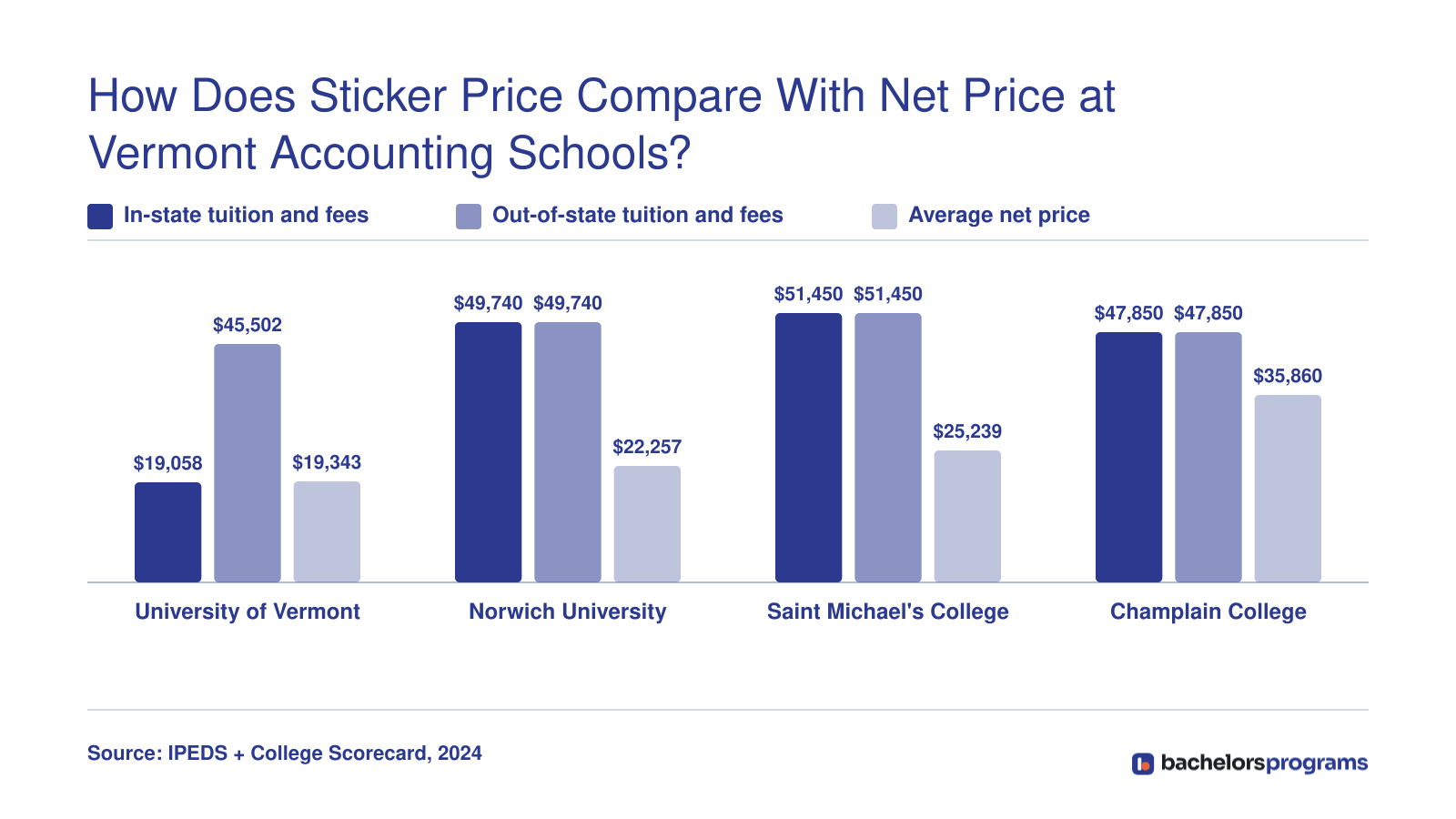
At the University of Vermont, tuition and fees run about $19,058 for Vermont residents and $45,502 for everyone else. That gap matters, because the out-of-state rate lands within a few thousand dollars of the private options here. Norwich University lists $49,740, Saint Michael's College $51,450 and Champlain College $47,850, charging residents and nonresidents the same.
UVM's rates also depend on course load. Full-time tuition covers 12 to 19 credits, part-time students pay per credit, and overload credits are billed on top. A comprehensive fee, and in some colleges a program fee, add to the bill, while room and board (about $7,342 on campus) sits outside tuition entirely.
What Students Actually Pay
Sticker price is rarely the real number. Average net price after grants and scholarships comes to roughly $19,343 at UVM, $22,257 at Norwich, $25,239 at Saint Michael's and $35,860 at Champlain. Read those as approximate sector averages rather than promises: your own net price depends on family income, merit awards and residency.
For graduates who took federal loans, median debt at completion is about $20,951 at UVM, $25,000 at Norwich, $26,000 at Saint Michael's and $27,000 at Champlain.
Vermont Aid and Scholarships
Vermont residents should start with the Vermont Grant, administered by VSAC, the state's student assistance agency. It is need-based, and award amounts, income cutoffs and deadlines shift from year to year, so confirm current terms with VSAC before you file. UVM also reports awarding $180 million in undergraduate support and says half of Vermonters attend tuition free, though individual eligibility varies by student.
How Does Sticker Price Compare With Net Price at Vermont Accounting Schools?
Published tuition and fees range from $19,058 for Vermont residents at the University of Vermont to $51,450 at Saint Michael's College, and the private colleges charge one rate regardless of residency. Average net price is what aided students pay toward the full cost of attendance after grants and scholarships. It is an institution-wide estimate for all aided undergraduates, not a figure for accounting majors, so use it as a starting point and confirm your own cost with each school's net price calculator.
Related Articles
Early-Career Earnings for Vermont Accounting Graduates
Champlain College posts the highest median earnings one year after completion among the accounting programs in our rankings data: $61,306 for graduates of its Accounting, B.S.
Vermont CPA Licensure at a Glance
Frequently Asked Questions About Vermont Accounting Schools
These answers cover the questions Vermont accounting students ask most often. Rules and figures change, so confirm current details with each school and with the state licensing board before you apply.
Can you get an accounting degree online in Vermont?
How many credits do you need to become a CPA in Vermont?
How much does an accounting degree cost in Vermont?
Do Vermont accounting programs publish CPA exam pass rates?
Do you need a standalone accounting major to sit for the CPA exam in Vermont?
Compare Accounting programs on the data that matters
Explore more Business & Management majors or browse every field of study.
All Business & Management programs Browse every field of study