Best Social Media Degree Programs
Compare 70+ accredited Social Media programs, with net price after aid, graduation rates, earnings and debt from IPEDS and the U.S. College Scorecard.

Ole Miss lists its social media option as a specialization inside an integrated marketing communications B.S.; UCF files it under digital media. That's typical: a bachelor's degree in social media is usually a concentration within marketing, communications, or digital media. Every program here is undergraduate, not graduate.
Because the label varies, outcomes matter more than the name. Average net price after aid runs from $7,021 at Cal State Northridge to $19,095 at the Fashion Institute of Technology, with online, hybrid, and campus programs all considered.
That $12,000 annual gap compounds over four years, yet graduates at either end compete for identical entry-level titles.
Key Points
- Most social media degrees are concentrations inside marketing or communication majors.
- Brigham Young University-Idaho and Weber State post the widest debt-to-earnings gaps.
- Employers hiring social media staff weigh real campaign portfolios over transcripts.
Top 10 Schools for a Bachelor's Degree in Social Media
These ten programs each award a bachelor's degree in social media, or a named concentration that sits inside a broader major. Every entry below lists the program name, the city and state, the format, the average net price after aid, and the school's graduation rate. Net price is an average after grant aid rather than a quoted sticker price, and graduation rates describe the whole institution, not any single major.
University of Central Florida
#1Orlando, FL · ~$10,000/yr (est.)
Best for: In-state Florida students eyeing web design
UCF is one of the largest public universities in the country, and its Nicholson School of Communication and Media houses the digital media degree that carries the social platforms track. The curriculum leans technical, moving through front-end web design, client-side and server-side scripting, and mobile development before a cohort-based capstone. This is a dedicated Digital Media major with a named specialization rather than a loose set of electives inside a general communication degree.
- Web and Social Platforms specialization inside a 48-credit major
- 36-credit advanced core covers front-end web design and scripting
- 6-credit capstone runs as cohort-based, sequential courses
- 120 total credit hours; at least a C required in each core course
- 2.75 GPA required in 3000-level Digital Media courses
- 24 upper-level residency hours at the Nicholson School
- Two semesters of foreign language proficiency required
- Equipment fees are $45 part-time and $90 full-time per term
Fashion Institute of Technology
#2New York, NY · $6,000 – $17,000/yr (est.)
Best for: Portfolio-driven creatives targeting ad agencies
Fashion Institute of Technology sits in Manhattan and carries a long reputation in advertising and design education. The social media concentration lives inside the BFA in Advertising and Digital Design, so students build campaigns and portfolios in a studio culture instead of studying platforms in the abstract. Entry runs through a portfolio review plus a completed Communication Design Foundation AAS or equivalent, which makes this a strong fit for transfer students who already have design coursework behind them.
- Five concentration options, including social media
- Portfolio plus a Communication Design Foundation AAS or equivalent
- Courses in UX/UI design, creative strategy, and kinetic typography
- Students have won 10 Young Ones Student Awards
- Internships at Ogilvy & Mather and Saatchi & Saatchi
- Graduates hired at BBDO, Droga5, and R/Ga
- Ranked #2 in the U.S. and #3 in the world by The One Club
University of Mississippi
#3University, MS · $10,000 – $15,000/yr (est.)
Best for: Future brand managers wanting a business minor
The University of Mississippi runs its social media specialization through the School of Journalism and New Media, where integrated marketing communications is the umbrella degree. Students complete a 33-hour IMC and journalism core, then layer social media coursework plus a required minor from business, public health, digital media studies, or a similar field. The structure suits readers who want marketing depth and a genuine second area of study rather than a single-subject social degree.
- 124 total credit hours, including 33 in IMC and journalism
- Social media track: Jour 310 plus two approved electives
- Approved social media internship can count toward the track
- Required minor options include business and digital media studies
- Minimum grade of C required in all IMC and Jour courses
- No IMC course may be taken more than twice
- School-approved laptop required before enrolling
- 3-hour diversity course required for graduation
California State University-Northridge
#4Northridge, CA · ~$7,000/yr (est.)
California State University, Northridge organizes its Communication Studies major around seven career pathways, and Social Media Communication is one of them. The department lets any upper-division communication course count as an elective, so internships, service learning, and directed activities can all feed the degree. Scheduling is unusually flexible for a large public university, with Saturday, evening, online, and winter or summer sections rotating through the catalog.
- Seven career pathways, including Social Media Communication
- Any upper-division COMS course counts as an elective
- Internships and service learning count toward the major
- Saturday, online, winter, and summer class options
- Advising required for students with fewer than 60 units
- Graduation application due about 13 months before finishing
- Priority registration for students in service programs
University of West Florida
#5Pensacola, FL · $5,000 – $10,000/yr (est.)
The University of West Florida folds social media into a Communication degree with a combined advertising, public relations, and social media track. Students take a 12-hour department core, then major courses in social media fundamentals, content development, and management, with access to a social media lab plus video production and podcasting studios. A Social Media Communication certificate can be earned through core coursework, and a professional ePortfolio is built alongside the capstone.
- 120 total credit hours; 48 credit hours per Communication track
- 12-hour department core plus social media major courses
- Social Media Communication certificate earned through core courses
- Social media lab, video production studio, and podcasting studio
- Strategic Communication Campaigns capstone required
- Internship optional and can count up to 6 semester hours
- Professional ePortfolio built across the program
Brigham Young University-Idaho
#6Rexburg, ID · ~$8,000/yr (est.)
Brigham Young University-Idaho structures its communication degree around emphases, and Digital and Social Media is one of six. Students choose two emphases, which means a social media focus can be paired with public relations, video production, or organizational leadership for a broader skill set. Classes such as Digital Media Brand Strategy and Design for Social Media are project based, often with work produced for real organizations.
- Two emphases required, chosen from six options
- Courses include Digital Media Brand Strategy and Design for Social Media
- Hands-on projects completed with real organizations
- Analytics, brand management, and campaign execution coursework
- Prepares students for social media specialist and manager roles
Michigan Technological University
#7Houghton, MI · $10,000 – $15,000/yr (est.)
Michigan Technological University pairs a liberal arts communication degree with a technology-focused campus culture. The Communication, Culture, and Media major offers a social media and journalism track alongside film and media studies and digital media, and students publish through the student-run Ink & Ore Enterprise. Houghton is remote and the cohorts are small, so the program fits readers who want close faculty contact and hands-on media production with a technical slant.
- Three tracks: film and media studies, digital media, social media and journalism
- Work on the student-run Ink & Ore Enterprise magazine and newspaper
- Documentary and digital media research projects
- Volunteer opportunities at the 41 North Film Festival
- Presidential Scholars Program begins at a 3.50 GPA
- About 90 percent of students receive financial aid
Oklahoma State University
#8Stillwater, OK · ~$17,000/yr (est.)
Oklahoma State University's media school awards a Strategic Communication degree with four options, and Social Media is one of them. Students clear a proficiency review, complete 51 to 54 hours in media and strategic communication, and finish with a campaign capstone and a graduation portfolio. The O'Colly Media Group and a National Student Advertising Competition team give students real publishing, pitching, and client-style experience before they graduate.
- One of four options, alongside advertising, global, and sport tracks
- 120 hours, with 51 to 54 in media and strategic communication
- Proficiency review: 2.75 GPA and a C in MC 2003 and MC 2023
- Language Proficiency Exam required before graduation
- Capstone campaign course and graduation portfolio required
- National Student Advertising Competition team on campus
- Student media experience through the O'Colly Media Group
Salisbury University
#9Salisbury, MD · ~$18,000/yr (est.)
Salisbury University places its social media coursework inside the Marketing B.S., where the Advertising and Social Media track sits next to the traditional marketing core. Students take Advertising and Promotion, a research or digital analytics choice, and three advertising electives, with an internship built into the plan. It is a business-school route into social media work rather than a communication or design degree, which matters for readers aiming at brand-side or agency marketing roles.
- 120 credits; a track inside the Marketing major
- Coursework in Advertising and Promotion and Consumer Behavior
- Digital Marketing Analytics can substitute for Marketing Research
- Three advertising electives plus a marketing or business internship
- 30 credits of 300/400-level work with a C or better
- 15 of those upper-level credits must be taken at Salisbury
- 30 of the last 37 credits completed at Salisbury
Montclair State University
#10Montclair, NJ · ~$16,000/yr (est.)
Montclair State University offers Social Media and Public Relations as a standalone major inside the School of Communication and Media. Coursework mixes content production, influencer marketing, trend analysis, and crisis communication, with campaign work aimed at platforms such as TikTok and Instagram. The Hawk Communications student agency and a nationally recognized PRSSA chapter supply portfolio material, and the campus sits 12 miles from New York City.
- Blends creative content production with strategic public relations
- Hands-on work at the Hawk Communications student agency
- Campaign work designed for platforms including TikTok and Instagram
- Internships at CNBC, HBO, and the NBA
- Nationally recognized PRSSA chapter with competition experience
- Social media data analytics research projects
- 12 miles from New York City media internships
Cost & outcomes by school
Federal data for the highest-earning Social Media programs, independent of the ranking above. Earnings are this field's bachelor's graduates four years after completing where the Scorecard reports them, else the school's undergraduate median.
| School | Net price / yr | Grad rate | Earnings | Debt | Grads/yr | Format |
|---|---|---|---|---|---|---|
| Fairfield University CT | $48,095 | 84% | $86,740 | $27,000 | 162 | Campus |
| University of Scranton PA | $32,568 | 80% | $83,756 | $26,000 | 22 | Campus |
| Maryville University MO | $22,066 | 66% | $83,256 | $22,000 | 20 | Online or campus |
| Berry College GA | $22,320 | 70% | $79,602 | $26,000 | 23 | Campus |
| Michigan Technological University MI | $14,182 | 68% | $78,198 | $24,990 | 14 | Campus |
| Weber State University UT | $10,258 | 46% | $77,828 | $10,083 | 27 | Campus |
| Bradley University IL | $22,719 | 76% | $76,255 | $24,017 | 33 | Campus |
| University of Pittsburgh-Johnstown PA | $18,202 | 56% | $75,461 | $24,188 | 22 | Campus |
| Fairleigh Dickinson University NJ | $22,829 | 67% | $75,172 | $25,000 | 22 | Campus |
| Fairleigh Dickinson University-Metropolitan Campus NJ | $15,404 | 53% | $75,172 | $25,000 | 8 | Campus |
| Niagara University NY | $17,248 | 75% | $73,611 | $25,280 | 26 | Campus |
| University of Central Florida FL | $10,411 | 78% | $72,440 | $20,000 | 205 | Campus |
Sources: U.S. Department of Education. Net price, graduation rate, earnings and debt: College Scorecard (earnings and debt for this field's bachelor's graduates where reported, else school-wide); graduates: IPEDS. A dash means no figure is reported.
Cost, debt & payoff
Median earnings of this field's bachelor's graduates (4 yrs after completing, else the school's undergraduate median) vs. their median federal loan debt · U.S. College Scorecard
Across these programs the median graduate earns about $63,579 and finishes with roughly $22,864 in debt — a ratio that clears a common rule of thumb (keep debt below first-year salary). Net price and debt vary widely school to school, so check the per-school figures in the table above before you shortlist.
Inside Our Scoring: Earnings, Debt, Net Price, and Completions
A social media degree can look affordable on paper and still leave a graduate underwater, so the ranking asks one question: which programs leave graduates better off for what they pay? Four inputs drive the answer.
- Earnings and debt: College Scorecard program-level earnings, paired with median federal debt for the same program.
- Net price: what students pay on average after grants and scholarships, not the sticker tuition.
- Graduation rate: the institution-wide rate, a signal of whether students who start actually finish.
- Completions: the number of students who finish, a rough gauge of program size and track record.
Why program-level earnings come first
A school's overall earnings figure blends nursing, engineering, and art history into one number. A social media graduate's outcome may look nothing like it. School-wide figures appear only as context and never as a program result.
Limits worth knowing
Scorecard reports medians, so half of graduates earned more and half earned less. Some small programs publish no earnings at all. Net price is a school-wide average, so your own bill may differ. Treat the figures as a starting point, then confirm your costs with the net price calculator each school publishes.
Social Media Degree Tracks Compared: Content, Analytics, Advertising, and Brand Strategy
Few colleges offer a standalone social media major, so most students earn a bachelor's degree in social media as a concentration inside strategic communication, marketing, or digital media, and the home department shapes what you actually study. Public relations tracks lean hardest on supervised internships (up to 12 credits in some programs), integrated communication tracks build portfolios through project-based coursework, and analytics tracks often embed industry certifications such as Google Analytics and Hootsuite directly into class requirements. To tell which track a program really emphasizes, read the required course list rather than the marketing copy: count how many courses cover measurement and data, how many cover writing and design, and whether an internship or portfolio is required to graduate.
| Program Track | Typical Home Department | Core Coursework | Common Certifications | Best Fit For |
|---|---|---|---|---|
| Content and brand communication: Integrated Marketing Communication with a New and Social Media emphasis | Communication and Media | Applied coursework in marketing, public relations, advertising, social media, and graphic design | N/A | Students seeking broad, project-based preparation spanning marketing, public relations, advertising, social media, and visual communication |
| Brand strategy and PR: Strategic Communication, Public Relations concentration | Strategic Communication and Media | Required internship (COMM 450, 3 to 12 credits) alongside public relations coursework | N/A | Students preparing for public relations and strategic communication careers |
| Social analytics: Digital Marketing Analytics | Marketing | Social Media and Consumer Engagement; Digital Marketing Analytics | Google AdWords, Hootsuite certification, Google Analytics Individual Qualification (IQ) | Students focused on campaign measurement, platform performance, and marketing analytics |
| Advertising and paid social skills: Google Digital Marketing and E-Commerce Certificate pathway (add-on credential) | Digital marketing and e-commerce | Foundations of digital marketing and e-commerce; customer engagement; social media marketing; email marketing; marketing analytics and measurement; e-commerce | Hands-on training with Google Analytics, Google Ads, Mailchimp, Shopify, Hootsuite, and Canva | Students seeking practical digital marketing, social media, analytics, and e-commerce skills |
Studying Social Media Online, on Campus, or Both
A fully online bachelor's degree in social media and a campus-based one can cover the same coursework, but they ask different things of your week. One runs on a laptop and a term calendar; the other runs on a classroom schedule and a local network.
Yes, you can earn a bachelor's degree in social media fully online, and several of the schools ranked here offer online or hybrid routes.
What Changes Online
Online programs tend to move in shorter blocks. Southern New Hampshire University runs 8-week terms with six start terms a year,1 and Arizona State University Online uses 7.5-week classes. Asynchronous coursework lets you study around a job, though deadlines still cluster. If an internship is required, ask whether it can be completed remotely, who supervises it, and how hours are verified.
Transfer credit is the other variable. SNHU accepts up to 90 credits toward its 120-credit BS in Marketing with a Social Media Marketing concentration2, leaving at least 30 credits, about 10 courses; your pace per 8-week term sets the finish date. ASU Online lists about four years for a full-time pace, a timeline that shifts with transfer credit and course load. Caps and completion times are program-specific, so get yours in writing before you enroll.
What Campus Adds
A campus program can put you inside a student-run agency, a campus media outlet, or a local employer's marketing team. That in-person rhythm builds the relationships that turn into internships and first jobs. Hybrid formats try to preserve some of that while keeping online flexibility.
Related Articles
Accredited Social Media Degree Programs: Quality Signals to Verify
How do you confirm a social media program is actually accredited? Start with the school, then check the department that houses the major.
Institutional Accreditation First
The Department of Education does not accredit colleges. It recognizes the agencies that do, and attending a school accredited by one of those agencies is the baseline for federal aid and credit transfer.1 Look the school up in the Department's DAPIP database or the CHEA directory. DAPIP data is reported by the agencies and is not audited, so confirm the status and dates with the accreditor itself. It also keeps historical records, which helps if you need to know whether a school was accredited when you enrolled.
Programmatic Accreditation
No accreditor exists specifically for social media. The relevant one depends on where the program sits:
- Business school: AACSB or ACBSP. Search each directory separately, because they are not interchangeable. Accreditation covers the business unit, so confirm your concentration falls inside it.
- Journalism or mass communication school: ACEJMC.3 It lists only programs submitted for review, so a general communication major with a social media concentration is not covered unless it appears in the Accredited Programs directory. The University of South Carolina's bachelor's listing, reaccredited in 2024, names Advertising and Public Relations, Mass Communications, Sports Media, and Visual Communication.2
Search the AACSB Accredited Schools list, the ACBSP directory, or the ACEJMC directory by school name, then check the status and dates.
Quality Signals Beyond Accreditation
Accreditation sets a floor. These features show whether a program prepares you to work:
- A required internship
- A portfolio review before graduation
- A capstone campaign built for a real client
- Hands-on time with analytics and social publishing tools
Top Early-Career Earnings Among Ranked Programs
Among the schools ranked here, one program stands out for pay in the first year after graduation.
Is a Social Media Degree Worth It, or Should You Major in Marketing?
Hiring managers in social media have quietly shifted from asking where you studied to asking what you have actually run.
What Employers Ask For
A 2026 posting for a digital marketing and social media manager preferred a degree in marketing, communications, advertising, digital media, or a related field, and required a portfolio or work examples. Social media manager roles generally list a bachelor's as preferred, not required, and stress content creation, SEO, analytics, and community engagement. Digital marketing specialist roles follow the same pattern. A certification such as the HubSpot Social Media Marketing Certification shows up as a supplement, not a substitute for the degree.
Our Guidance
A bachelor's in social media pays off when the price is low and the curriculum makes you build a portfolio. Otherwise, a broader marketing or communications major with a social media focus usually keeps more doors open. Marketing graduates often move into brand management, product marketing, digital advertising, and analytics. Communications graduates tend toward content strategy, public relations, and corporate communications. Either route can lead to a social media manager role.
Run the Debt Math
Use the debt and earnings figures in the ranking above. Take a program's median debt and its 10-year monthly payment, then weigh that payment against early earnings, noting the window those earnings cover. If the payment takes a large bite out of a first paycheck, the narrow label is costing you. For context, one 2026 comparison puts marketing starting salaries at $48,000 to $60,000 and communications at $45,000 to $55,000, though broad ranges like these are not controlled graduate outcomes.
The Main Risk
The real danger is a narrowly labeled degree in a field whose platforms change constantly. Real campaign examples, analytics reports, and a recognized certification can offset that risk.
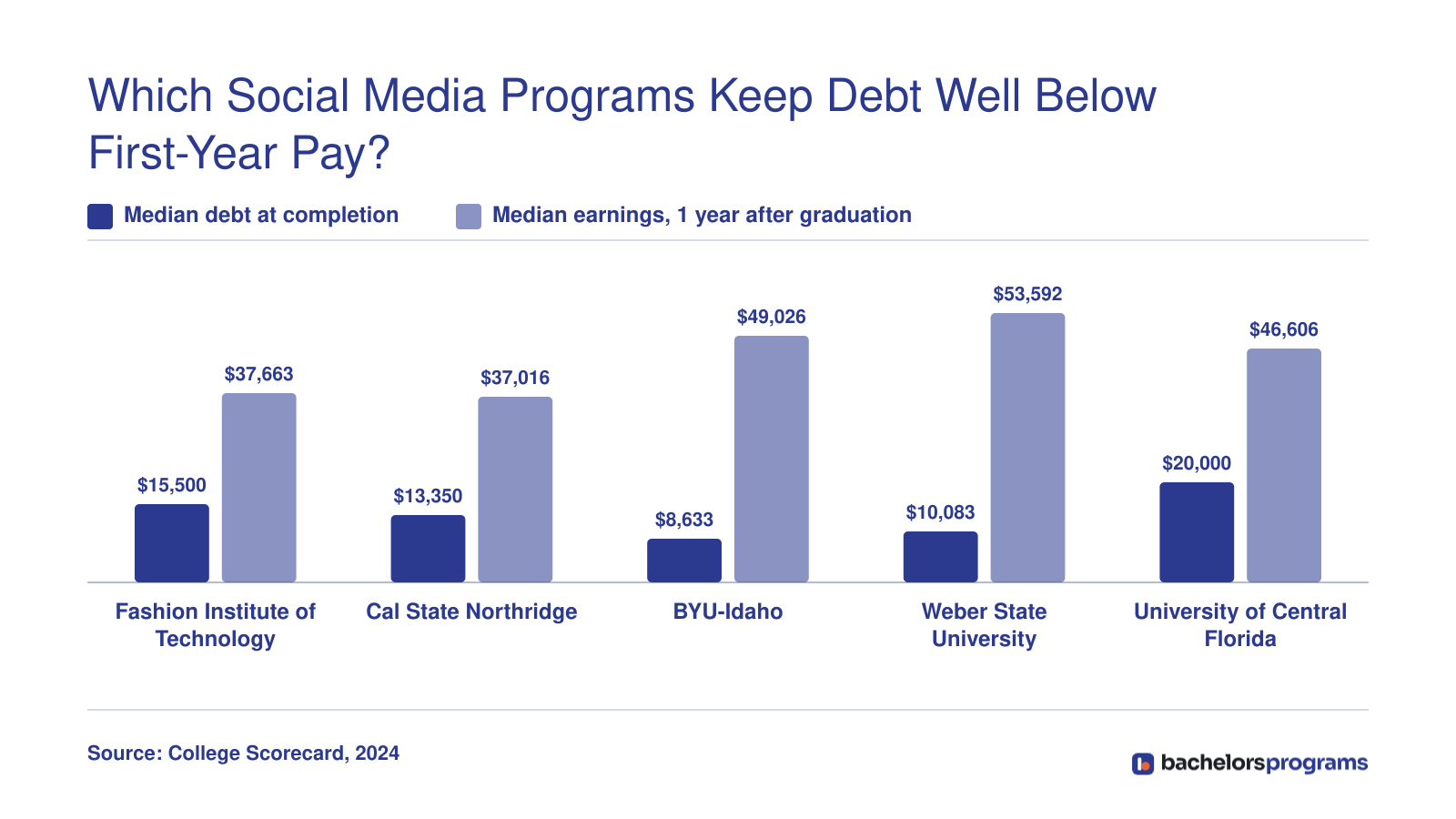
Which Social Media Programs Keep Debt Well Below First-Year Pay?
Each pair of bars sets a program's median debt at completion against its graduates' median earnings one year after finishing, the earliest program-level window the federal data reports. Brigham Young University-Idaho and Weber State University show the widest gaps: median debt of $8,633 and $10,083 against first-year pay of $49,026 and $53,592. Fashion Institute of Technology, California State University-Northridge, and the University of Central Florida still post first-year earnings more than twice their median debt.
Social Media programs by state
Compare Social Media programs on the data that matters
Explore more Communications & Media majors or browse every field of study.
All Communications & Media programs Browse every field of study