Best Public Relations Degree Programs
Compare 480+ accredited Public Relations programs at 450+ colleges, with net price after aid, graduation rates, earnings and debt from IPEDS and the U.S. College Scorecard.

An online public relations degree from the University of Florida carries an average net price of $4,815 a year, while a campus seat at Virginia Tech runs $24,953. That gap is the first thing to weigh when comparing bachelor's degrees in public relations. Most of these programs award the Bachelor of Arts (B.A.) in Public Relations; several award a B.S. instead.
Campus and online programs both made the ranking. A lower price does not guarantee better value. Median earnings one year after graduation run from $34,435 to $51,436 among programs reporting them, so what you borrow matters as much as what you pay.
Key Points
- The University of Florida posts the lowest average net price here: $4,815.
- Keep total borrowing below your expected first-year salary after graduation.
- Online PR students usually must line up their own internships.
The 10 Best Public Relations Degree Programs Ranked
This ranking covers public relations bachelor's programs in every format: fully on-campus, fully online, and everything in between. Ten programs made the list, each tied to a different kind of student, from Texas flagship seekers to working adults who need a flexible schedule. The notes below each entry focus on what the PR major actually requires and where the school stands out.
The University of Texas at Austin
#1Austin, TX · ~$20,000/yr (est.)
Best for: Texas students seeking a flagship communication school
UT Austin's Moody College of Communication runs a large public relations program, and its Bachelor of Science in Public Relations sits inside a 120-credit curriculum shared with advertising, journalism and marketing coursework. Core classes cover PR principles, writing, research, strategy and ethics, and the catalog requires an internship or capstone plus several courses completed in residence. Graduates head into agency, corporate, nonprofit and media relations work, backed by a communication school with deep recruiting ties across Texas.
- 120 total credit hours
- Core courses must be completed in residence, including PR 309 and PR 367
- Internship or capstone required for completion
- Competitive elective sequences for deeper specialization
- Cannot double major with Advertising
- Blends PR, advertising, journalism and marketing coursework
University of Georgia
#2Athens, GA · ~$14,000/yr (est.)
Best for: PR majors wanting stacked certificate options
The University of Georgia treats public relations as one of four majors inside the Grady College of Journalism and Mass Communication, which keeps PR students in a focused media school rather than a general communication department. The major trains both traditional and new media skills, and students can stack certificates in New Media, Public Affairs, Sports Media or Strategic Health and Risk Communication. A Double Dawgs pathway lets qualified students finish a bachelor's and a master's in five years.
- One of four undergraduate majors in the Grady College
- Certificates in New Media, Public Affairs, Sports Media and more
- Strategic Health and Risk Communication certificate option
- Double Dawgs: bachelor's and master's in five years
- Training in traditional and new media skills
- Grady College Prospective Student Day for applicants
North Carolina State University at Raleigh
#3Raleigh, NC · $9,000 – $33,000/yr (est.)
Best for: Communication majors eyeing an honors track
At NC State, public relations is a concentration inside the B.A. in Communication, one of six competencies the Department of Communication builds its degree around. The public relations and strategic communication track centers on the relationships between organizations and their publics, with coursework in campaigns, publicity and event planning. Students can join an active PRSSA chapter and the Lambda Pi Eta honor society, and an undergraduate honors program plus a Science Communication minor round out the options.
- One of six competencies in the B.A. in Communication
- Focus on relationships between organizations and their publics
- PRSSA student chapter on campus
- Lambda Pi Eta honor society chapter
- Undergraduate honors program available
- Science Communication minor also offered
Purdue University
#4West Lafayette, IN · ~$15,000/yr (est.)
Purdue's Bachelor of Arts in Communication makes public relations and strategic communication its most popular concentration, so PR students learn alongside a sizable cohort in the Lamb School. The curriculum pairs communication theory with hands-on work, including projects for real clients and the student-run Boiler Communication agency. A Degree in Three option, study abroad with internships, and more than $20,000 in annual Lamb School scholarships give students room to move fast or go broad.
- Most popular concentration in the B.A. in Communication
- Five selected classes build the specialization
- Boiler Communication student-run PR agency
- Projects with real clients in upper-level courses
- Degree in Three option with summer scholarship support
- Study abroad in London and Sydney with internships
- Over $20,000 in annual Lamb School scholarships
- Accelerated bachelor's/master's pathways available
University of Florida
#5Gainesville, FL · ~$4,800/yr (est.)
The University of Florida runs its public relations degree through the College of Journalism and Communications, with a 120-credit curriculum in writing, research, ethics and campaign planning that ends in a capstone campaign project. Students choose between corporate and public interest communications concentrations, aiming either at agency and corporate work or at advocacy and nonprofit communication. A large PRSSA chapter and an optional international communication certificate add professional experience alongside the degree.
- 120 total credit hours
- Capstone campaign project required
- Tracks: Corporate; Public Interest Communications
- 55 core course credits and 19 professional elective credits
- Large PRSSA chapter
- Optional certificate in International Communication
- Laptop with Adobe Creative Cloud required
Brigham Young University
#6Provo, UT · $15,000 – $20,000/yr (est.)
Brigham Young University offers public relations and advertising as an emphasis inside its B.A. in Communications, a compact 45-credit major that leaves room to pair it with a second field. Admission is selective: applicants need a B or better in three prerequisite courses plus a campus writing course before they apply. The PRAD core covers ethics and leadership, PR writing, visual communication and strategy, with electives that build data-driven and cross-platform skills.
- 45 total credit hours
- B or better required in three prerequisite courses to apply
- Campus writing course prerequisite
- 15 PRAD elective credits
- Choose two of eight media courses
- Data-driven strategy and cross-platform message design
- Christ-centered leadership emphasis
Florida State University
#7Tallahassee, FL · ~$11,000/yr (est.)
Florida State University's public relations program is a limited-access major inside the College of Communication and Information, with new cohorts starting each summer and fall. Students take 120 credits covering audience analysis, message production, research methods and campaign management, plus a 6-7 credit internship and a minor outside communication. Admission and continuation both require a 3.0 GPA, and the application pool is competitive.
- 120 total credit hours
- 3.0 GPA required for admission and continuation
- Limited-access program with competitive admission
- Internship of 6-7 credits required
- Minor outside Communication required
- Foreign language proficiency required
- Two start dates per year; apply by December 31
Virginia Polytechnic Institute and State University
#8Blacksburg, VA · $25,000/yr (est. net price)
Virginia Tech's Bachelor of Arts in Public Relations sits in the College of Liberal Arts and Human Sciences and centers on reputation management and relationship building. Coursework runs through writing, communication research, message production, case analysis and campaign planning, with an emphasis on critical thinking about how organizations and publics interact. Graduates move into corporations, government, nonprofits and agencies in roles from public relations specialist to communication director.
- B.A. housed in the College of Liberal Arts and Human Sciences
- Coursework in writing, research, message production and campaigns
- Open to first-year and transfer applicants
- Case analysis and campaign planning in the core
- Prepares for PR specialist, communication director and brand manager roles
Florida International University
#9Miami, FL · ~$9,000/yr (est.)
Florida International University bundles public relations, advertising and applied communication into one Bachelor of Science, giving students a broader applied skill set than a PR-only major. The 120-credit degree blends communication theory, digital media and applied research, with coursework in persuasive writing and strategic messaging, and each student works with a personal success coach. An Honors College option is available for students who want a more demanding academic path.
- 120 total credit hours
- Personal success coach assigned to each student
- Blends communication theory, digital media and applied research
- Coursework in persuasive writing and strategic messaging
- Honors College available
- Per-credit tuition: $235.57 in-state, $758.38 out-of-state
- Multiple start dates per year
Michigan State University
#10East Lansing, MI · $16,000 – $44,000/yr (est.)
Michigan State University's public relations major is large and deliberately practical: students complete a 250-hour professional internship and a cognate in business, fine arts, sciences or social sciences alongside the PR core. Coursework covers research methods, writing for traditional and social media, campaign planning, and diversity and ethics. Enrollment is limited and competitive, with a 3.0 GPA required for admission.
- 120 total credit hours
- 3.0 GPA minimum for admission
- 250-hour professional internship required
- Cognate in business, fine arts, sciences or social sciences
- Limited and competitive enrollment
- Student clubs and national competitions
- Coursework in campaign planning, research methods and ethics
Cost & outcomes by school
Federal data for the highest-earning Public Relations programs, independent of the ranking above. Earnings are this field's bachelor's graduates four years after completing where the Scorecard reports them, else the school's undergraduate median.
| School | Net price / yr | Grad rate | Earnings | Debt | Grads/yr | Format |
|---|---|---|---|---|---|---|
| Bentley University MA | $37,930 | 87% | $120,959 | $25,023 | — | Campus |
| Villanova University PA | $43,756 | 92% | $100,423 | $25,874 | — | Online or campus |
| Northeastern University MA | $30,915 | 91% | $92,538 | $24,250 | — | Campus |
| California Polytechnic State University-San Luis Obispo CA | $16,665 | 86% | $90,768 | $18,500 | — | Campus |
| Syracuse University NY | $38,793 | 84% | $90,535 | $24,375 | 188 | Campus |
| Southern Methodist University TX | $40,892 | 84% | $89,330 | $19,500 | 146 | Campus |
| University of Southern California CA | $32,740 | 92% | $87,946 | $19,500 | 106 | Campus |
| Boston University MA | $24,402 | 89% | $83,238 | $23,250 | 387 | Campus |
| University of Miami FL | $37,244 | 84% | $82,999 | $17,000 | 172 | Campus |
| University of Maryland-College Park MD | $15,678 | 89% | $82,860 | $19,000 | — | Campus |
| Loyola University Maryland MD | $30,574 | 79% | $82,652 | $27,000 | — | Campus |
| New York University NY | $37,050 | 88% | $82,509 | $20,500 | — | Campus |
Sources: U.S. Department of Education. Net price, graduation rate, earnings and debt: College Scorecard (earnings and debt for this field's bachelor's graduates where reported, else school-wide); graduates: IPEDS. A dash means no figure is reported.
Cost, debt & payoff
Median earnings of this field's bachelor's graduates (4 yrs after completing, else the school's undergraduate median) vs. their median federal loan debt · U.S. College Scorecard
Across these programs the median graduate earns about $56,346 and finishes with roughly $23,125 in debt — a ratio that clears a common rule of thumb (keep debt below first-year salary). Net price and debt vary widely school to school, so check the per-school figures in the table above before you shortlist.
Our Scoring Model: Affordability, Completion and Graduate Earnings
A public relations program earns its place here by answering three questions families actually ask: what will it cost, will students finish, and what do graduates earn?
The Four Numbers We Weigh
- Average net price after aid: the typical yearly cost after grants and scholarships, which comes closer to what a family really pays than the published tuition rate.
- Graduation rate: the share of first-time, full-time students who complete a degree at that institution.
- Median earnings after completion: what graduates of the public relations program typically earn a few years into their careers.
- Median federal debt: how much borrowers who finished the program typically owe when they leave.
Cost and completion come first because they shape everything that follows. Earnings and debt sit next to them because a cheap degree that leads nowhere is not a bargain, and a strong salary weighed down by heavy borrowing is not a win either.
Where These Numbers Stop
Graduation rate describes the whole school, not the public relations department, so a strong PR program can sit inside an institution with a middling completion figure. Net price is an institution-wide average, not a personal quote; your own aid offer will differ. Where a program has no published program-level earnings, we leave that measure out rather than substitute a school-wide figure.
One Standard Across Formats
Campus, online and hybrid programs were all eligible, and every offering on this list is a bachelor's-level degree, most commonly the B.A. in Public Relations. Format changes how you study, not the bar a program has to clear.
What a Bachelor's Degree in Public Relations Covers
A bachelor's degree in public relations trains you to write, plan and measure persuasive communication, and the coursework is more alike across schools than the degree labels suggest. Most programs total about 120 credits.1
Core Coursework
Expect a sequence built around PR writing, media relations and planning, campaign strategy, crisis communication, and law and ethics. Research and analytics are a standard requirement. Examples include Public Relations Research and Strategy at Texas State, Research Basics for Advertising and Public Relations at Grand Valley State, and Advertising and Public Relations Research at UT Austin. Digital, social and content courses round out the core. Northeastern adds marketing communications and reputation management.4
B.A. vs. B.S.
The labels are not standardized nationally, so the school's catalog is what counts. A B.A. often leaves more room for liberal arts and foreign language. Mississippi College and Northeastern each require 12 hours of language3, and Grand Valley State requires third-semester proficiency.2 A B.S. often leans toward business, analytics or technical work. UT Austin's B.S. requires marketing courses and business foundations1, and Texas State's requires a minor plus extra math, science and computer science.5
There are exceptions both ways. UT Austin's B.S. also has a language-and-culture requirement, and Northeastern's B.A. includes business and professional speaking.4 The sources do not show a general employer preference for either credential. Writing ability, internships and a strong portfolio usually matter more to hiring managers.
Capstone, Agency Work and Portfolio
Many programs end with applied work. UT Austin requires an internship or capstone1, and Mississippi College requires an internship and a senior portfolio.3 Where a school runs a student agency or PRSSA chapter, use it to collect real client work: press releases, campaign plans, social content. Those samples become the portfolio you show employers.
Entry-Level Jobs Graduates Pursue
- Public relations specialist
- Communications coordinator
- Social media coordinator
- Agency account coordinator
Should You Earn an Online Public Relations Degree or Study on Campus?
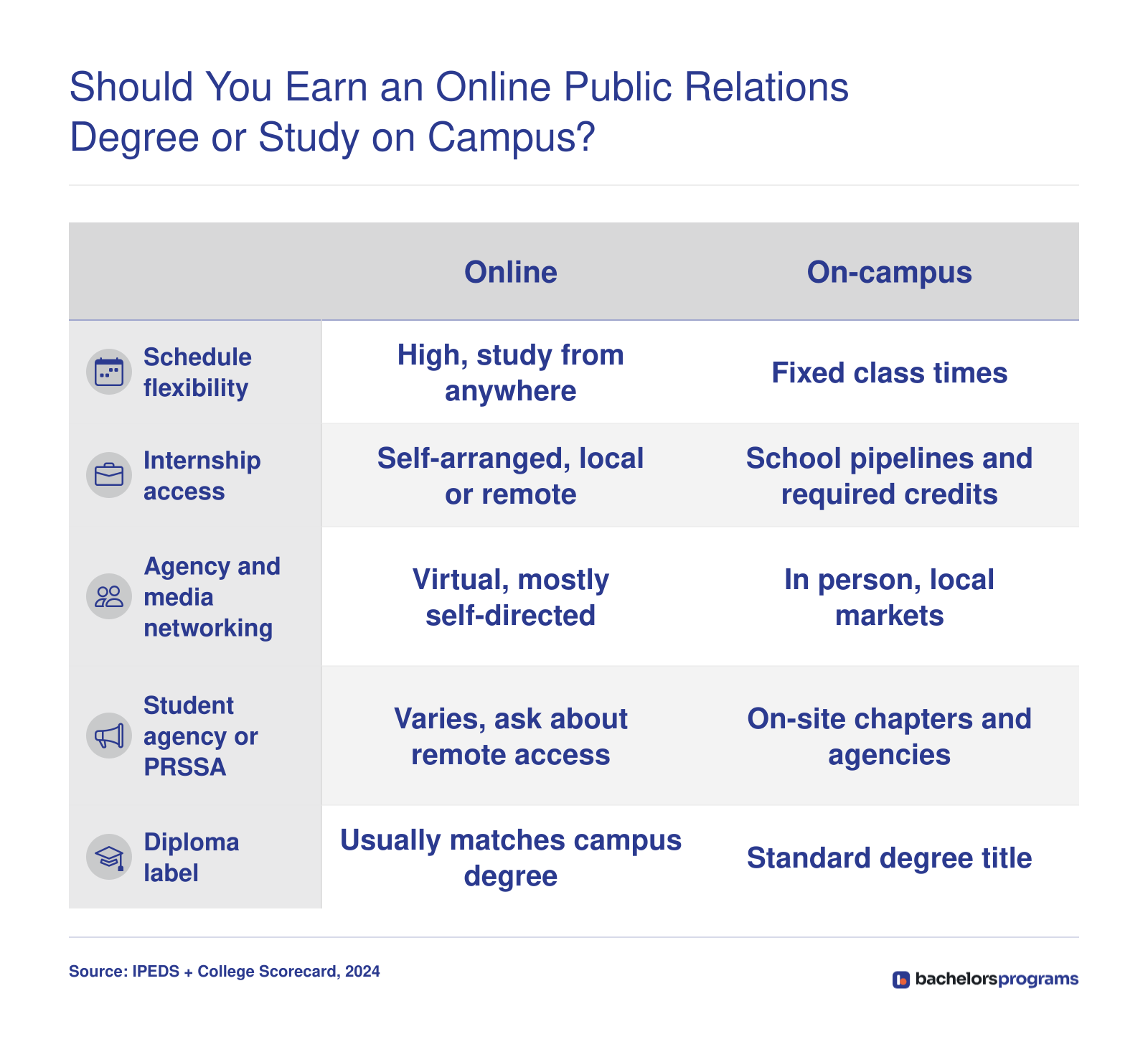
An online public relations degree gives you the same core coursework in writing, research and campaign planning, but the hands-on parts of PR training work differently. Online students usually have to find and arrange their own local or remote internships, while campus students can lean on in-person chapters, student agencies and school-run placement pipelines. Among the schools ranked here, the University of Florida and Florida International University offer their PR bachelor's online, and the rest of the programs are campus-based.
Related Articles
Accreditation vs. Program Recognition: CEPR, ACEJMC and Regional Approval
A public relations program is only as credible as the school behind it, and that starts with institutional accreditation. Confirm that the college is accredited by a recognized regional or national accreditor. That status determines whether you can use federal financial aid and whether your credits will transfer if you change schools or finish elsewhere.
PRSA's CEPR Endorsement
The Certification in Education for Public Relations (CEPR) is a voluntary, PR-specific endorsement from the Public Relations Society of America, established in 1989.1 Reviewers assess eight areas: curriculum, faculty, resources and facilities, students, assessment, professional affiliations, the program's relationship with its unit and university, and diversity and global perspectives.2 Since 2019, programs seeking certification must also require a PR ethics course.3
The process begins with a self-assessment. A two-person team then visits for two to three days.2 One member is an educator from a certified school, and the other is a practitioner with the APR credential. PRSA's Educational Affairs Committee administers the review, and the PRSA Board makes the final decision. Certification lasts six years before recertification.2 Syracuse University, for example, is listed for 2017 to 2029, and Kent State was recertified in November 2023.1
The credential is selective. The University of Memphis describes itself as one of only 45 undergraduate programs worldwide with CEPR.4
ACEJMC Accreditation
The Accrediting Council on Education in Journalism and Mass Communications evaluates the journalism or mass communication unit that houses a PR major, not public relations itself. It does not prescribe a single PR curriculum. Review runs on a six-year cycle, with a self-study and a peer site visit, against eight published standards.
The two are separate. A PR program can hold CEPR, ACEJMC, both, or neither, and one does not replace the other.6 Kent State holds both.5
Verify Before You Trust the Brochure
Do not rely on marketing language like "nationally recognized." Check the school's status on the PRSA certification listing and the ACEJMC accredited-programs directory, and confirm the institution's accreditor directly.
How Much a Public Relations Degree Costs and What Graduates Borrow
Residency shapes the price of a public relations degree more than almost any other choice you will make. Average net price across the ranked schools runs from $4,815 at the University of Florida to $15,564 at Brigham Young University. Net price is an institution-wide average after grants and scholarships, so it reflects what students at the whole school pay, not just those in the PR major.
The Residency Premium
Published tuition tells a sharper story at public universities. The University of Florida lists $3,876 for in-state students and $16,579 for out-of-state students, a gap of roughly $12,700 a year. The University of Georgia charges $11,450 in-state and $31,688 out-of-state, a difference of more than $20,000. Florida State is $6,517 in-state against $21,683 out-of-state, and San Diego State is $8,728 against $21,328. Brigham Young, a private school, charges one rate of $6,688 regardless of residency.
What Graduates Borrow
Program-level median federal debt at completion for PR graduates is modest at several schools. It runs from $11,572 at Florida International University to $22,976 at California State University-Long Beach. Brigham Young sits near the low end at $11,974, and Florida State is at $14,442. At the high end, the University of Oklahoma is at $20,718 and the University of Georgia at $18,750.
Median monthly payments on a 10-year standard plan follow the same pattern. It is $123 at Florida International, $162 at the University of Florida, $220 at Oklahoma and $244 at Long Beach. Debt figures are not published for every program, so treat a missing number as a question to ask the admissions office, not as a zero.
A Practical Tip
Compare net price, not sticker tuition. Every school must post a net price calculator on its website. Run it with your own family income and residency before you rank your options, because a school with higher published tuition can sometimes cost less after aid.
PR vs. Strategic Communication, Marketing, Advertising and Journalism Majors
The best degree for public relations is usually a PR major, but the neighboring majors overlap with it more than their names suggest. Degree titles and required courses vary by school, and PR, advertising and journalism are sometimes concentrations inside a broader communication degree. Entry-level jobs cross these lines often, so check each curriculum rather than relying on the title alone.
| Major | Core focus | Typical coursework | Common entry-level roles | Pick PR over this major if... |
|---|---|---|---|---|
| Public Relations | Relationships and reputation | Media relations, crisis communication, PR writing | PR specialist, communications coordinator, account coordinator | You want to build trust and manage how an organization is seen (this is the PR baseline) |
| Strategic Communication | Research-driven communication planning | Communication theory, audience research, campaign development | Communications specialist, content strategist, social-media specialist | You want to specialize in media relations and reputation instead of broad, cross-channel planning |
| Marketing | Customer value | Consumer behavior, marketing research, marketing strategy | Marketing coordinator, market-research analyst, brand coordinator | You care more about public trust and earned media than about customers and revenue |
| Advertising | Paid persuasive campaigns | Copywriting, media planning, creative strategy | Account coordinator, copywriter, media planner | You prefer earning coverage and stakeholder goodwill to buying media and producing creative |
| Journalism | Independent public-interest reporting | Reporting, editing, media law | Reporter, copy editor, multimedia journalist | You want to advocate for an organization rather than report on it independently |
Public Relations programs by state
Compare Public Relations programs on the data that matters
Explore more Communications & Media majors or browse every field of study.
All Communications & Media programs Browse every field of study