Best Speech Pathology Degree Programs
Compare 270+ accredited Speech Pathology programs at 260+ colleges, with net price after aid, graduation rates, earnings and debt from IPEDS and the U.S. College Scorecard.

A bachelor's degree in speech pathology, usually a Bachelor of Science (B.S.) in Speech Pathology or communication sciences and disorders, does not license anyone to practice. Speech-language pathologists need a master's degree, a supervised clinical fellowship and a state license, so the undergraduate degree is step one of a multi-year sequence.
That sequence is where the real decisions sit. Tuition at the public flagships here runs from under $6,000 to over $13,000 a year in-state, and the degree on its own leads mainly to SLP assistant roles or graduate applications.
Spots in graduate programs are competitive, so the undergraduate you choose matters less for its name than for what it costs and how well it prepares you for admission.
Key Points
- Net price and completion odds matter more than a school's name recognition.
- Speech pathology and communication sciences and disorders usually name the same degree.
- Plan on roughly 6 to 7 years to become a licensed SLP.
Top 10 Schools for a Bachelor's Degree in Speech Pathology
This list favors what you pay and what graduates walk away with, not what deans think of each other. Every entry below is a campus-based bachelor's program in communication sciences and disorders, and the order reflects how consistently each school's students finish on time and hold cost down. Read each card for the details that decide a four-year commitment: coursework structure, clinical exposure, and the route into graduate study.
Women's Institute of Torah Seminary and College
#1Baltimore, MD · $10,000 – $15,000/yr (est.)
Best for: Students seeking faith-integrated clinical training
A small Baltimore college whose communication sciences and disorders major is built as a pre-professional track, with phonetics, speech and hearing science, and clinical methods alongside required observation hours. Jewish studies and ethics run through the curriculum, and the coursework maps to ASHA certification requirements. The school graduates 91% of students.
- 120 total credit hours
- Courses required for ASHA certification
- Clinical observation of speech-language pathologists
- Combines communication sciences with Jewish studies
- Paths into education and healthcare settings
- Ethics and cultural competence emphasized
University of Virginia
#2Charlottesville, VA · $22,000/yr (est. net price)
Best for: Future audiologists mapping a research path
The speech communication disorders major sits inside the education school and runs 120 credits, 45 of them in the major, with 21 core credits plus separate blocks on special populations and developmental communication sciences. Faculty frame the degree around three graduate routes: audiology, speech-language pathology, and speech and hearing science. The school graduates 96% of students.
- 120 total credit hours
- 45 credits in the major
- 21 core communication disorders credits
- 36 credits of general education
- At least 60 credits completed in residence
- 2.0 GPA minimum
- Three graduate paths: audiology, SLP, hearing science
- 12 credits on special populations
Florida State University
#3Tallahassee, FL · ~$11,000/yr (est.)
Best for: Transfer students entering a limited-access major
A clinical observation seminar is built in, prerequisites span the sciences and statistics, and applicants need a 3.0 GPA. The school graduates 86% of students.
- 42-hour major curriculum
- 3.0 GPA minimum for admission
- Two start dates per year
- Clinical observation seminar included
- Prerequisite science and statistics coursework
- Minimum of two years after acceptance to the major
The University of Texas at Austin
#4Austin, TX · ~$20,000/yr (est.)
A 120-credit degree in the Moody College of Communication with tracks in speech-language pathology or audiology, 45 to 54 hours in the major, and internship and clinical hours built into the plan. A third track adds deaf education coursework and a required internship. Median earnings four years after finishing were $67,405, and the school graduates 89% of students.
- 120 total credit hours
- 45 to 54 hours of speech, language, and hearing coursework
- Internship and clinical hours for certification
- Three hours of introductory statistics
- Cap of 60 hours in the College of Communication
- Minor or certificate can fill electives
- One of two concentration options
- Pathway toward audiology graduate study
- Core curriculum in humanities and sciences
- Deaf Education internship required
- Instructional methods for deaf students
- Communication and Deaf People course
- Perspectives on Deafness course
- Anatomy and hearing science coursework
Texas Tech University Health Sciences Center
#5Lubbock, TX
A two-year upper-division program in Lubbock with roughly 75 students per class, 63 credit hours, and an on-site speech and hearing clinic for observation hours. Admission requires a 2.5 GPA in cumulative and prerequisite work, and the coursework also covers the licensed speech-language pathology assistant credential. Applications for fall 2027 open December 1, with priority review for April 1.
- 2-year program
- 63 total credit hours
- 42 hours of Texas Core Curriculum
- 2.5 GPA minimum, cumulative and prerequisite
- Class size of about 75 students
- On-site speech and hearing clinic
- Coursework for licensed SLPA credential
- Fall start with April 1 priority review
University of Washington-Seattle Campus
#6Seattle, WA · ~$14,000/yr (est.)
The speech and hearing sciences major is a four-year campus degree, with a post-baccalaureate version for career changers that finishes in three or six quarters. Coursework is designed as preparation for graduate study in speech-language pathology. Median earnings four years after finishing were $80,947, and the school graduates 85% of students.
- 4-year campus program
- Post-bacc BS option in 3 or 6 quarters
- Open to students changing fields
- Prepares for graduate study in speech-language pathology
San Diego State University
#7San Diego, CA · $15,000/yr (est. net price)
A master's degree and certification are still required to practice, so the faculty treat this as a foundation for graduate work. The school graduates 76% of students.
- 19 units of general studies
- 36 upper division specialization units
- Normal and disordered speech, language and hearing coursework
- Clinical procedures coursework
- Master's plus certification needed to practice
- Recommended prep: anatomy, biology, psychology, linguistics
- Careers in rehab centers, schools, hospitals
University of Wisconsin-Madison
#8Madison, WI · ~$17,000/yr (est.)
Coursework covers speech anatomy and physiology, hearing science, neural communication, and language development. The school graduates 90% of students.
- 120 total credit hours
- No application required to declare the major
- Four-year sample plan provided
- Honors in the major available
- Study abroad in 80+ countries
- Career advising through SuccessWorks
- Prepares for ASHA clinical certification
Purdue University
#9West Lafayette, IN · ~$15,000/yr (est.)
A Bachelor of Science in speech, language, and hearing sciences taught in the College of Health and Human Sciences, with clinical training in on-site audiology and speech-language clinics and research labs in Lyles-Porter Hall. Coursework covers hearing, language, speech, and swallowing, and graduates move into healthcare, education, rehabilitation, or graduate study. The school graduates 83% of students.
- Bachelor of Science in the College of Health and Human Sciences
- On-site audiology and speech-language clinics
- Research labs in Lyles-Porter Hall
- 2.5 GPA minimum for transfer applicants
- Prepares for graduate study in audiology and SLP
- Coursework covers hearing, language, speech and swallowing
Ohio State University
#10Columbus, OH · $17,000/yr (est. net price)
A BA in speech and hearing science in the College of Arts and Sciences, built on nine core courses plus two approved 5000-level electives and drawing on anatomy, psychology, linguistics, and medicine. The American Sign Language sequence can satisfy the foreign language requirement, and a senior honors thesis is optional. The school graduates 88% of students.
- BA major in the College of Arts and Sciences
- Nine core courses in speech and hearing science
- Two approved 5000-level courses required
- American Sign Language series can meet the language requirement
- College Algebra is the minimum math requirement
- No thesis or capstone required
- Optional senior Honors thesis
- Recommended preparation in biology and psychology
Cost & outcomes by school
Federal data for the highest-earning Speech Pathology programs, independent of the ranking above. Earnings are this field's bachelor's graduates four years after completing where the Scorecard reports them, else the school's undergraduate median.
| School | Net price / yr | Grad rate | Earnings | Debt | Grads/yr | Format |
|---|---|---|---|---|---|---|
| Northeastern University MA | $30,915 | 91% | $92,538 | $24,250 | 22 | Campus |
| Northeastern University MA | — | — | $92,538 | $24,250 | — | Campus |
| Case Western Reserve University OH | $41,190 | 87% | $87,989 | $24,000 | 15 | Campus |
| Saint Joseph's University - Philadelphia PA | $29,689 | 79% | $86,881 | $25,500 | 4 | Campus |
| Boston University MA | $24,402 | 89% | $83,238 | $23,250 | 10 | Campus |
| University of Washington-Seattle Campus WA | $14,091 | 85% | $80,947 | $12,542 | 50 | Campus |
| CUNY Queens College NY | $4,195 | 53% | $78,281 | $11,000 | 28 | Campus |
| University of the Pacific CA | $25,447 | 69% | $77,549 | $16,684 | 12 | Campus |
| New York University NY | $37,050 | 88% | $75,970 | $23,195 | 30 | Campus |
| Brigham Young University UT | $15,564 | 81% | $75,790 | $11,438 | 97 | Campus |
| California State University-Long Beach CA | $10,440 | 69% | $75,137 | $12,250 | 62 | Campus |
| The College of New Jersey NJ | $27,646 | 86% | $73,323 | $23,250 | 25 | Campus |
Sources: U.S. Department of Education. Net price, graduation rate, earnings and debt: College Scorecard (earnings and debt for this field's bachelor's graduates where reported, else school-wide); graduates: IPEDS. A dash means no figure is reported.
Cost, debt & payoff
Median earnings of this field's bachelor's graduates (4 yrs after completing, else the school's undergraduate median) vs. their median federal loan debt · U.S. College Scorecard
Across these programs the median graduate earns about $58,023 and finishes with roughly $21,397 in debt — a ratio that clears a common rule of thumb (keep debt below first-year salary). Net price and debt vary widely school to school, so check the per-school figures in the table above before you shortlist.
Why Cost and Outcomes Outweighed Reputation in Our List
Reputation alone will not tell you whether a bachelor's degree in speech pathology is worth its price. Two schools with similar name recognition can leave you with very different debt loads and very different odds of finishing on time, so cost and measurable outcomes carried more weight than prestige here.
What We Looked At
Federal net price after aid, school-wide graduation and retention rates, and, where a department publishes it, program-level earnings and typical federal debt. Format flexibility counted too: whether a program runs online, hybrid, or in person, and whether it fits around a job.
Why the Usual Rankings Miss You
U.S. News and similar guides survey academics and concentrate on graduate speech-language pathology programs. An undergraduate comparing bachelor's programs gets no bachelor's-level comparison from them.
Treat It as a Shortlist
Graduation rates and net price are institution-wide averages rather than program figures, and small cohorts often go unpublished on earnings. Use the list as a starting point, then contact each department directly about prerequisites, clinical observation hours, and how many students actually finish in four years.
What a Bachelor's in Communication Sciences and Disorders Qualifies You to Do
Undergraduate departments have spent the past decade renaming themselves, and that churn confuses applicants more than it helps them. Speech pathology, communication sciences and disorders (CSD), and speech-language-hearing sciences almost always describe the same pre-professional bachelor's degree. The course sequence (phonetics, anatomy of speech and hearing, language development, audiology, clinical observation) looks remarkably similar whichever label the catalog uses, so screen programs on their curriculum and accreditation rather than their title.
The Master's Requirement Is Not Negotiable
ASHA's certification standards, in effect since 2020, require a master's or other recognized post-baccalaureate degree for the Certificate of Clinical Competence in Speech-Language Pathology, with graduate coursework and supervised practicum completed in a program holding CAA accreditation or candidacy status.1 A national examination and a clinical fellowship follow. Separately, state boards license speech-language pathologists, and most states require a master's degree or its equivalent before you can practice clinically.1 The CCC-SLP is a voluntary national credential and does not substitute for that state license. A bachelor's degree alone qualifies you for neither.
What the Degree Does Open
- SLP assistant: ASHA's recommended minimum qualifications include a bachelor's in speech-language pathology or communication disorders plus at least 100 hours of supervised fieldwork. There is no national SLPA license, and scope of practice is set state by state, so eligibility depends entirely on your state board.
- Support and research roles: audiology assistant, behavior technician, early intervention aide, or research assistant in a university lab, subject to employer and state rules.
Most graduates go straight to a master's program. Judge your undergraduate choice accordingly: it needs to deliver the prerequisite coursework, documented observation hours, and faculty who know you well enough to write a serious recommendation.
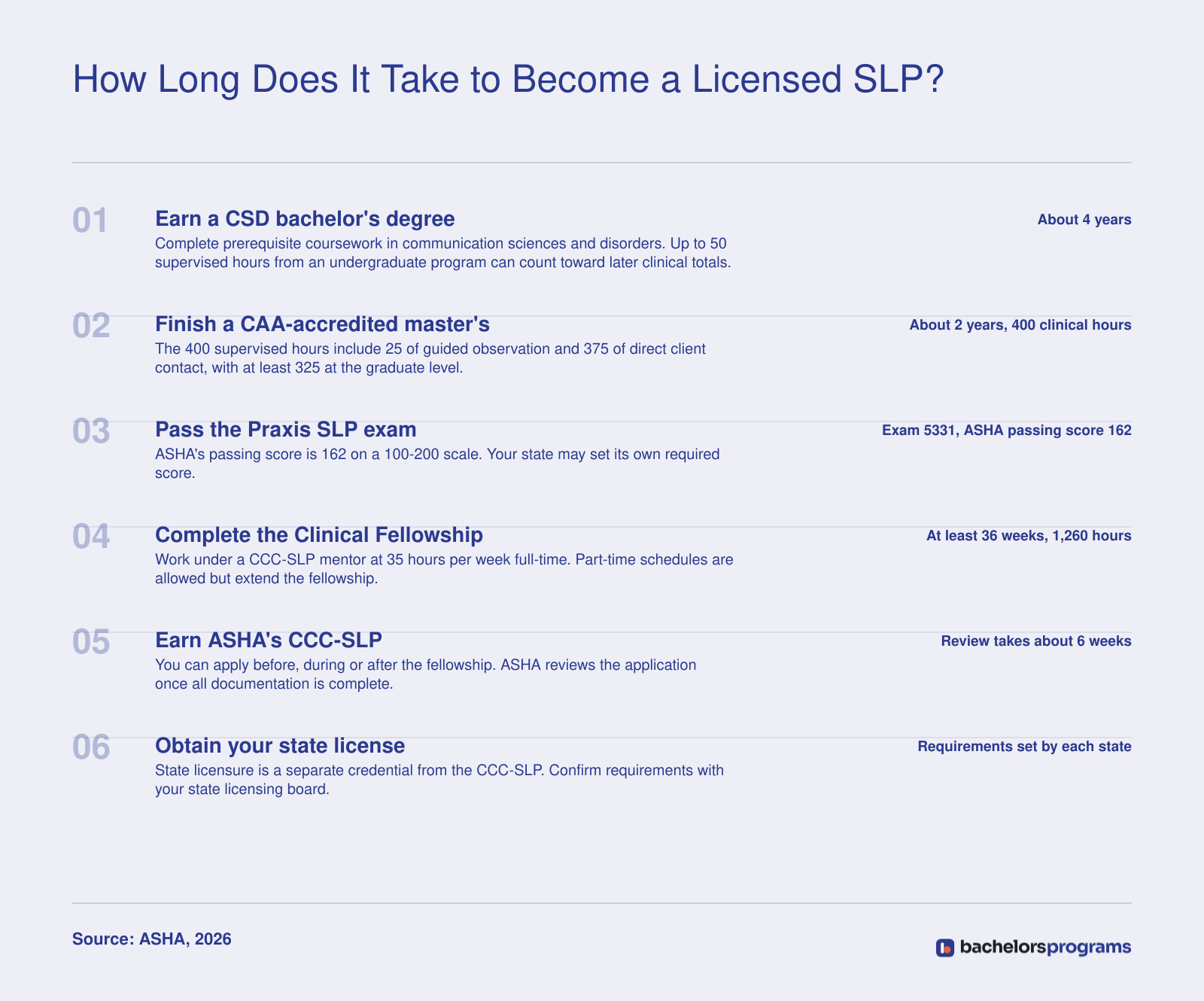
How Long Does It Take to Become a Licensed SLP?
Expect roughly 6-7 years from your first undergraduate class to full credentials. State licensure details vary, and many states require an interim or provisional license during the fellowship, so check your state board's rules.
Working as an SLP Assistant Before (Or Instead Of) Grad School
What an SLPA Does
A speech-language pathology assistant (SLPA) carries out treatment plans written by a licensed SLP and works under that clinician's supervision. SLPAs lead therapy activities, track client progress and support a caseload, but they do not evaluate or diagnose. For a new graduate, that boundary is the appeal: steady clinical contact without the responsibility a master's degree prepares you for.
Earning ASHA's C-SLPA
ASHA offers the Certified SLPA (C-SLPA) credential to bachelor's graduates. With a communication sciences and disorders degree, you need:
- Coursework: ASHA's online SLPA modules or an academic equivalent, plus 1-hour courses in ethics, universal safety precautions and patient confidentiality.
- Fieldwork: 100 clinical hours directly supervised by an ASHA-certified SLP, completed within five years before you apply. Observation and simulation do not count.
- Exam: a passing score on the ASHA Assistants Certification Exam.
Graduates from other majors can qualify by adding coursework in six areas, including phonetics, language development, and anatomy and physiology.
State Rules Still Decide
Certification is a credential, not permission to practice. Texas licenses SLPAs and offers reciprocity to current C-SLPA holders. California requires board registration in health-care settings and accepts a bachelor's plus 100 clinical hours, or 36 weeks of full-time SLPA experience instead. Oversight also shifts by setting: ASHA counts 19 states that license SLPAs in schools and 21 outside them. Check your state board before you plan around the role.
Why It Pays Off
You earn income while logging supervised clinical time, building a relationship with an SLP who can write your recommendation, and showing graduate admissions committees that you understand the work.
Questions to Ask Yourself
Is this online program authorized to enroll students in my state?
Can I line up observation hours close to home, and will recorded sessions count?
Who will write my graduate school recommendations?
Does the tuition price include placement support, or will I cover travel and supervision myself?
Related Articles
Prerequisites and Accreditation to Confirm on Any Curriculum
A bachelor's degree in speech pathology prepares you for graduate admission, so check its curriculum against what master's programs and ASHA expect.
- Core CSD coursesConfirm the major includes phonetics, anatomy and physiology of speech and hearing, speech and language development, audiology, and speech science. Graduate programs list these most often.
- ASHA science and statistics courseworkASHA's 2020 standards require biological science, physical science (chemistry or physics), statistics, and social/behavioral science, shown on a transcript from an accredited institution. These generally cannot be CSD courses.
- Guided observation hoursAsk whether the program builds in the 25 guided clinical observation hours ASHA requires, or whether you must arrange them yourself.
- Accreditation at the right levelCAA accredits master's SLP programs, not bachelor's degrees. Confirm that your target graduate programs appear on ASHA EdFind.
- CSDCAS and GPA minimumsMany graduate programs accept applications through CSDCAS and list a minimum GPA. Central Michigan, for example, requires a 3.00 and no prerequisite CSD grade below a C.
Questions to Ask Yourself
If you already hold a bachelor's in another field, would a post-bacc leveling program cover your prerequisites faster than a second bachelor's degree?
As a transfer student, will your community college credits count toward the CSD major or only toward general education?
As a working adult, can you study part time online and still get help arranging the observation hours graduate programs require?
Speech Pathology programs by state
Speech Pathology Degree Questions, Answered
These answers cover the most common questions about a bachelor's degree in speech pathology and the path to becoming a licensed SLP. Details on licensure vary by state, so confirm requirements with your state board and with ASHA.
Can you become a speech pathologist with a bachelor's degree?
What is the best bachelor's degree for speech pathology?
Can you get a speech pathology degree online?
How many years after high school does it take to become a licensed SLP?
Is a speech pathology degree worth it?
Are there 5-year speech pathology programs?
Compare Speech Pathology programs on the data that matters
Explore more Communications & Media majors or browse every field of study.
All Communications & Media programs Browse every field of study