Best Journalism Degree Programs
Compare 890+ accredited Journalism programs at 540+ colleges, with net price after aid, graduation rates, earnings and debt from IPEDS and the U.S. College Scorecard.

Journalism has stopped being a single career track, and degree programs now split among broadcast, data, sports media, and strategic communication. A bachelor's degree in journalism, most often a Bachelor of Arts (B.A.) in Journalism, can cost very different amounts depending on where you earn it. Among the schools ranked here, average net price after aid runs from about $3,000 a year to nearly $20,000.
Graduate earnings spread just as widely, and the most selective name does not reliably produce the biggest paycheck. Prestige alone is a poor guide.
With first-year pay varying this much, what you borrow deserves as much scrutiny as the school's reputation.
Key Points
- CUNY Baruch and Brooklyn College average near $3,000 in yearly net price.
- Graduates' first-year median earnings here range from $40,942 to $48,637.
- ACEJMC accredits about 120 programs worldwide, per its 2026 fact sheet.
Best Bachelor's Degree in Journalism Programs Ranked
The ten programs below share a required reporting core, a working student newsroom, and a net price after aid that stays under $20,000. Three of them admit fewer than one in three applicants, and every school listed graduates at least 72% of its students. Nine are built for on-campus study, and one delivers the full degree online.
University of Georgia
#1Athens, GA · ~$14,000/yr (est.)
Best for: Student journalists seeking metro newsroom fellowships
Grady College's journalism AB covers 120 credit hours, 30 of them in required journalism courses, with a 2.8 GPA and a written statement of interest needed to enter the major. The Red & Black has published since 1893 and Newsource airs a live daily newscast, while fellowships with the Atlanta Journal-Constitution and the Cox Institute's Fink Fellows put students inside working newsrooms. Net price after aid is $13,936; the school admits 37.7% of applicants and graduates 89.7% of its students.
- 120 total credit hours, including 30 in required journalism courses
- 2.8 GPA and written statement required for major admission
- Grades count 75% of the admission decision, statement 25%
- About 100 Grady College undergraduate scholarships awarded yearly
- Student newspaper The Red & Black has published since 1893
- Newsource produces a live daily newscast
- Study abroad in Prague and Copenhagen
- Internships encouraged but not required
University of Wisconsin-Madison
#2Madison, WI · ~$17,000/yr (est.)
Best for: Writers weighing reporting against strategic communication
Wisconsin awards the Journalism Bachelor of Science or Bachelor of Arts, and students pick one track: reporting and multimedia journalism or strategic communication. Three semesters is the minimum once admitted, and a prerequisite course is required before entry to the school. Certificates in Digital Media Analytics and Sports Communication add depth without a second major. Net price after aid is $17,354; the school admits 45.2% of applicants and graduates 89.6% of its students.
- Strategic communication track, one of two major tracks
- Three semesters minimum to complete degree requirements
- JOURN 201 required for admission to the school
- Media law and history fundamentals in the core
- Certificate in Digital Media Analytics offered
- Double major and study abroad possible in four years
- Reporting and multimedia journalism track
- JOURN 202 is a prerequisite for JOURN 335 and JOURN 345
- Those two courses cannot be taken in the same semester
- Letters & Science general education plus a breadth requirement
- Certificate in Sports Communication offered
- No general journalism minor offered
University of Maryland-College Park
#3College Park, MD · $16,000/yr (est. net price)
Best for: Aspiring investigative reporters in the capital region
The Philip Merrill College of Journalism requires 122 credits, 42 of them in journalism and at least 65 in liberal arts courses, plus a two-credit internship and a capstone. Career-path sequences run from local news and investigations to data and AI, and students file for Capital News Service and produce at the college's cable station. The campus sits ten miles from Washington's news bureaus. Net price after aid is $15,678; the school admits 44.8% of applicants and graduates 88.6% of its students.
- 122 total credits, 42 of them in journalism
- At least 65 of the remaining 80 credits in liberal arts courses
- 57 upper-level credits at the 300 to 499 level required
- Required two-credit internship plus a capstone
- Career paths include data and AI, investigations and sports
- Capital News Service daily wire and college-run UMTV
- Ten miles from Washington news bureaus
- Grammar diagnostic of 80 or C- in JOUR181 to enter JOUR201
University of Florida
#4Gainesville, FL · ~$4,800/yr (est.)
Florida's College of Journalism and Communications delivers the Bachelor of Science in Journalism with a Sports & Media concentration entirely through UF Online, and it is the same degree awarded on campus. The curriculum pairs a journalism core in writing, reporting, and data literacy with sports reporting, sports communication, and sports media law. Upper-division transfer applicants need 60 college credits, a 2.0 GPA, and five prerequisites. Net price after aid is $4,815, the lowest on this list; the school admits 61.3% of applicants and graduates 84.7% of its students.
- Fully online through UF Online; same degree as on campus
- Transfer applicants need 60 or more college credits
- Five prerequisites including ENC 1102, STA 2023 and ECO 2013
- 2.0 GPA required, with 2.5 or higher considered competitive
- Cross-disciplinary core in journalism and sports media
- Coursework in multimedia sports reporting and sports media law
- Accelerated B.S. to M.A. in Mass Communication available
University of California-Irvine
#5Irvine, CA · $14,000/yr (est. net price)
UC Irvine offers the Bachelor of Arts in Literary Journalism, 14 courses and 56 units built around three intensive writing seminars and a core workshop taken three times. Students study reporting and advanced reporting alongside narrative, memoir, profile, and essay forms, and leave with a portfolio. A Literary Journalism minor is also available, and study abroad runs through the UC Education Abroad Program. Net price after aid is $14,251; the school admits 28.6% of applicants and graduates 86.9% of its students.
- 14 courses and 56 units in literary journalism
- Three intensive writing seminars required
- Core writing workshop taken three times
- Portfolio required by graduation
- Literary Journalism minor also offered
- Study abroad through UC Education Abroad Program
The University of Texas at Austin
#6Austin, TX · ~$20,000/yr (est.)
UT Austin's Bachelor of Journalism runs 120 credits with 42 to 48 hours in journalism and no more than 60 hours of communication coursework. Foundation classes in media law, print journalism, and digital content creation lead into reporting in words and images, with a B- required in the two gateway reporting courses. Upper-level skills work covers government, business, data, sports, audio, photo, and video. Net price after aid is $19,857; the school admits 26.6% of applicants and graduates 88.9% of its students.
- 120 credits, with 42 to 48 hours in journalism
- No more than 60 hours of communication coursework
- B- minimum in the J 310F and J 311F reporting courses
- Four courses must be taken in residence at UT Austin
- Nine hours of specialized skills, from data to photo and video
- Professional practice via internship, Reporting Texas or capstone
- Minor or certificate declared before 65% of degree completion
University of Washington-Seattle Campus
#7Seattle, WA · ~$14,000/yr (est.)
Washington houses journalism inside the Department of Communication as the Journalism and Public Interest Communication option, a 55-credit path with a 20-credit skills core and 10 credits of law and ethics. Admission is capacity constrained and asks for a 2.50 GPA, an essay, and a writing sample, with entry in autumn, winter, or spring. Students work in the department's Media Lab and News Lab. Net price after aid is $14,091; the school admits 39.2% of applicants and graduates 85.2% of its students.
- 55 credits minimum inside the Department of Communication
- 20-credit skills core: COM 360, 361, 362 and 364
- 10 law and ethics credits in COM 440 and COM 468
- Capacity-constrained admission with essay and writing sample
- 2.50 GPA required in COM 200 and in all college work
- Starts autumn, winter and spring quarters
- Media Lab, News Lab and Observation Labs on site
CUNY Bernard M Baruch College
#8New York, NY · $7,000 – $15,000/yr (est.)
Baruch's journalism major carries a Journalism and Creative Writing track that opens with The Individual and the News and moves through reporting and writing, media ethics and law, and an advanced reporting course. Students choose a media internship or narrative writing and add 9 to 11 credits of specialization electives. Work appears in Dollars & Sense magazine, and the department lists paid internships and full-tuition fellowships. Net price after aid is $3,033, among the lowest here; the school admits 47.5% of applicants and graduates 72.1% of its students.
- 15-credit core in reporting, ethics and media law
- JRN 2500 prerequisite: The Individual and the News
- 9 to 11 credits of specialization electives
- 6 credits of literature at the 3000 level or above
- Media internship or Narrative Writing option
- Student work published in Dollars & Sense magazine
- Paid internships and full-tuition fellowships listed
California Polytechnic State University-San Luis Obispo
#9San Luis Obispo, CA · ~$17,000/yr (est.)
Cal Poly awards a Bachelor of Science in Journalism with four concentrations: News, Public Relations, Media Innovation, and an individualized course of study. The core covers news reporting, multimedia journalism, mass media law, ethics, video storytelling, and editing, plus a two-unit media internship and a senior project in each concentration. Students feed Mustang Media Group, which runs Mustang News, KCPR-FM, and MNTV. Net price after aid is $16,665; the school admits 31.3% of applicants and graduates 86.4% of its students.
- 120 units with a 2.0 GPA minimum
- Four concentrations: News, Public Relations, Media Innovation, Individualized
- Core includes mass media law, ethics and video storytelling
- Two-unit approved media internship required
- Senior project required in each concentration
- Mustang Media Group runs Mustang News, KCPR-FM and MNTV
- 40 upper-division units required to graduate
Brigham Young University
#10Provo, UT · $15,000 – $20,000/yr (est.)
BYU's Bachelor of Arts in Journalism & Sports Media builds a foundation in communication theory, media writing, law, and ethics, then splits into traditional journalism or sports media. Students work in a newsroom with studio sets and digital editing tools and cover campus news and games for The Daily Universe. Prerequisites must be completed with a B or better before applying in August or December. Net price after aid is $15,564; the school admits 67.8% of applicants and graduates 81% of its students.
- Paths in traditional journalism or sports media
- Foundation in communication theory, media writing, law and ethics
- Newsroom with studio sets, video and automated production gear
- Students cover news and sports for The Daily Universe
- Prerequisites must be completed with a B or better
- Major application in August or December
Cost & outcomes by school
Federal data for the highest-earning Journalism programs, independent of the ranking above. Earnings are this field's bachelor's graduates four years after completing where the Scorecard reports them, else the school's undergraduate median.
| School | Net price / yr | Grad rate | Earnings | Debt | Grads/yr | Format |
|---|---|---|---|---|---|---|
| University of Pennsylvania PA | $28,699 | 97% | $111,371 | $15,715 | — | Campus |
| Santa Clara University CA | $50,062 | 88% | $109,183 | $19,162 | — | Campus |
| Villanova University PA | $43,756 | 92% | $100,423 | $25,874 | — | Campus |
| Washington and Lee University VA | $23,781 | 94% | $94,810 | $19,500 | 6 | Campus |
| Saint Joseph's University - Philadelphia PA | $29,689 | 79% | $86,881 | $25,500 | — | Campus |
| Drexel University PA | $38,509 | 78% | $84,648 | $25,325 | — | Campus |
| New Jersey Institute of Technology NJ | $16,504 | 73% | $84,276 | $21,000 | — | Campus |
| Loyola University Maryland MD | $30,574 | 79% | $82,652 | $27,000 | — | Campus |
| Illinois Institute of Technology IL | $18,425 | 75% | $82,592 | $25,000 | — | Campus |
| New York University NY | $37,050 | 88% | $82,509 | $20,500 | — | Campus |
| Lehigh University PA | $36,931 | 88% | $81,935 | $19,500 | 28 | Campus |
| Virginia Polytechnic Institute and State University VA | $24,953 | 86% | $81,698 | $21,500 | — | Campus |
Sources: U.S. Department of Education. Net price, graduation rate, earnings and debt: College Scorecard (earnings and debt for this field's bachelor's graduates where reported, else school-wide); graduates: IPEDS. A dash means no figure is reported.
Cost, debt & payoff
Median earnings of this field's bachelor's graduates (4 yrs after completing, else the school's undergraduate median) vs. their median federal loan debt · U.S. College Scorecard
Across these programs the median graduate earns about $54,549 and finishes with roughly $23,000 in debt — a ratio that clears a common rule of thumb (keep debt below first-year salary). Net price and debt vary widely school to school, so check the per-school figures in the table above before you shortlist.
How We Ranked These Journalism Schools
Many journalism rankings rely on award counts or reputation surveys and never explain how those signals are weighted. This ranking instead blends three groups of measurable data, so you can see what drives each placement.
What Goes Into the Ranking
- Affordability: average net price after grants and scholarships.
- Student success: first-year retention and graduation rates for the institution as a whole.
- Program outcomes: earnings and median debt for journalism completers.
A school that is affordable, keeps its students enrolled, and sends journalism graduates into the workforce with manageable debt rises. A school that excels in only one area does not.
Scope and Sources
The ranking covers bachelor's programs in every delivery format: online, on-campus, and hybrid. Figures come from the College Scorecard and IPEDS, both federal data systems maintained by the U.S. Department of Education. They reflect the latest available snapshot, so numbers can shift as new data is released.
Limits to Keep in Mind
- Net price is an average: it is not a personal quote. Your actual cost depends on family income, residency, and your aid package, so run each school's net price calculator.
- Graduation rates are school-wide: they describe the whole institution, not the journalism major.
- Program earnings can be thin: results for journalism completers may rest on small groups of graduates, so read them as a general signal rather than a promise.
Use the order as a starting point. Then look at each program's curriculum, student newsroom, and internship pipeline before you decide.
How Much Does a Journalism Degree Cost?
A bachelor's degree in journalism carries two price tags: the published tuition and fees a college advertises, and the price students actually pay once grants and scholarships are applied. Average net price after aid at these schools ranges from $3,033 to $14,251 a year. That is the most useful starting point for comparing cost.
Sticker Price vs. Net Price
Published tuition at these public universities runs from $3,876 to $15,722 a year for state residents and from $15,402 to $49,922 for out-of-state students. The gap between those stickers and the net prices above is financial aid. Federal Pell Grants, state grants, institutional scholarships, and tuition waivers all reduce what a student pays. Few families pay the full published price.
Because 24 of the 28 schools in this group are public, the net price range mostly reflects public-sector pricing. Private journalism programs usually publish higher tuition and often award larger institutional aid, so compare their net prices directly rather than assuming the public range applies.
Borrowing After Graduation
Where programs report it, median federal debt at completion for journalism graduates ranges from $13,654 to $19,500. On a standard 10-year repayment plan, the median monthly payment runs from $145 to $207. That is a manageable payment for many graduates, but it assumes completing on time and borrowing only the median amount. Students who take longer, transfer credits, or pay out-of-state tuition may borrow more.
Get a Personal Number
That net figure is an institution-wide average, not a quote. It blends aid across all students, including those with very different financial situations. Run each journalism school's net price calculator with your family's income and assets before you apply, and ask the financial aid office how outside scholarships affect your package. The calculator gives a closer estimate than any published average.
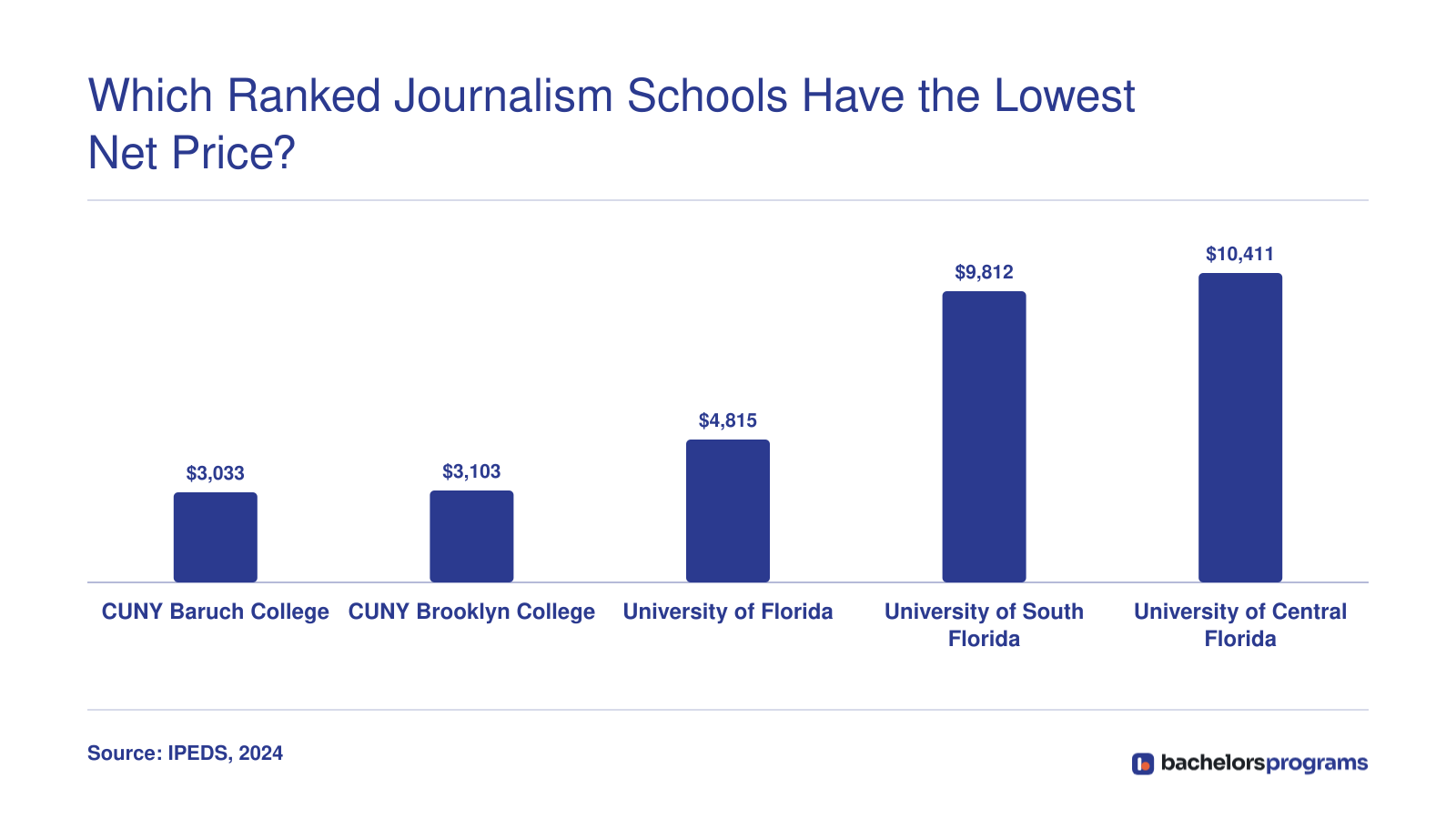
Which Ranked Journalism Schools Have the Lowest Net Price?
Average net price is what students typically pay per year after grants and scholarships, not the sticker tuition. Among the schools ranked here, CUNY Baruch College and CUNY Brooklyn College come in near $3,000, and the University of Florida, which offers its journalism degree online, stays under $5,000. These are approximate institution-wide averages for public colleges, so your own cost will depend on family income, residency and the aid you receive.
Journalism Graduate Earnings and Career Outcomes
What does a journalism degree actually pay in the first year after graduation?
For the programs in this ranking, median earnings one year after completion run from $40,942 to $48,637. That window matters. First-year pay in this field is modest by design: many graduates start in small newsrooms, fellowships, or part-time contracts before moving into steadier roles.
Earnings Growth Over Four and Five Years
The picture improves with time. Four years after completion, medians at these programs range from $50,338 to $79,776. Five years out, the range sits between $54,592 and $73,406, which suggests early gaps between programs tend to compress as graduates settle into beats or move into adjacent communications work.
The Debt Side of the Ledger
Median debt among the same programs runs from $14,959 to $24,500. Set against first-year earnings, most graduates carry debt equal to roughly a third to just over half of what they earn in year one, a reasonable starting position for a liberal arts credential. The programs worth hunting for are the ones that pair higher four-year earnings with debt near the low end.
Where Journalism Graduates Actually Work
Bureau of Labor Statistics figures for 2025 show what nearby occupations pay and where they are headed. Editors report a median of $77,920, though employment is projected to shrink about 1% from 2025 to 2035. Writers and authors report $76,910 with flat projected growth. Public relations specialists report $74,750 and are projected to add roughly 5,700 jobs over that window, the strongest growth of the group. Broadcast, sound, and video technicians report $60,150 with about 1% growth.
Be realistic about the entry point: newsroom starting salaries run below those medians, and many graduates spend their first years building clips before shifting into editing, audience work, or communications roles at companies, nonprofits, and agencies, where pay is steadier.
Related Articles
What Reporters and Journalists Earn Nationally
National wage data gives you a baseline for what a bachelor's degree in journalism can lead to after graduation.
Does ACEJMC Accreditation Matter for Journalism Programs?
About 120 journalism and mass communications programs worldwide hold accreditation from the Accrediting Council on Education in Journalism and Mass Communications (ACEJMC), according to the council's 2026 fact sheet.1 That is a global figure, not a confirmed count of accredited U.S. bachelor's programs.
What the review covers
ACEJMC reviews a journalism unit against standards for curriculum, faculty, resources, and professional values. Programs complete a self-study and a campus visit every six years.1 Accreditation applies to the unit and to the specific degrees or concentrations submitted for review, not to the whole university. A school can appear in the directory while other communications majors on the same campus remain outside it. For a bachelor's degree in journalism, the question is whether the major you plan to enter is listed.
Which ranked schools are listed
Within this ranking, the University of Georgia's Grady College of Journalism and Mass Communication and the University of Florida's College of Journalism and Communications both show reaccreditation in 2025.2 Their entries cover particular programs, such as Georgia's A.B. in Journalism and Florida's B.S. in Journalism, along with related advertising, public relations, and media degrees. Do not assume status for a school the directory does not confirm.
How to check a program
Start at acejmc.org and open the Accredited Programs page. Choose the U.S. Schools directory, which is separate from the International/U.S. Territories and Provisional lists, then read the institution profile for its accreditation or reaccreditation year. ACEJMC retired its old searchable LookUp database on June 30, 2026, so outdated links may no longer work.3 A provisional label is not full reaccreditation.
The limits of the seal
Accreditation is voluntary, and some respected journalism programs have never sought it. Treat it as one quality signal, then compare net price, graduation rates, earnings, and internship access before you commit.
Online vs. On-Campus Journalism Degrees
A fully online bachelor's degree in journalism is available: Utah State University lists a 100% online Journalism, BS that requires 60 credits, and Colorado State University offers an online Journalism and Media Communication B.A. Transfer policies vary, but many programs accept prior credits. Colorado State requires 30 upper-division credits to be completed through the university, and Ohio University asks transfer applicants for a cumulative GPA of at least 2.0. Associate-degree pathways, such as the 60-credit Associate in Arts Journalism Pathway at Lake-Sumter State College and the Journalism AA-T from Los Rios Community College District, can cut the time and cost of the first two years. Online students can still build clips through remote internships and freelance reporting.
| Factor | Online Bachelor's in Journalism | On-Campus Bachelor's in Journalism |
|---|---|---|
| Newsroom and student media access | Limited. Most work happens remotely, so students often pitch to outside outlets or start their own publications. | Direct access to campus newsrooms, student papers, radio and TV stations, and in-person editors. |
| Scheduling flexibility | High. Coursework fits around jobs and family, which suits working adults and transfer students. | Fixed class and lab times. Newsroom shifts add to the weekly schedule. |
| Transfer-credit acceptance | Typically accepts prior credits. Colorado State applies transfer credits to its core and degree requirements, then requires 30 upper-division credits through the university. | Accepted, but residency rules apply. UT Austin requires J 302F, J 304F, J 310F, and J 311F to be taken in residence. |
| Internship access | Remote internships, freelance assignments, and local outlets near the student's home. | Easier access to nearby newsrooms, campus career offices, and in-person placements. |
| Cost considerations | Can lower housing, relocation, and commuting costs. Compare per-credit pricing and fees by school. | Includes housing, meals, and campus costs, but may offer more on-campus jobs and in-person aid options. |
| International student suitability | Often a poor fit for student visas, since U.S. rules limit fully online study. Confirm with the school's international office. | The standard route for international students seeking a U.S. student visa. |
Journalism programs by state
Compare Journalism programs on the data that matters
Explore more Communications & Media majors or browse every field of study.
All Communications & Media programs Browse every field of study