Best Strategic Communications Degree Programs
Compare 210+ accredited Strategic Communications programs, with net price after aid, graduation rates, earnings and debt from IPEDS and the U.S. College Scorecard.

At Rutgers, strategic public communication is an 18-credit specialization inside a broader communication major. At the University of Missouri, the label sits within a journalism school, and at Northwestern it is an online professional-studies degree. Same name, different programs, and the title alone says little about cost, format, or graduate earnings.
The best strategic communications degree programs in 2026 are easier to separate on numbers than on prestige. The ranking draws on federal College Scorecard data, not reputation surveys. The debt, earnings, online, accreditation, and career comparisons apply the same lens.
One caveat: federal reporting withholds program-level earnings for small graduating classes, so school-wide outcomes often carry the comparison.
Key Points
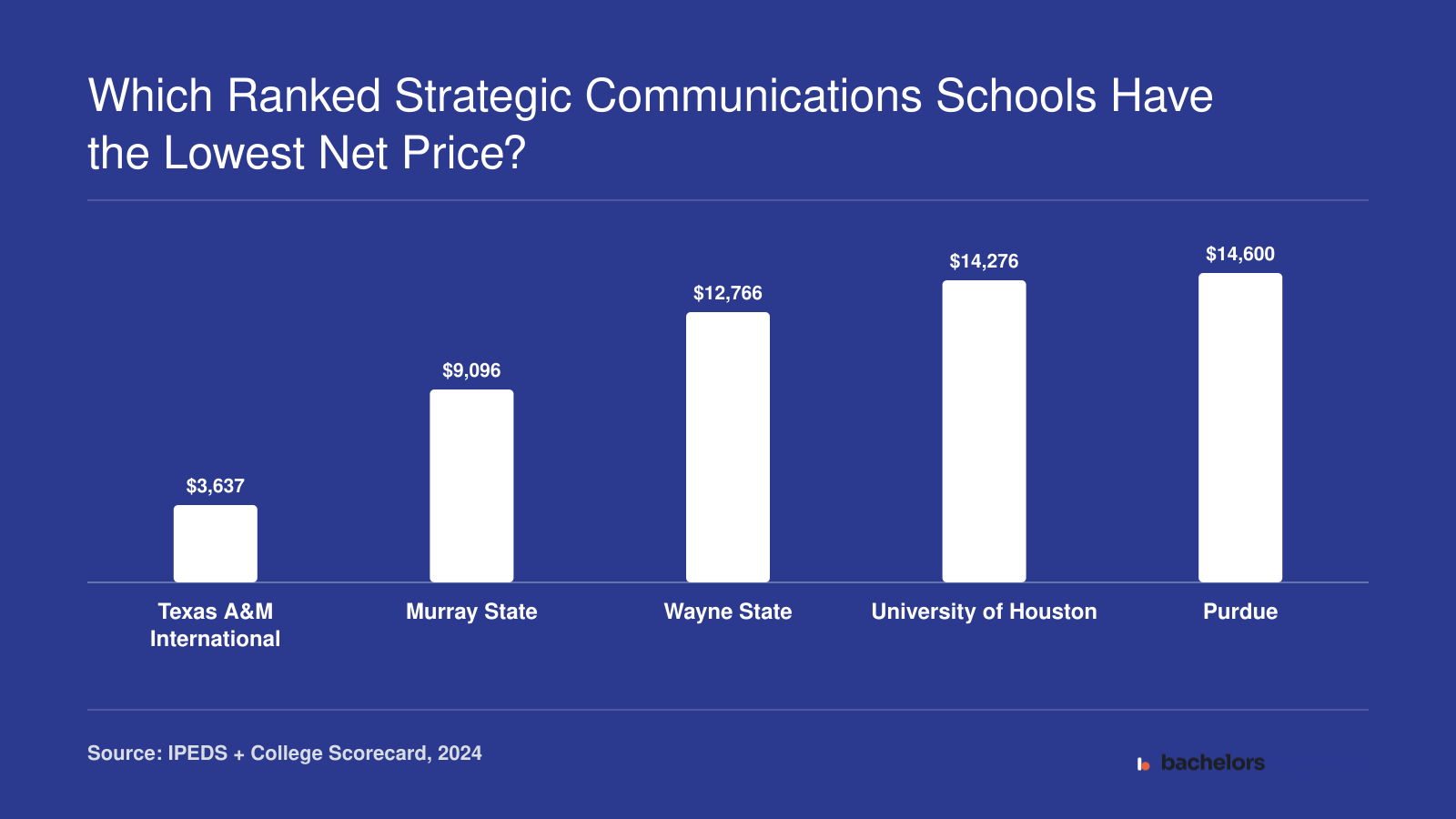
- Texas A&M International University posts the lowest net price: $3,637 a year.
- Strongest-return programs keep typical student debt between $15,000 and $19,500.
- Strategic communications blends PR, advertising, and digital media into one major.
The 10 Best Strategic Communications Degree Programs
The ten programs below cover fully online, on-campus, and hybrid paths into strategic communication, from a professional-studies degree built for working adults to journalism-school programs where students run live campaigns. Each card gives the credential, the concentration options, and the format so you can compare what you would actually study.
Northwestern University
#1Evanston, IL · $29,000/yr (est. net price)
Best for: Working adults seeking a fully online completion
One of the few strategic communication bachelor's degrees from a major private research university that is delivered fully online. The program is designed for working adults, combining a persuasion and organizational communication core with a capstone and an elective certificate from a field outside the major. The school's overall graduation rate is about 95 percent.
- 45 credit hours, including a strategic communication capstone
- Three concentration options, including Corporate Communication and Branding
- Elective certificate from outside the major, such as AI or data science
- Online format designed for working professionals
- Transfer students may appeal the writing requirement
Washington University in St Louis
#2St. Louis, MO · ~$22,000/yr (est.)
Best for: Career changers who want a customizable interdisciplinary degree
A private research university where strategic communication is offered as a concentration inside a broader interdisciplinary bachelor's degree. That structure lets students pair communication coursework with electives from other fields while covering organizational culture, media relations, and message design. The school's overall graduation rate is about 94 percent.
- Concentration sits inside the BS in Integrated Studies
- Coursework in organizational culture and media relations
- Foundation in oral and speech communication
- Practical business and speech skills for government, business, and media settings
- Electives let students tailor the degree
Washington and Lee University
#3Lexington, VA · ~$24,000/yr (est.)
Best for: Small-cohort liberal arts students drawn to journalism
A small liberal arts university whose strategic communication major sits inside the only accredited journalism department at a college of its size. Classes are small, the capstone is a campaign built for a real community client, and students leave with a portfolio. The school's overall graduation rate is about 94 percent.
- Housed in the only accredited journalism department at a small liberal arts college
- Students develop and launch a campaign for a community client
- Internships and a professional portfolio are part of the major
- Cross-disciplinary coursework in advertising, marketing, public health, politics
- Small classes with close faculty mentorship
Rutgers University
#4New Brunswick, NJ · $24,000/yr (est. net price)
A large public flagship whose strategic communication specialization is nested in the communication major, so students take the track alongside a broad liberal arts base. The department connects students to PRSA and PRSSA, and coursework leans toward entertainment, sports, and pharmaceutical communication. The school's overall graduation rate is about 84 percent.
- 18 credit hours across six courses in the specialization
- At least 6 credits must be at the 400 level
- Core courses in organizational, persuasive, and crisis communication
- Electives in intercultural communication, health campaigns, conflict negotiation
- Professional resources through PRSA and PRSSA
- Industry focus on entertainment, sports, and pharma
University of Wisconsin-Madison
#5Madison, WI · ~$17,000/yr (est.)
A public flagship where strategic communication is a concentration inside the journalism bachelor's, mixing persuasive messaging with digital and social media strategy. Majors get a dedicated career adviser and an active alumni network, and the program reports strong placement within six months of graduation. The school's overall graduation rate is about 90 percent.
- Concentration within the Bachelor of Science in Journalism
- 120 total credit hours over four years
- Courses in digital media strategy and social media marketing
- Dedicated industry career adviser for majors
- Real-world projects and an active alumni network
- Program reports about 90 percent job placement
Ohio State University
#6Columbus, OH · $17,000/yr (est. net price)
A large public research university with a standalone strategic communication major covering public relations, advertising, crisis communication, and campaign design. Admission to the major is competitive and requires prerequisite coursework, and students must complete an experiential learning component. The school's overall graduation rate is about 88 percent.
- Prerequisite courses and competitive admission to the major
- Core sequence in writing, message design, and campaigns
- Research methods course plus oral communication training
- Experiential learning through internship, research, or thesis
- Focus area electives in strategic planning or communication contexts
Purdue University
#7West Lafayette, IN · ~$15,000/yr (est.)
A public research university whose public relations and strategic communication concentration lives inside the communication major. The curriculum pairs theory with hands-on training, and an experiential learning requirement can be met through an internship or a campaign course. An accelerated Degree in 3 track is available for students who want to finish faster. The school's overall graduation rate is about 83 percent.
- Concentration in Public Relations and Strategic Communication
- 120 credit hours with a four-year plan
- Experiential learning: internship, health campaign, or news production
- Optional Degree in 3 accelerated track
- 2.7 GPA minimum for the major
Stony Brook University
#8Stony Brook, NY · ~$19,000/yr (est.)
A public research university where the organizational and strategic communication track is part of a non-restricted communication major, so students can enter without a second application. Coursework reaches into social media analytics and communication for social change, and the program reports most graduates employed or in graduate school. The school's overall graduation rate is about 76 percent.
- Concentration in Organizational and Strategic Communication
- No additional admission requirements for the major
- Coursework in social media analytics and communication for social change
- Small classes with individual faculty attention
- Program reports 95 percent of graduates employed or in graduate school
University of Houston
#9Houston, TX · $10,000 – $23,000/yr (est.)
A public research university whose Valenti School of Communication runs a dedicated strategic communication major with four concentration tracks. Federal data for the program show median earnings of $60,180 four years after finishing and median debt of $23,800 among graduates who borrowed. The school's overall graduation rate is about 65 percent, and the program awarded 208 bachelor's degrees in the most recent year reported.
- Four concentrations: Advertising, Integrated Communication, Corporate, Public Relations
- Program-level median earnings of $60,180 four years after finishing
- Median debt of $23,800 among program graduates who borrowed
- Live client projects in a major media and corporate market
- Audience analysis, message strategy, and ethical communication
University of Missouri
#10Columbia, MO · ~$20,000/yr (est.)
A public research university whose strategic communication emphasis is part of the Missouri School of Journalism, a program with deep industry ties. Students study account management, copywriting, digital strategy, and public relations while working on real campaigns. The school's overall graduation rate is about 75 percent.
- Emphasis in Strategic Communication within the Bachelor of Journalism
- Coursework in account management, copywriting, digital strategy, and PR
- Students work on live campaigns through the Missouri School of Journalism
- Four-year graduation plan with personalized advising
Cost & outcomes by school
Federal data for the highest-earning Strategic Communications programs, independent of the ranking above. Earnings are this field's bachelor's graduates four years after completing where the Scorecard reports them, else the school's undergraduate median.
| School | Net price / yr | Grad rate | Earnings | Debt | Grads/yr | Format |
|---|---|---|---|---|---|---|
| Santa Clara University CA | $50,062 | 88% | $109,183 | $19,162 | — | Campus |
| Washington and Lee University VA | $23,781 | 94% | $94,810 | $19,500 | 13 | Campus |
| Syracuse University NY | $38,793 | 84% | $90,535 | $24,375 | 188 | Online |
| Northwestern University IL | $29,167 | 95% | $89,363 | $15,000 | — | Online |
| Saint Joseph's University - Philadelphia PA | $29,689 | 79% | $86,881 | $25,500 | — | Online |
| Washington University in St Louis MO | $21,786 | 94% | $86,182 | $17,500 | 3 | Online |
| Miami University OH | $28,384 | 80% | $79,710 | $23,500 | 167 | Campus |
| Saint Johns University MN | $25,672 | 75% | $76,786 | $27,000 | — | Campus |
| Pennsylvania State University PA | $32,875 | 86% | $76,246 | $23,250 | 281 | Online |
| University of Colorado Boulder CO | $25,346 | 74% | $74,779 | $18,500 | 311 | Campus |
| Elon University NC | $41,555 | 84% | $74,545 | $20,500 | 152 | Campus |
| Stony Brook University NY | $18,784 | 76% | $74,502 | $18,228 | — | Campus |
Sources: U.S. Department of Education. Net price, graduation rate, earnings and debt: College Scorecard (earnings and debt for this field's bachelor's graduates where reported, else school-wide); graduates: IPEDS. A dash means no figure is reported.
Cost, debt & payoff
Median earnings of this field's bachelor's graduates (4 yrs after completing, else the school's undergraduate median) vs. their median federal loan debt · U.S. College Scorecard
Across these programs the median graduate earns about $56,303 and finishes with roughly $22,990 in debt — a ratio that clears a common rule of thumb (keep debt below first-year salary). Net price and debt vary widely school to school, so check the per-school figures in the table above before you shortlist.
Behind the List: The Federal Data That Decided Each Spot
A recognizable name on a diploma tells you nothing about what a family will actually pay or what graduates earn a few years out. The figures that answer those questions are public, and they carried far more weight than reputation in deciding where each school landed.
What Went Into Each Placement
Four kinds of evidence did the work. Average net price after grant aid shows what students paid once scholarships and institutional aid were applied, often well below sticker tuition. Institution-wide graduation and retention rates indicate whether students stay and finish. Program-level median earnings and typical federal debt, drawn from College Scorecard reporting, show what the credential returned in the job market. Delivery format was recorded too, so you know whether a degree can be completed without relocating.
Where the Numbers Stop Short
Two caveats matter before you compare schools. A graduation rate covers everyone at the university rather than the strategic communications majors alone, so a large school's overall figure can hide a stronger or weaker department. The net price averages all aided students rather than quoting yours, because your own package depends on income and residency. Where a graduating class is small, program-level earnings often go unpublished, which leaves price, debt, and format as the comparables.
One Standard for Every Format
Online and campus programs sit on the same list and were measured the same way. A remote degree earns no discount for convenience and a residential one earns no credit for tradition; both stand on cost, completion, and what graduates earn.
Which Ranked Strategic Communications Schools Have the Lowest Net Price?
Texas A&M International University has the lowest average net price among the schools ranked here at $3,637 a year, followed by Murray State University at $9,096. These are institution-wide averages after grants and scholarships, not guaranteed costs, so your actual price will depend on family income and the aid you receive. Each of these low-cost options delivers its strategic communications program on campus, so budget-minded students who need an online format should compare the other schools on this list.
Debt vs. Earnings: Three Programs With the Strongest Return
Sticker price says little about value. What matters is how much you borrow compared with what graduates earn, and by that measure these schools post the strongest returns among the programs ranked here: typical debt of $15,000 to $19,500 against school-wide median earnings of $86,182 to $94,810 ten years after entry, according to 2024 IPEDS and College Scorecard data. Program-level earnings and a 10-year monthly payment figure are not published for these strategic communications majors, so the debt and earnings below are school-level context covering all graduates rather than outcomes for strategic communications graduates alone. Before you commit, estimate the monthly payment on what you expect to borrow and compare it with your likely first-year take-home pay; if the loan would take an uncomfortable share of each paycheck, seek more aid or borrow less.
| School | Format | Average Annual Net Price | Median Debt at Completion (school-wide) | Median Earnings 10 Years After Entry (school-wide) | Earnings-to-Debt Ratio |
|---|---|---|---|---|---|
| Northwestern University (Evanston, IL) | Online | $29,167 | $15,000 | $89,363 | 5.96 |
| Washington University in St. Louis (St. Louis, MO) | Online | $21,786 | $17,500 | $86,182 | 4.92 |
| Washington and Lee University (Lexington, VA) | On campus | $23,781 | $19,500 | $94,810 | 4.86 |
Earning a Strategic Communications Degree Online or on Campus
A fully online strategic communications bachelor's covers the same ground, messaging, audience research, campaign planning, and writing, through virtual coursework instead of a lecture hall. Yes, you can finish one without visiting a campus. Northwestern University and Washington University in St. Louis both list an online format among the schools ranked here, while the rest are campus-based.
What Online Programs Typically Offer
These patterns are common, not universal, so confirm each school's terms.
- Start dates: Liberty advertises eight starts a year1, Point Loma Nazarene lists six2, and UA Grantham starts most courses monthly.4
- Short terms: Liberty and Point Loma use 8-week courses, and Franklin mixes 6- and 12-week courses, often one class at a time.
- Transfer credit: Liberty and UA Grantham accept up to 75% of the degree. Franklin caps transfers at 90 of 120 credits, with an average of 61. Point Loma states no numerical limit, so you would need to speak with a counselor.2
Internships are usually supervised field experiences rather than ordinary online classes. Point Loma requires 120 hours over 16 weeks2, and Arkansas State offers a 3-credit, 7-week field-based course that needs department-chair approval.5 Liberty notes that its asynchronous format may not extend to practicums or internships.1 Capstones tend to be applied projects, as at Oklahoma3 and Franklin.
What Campus Programs Add
Campus programs offer things that are harder to replicate on a screen. Student media outlets and agency-style labs let you build a portfolio with real deadlines. Chapters of the Public Relations Student Society of America (PRSSA) put you in a room with working professionals, and Rutgers highlights PRSA and PRSSA resources. Local internship pipelines can also matter. Washington and Lee, for example, emphasizes internships and a campaign built for a community client.
A Simple Decision Rule
If you are a working adult with prior college credits, online is usually the stronger fit. Generous transfer rules, frequent starts, and short terms let you finish faster without leaving your job. If you are a first-time student who wants networking, mentors, and hands-on lab or media experience, lean toward campus or a hybrid format. Whichever you choose, ask how the internship and capstone are handled before you apply.
Related Articles
Checking Accreditation Before You Enroll
A famous program badge matters less than a boring one: institutional accreditation. Specialized credentials are a bonus, and most strategic communications majors will not have them. That tradeoff shapes how you screen an accredited strategic communications program.
Start With Institutional Accreditation
The baseline is accreditation of the whole college by an accreditor recognized by the U.S. Department of Education, such as HLC, MSCHE, SACSCOC, or WSCUC. It underpins federal financial aid eligibility and the likelihood that credits will transfer. Without it, nothing else here matters.
Optional Programmatic Signals
ACEJMC accredits journalism and mass communication units, not a whole university. Morgan State University and Oklahoma State University hold it (2020), as does the University of Wisconsin, Eau Claire (2022). The credential covers the eligible unit and its degrees, so confirm your specific major sits inside it.
PRSA's Certification in Education for Public Relations (CEPR) is voluntary. It involves eight standards, a two-to-three-day site visit, and a $900 fee.1 It fits best when a program has a defined public relations concentration or curriculum, even if the degree title says strategic communication. Neither credential replaces institutional accreditation, and a program lacking both is not disqualified. Many solid programs hold neither.
A Verification Checklist
- Search DAPIP: Look up the school in the Department of Education's database. Match the exact legal name and campus, and note the accreditor, status, and any action dates. A specialized listing is not institutional accreditation.
- Cross-check CHEA: The Council for Higher Education Accreditation database covers institutional and programmatic accreditors.2 Compare it with DAPIP rather than trusting school marketing alone.
- Check the ACEJMC list: If a school claims it, find the unit and degree on the council's accredited-programs list.
- Get transfer policies in writing: Ask the admissions office to confirm in an email how prior credits are evaluated and whether your credits would move to another school later.
Run these checks for the enrollment period you are considering, since listings reflect the date displayed.
How Strategic Communications Compares With PR, Marketing, and Communication Degrees
Strategic communications versus public relations is the question students ask most. Strategic communications integrates public relations, advertising, digital media, and organizational messaging toward broader business or mission goals. Public relations is narrower, centered on media and stakeholder relations, and at many schools it appears as a concentration or course set inside the strategic communications major. Many universities also house strategic communications within a journalism or mass communication unit, so check the department behind a program as well as its name. Course names below are drawn from sample curricula at schools such as Arizona State, Northwestern, Mercer, and Central Connecticut State, and they vary by campus.
| Factor | Strategic Communications | Public Relations | Marketing | Communication Studies |
|---|---|---|---|---|
| Core focus | Interdisciplinary messaging tied to organizational goals, with concentrations such as corporate communication and branding, research and analytics, or leadership | Media relations, reputation, and stakeholder relationships; often a concentration within strategic communications | Consumer behavior, promotion, and brand growth | Theory of how people and organizations communicate, persuade, and interact |
| Typical coursework | Theories of Persuasion, Organizational Communication, Digital Media & Society, Research Seminar, Strategic Communication Capstone | Public Relations, Crisis Communication, Brand Management, Introduction to Corporate Strategic Communication | Marketing Principles, Marketing Research, Strategic Writing, Consumer Behavior | Interpersonal Communication, Organizational Communication, Communication and Social Influence, intercultural communication |
| Signature skills | Campaign planning, audience research, content and social media strategy, cross-channel messaging | Press writing, crisis response, media pitching, and stakeholder engagement | Market research, social media marketing funnels, content marketing, media planning | Communication theory, research methods, persuasion analysis, and team leadership |
| Common first jobs | Social media manager, content marketer, communications coordinator, digital marketer | Public relations coordinator, media relations assistant, communications associate | Marketing coordinator, digital marketing associate, brand assistant | Digital media communication roles, crisis communication support, internal communications assistant |
| Best fit for | Students who want flexibility across PR, digital, and corporate or nonprofit communication | Students set on media, reputation, and public-facing roles | Students drawn to consumer behavior, sales, and brand performance | Students who want a theory and research foundation, including for graduate study |
Careers for Strategic Communications Graduates: Roles, Pay, and Outlook
A strategic communications degree leads into several career paths, and pay climbs sharply when you move from producing messages to directing them. Most graduates start on the execution side and work toward management.
Entry-Level Paths
Four roles account for most first jobs:
- Public relations specialist: Writes press releases, pitches media, manages social channels, and monitors coverage for a company, agency, nonprofit, or government office.
- Corporate communications specialist: Handles internal messaging, executive communications, and brand voice inside a single organization.
- Crisis communications: Prepares response plans and shapes messaging when a recall, lawsuit, or public controversy hits. Many people enter this niche through agency or corporate comms roles.
- Digital and content strategy: Plans editorial calendars, audience research, and campaign measurement across web, email, and social platforms.
Manager Roles
Public relations managers and marketing managers sit at the advanced end. These jobs typically require five or more years of experience, so they are a mid-career goal rather than a starting point. Managers set strategy, oversee budgets, and lead teams of specialists.
What the Numbers Say
Bureau of Labor Statistics figures show the gap between rungs. Public relations specialists earned a median of $74,750 in May 2025, with 2 percent projected growth from 2025 to 2035, or about 5,700 added jobs. Public relations and fundraising managers earned a median of $136,470, with 6 percent growth and roughly 7,200 added jobs. Marketing managers earned $166,790, with 6.9 percent growth (about 7 percent) and 29,100 added jobs, taking employment from 421,600 in 2025 to 450,800 in 2035.
So how much do strategic communications graduates earn? Keep two measures separate. The BLS numbers above describe everyone working in an occupation, including veterans with decades of experience. The school-level earnings in the ranking and the debt-versus-earnings table describe recent graduates of specific programs, so they sit closer to the specialist level than to the manager level. Expect to land near the specialist figure early and reach manager pay only after years of progression.
Slow specialist growth also means competition for entry-level openings. Internships, a writing portfolio, and campaign results often matter as much as the diploma.
Median Pay for Public Relations Specialists
Public relations specialist is one of the most common entry points for strategic communications graduates, and federal wage data gives a clear benchmark for that role.
Strategic Communications programs by state
Compare Strategic Communications programs on the data that matters
Explore more Communications & Media majors or browse every field of study.
All Communications & Media programs Browse every field of study