Best Online Agriculture Degree Programs
Compare 30+ accredited online Agriculture programs, with net price after aid, graduation rates, earnings and debt from IPEDS and the U.S. College Scorecard.

Agriculture employers hire into a persistent gap between openings and qualified graduates, and the credential most often attached to those openings is a bachelor's degree in agriculture, typically the Bachelor of Science (B.S.) in Agriculture. Relocation is no longer the deciding factor. Accredited programs now deliver the full degree fully online, and the hybrid formats that still pull students to campus for lab work sit outside this list.
Cost is where these programs separate. Average net price after aid among the schools below runs from roughly $6,500 to just under $20,000 a year, and early-career earnings for their agriculture graduates vary just as widely.
Key Points
- University of Florida posts the lowest average net price, $6,541 a year.
- Agribusiness and agricultural education are the most common online specializations.
- Every ranked program can be completed fully online, with no campus residencies.
Top 10 Fully Online Agriculture Bachelor's Programs for 2027
Below are ten schools offering a bachelor's degree in agriculture that can be completed fully online, ordered on a mix of program delivery, cost after aid, graduation rate, and student outcomes rather than on any single measure. Hybrid programs and programs that require a campus residency were excluded. Each card shows the specializations a school offers and, where the data exists, what graduates of the program earned after finishing.
North Carolina State University at Raleigh
#1Raleigh, NC · $9,000 – $33,000/yr (est.)
Best for: Working agricultural professionals who cannot relocate
North Carolina State University's Department of Agricultural and Human Sciences awards the B.S. in Agricultural Science, a 120-credit degree built around two specializations chosen from ten options, including animal science, agribusiness management, crop and soil science, poultry science, and feed mill management. The online route follows the same curriculum for students who cannot relocate to Raleigh. Median earnings for graduates were $53,969 four years after finishing. In-state tuition and fees of about $8,800 compare with roughly $32,800 out of state.
- 120 credit hours with two specializations from ten options
- Each specialization is 12 credits, 6 at the 300 level or above
- Required coursework in crop, soil, and animal or poultry science
- 15 hours of advised electives
- Economics and agricultural and extension education coursework
- Grade of C- or higher required in designated courses
- Careers include agricultural inspector, farm and ranch manager, winemaker
- Same 120-credit curriculum delivered fully online
- Synchronous and asynchronous class options
- Built for distance learners who cannot move to Raleigh
- All 10 specialization options open to online students
- Leadership development and agricultural extension education coursework
North Carolina A & T State University
#2Greensboro, NC · ~$11,000/yr (est.)
Best for: Community college transfers with an agriculture associate degree
North Carolina A&T State University's B.S. in Agricultural Education prepares students for Cooperative Extension, government agencies, agribusiness, and, through its secondary education track, North Carolina teaching licensure in agriscience. The program is structured as a 2+2 completion route for students arriving with an agriculture associate degree from partner North Carolina community colleges or NC State's Agricultural Institute, with case-by-case review for other accredited institutions. Median earnings for graduates were $46,990 four years after finishing. In-state tuition and fees run near $6,800 against about $20,700 out of state.
- Tracks: Agricultural Professional Service and Secondary Education
- Both tracks cover animal, plant and soil sciences and agribusiness
- Secondary education track leads to North Carolina teaching licensure
- Secondary track requires a 2.8 GPA and Teacher Education admission
- Professional service track targets Extension, agencies and agribusiness
- Curriculum includes natural resources and biological engineering
Oregon State University
#3Corvallis, OR · $15,000 – $20,000/yr (est.)
Best for: Self-directed students building a custom focus
Oregon State University's College of Agricultural Sciences offers the B.S. in Agricultural Sciences as a deliberately flexible degree: 180 quarter credits, a 60-credit agricultural elective block with at least 24 upper-division credits, and room to combine two or more emphasis areas around a career goal. Students complete at least 45 of their final 75 credits through Oregon State, online or on campus. Median earnings for graduates were $53,547 four years after finishing, and coursework runs on four 11-week quarters a year.
- 180 quarter credits; students design their own degree
- 60 agricultural elective credits, 24 at upper division
- Combine two or more emphasis areas
- At least 45 of the final 75 credits taken through Oregon State
- Core includes applied economics, general chemistry and a biology series
- Business and law, communication and leadership coursework
- Major code 259; also offered as an Honors B.S.
- Prepares for teaching agriculture, Extension work and industry sales
The University of Tennessee-Martin
#4Martin, TN · $11,000/yr (est. net price)
The University of Tennessee at Martin awards the B.S. in Agricultural Business from its College of Agriculture and Applied Sciences, pairing finance, economics, and management with the production side of the industry. Internship pipelines include Farm Credit Mid-America, Tennessee Farmers Cooperative, Tyson Foods, Cargill, ADM, and Farm Bureau, and graduates move into farm management, operations, sales, and logistics roles. Median earnings were $47,956 four years after finishing. Tuition and fees are about $10,600 in state and $16,600 out of state.
- Coursework in finance, economics and management applied to agriculture
- Internships with Farm Credit Mid-America, Tyson Foods, Cargill and ADM
- Career paths include operations manager, farm manager and logistics
- Small class sizes and low student-to-teacher ratios
- Available on campus, fully online or in a hybrid format
- Department sits in the College of Agriculture and Applied Sciences
Fort Hays State University
#5Hays, KS · ~$13,000/yr (est.)
Fort Hays State University's B.S. in Agriculture with an agricultural leadership concentration requires 120 credits and threads leadership study through applied agriculture, including a field work course where students design and carry out a community project. The department farms 3,825 acres for hands-on practice, and the online rate of about $275 per credit brings the degree to roughly $22,500. Graduates work as agribusiness professionals, extension educators, and farm or ranch managers.
- 120 credits in a four-year plan
- Online rate about $275.65 per credit, roughly $22,500 total
- Field work course where students carry out a community project
- Department farms 3,825 acres for hands-on practice
- Fieldwork, internships and undergraduate research
- Seminars and guest lectures from industry experts
- Delta Tau Alpha honor society for the top 35 percent
- Careers: agribusiness, ranch manager, extension educator
East Texas A&M University
#6Commerce, TX · $12,000/yr (est. net price)
East Texas A&M University in Commerce offers the B.S. in Agricultural Sciences on a 120-credit, four-year plan with no foreign language requirement, starting with foundation courses in agriculture, agricultural economics, chemistry, botany, and zoology before core work in plant, soil, and animal science. Students add minors such as agribusiness, agronomy, equine science, or horticulture and complete a supervised internship at an approved location. Median earnings were $51,983 four years after finishing. Tuition and fees run about $10,000 in state and $22,300 out of state.
- 120 credits over four years; no foreign language requirement
- Foundation courses in agriculture, chemistry, botany and zoology
- Core covers plant science, soil science, animal science and livestock
- Minors in agribusiness, agronomy, equine science and horticulture
- Supervised internships at approved locations
- Competitive judging and show teams; Collegiate FFA chapter
- Scholarships and financial aid available
Sam Houston State University
#7Huntsville, TX · ~$16,000/yr (est.)
Sam Houston State University's B.S. in Interdisciplinary Agriculture is a 120-credit degree that lets students build a minor from chemistry, biology, business, environmental science, secondary education, or computer science, then stack 21 credits of advanced electives in agribusiness, animal science, equine science, plant and soil science, or wildlife management. The major requires a 2.0 overall and 2.0 major GPA and no entrance exam. Median earnings for graduates were $60,598 four years after finishing, the highest program-level figure among the ranked schools that report one.
- 120 credits with a 2.0 overall and 2.0 major GPA
- Minor options include business, environmental science and secondary education
- 21 credits of prescribed advanced electives in agriculture
- Foundation coursework in agricultural economics and animal science
- No entrance exam required
- Requirements set with faculty advisor approval
Colorado State University-Fort Collins
#8Fort Collins, CO · ~$21,000/yr (est.)
Colorado State University's online agriculture degrees are built for working adults. The B.S. in Agricultural Business covers marketing, management, finance, and agricultural law, while the B.S. in Agricultural Biology adds a capstone and a three-credit internship backed by USDA and state agency partnerships. Courses are $490 per credit, admissions are rolling with three start dates a year, and upper-division work includes 42 credits, 30 of them taken through CSU. Online classes average 21 students.
- $490 per credit; 120 credits total
- 42 upper-division credits, 30 of them through CSU
- Rolling admissions with fall, spring and summer starts
- Coursework in marketing, management, finance and agricultural law
- Average class size of 21 students
- Dedicated student success coach
- More than a dozen minor options
- Careers in commodity brokerage, farm management and input sales
- Tracks: General Concentration, Entomology
- Capstone required; 3-credit internship in BSPM 487
- 42 upper-division credits, 30 completed at CSU
- Partnerships with USDA and state agencies
- Careers as agronomist, entomologist and plant pathologist
- Integrated pest management diagnosis skills
- Internships and research projects; placement not guaranteed
University of Florida
#9Gainesville, FL · ~$7,000/yr (est.)
The University of Florida's College of Agricultural and Life Sciences offers Agricultural Education and Communication as a 120-credit major available on campus and through UF Online. The college awards close to $400,000 a year in undergraduate scholarships, runs research and Extension internships on a competitive basis, and supports more than 45 student organizations plus an October career expo. Transfer applicants from Florida public colleges enter with an Associate of Arts, while applicants from private or out-of-state institutions need 60 credits.
- 120 credits; also offered as a UF Online major
- Transfer with an Associate of Arts or 60 credits
- Nearly $400,000 in CALS undergraduate scholarships annually
- Honors program requires a 3.75 GPA and a thesis project
- Research and Extension internships awarded competitively
- More than 45 CALS student organizations; October career expo
- Scholarships available for study abroad
Buena Vista University
#10Storm Lake, IA · $15,000 – $20,000/yr (est.)
Buena Vista University awards a Bachelor of Arts in Agricultural Business that pairs agricultural science with business strategy for production, finance, and global markets, with projects at the BVU research farm and industry-focused internships. Graduates move into roles as ag bankers, farm business managers, crop advisors, and sales representatives, and the program's employer list includes Corteva Agriscience, Syngenta, Tyson Foods, and Iowa State Extension.
- Bachelor of Arts degree, offered on campus or online
- Projects at the BVU research farm
- Coursework in agricultural foundations, market analysis and management
- Industry-focused internships with ag businesses
- Employers include Corteva Agriscience, Syngenta and Tyson Foods
- Global perspective through travel and industry engagement
- Advanced coursework in management and leadership
Cost & outcomes by school
Federal data for the highest-earning Agriculture programs, independent of the ranking above. Earnings are this field's bachelor's graduates four years after completing where the Scorecard reports them, else the school's undergraduate median.
| School | Net price / yr | Grad rate | Earnings | Debt | Grads/yr | Format |
|---|---|---|---|---|---|---|
| University of Massachusetts-Amherst MA | $22,383 | 83% | $71,631 | $22,763 | — | Online or campus |
| University of Florida FL | $6,541 | 91% | $71,588 | $15,000 | — | Online or campus |
| Colorado State University-Fort Collins CO | $21,279 | 67% | $60,543 | $20,000 | — | Online |
| The University of Tennessee-Knoxville TN | $18,976 | 74% | $60,249 | $20,500 | — | Online |
| University of Kentucky KY | $18,851 | 71% | $59,025 | $22,500 | — | Online or campus |
| University of Arkansas AR | $18,209 | 71% | $58,191 | $21,500 | — | Online |
| Kansas State University KS | $19,406 | 71% | $57,262 | $21,250 | — | Online |
| North Carolina State University at Raleigh NC | $17,303 | 85% | $53,969 | $19,500 | 40 | Online or campus |
| Oregon State University OR | $19,604 | 70% | $53,547 | $23,500 | 62 | Online or campus |
Sources: U.S. Department of Education. Net price, graduation rate, earnings and debt: College Scorecard (earnings and debt for this field's bachelor's graduates where reported, else school-wide); graduates: IPEDS. A dash means no figure is reported.
Cost, debt & payoff
Median earnings of this field's bachelor's graduates (4 yrs after completing, else the school's undergraduate median) vs. their median federal loan debt · U.S. College Scorecard
Across these programs the median graduate earns about $51,513 and finishes with roughly $20,500 in debt — a ratio that clears a common rule of thumb (keep debt below first-year salary). Net price and debt vary widely school to school, so check the per-school figures in the table above before you shortlist.
How We Ranked Fully Online Agriculture Programs
Every program here cleared the same screen: a bachelor's-level agriculture degree that can be completed entirely online. Hybrid formats, weekend residencies, and lab requirements that pull students to campus were set aside; a degree that stalls on a single campus visit is not the flexible option most online students want.
What Weighed In
The ranking leans on federal data rather than reputation: program-level earnings and debt reported to the College Scorecard, net price after aid, and each institution's graduation rate. That separates these rankings from roundups built on alumni testimonials or name recognition alone, which say little about what graduates actually earn or owe.
Where the Numbers Thin Out
Graduation rates and net price are school-wide averages, not agriculture-specific figures, and smaller programs sometimes have too few graduates for the Scorecard to publish earnings at all. Treat the order as a shortlist for your own research, not a verdict. Cost, the specialization you want, and access to internships with farms, agribusinesses, or co-ops will shape your outcome more than a few places of difference in the ranking.
What a Bachelor's Degree in Agriculture Covers Online
Online agriculture degrees have moved past the old assumption that you need to live on a farm to learn the field. The coursework, credit load, and hands-on expectations now look much like the on-campus versions.
How the Credits Break Down
Most online B.S. programs follow the standard 120-semester-credit structure. NC State's online B.S. in Agricultural Science, delivered through its WolfWare platform, requires 120 credit hours. Quarter-system schools count differently: Oregon State's online B.S. in Crop and Soil Science calls for at least 180 quarter credits, 60 of them upper-division. Credits typically fall into four groups:
- General education: Writing, math, chemistry, biology, and social sciences.
- Agriculture core: Soils, plant and animal science, and agricultural economics.
- Concentration: Agribusiness, agronomy, agricultural education, or a similar track.
- Electives: Courses that round out your interests or career plans.
Full-time students usually finish in about four years. Transfer credit, especially an associate degree, can shorten that considerably.
Labs, Fieldwork, and Internships
Program pages rarely spell out how science labs run online. Online science degrees commonly use at-home lab kits, virtual simulations, or short campus visits, so ask each school which format applies. NC State's Agricultural Education degree, for example, lists lab courses in animal science and chemistry.1
Experiential requirements vary by program:
- Oregon State's online Crop and Soil Science degree requires a 3-credit internship or research project.
- NC State's agronomy concentration within Crop and Soil Sciences requires 3 credit hours of experiential learning.2
- Oregon State's Agricultural Sciences program encourages internships without requiring them.3 Its internship course awards 1 to 12 credits per term (16 maximum), runs every term including summer, and includes an online component with no set class meetings.
If a placement is required, confirm before enrolling whether you can arrange it with an employer near home.
No Farm Background Required
The degree suits career changers, agribusiness professionals, and people aiming for extension or teaching roles. Coursework builds the background step by step. A loan officer who works with growers, for instance, can learn from soils and crop science courses why fertilizer costs and yield swings shape a farm's finances, turning numbers they already see into field knowledge.
Online Agriculture Specializations Compared
Agribusiness and agricultural education are the most common online paths among the schools ranked here. Several other programs let you combine emphasis areas inside a broad agricultural science major. Horticulture, food science, and precision agriculture do not appear as named tracks in these programs, so if you want one of those fields, check each school's elective list before you apply.
| Specialization | Ranked schools offering it | How it appears | Typical career path |
|---|---|---|---|
| Agribusiness | University of Tennessee at Martin; Colorado State University-Fort Collins; Buena Vista University; North Carolina A&T State University (coursework) | Dedicated Agricultural Business majors at UT Martin, Colorado State, and Buena Vista (a Bachelor of Arts); agribusiness management coursework at NC A&T | Leads to sales, commodity brokerage, operations management, and farm management roles. UT Martin lists internships with Farm Credit Mid-America and Tyson Foods. |
| Agricultural education | North Carolina A&T State University; University of Florida; Oregon State University | Agricultural Education major at NC A&T; Agricultural Education and Communication at Florida; teaching preparation within Oregon State's Agricultural Sciences major | Prepares graduates for Cooperative Extension work, teaching agriculture, and roles with government agencies. |
| Agricultural leadership and communication | Fort Hays State University; University of Florida | Agricultural Leadership concentration at Fort Hays State; communication paired with education at Florida | Points toward extension educator, ranch manager, and agribusiness leadership roles, plus agricultural communicator positions. |
| Animal science | North Carolina A&T State University; East Texas A&M University | Core coursework within broader agriculture majors rather than a standalone track | Typically supports livestock and ranch operations work, often alongside farm and ranch management. |
| Agronomy and crop science | North Carolina A&T State University; East Texas A&M University | Plant and soil science coursework within broader agriculture majors | Typically supports crop production and farm management roles. |
| Flexible or self-designed agricultural science | North Carolina State University; Oregon State University; East Texas A&M University; Sam Houston State University | NC State requires two specializations chosen from 10 concentration options; Oregon State lets you design your own degree with two or more emphasis areas; Sam Houston offers Interdisciplinary Agriculture with 3 concentration options | Leads to extension agent, farm and ranch manager, and general agricultural enterprise roles. |
Related Articles
Cheapest Online Agriculture Degrees by Average Net Price
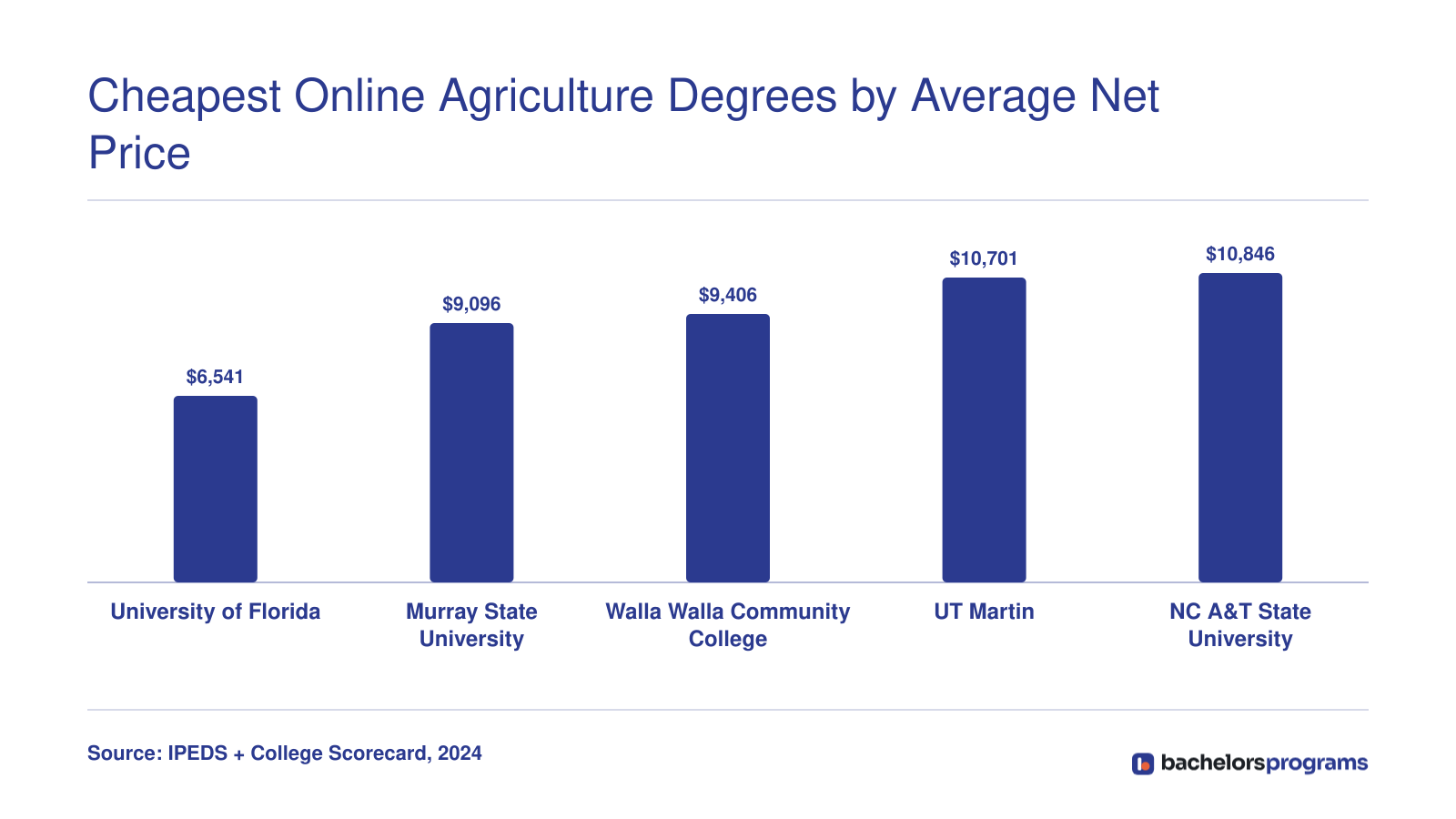
The University of Florida posts the lowest average net price of the most affordable fully online agriculture programs, at $6,541 a year, followed by Murray State University ($9,096), Walla Walla Community College ($9,406), UT Martin ($10,701) and North Carolina A&T State University ($10,846). That puts $4,305 between Florida and NC A&T, the cheapest and fifth-cheapest options on this chart, a gap that adds up quickly across a full bachelor's degree. Each figure is a school-wide average of what students actually paid after grants and scholarships, not a personal quote, so your own cost will depend on your aid package, residency and enrollment status.
Online Agriculture Degree Cost: Tuition, Fees, and Financial Aid
Published tuition is only the sticker; what matters for online agriculture students is what families actually pay after aid.
Sticker Price vs. Net Price
At several ranked schools the published in-state and out-of-state figures diverge sharply. The University of Florida publishes $6,381 for residents and $28,659 for nonresidents, while Murray State lists $9,900 and $19,836. Net price after grant aid tells a different story: Florida's effective net price lands near $6,541, and Murray State's near $9,096. Aid narrows the out-of-state penalty considerably, sometimes to a few thousand dollars, and that is the number worth comparing across programs.
What Online Students Actually Pay Per Credit
Oregon State Ecampus charges $409 per quarter credit for 2026-27, which is a $394 base rate plus a mandatory $15-per-credit distance-education fee. Resident and nonresident students pay the same rate, and a one-time $435 matriculation fee applies to new and transfer degree-seeking undergraduates. NC State charges $301.84 per credit hour, $280.46 in tuition plus $21.38 in required fees, capped at 12 credit hours per semester1, and distance students follow the same tuition structure as on-campus students. NC State's published rate was still awaiting the state budget bill, so confirm it before you budget.
Aid, Debt, and a Practical Rule
Pell share signals how heavily a campus serves lower-income students; Florida enrolls a Pell share of about 24 percent, Murray State about 60 percent. Where program-level debt figures exist, monthly payments on a 10-year plan run roughly $200 or a little above.
Before you commit, take the per-credit rate and multiply it by the credits you still need after transfer. That product, plus fees, is your real total.
Questions to Ask Yourself
Does your home state's land-grant university offer an online agriculture B.S. at in-state rates?
Do you want a business-facing path or a science-facing one?
Can you line up an internship if your program requires one?
Top Program-Level Earnings Among Ranked Schools
Program-level earnings show what graduates of a specific agriculture major earn, not the university as a whole.
Agriculture programs by state
Online Agriculture Degree FAQs
These answers cover timing, hands-on requirements, and two common career questions: the Certified Crop Adviser credential and veterinary school prerequisites. Check each school and credentialing body directly before you commit to a program.
How long does it take to earn an agriculture degree online?
Do online agriculture programs require in-person labs or internships?
Can an online agriculture bachelor's prepare you for the Certified Crop Adviser (CCA) credential?
Can an online animal science or agriculture B.S. cover pre-vet prerequisites?
Compare Agriculture programs on the data that matters
Explore more Natural & Applied Sciences majors or browse every field of study.
All Natural & Applied Sciences programs Browse every field of study